
Running Paid Ads for Free NFL Training Camp Tickets
When NFL training camp tickets are free, standard purchase conversion optimization breaks. This article explains how to build a proxy conversion architecture using registration completions, parking upsells, and email capture, and why current landing-page view optimizations may be hiding a 2x performance gap.
- Platform
- Meta Ads
- Campaign type
- Advantage+
- Spend range
- Under $0k
- Timeframe
- July-August 2026
- ROAS
- >0
- Verdict
- mixed
- Industry vertical
- Sports
- Last reviewed
- 0-07-30
The awkward part of running paid media for NFL training camp tickets in 2026 is that the fan sees a free ticket, the team still spends real media dollars, and the ad platform may only see a landing-page view before the actual registration disappears into SeatGeek, Universe, or Ticketmaster. That is not a small reporting inconvenience. It changes what the campaign can learn from.
The free-ticket pattern is now broad enough that it has to shape the bidding strategy, not sit in the footnotes. The Saints list free 2026 training camp tickets through SeatGeek with a limit of six per account; the Commanders also use SeatGeek for free camp tickets with a six-ticket limit; the Rams route free tickets through Universe with a four-ticket limit and a separate $20 parking charge; the 49ers are the documented exception here, with open practice tickets priced at $10 to $20 and proceeds going to the 49ers Foundation.[1][2][3][4] Around Back Together Weekend on August 1-2, 2026, all 32 teams are in the training camp window, which gives media teams a compressed launch-and-fill period rather than a long retail calendar.[5]
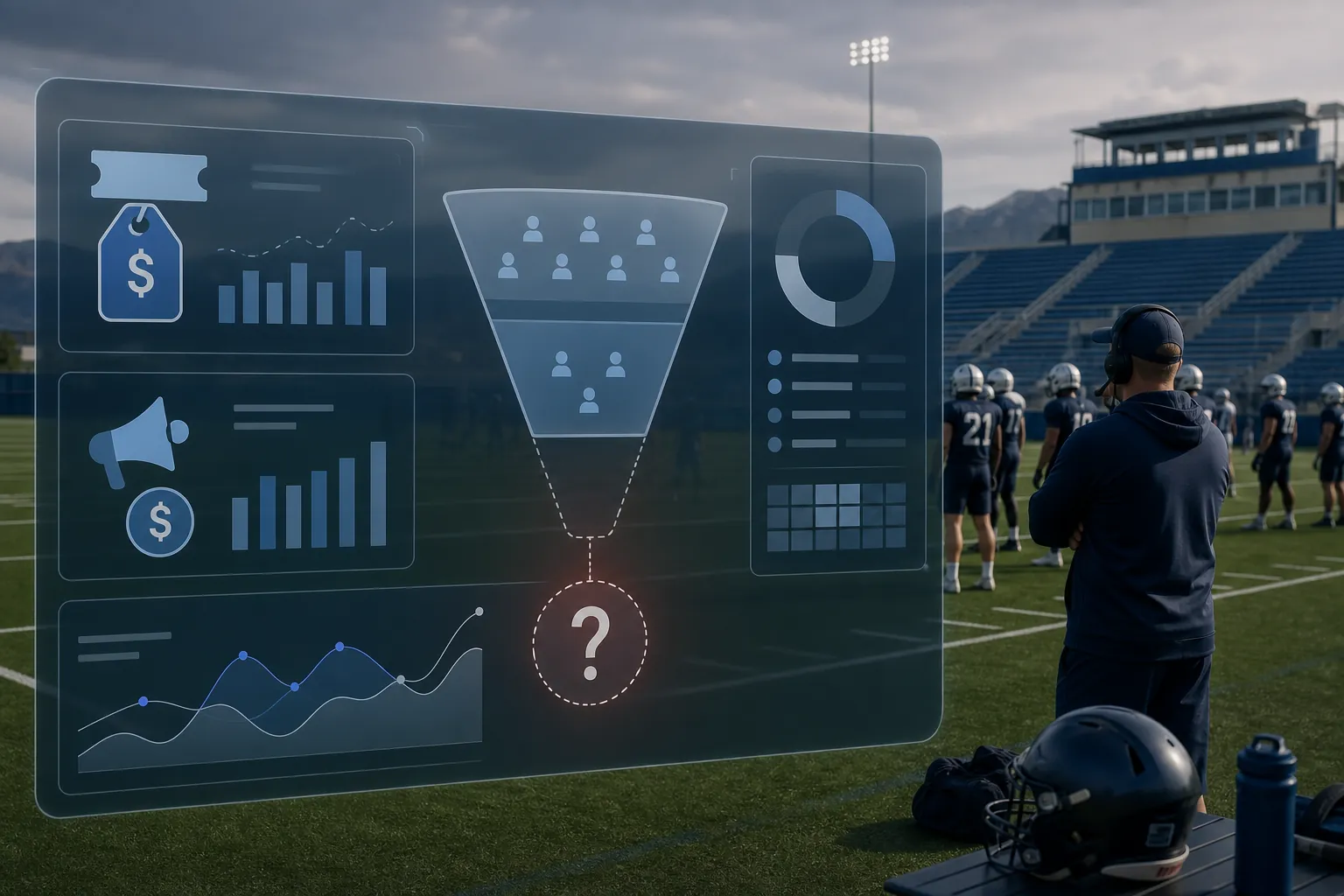
That mix creates the central problem: if the ticket itself has no price, purchase optimization is either unavailable or misleading. A campaign can spend efficiently against cheap traffic and still fail the people who actually live with the result: operations teams managing parking volume, sponsorship teams promising activation reach, CRM owners trying to identify future buyers, and ticketing contacts who may own the final conversion path but not the media budget.
Landing-page views are too weak to carry the budget
A landing-page view is reportable. It is not always worth optimizing toward. That distinction matters most when the real action happens one or two steps later on a domain the team does not control.
Matchnode’s Ticketmaster case is the cleanest warning in the available material. In an NBA/NHL paid social account during 2021-2022, campaigns optimized for landing-page views produced about 0.5 ROAS. After the team gained the access needed to optimize against direct ticketing conversions, ROAS rose above 3, and Matchnode described direct-ticketing conversion campaigns as outperforming landing-page-view campaigns by 2X or more.[6]
That is not proof that an NFL training camp campaign will suddenly triple its return. The case is from different leagues, a different ticketing context, and an earlier platform environment. Meta conversion API adoption and signal quality have changed since then, and free camp registrations do not behave like paid game tickets. Still, the case shows the cost of feeding the algorithm an event that sits too far above the outcome the business cares about. If the machine is asked to find people who load a page, it should not surprise anyone when it finds people who load pages.
For free training camp tickets, the danger is even subtler because the dashboard can look healthy. CPMs are manageable, click-through rates may be fine, landing-page-view costs can fall, and the event itself sounds relevant. Meanwhile, the ticketing platform may be absorbing the only conversion that proves attendance intent. The buyer is left defending a campaign that optimized cleanly toward an event no one in operations or sponsorship would recognize as success.
Build the signal before the ticketing handoff
The practical answer is not to pretend attribution can be made perfect. It is to create a team-controlled conversion layer before the user leaves for SeatGeek, Universe, or Ticketmaster. That layer should collect the closest available intent signals and separate events that are useful for bidding from events that are only useful for reporting.
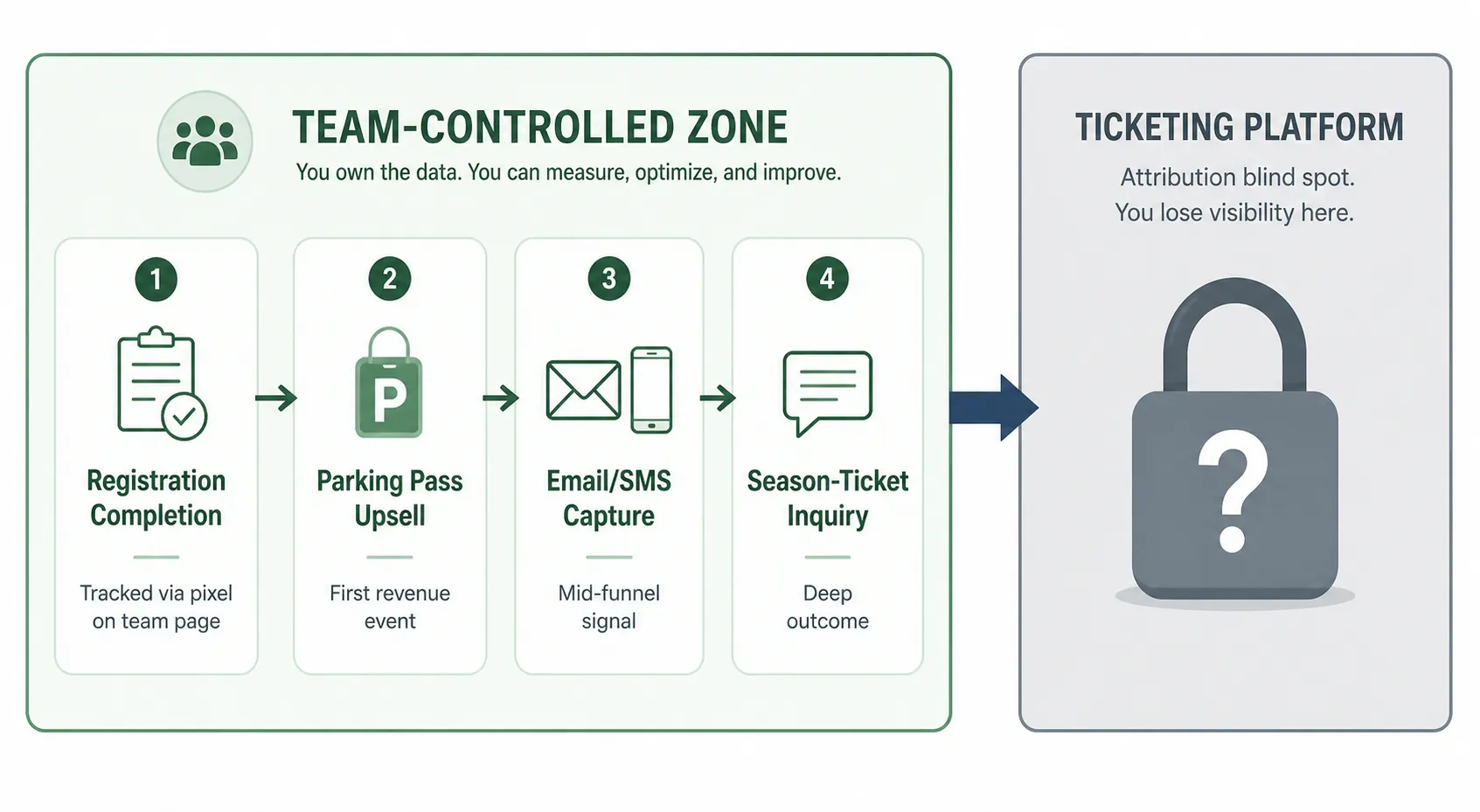
The strongest proxy event is a registration completion on a team-controlled page before the redirect. It does not have to replace the ticketing platform’s own registration. It can work as a gate or confirmation step: the fan selects a practice, provides contact details or confirms eligibility, and then moves to the ticketing platform to claim the actual mobile ticket. The pixel, conversion API event, GA4 event, and CRM record all fire while the team still controls the page.
That event is more valuable than a landing-page view because it contains a decision. A fan has moved from curiosity to claimed intent for a specific practice date. It also gives the paid media team a conversion that can be deduplicated, exported, and compared by campaign, audience, creative, and date. It will still overstate attendance because free tickets create no-show risk, but it is closer to the operational outcome than a page load.
The next useful signal is parking. The Rams make the value obvious because training camp tickets are free while parking is listed at $20.[3] A parking pass is not just revenue; it is a high-intent attendance signal. Someone willing to handle parking is less casual than someone who tapped through a free-ticket prompt. The Commanders add a different version of the same constraint by limiting parking to one pass per registration, which makes the parking object operationally important even when it is not framed as an upsell.[2]
Parking should not be treated as the universal north-star metric. Families carpool. Some fans use rideshare. Some venues have sponsor or member parking rules that complicate the path. But when parking exists as a paid or capacity-managed action, it deserves its own conversion event and its own report line. It is the first place in many free-ticket funnels where the team can see economic value or a stronger attendance commitment.
| Signal | Best use | What it still misses |
|---|---|---|
| Registration completion on team-controlled page | Primary optimization event when ticketing conversion is unavailable | Actual attendance and no-show behavior |
| Parking pass purchase or reservation | High-intent signal and, when paid, first revenue event | Fans who attend without parking or with shared parking |
| Email/SMS capture | Mid-funnel audience building, retargeting, CRM enrichment | Whether the fan claims or uses the ticket |
| Season-ticket inquiry | Deeper business outcome for sales teams | Short-term camp attendance volume |
Email and SMS capture sit one level lower than registration completion for bidding, but they matter because training camp is rarely only about filling one practice. A free-ticket registrant may be a youth football parent, a sponsor guest, a single-game buyer, or a future season-ticket lead. If the campaign only reports registrations, the CRM team inherits a pile of names with no source quality attached. If the media setup passes campaign, creative, audience, practice date, and opt-in status into the CRM, the same free-ticket effort can become a usable audience asset.
Season-ticket inquiry submissions are the deeper outcome, not the default optimization event for every camp campaign. They are too sparse for many short windows, and optimizing only toward them can starve the top of the funnel. They should be tracked aggressively, valued separately, and reviewed with sales, but they usually work better as a reporting and retargeting signal than as the primary bid event for a four-to-five-week camp push.
Automation needs volume, not wishful thinking
Automated bidding is not the enemy here. Advantage+ and automated conversion campaigns can be excellent when the account feeds them repeated, meaningful events. The problem is asking those systems to stabilize on a short campaign with a thin conversion pool and then acting surprised when learning never settles.
Third-party guidance for Meta Advantage+ commonly points to 50 or more conversions per week as the kind of volume needed for stable learning.[7] That benchmark is not official Meta documentation, so it should not be treated as a hard law. It is still a useful planning check. A training camp campaign that produces only 30 to 80 registrations across the full practice window is not giving the algorithm the same environment as an always-on ecommerce account or a full-season ticket campaign.
That changes the bidding architecture. If the registration event is too low-volume at the individual practice level, consolidate where the business can tolerate it: optimize across all open practices, group similar camp dates, or use broader event definitions early in the flight before tightening toward registration or parking. The point is not to water down the goal until the dashboard looks stable. It is to give the system enough of a real signal to learn from while keeping the event close enough to attendance intent.
Warm audiences also deserve more respect than they usually get in these campaigns. Patchboard’s sports marketing retargeting guide reports that 70% of retargeted users purchase, but that is general sports-marketing data, not NFL training camp evidence.[8] It supports a narrower conclusion: people who have already engaged with the team are often worth treating differently from cold audiences. For camp, that can mean retargeting schedule-page visitors, past single-game buyers, youth program lists, app users, email clickers, and video viewers with practice-specific creative.
A workable campaign structure
A clean setup starts before the media plan. The team needs to decide which page it controls, which events fire there, what fields pass to CRM, and what the ticketing partner can return. If those conversations happen after launch, the campaign usually defaults to traffic optimization because traffic is the only thing that works immediately.
- Use a team-controlled registration or intent page before the ticketing redirect whenever possible.
- Fire separate events for registration completion, parking purchase or reservation, email/SMS opt-in, and season-ticket inquiry.
- Optimize primarily toward registration completion when volume is sufficient; use parking as a high-intent or value-based signal where the path supports it.
- Report landing-page views as diagnostic traffic quality, not as the campaign’s main performance result.
- Import offline or downstream outcomes where available, but label them as attribution workarounds rather than guaranteed fixes.
The creative and audience plan should follow the same logic. Cold prospecting can sell the date, player access, family experience, and free-ticket availability. Retargeting should remove friction: selected practice dates, parking instructions, mobile-ticket reminders, sponsor perks, and what happens at the venue. CRM audiences can be segmented around value: season-ticket prospects, youth football families, lapsed buyers, premium leads, and sponsor-invited guests do not need the same message.
UTMs, GA4 audiences, pixel events, conversion API events, and offline imports all help. None of them erase the platform-level blind spot if SeatGeek, Universe, or Ticketmaster owns the decisive step and does not return clean event-level data to the ad account. That is the part stakeholders need to hear plainly. The right setup can make campaign-level ROAS more directional and more useful; it cannot always make it definitive.
Sponsors complicate the KPI, and they should
Training camp is not only a ticketing exercise. The Saints’ camp page includes the Rouses Markets Fast Pass, the 49ers describe open practices presented by Visa, and the Rams list a Corona Beer Garden in their camp FAQ.[1][4][3] Those activations can make a pure registration KPI too narrow. A campaign that fills the wrong dates, under-delivers a sponsor zone, or creates parking pressure in the wrong window can still look good in the ad account.
This is where KPI design has to include the non-media consequences. Sponsorship may need scans, offer redemptions, QR visits, or branded-area traffic. Operations may need arrivals distributed across dates and parking products. CRM may need opt-in quality instead of raw lead count. Ticketing may only be able to confirm totals after the fact. Paid media cannot solve each of those jobs with one optimization event, but it can stop pretending that one event represents all of them.
For the paid buyer, the discipline is to separate the bidding signal from the scorecard. Bid toward the closest controllable event with enough volume to learn from. Report registrations, parking, CRM opt-ins, and downstream inquiries separately. Compare campaign performance by practice date and audience, not only by blended cost per landing-page view. When the final ticket claim sits inside a third-party platform, say so in the report and treat ROAS as directional.
Free tickets do not make the campaign free to measure poorly. They make measurement more important. The better 2026 setup is not a perfect attribution model; it is a proxy conversion architecture honest enough for the dashboard and useful enough for the people managing the gates, the lots, the sponsors, and the next sales conversation.
References
- Saints Training Camp Tickets, New Orleans Saints
- Commanders Training Camp, Washington Commanders
- Rams Training Camp FAQ, Los Angeles Rams
- 49ers Announce 2026 Open Training Camp Schedule, San Francisco 49ers
- NFL Training Camps for 2026 Season Open This Week, NFL.com
- How to Run Ticketmaster Conversion Ads on Paid Social in 2021-2022, Matchnode
- Meta Advantage Plus Guide 2026, Optimyzee
- Sports Marketer's Guide, Patchboard
Built on this evidence
No Bidding tactic or Creative record currently cites this case file. Compare it against other results in Benchmarks.
Related benchmark reading
Report a corroborating or contradicting result
Seeing something different in your own account? Feed the data-integrity loop instead of leaving an open comment.