

How to Choose the Right AI PPC Management Tool Stack for Your Team
A decision framework that matches AI PPC platforms to team size, ad spend, and autonomy preference — so you can build a defensible tool stack rather than chase the latest headline.
Last reviewed: June 25, 2026.
The wrong first question is “Which AI PPC management tool is best?” That question usually produces a demo-driven shortlist, a few screenshots of automated recommendations, and a subscription nobody wants to defend six months later. The better question is more operational: which mix of native platform AI, third-party automation, and autonomous agents fits your monthly ad spend, your appetite for control, and the technical ability of the people who will actually supervise it?
That distinction matters because AI PPC management is no longer one category. Google Smart Bidding and Meta Advantage+ are already embedded in the platforms. Tools like Optmyzr, Adalysis, and Opteo sit above the platforms with rules, workflows, scripts, and scheduled checks. Newer autonomous agents, including Ryze AI and vendor-described MCP-native tools such as Adspirer, promise conversational or agentic campaign management rather than another dashboard to babysit.[1][2]
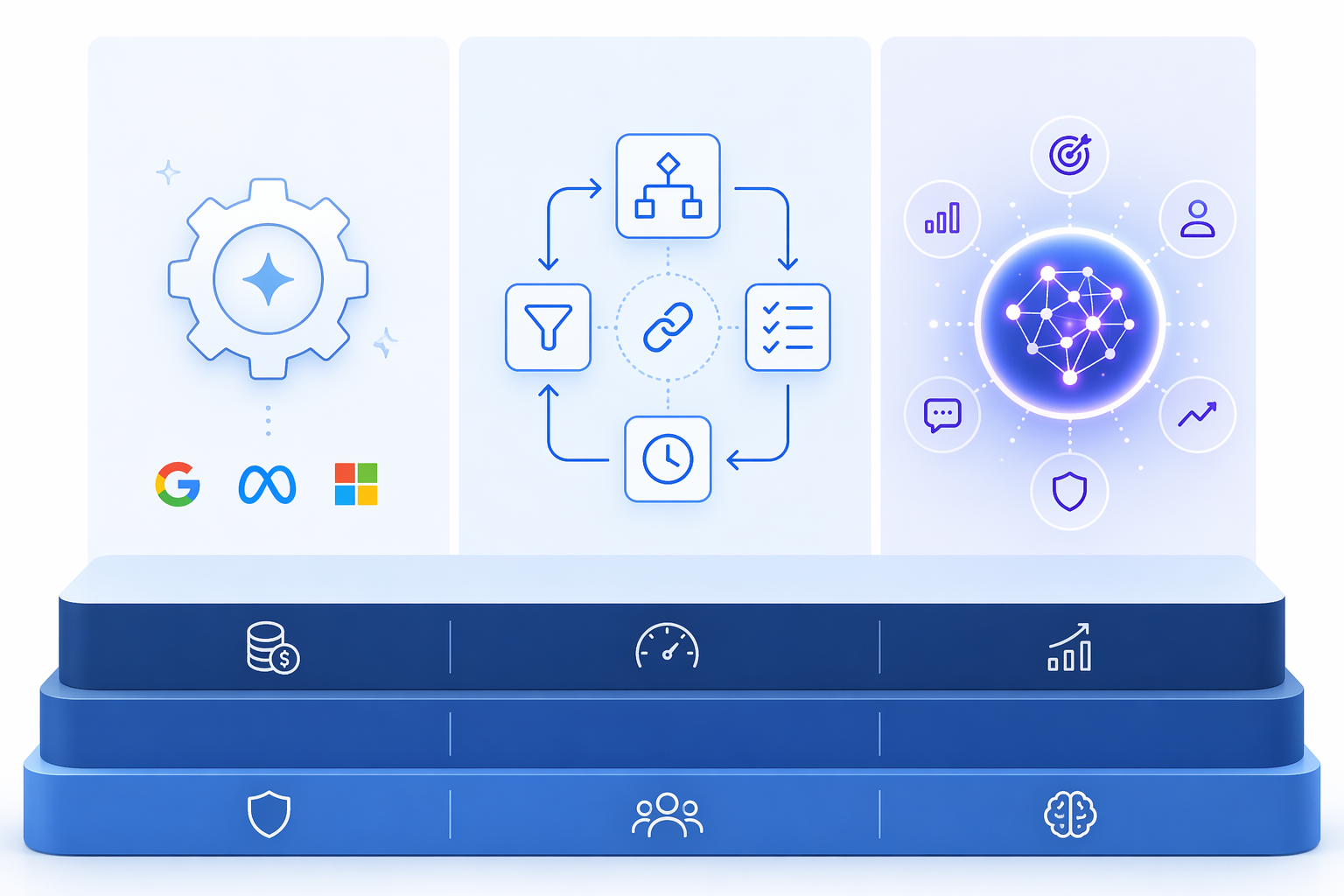
The Three Layers You Are Really Choosing Between
A defensible PPC tool stack starts by separating the job each layer is supposed to do. If those jobs blur together, you end up with Smart Bidding changing bids, a third-party rule changing budgets, an agent suggesting structural edits, and a reporting tool explaining performance as if one system made all the decisions.
| Layer | What It Usually Does | Where It Fits | Main Budget Question |
|---|---|---|---|
| Native platform AI | Bidding, targeting expansion, budget pacing, placement and creative delivery inside ad platforms | Baseline automation for Google Ads, Meta Ads, and similar platforms | Is the platform automation enough, or do we need oversight outside the platform? |
| Third-party automation | Scheduled rules, alerts, scripts, audits, workflow management, and cross-account checks | Teams that need repeatable control and documented operating procedures | Does the time saved and risk reduced justify another monthly subscription? |
| Autonomous agents | Conversational management, task execution, account analysis, and agent-led recommendations | Teams willing to test newer workflows with clear supervision | Can the team govern the agent well enough to trust it with real account actions? |
Native platform AI is not optional in most modern accounts. Google Smart Bidding, Performance Max automation, and Meta Advantage+ already shape delivery before any external tool enters the stack. That makes native AI the baseline layer, not the buying decision by itself. If you are evaluating Google automation specifically, it is worth separating platform claims from observed outcomes before adding another tool on top; this is where Google AI Advertising: Real Results vs. the Marketing Claims becomes a useful companion read.
The same is true on Meta. Advantage+ can reduce manual campaign construction, but it also changes where human control sits. The paid media lead is less often adjusting every lever and more often deciding which inputs, exclusions, creative assets, measurement windows, and budget boundaries are safe enough to let the system work. For a deeper look at that tradeoff, see Meta AI Advertising in 2026: What Advantage+ Automation Actually Does.
Third-party automation earns its keep when the platform layer leaves too much manual checking behind. This is where scheduled budget rules, anomaly alerts, search term workflows, account audits, naming checks, feed checks, and multi-account reporting start to matter. The value is not “AI magic.” It is fewer missed checks, fewer one-off spreadsheets, and a clearer audit trail when someone asks why a budget moved.
Autonomous agents are the newest and least settled layer. The interesting structural claim from vendor-published material is that MCP-native tools can benefit from improvements in the underlying large language model without requiring a conventional software update.[1] That is meaningful if true in practice, because the intelligence layer can improve faster than a traditional PPC software release cycle. It does not remove the need for permissions, logs, approval rules, rollback plans, and human review.
Use Spend, Autonomy, and Technical Capability as the Buying Filter
A tool that is sensible for a $3,000-per-month account can be a distraction for an enterprise account. A tool that is cheap at $40 per month can still be expensive if nobody has time to supervise it. A platform that costs enterprise money can be perfectly rational if it replaces fragile manual processes across dozens of markets. The decision needs three axes, not a feature checklist.
1. Monthly Ad Spend
Ad spend is the bluntest filter because it determines how much subscription cost can be absorbed before the tool starts stealing from the learning budget. Vendor-published pricing cited by Adspirer places Optmyzr’s Rule Engine starting at $208 per month, with a reported two-to-three-week onboarding period; Adzooma is described as having a genuine free tier for accounts under $5,000 per month, though with more surface-level recommendations; Ryze AI is described around $20 per week or about $40 per month; and Adspirer is listed at $49 to $199 per month.[1]
Those numbers change the decision fast. On a small account, a $208 monthly tool is not just a software expense; it may be a meaningful share of the monthly test budget. On a larger account, the same fee can be easy to justify if it prevents even a few budget leaks, approval delays, or missed anomalies. This is why “affordable” cannot be judged without spend scale.
Enterprise pricing has a different problem. The same vendor-published comparison lists Smartly as percentage-of-spend pricing with a $2,500 monthly minimum and Skai around $95,000 per year, while noting that actual pricing can vary.[1] Those models may make sense for complex organizations, but percentage-of-spend pricing creates an awkward incentive: as the media program grows, the software bill grows with it. That is not automatically bad, but it needs to be defended as a platform cost, not hidden as a minor optimization add-on.
2. Autonomy Preference
Some teams want recommendations and approval queues. Others want rules that execute at scheduled times. A smaller group wants agents that can analyze, propose, and in some cases act through connected systems. Those are different governance models, even when vendors describe all of them as AI PPC management.
| Preferred Control Level | Better Fit | Avoid |
|---|---|---|
| Low autonomy | Native platform AI plus alerts and human-approved recommendations | Agents that can make account changes without a review process |
| Moderate autonomy | Scheduled third-party automation with clear rules, logs, and exception handling | Uncoordinated rules across multiple systems |
| High autonomy | Agentic tools tested on bounded workflows with explicit permissions | Broad account access before the team understands failure modes |
The practical question is not whether automation is good. It is where the approval point should sit. If a junior manager can review recommendations once a day, a recommendation engine may be enough. If an agency has repetitive budget checks across many accounts, scheduled automation may be worth the cost. If a senior operator wants to interrogate accounts conversationally and delegate bounded tasks, an autonomous agent may deserve a test. Each choice shifts labor from one place to another; none eliminates responsibility.
3. Technical Capability
Technical capability is where many procurement conversations get too optimistic. A team that cannot maintain naming conventions, conversion tracking, or budget governance will not suddenly become safer because an AI layer is added. More automation usually raises the value of clean inputs and clear ownership.
Low-technical teams should favor tools with simple recommendations, clear explanations, and limited permissions. Mid-technical teams can use scheduled rules, scripts, feed checks, and workflow automation if someone owns the rule logic. High-technical teams can test agentic workflows, APIs, and MCP-style integrations, but only if they also have logging, access control, and rollback discipline.
This is also where explainability becomes a buying criterion rather than a philosophical preference. If a tool changes budgets, pauses assets, restructures campaigns, or rewrites recommendations, the team needs to see what happened and why. Black-box convenience becomes a governance gap when a client, CFO, or VP asks for the decision trail. That risk is broader than PPC; the same issue shows up in The AI-Targeted Advertising Trap: Why 70% of Marketers Have Already Had an AI Incident.
A Practical Decision Matrix
The matrix below is not a ranking. It is a way to stop mismatching tools to accounts. The same product can be right in one row and wrong in another.
| Team Situation | Likely Stack | Why It Fits | Main Watchout |
|---|---|---|---|
| Sub-$5K/month account, limited technical support | Native platform AI plus free or very low-cost recommendation tools | Preserves learning budget while adding basic checks | Surface-level recommendations may not catch deeper account issues |
| Small team or lean agency managing several modest accounts | Native AI plus flat-fee agent or lightweight automation | Keeps software cost predictable as account count grows | Autonomy needs tight permissions and review habits |
| Mid-market paid media team with recurring operational checks | Native AI plus scheduled third-party automation | Automates repeatable PPC work and creates a clearer process trail | Rule conflicts can appear if multiple systems touch the same settings |
| Advanced agency or in-house team with strong governance | Conversational management plus scheduled automation plus reporting | Separates analysis, execution, and visibility across layers | Requires ownership over how systems interact |
| Enterprise program with many markets, brands, or channels | Enterprise platform plus native AI and internal governance | Supports scale, permissions, and cross-market coordination | Spend-based or high annual pricing needs explicit budget logic |
For sub-$5K-per-month accounts, the burden of proof is high. Adzooma’s free tier, as described in vendor-published comparison material, is attractive because it does not consume budget that could otherwise fund tests.[1] The tradeoff is depth. A free recommendation layer can help surface obvious cleanup work, but it should not be mistaken for a senior PPC operator or a full automation system.
For small agencies and lean in-house teams, flat-fee pricing is often easier to defend than spend-based pricing. A reported $40-per-month Ryze AI price point or $49-to-$199-per-month Adspirer range is not automatically better than a more mature workflow tool, but it is easier to budget as account spend grows.[1][2] The question becomes whether the tool’s capabilities are mature enough for the workflows you plan to hand it.
For mid-market accounts, Optmyzr-style scheduled automation starts to make more sense. A $208 monthly starting point is not trivial, but it can be reasonable when the team has enough recurring work to automate and enough account value at stake to justify deeper checks.[1] The reported two-to-three-week onboarding period matters here. It signals that this is not just a plug-in recommendation widget; someone has to configure, validate, and maintain the operating logic.
For enterprise teams, the buying logic changes again. Skai and Smartly are not competing with a $49 agent on price. They are competing on scale, workflow depth, channel coverage, service expectations, permissions, and organizational fit. If the business needs that infrastructure, high annual or minimum pricing may be rational. If it does not, enterprise software can become an expensive layer of ceremony around decisions the team could have handled with native AI and a lighter automation stack.
Why Combination Stacks Often Beat One-Tool Decisions
The cleanest tool pitch is usually the least realistic: one AI system manages everything. In actual paid media operations, the better stack is often layered. Let the ad platforms do what they are structurally built to do. Use third-party automation where repeatable oversight is valuable. Add an agent only where conversational analysis or task delegation has a defined job.
Adspirer’s vendor-published comparison gives one useful example: conversational management through Adspirer, scheduled automation through Optmyzr, and cross-platform reporting through Adzviser, with an estimated combined cost of about $283 per month.[1] Treat that as a model for stack thinking, not a universal prescription. The important part is the separation of duties: one layer helps interrogate and manage, another executes scheduled checks, and another improves visibility.
A layered stack also makes failures easier to diagnose. If ROAS drops after a budget change, the team can ask whether the platform bidding system responded to new constraints, whether a scheduled rule fired, whether an agent suggested a change, or whether the reporting layer changed attribution views. In a one-tool fantasy, those distinctions disappear. In a real account review, they are the difference between fixing a problem and guessing at it.
This does not mean more tools are better. Every added system creates another control surface, another permissions decision, another invoice, and another place where recommendations can conflict. A stack is only better than a single tool when the boundaries are clear enough for the team to operate it.
How Much Weight to Give Market Growth and Performance Claims
The category is growing, but category growth is not a purchase order. Ryze AI’s vendor-published blog cites MarketsandMarkets for a projection that the AI advertising market will grow from $5.6 billion in 2024 to $16.42 billion in 2029.[2] That supports the obvious point that more vendors and budgets are moving into AI advertising. It does not prove that a specific PPC tool will improve your account.
Broad performance statistics need the same treatment. MarketerHire cites aggregated figures including a 37% waste reduction, 47% CTR lift, and 72% ROAS increase, but those figures trace back to a single Zebracat 2025 aggregation rather than independent validation across every PPC context.[3] They may be directionally interesting. They should not be used as a guaranteed business case.
If leadership wants outcome examples, use case material as a prompt for better questions: What was the starting account condition? Which channel changed? Was the improvement from bidding, creative, feed quality, query control, landing pages, or measurement cleanup? How long did the test run? For broader AI marketing examples outside this selection framework, 15 AI Marketing Examples Organized by What You Actually Do is a better place to compare use cases.
When Native Platform AI Is Enough
Native AI may be enough when the account is small, the campaign structure is simple, the conversion data is reliable, and the team can manually review budgets, queries, assets, and performance trends without falling behind. In that situation, buying another tool can create more work than it removes.
- Use platform automation for bidding and delivery when conversion tracking is trustworthy.
- Keep human review over budgets, creative quality, search terms, exclusions, and landing page alignment.
- Add external tools only when recurring checks are being missed or manual work is slowing decisions.
- Avoid paying for automation before the account has enough spend or complexity to benefit from it.
This is the hardest recommendation to sell to people who want a shiny AI line item, but it is often the right one. If the account is still learning which offers, audiences, queries, and landing pages work, the best software decision may be to preserve media budget and clean up the basics.
When Scheduled Automation Justifies Its Cost
Scheduled automation becomes attractive when the team can name the exact recurring work it wants to remove. “Make PPC smarter” is not enough. “Alert us when spend pacing deviates,” “pause low-quality variants after a defined threshold,” “check broken URLs,” “flag conversion drops,” and “standardize account audits across clients” are clearer use cases.
The best candidates are teams with repeatable processes and enough account volume to make consistency valuable. Agencies often feel this first because the same small error can repeat across many accounts. In-house teams feel it when one or two paid media managers are responsible for more campaigns than they can manually inspect with discipline.
The red flag is rule sprawl. If one tool changes budgets, another modifies bids, and a platform recommendation is auto-applied, the account can become a negotiation among systems. Before buying scheduled automation, decide which system owns each class of action.
When an Autonomous Agent Is Worth Testing
An autonomous PPC agent is worth testing when the workflow is bounded, the team has enough expertise to evaluate its output, and the account can tolerate a controlled pilot. Good early use cases are analysis, QA, reporting assistance, structured recommendations, and draft changes awaiting approval. Riskier use cases are broad budget control, account restructuring, and unsupervised creative or query decisions.
The low monthly price points reported for newer tools make testing easier, but cheap autonomy is still autonomy. A $40-per-month or $49-per-month tool can create expensive consequences if it has too much access and too little oversight.[1][2] The pilot plan matters more than the demo.
- Start with read-only analysis or human-approved recommendations.
- Limit access by account, channel, and action type.
- Require logs that show what the agent reviewed, recommended, and changed.
- Define rollback steps before allowing execution.
- Compare the agent’s output against an experienced operator’s judgment before expanding permissions.
A good autonomous layer should reduce repetitive operator work without making the account harder to explain. If the paid media lead cannot tell leadership what the agent did last week, the stack is not mature enough for broader use.
Pricing Models Are Strategy Decisions
Flat-fee, free-tier, minimum-fee, and percentage-of-spend pricing create different incentives. This is where the buying conversation should get specific, because pricing is often the first place an AI PPC management decision becomes visible to finance.
| Pricing Model | Best For | Budget Risk |
|---|---|---|
| Free tier | Small accounts and early-stage testing | Limited depth may create false confidence |
| Low flat fee | Lean teams, small agencies, and pilots | Capability may lag behind operational promises |
| Mid-range flat fee | Teams with repeatable workflows and enough account complexity | Cost can be hard to justify if usage is shallow |
| Percentage of spend | Enterprise programs where platform value scales with media operations | Software cost rises as media spend grows |
| High annual contract | Large organizations needing scale, service, and governance | Procurement may lock in a platform before workflows are proven |
For budget defense, translate the fee into the account’s operating reality. What manual work disappears? Which errors become less likely? Which decisions become faster? Which reports become more trustworthy? A tool does not need to produce a dramatic performance lift to be worth buying, but it does need a role that is clearer than “AI optimization.”
Also separate acquisition cost from supervision cost. A cheap agent that requires daily senior review may be less economical than a more expensive rule-based tool that reliably handles known workflows. A high-end platform that reduces coordination across regions may be cheaper than the meetings and manual reconciliations it replaces. The invoice is only one part of the cost.
What to Avoid
- Avoid buying a tool before deciding which layer it occupies: native AI oversight, scheduled automation, autonomous agent, or reporting.
- Avoid spend-based pricing unless the platform’s value clearly scales with the complexity of the media program.
- Avoid giving an autonomous tool broad execution rights before testing it on bounded workflows.
- Avoid stacking rules across multiple systems without a clear owner for bids, budgets, creative, and structural changes.
- Avoid using market growth projections or aggregated performance stats as proof that a specific tool will work in your account.
The final selection logic is deliberately plain: choose the cheapest stack that gives your team the level of control, automation, and oversight it can actually operate. For some teams, that is native platform AI plus disciplined manual review. For others, it is native AI plus scheduled automation. For a smaller but growing group, it is a layered setup with conversational management, automation, and reporting separated by job. Revisit the stack as pricing, platform automation, and agent capabilities change.
References
- 10 Best AI Tools for PPC Managers in 2026, Adspirer
- Top 10 AI Tools for Google Ads Management in 2026, Ryze AI
- 6 Ways AI PPC Management Makes Your PPC Campaigns Smarter, MarketerHire
Comments
Join the discussion with an anonymous comment.