
Google AI Advertising: Real Results vs. the Marketing Claims
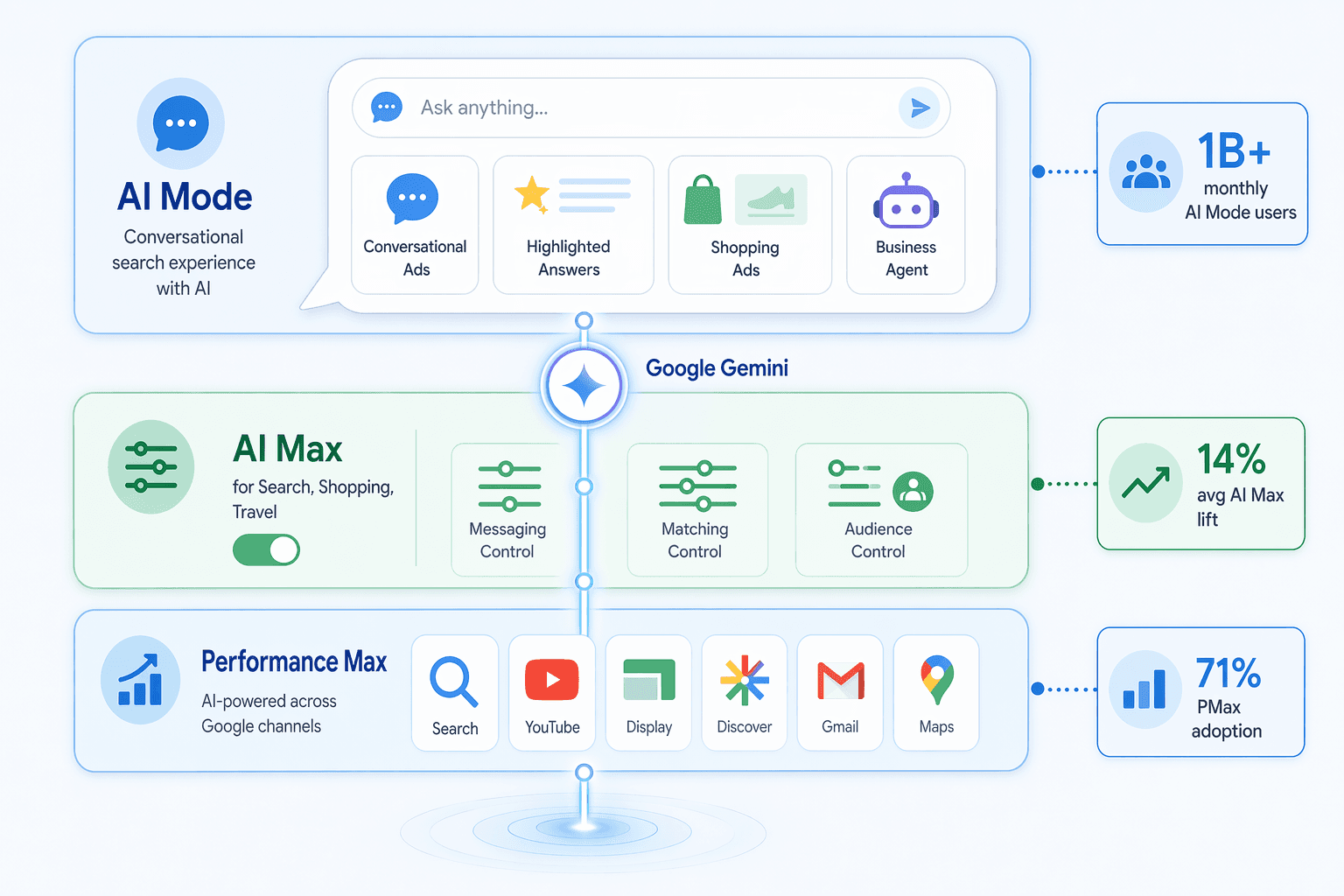
A data-driven comparison of Google's reported AI advertising performance (AI Max, PMax, AI Mode) against independently verified benchmarks, MMM data, and controlled tests — written for paid media managers who need honest numbers to set expectations and justify budget decisions.
The Gap Between Google's AI Ad Claims and What Independent Data Shows
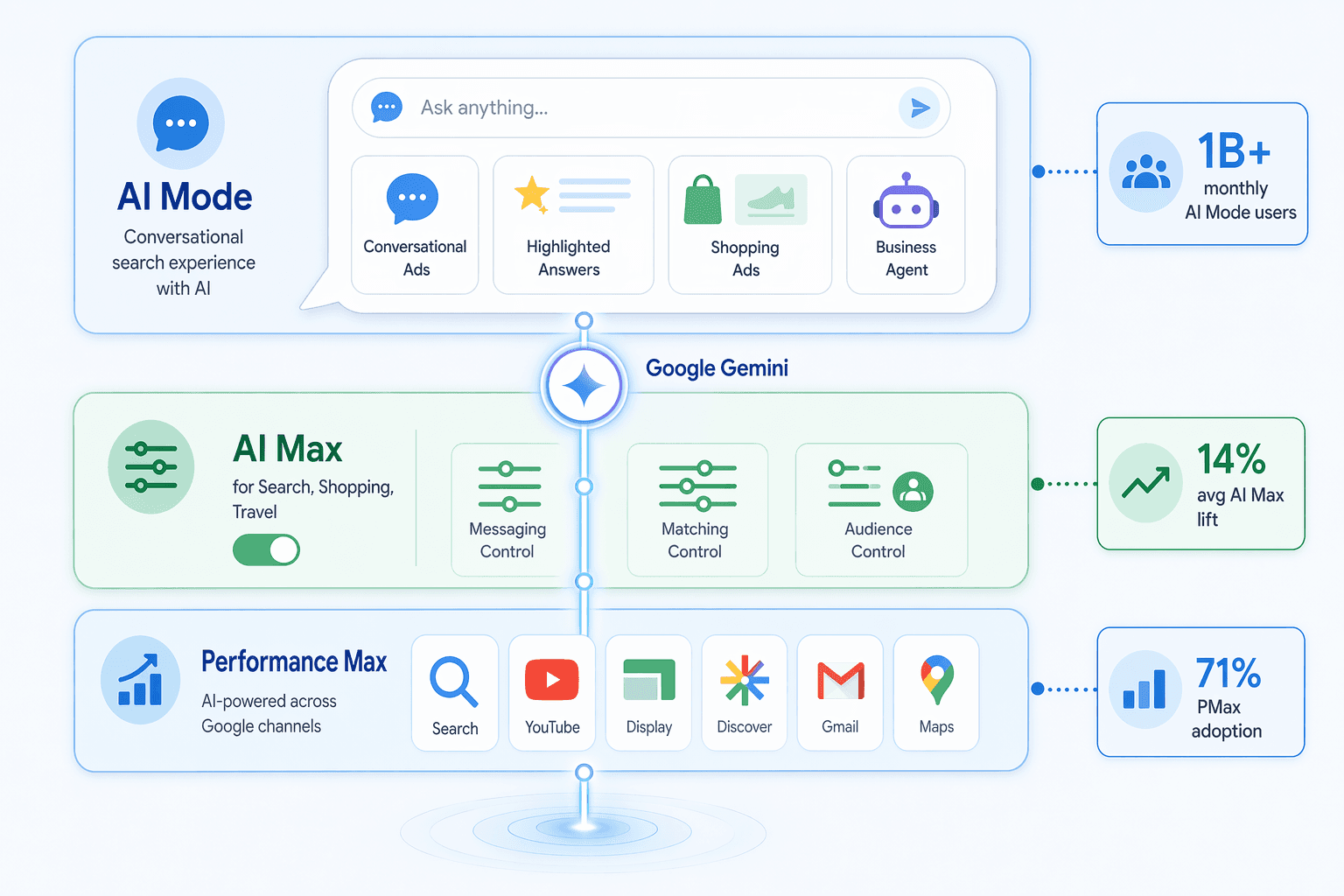
Google's AI advertising products — AI Max, Performance Max, and the new AI Mode placements — are being rolled out with impressive-sounding performance statistics. A 14% average conversion lift for AI Max. An 80% revenue increase for Aritzia. A 4.64x median incremental ROI for Performance Max. These numbers are designed to convince paid media managers and their leadership that the AI-powered future of search advertising has arrived and that opting in is a competitive necessity.
But the data that lands on a practitioner's dashboard every Monday morning often tells a different story. Independent tests, media-mix-modeling (MMM) analyses, and controlled experiments are surfacing results that range from modestly positive to flat to actively negative. The gap between what Google reports and what advertisers actually observe is not a conspiracy — it is a structural consequence of selection bias, attribution methodology differences, and the inherent difficulty of measuring incrementality in a platform that controls both the auction and the reporting.
This article is written for the paid media manager who needs honest benchmarks — not to dismiss AI tools, but to calibrate expectations, design better tests, and justify budget decisions with evidence rather than vendor-reported lift numbers. We will walk through Google's official claims, stack them against the best independent data available as of Q2 2026, and provide a practical framework for running your own controlled evaluations.
Google's Own Reported Results: What the Platform Claims
Before we examine the independent evidence, it is worth laying out exactly what Google has publicly stated about its AI advertising products. These claims come from official blog posts, executive interviews, and published case studies. They represent the baseline that practitioners are expected to use when making adoption decisions.
| Product | Claimed Performance | Source Context |
|---|---|---|
| AI Max (Search) | 14% average conversion lift; 27% for accounts with heavy exact-match traffic | Google Ads blog, April 2026 — described as the fastest-growing AI-powered Search ads product since launch |
| Performance Max | 4.64x median incremental ROI per MMM; drives ~62% of all Google ad clicks | Hooked Marketing compilation citing Google MMM data and industry benchmarks, 2026 |
| Demand Gen | 26% more conversions per dollar vs. standard Discovery campaigns | Google Ads product documentation, 2025-2026 |
| AI Max (Aritzia case study) | 80% revenue increase after activating AI Max | Modern Retail interview with Courtney Rose, VP of retail at Google Ads, Shoptalk Spring 2026 |
| AI Mode ad expansion | Ads appear in 25.5% of AI Overview SERPs (up 394% YoY from ~3% in Jan 2025) | Digital Applied analysis of Google AI Mode rollout, 2026 |
| AI Mode user adoption | 75M daily users; 100M+ monthly active users; 1B+ monthly queries | Digital Applied and Yellowhead summaries of Google AI Mode metrics, 2026 |
These numbers are not fabricated. Google's internal data almost certainly shows these lifts within the specific accounts and time periods measured. The question is whether those accounts and time periods are representative of what a typical advertiser should expect — or whether they represent a carefully selected subset where the tools happened to work well.
Consider the Aritzia case. The brand saw an 80% revenue lift after activating AI Max. But as Andrew Lolk of SavvyRevenue has pointed out in his critical analysis of Google's case studies, these single-brand examples lack crucial context: What was the baseline? How much of the lift came from cannibalizing existing branded search traffic? What was the time frame? Google's VP of retail, Courtney Rose, told Modern Retail that AI Max "goes to the retailer's site and understands what's on their site" to match user intent — but that description also applies to standard Performance Max, which has been doing exactly that for years.
What Independent Data Actually Shows
When we turn to data collected outside of Google's reporting infrastructure — from agency tests, MMM providers, and independent analysts — the picture becomes substantially more nuanced. The table below summarizes the key independent findings that challenge or qualify Google's reported results.
| Data Point | Finding | Source |
|---|---|---|
| AI Max advertiser satisfaction | 84% of advertisers report neutral or negative results with AI Max in independent testing | ALM Corp analysis of independent advertiser data, 2026 (cited by Hooked Marketing) |
| AI Max 30-day controlled test | $122 CPA for AI Max vs. $112 CPA for non-AI Search; 8 leads vs. 26 leads total | Search Engines Marketer, independent 30-day case study, 2026 |
| Platform ROAS vs. incremental ROI | 2-5x gap between Google Ads platform-reported ROAS and MMM-based incremental ROI | Cassandra MMM data, cited by Hooked Marketing, 2026 |
| AI Mode no-click rate | 92-94% of AI Mode sessions end without a click to an external website | Seer Interactive analysis of 25.1M impressions, cited by Digital Applied and Yellowhead |
| AI Overview organic click impact | Organic click-through rates drop 15-61% on queries affected by AI Overviews | Digital Applied, citing multiple studies, 2026 |
| AI Mode user session duration | 49 seconds per session vs. 21 seconds for standard AI Overviews | Digital Applied, 2026 |
The 84% neutral-or-negative finding from ALM Corp is the most striking single data point. If accurate, it suggests that the majority of advertisers who have tested AI Max are not seeing the 14% average lift that Google reports. This is not necessarily a contradiction — Google's 14% figure could be an average that includes a small number of very successful accounts pulling the mean upward, while the median account sees little to no benefit.
The 30-day test conducted by Search Engines Marketer provides a concrete example of what a neutral-to-negative outcome looks like in practice. Over 30 days, the AI Max campaign generated 8 leads at a $122 CPA, while the non-AI Search campaign generated 26 leads at a $112 CPA. The test also revealed a critical operational issue: AI Max initially targeted competitor brand names, expanded keywords to unwanted service categories (e.g., "TV repair" for a TV installation business), and began serving ads based on service pages the advertiser was not actively promoting (security cameras).
The 2-5x gap between platform ROAS and MMM-based incremental ROI is perhaps the most important structural issue for practitioners to understand. When Google Ads reports a 5x ROAS, the true incremental return — after accounting for brand search cannibalization, audience overlap, and attribution window differences — may be closer to 1x or 2x. This gap is not unique to AI tools, but it becomes especially consequential when evaluating AI products that may be shifting spend rather than creating new demand.
Where Each AI Tool Actually Delivers — and Where It Underperforms
The available evidence does not suggest that Google's AI advertising tools are universally ineffective. Rather, it suggests that their performance is highly context-dependent. The following table summarizes the conditions under which each tool appears to deliver versus underperform, based on the data reviewed.
| Tool | Delivers When | Underperforms When |
|---|---|---|
| AI Max (Search) | Accounts with heavy exact-match historical data; eCommerce with clean product feeds; high-volume lead gen with clear conversion signals | Niche B2B with low search volume; brand-new accounts without conversion history; accounts with complex negative keyword requirements |
| Performance Max | Multi-channel campaigns with strong creative assets; eCommerce with Shopping feeds; accounts where cross-channel attribution is already established | Accounts with strict brand/non-brand separation requirements; low-budget campaigns where spend is spread too thin across channels |
| AI Mode placements | Brand awareness and consideration campaigns; categories where users are in research mode (e.g., travel, complex purchases) | Direct-response campaigns where click-based ROI is the primary metric; accounts that cannot accept 92-94% no-click rates |
| Demand Gen | Visual-first products with strong lifestyle imagery; B2C brands with high engagement on YouTube and Discover | B2B with long sales cycles; text-heavy value propositions that do not translate to visual formats |
The 30-day AI Max test from Search Engines Marketer illustrates a recurring pattern: AI Max tends to expand aggressively into adjacent keywords and competitor terms, which can be beneficial for discovery but problematic for accounts with strict brand safety or service-scope requirements. The test found that AI Max began targeting "competitor brand names" and "services not offered" — behavior that required active negative keyword management to control.
For Performance Max, the 4.64x median incremental ROI figure from MMM data is a legitimate positive signal, but it should be read alongside the 2-5x gap between platform ROAS and incremental ROI. A 4.64x incremental return is strong, but it is not the same as the 8-12x platform ROAS that some advertisers may see in their dashboards. The difference matters when presenting results to leadership.
The Attribution Problem: Why Platform ROAS Overstates True Incremental Return
The single most important concept for evaluating any AI advertising tool is the difference between platform-reported ROAS and true incremental return. Google Ads attributes conversions using a combination of last-click, data-driven, and view-through attribution models — all of which tend to overcredit the platform for conversions that would have happened anyway.
The Cassandra MMM data cited by Hooked Marketing shows a consistent 2-5x gap between what Google Ads reports and what MMM attributes as incremental. This means that a campaign showing a 6x ROAS in the Google Ads console may only be delivering 1.2x to 3x true incremental return. For AI tools that are designed to maximize platform-reported conversions, this gap can create a misleading feedback loop: the tool optimizes for what the platform measures, not necessarily for what the business actually gains.
This is especially relevant for AI Max and Performance Max, which use automated bidding and targeting to maximize conversions within a given budget. If the attribution model overcredits the platform, the algorithm will naturally favor channels and audiences that generate easy, low-friction conversions — often branded search and remarketing — rather than truly incremental new customer acquisition.
Practitioners should track at least three metrics when evaluating AI tools: platform-reported ROAS (for operational optimization), MMM-based incremental ROI (for strategic evaluation), and controlled experiment lift (for causal validation). No single metric tells the full story.
How to Run Your Own Controlled Tests: A Practical Framework
Given the thinness of independent AI Max data and the selection bias in Google's case studies, the most reliable evidence for any specific account will come from well-designed controlled experiments. The following framework is designed for paid media managers who need to generate defensible internal evidence.
- Set up a holdout campaign structure. Run your existing non-AI Search campaign alongside an AI Max campaign with identical budgets, targeting the same geos and language markets. Do not let AI Max access your entire account — create a dedicated campaign with a defined set of high-intent keywords.
- Define success metrics before launch. Platform-reported ROAS is not enough. Track incremental conversions (using a holdout geo or time-period design), CPA by source (AI Max vs. non-AI), and MMM inputs if available. Include a qualitative assessment of search term relevance.
- Set minimum test duration and budget. AI Max needs time to learn. A minimum of 30 days and $5,000 in spend per campaign is a reasonable starting point, though larger accounts may need more. Do not make decisions based on the first two weeks of data.
- Implement negative keyword governance from day one. The 30-day test showed that AI Max will expand to competitor brand names and unrelated service terms. Build a comprehensive negative keyword list before launch and monitor search term reports daily for the first two weeks.
- Separate brand and non-brand performance. AI Max tends to overperform on branded queries because those conversions are easier to capture. Run separate analyses for brand and non-brand traffic to understand where the incremental value is actually coming from.
- Align attribution windows. If your non-AI campaign uses a 30-day click-through attribution window, ensure AI Max uses the same window. Differences in attribution settings can create false apparent lifts.
Key Risks to Monitor as AI Ads Evolve Through H2 2026
Google's AI advertising products are not static. AI Max was expanded to Shopping and Travel campaigns in April 2026, and Google Marketing Live in May 2026 introduced new AI-powered ad formats including Conversational Discovery ads, Highlighted Answers, and AI Shopping Ads. The pace of change creates both opportunity and risk for practitioners.
- Inability to isolate AI Mode placement performance. As of Q2 2026, advertisers cannot isolate AI Mode placement performance in standard reporting. This means you cannot directly measure whether your ads appearing in AI Mode are driving conversions at a different rate than ads appearing in traditional search results. This lack of transparency makes it difficult to optimize or justify spend.
- The 92-94% no-click rate on AI Mode. If the majority of AI Mode sessions end without a click, traditional click-based ROI models will systematically undervalue these placements. Brands that rely on click-based attribution may conclude AI Mode is underperforming when it may actually be driving valuable brand exposure and consideration.
- Consumer trust concerns around AI-labeled ads. As AI-generated ad content becomes more common, consumer skepticism is rising. Our analysis of the AI ad perception gap shows that marketers and consumers have very different views on the effectiveness and trustworthiness of AI-generated advertising.
- Rapid feature evolution creating comparison instability. AI Max features are being added on a monthly cadence. A test conducted in April 2026 may not be valid in July 2026. Any article, case study, or benchmark must carry a last-reviewed date to remain useful.
- Regulatory and disclosure developments. The FTC continues to scrutinize AI-generated advertising content and disclosure practices. Advertisers using AI-generated ad copy or images should monitor regulatory guidance closely, particularly around material connection disclosures.
The Bottom Line: Calibrating Expectations for Google's AI Advertising Tools
Google's AI advertising tools are not a mirage. Performance Max has demonstrated a legitimate 4.64x median incremental ROI in MMM data. AI Max can deliver real conversion lifts for accounts with strong historical data and clean product feeds. AI Mode is opening new inventory that may be valuable for brand-building and consideration-stage campaigns.
But the gap between Google's reported results and what independent data shows is real and consequential. The 14% average conversion lift for AI Max coexists with an 84% neutral-or-negative finding from independent testing. The 80% revenue lift for Aritzia coexists with a 30-day test showing $122 CPA vs. $112 CPA. The 4.64x incremental ROI for PMax coexists with a 2-5x gap between platform ROAS and true incremental return.
For the paid media manager who needs to make budget decisions and justify them to leadership, the path forward is clear:
- Run your own controlled tests using the framework above. Do not rely on Google-reported case studies or averages to make adoption decisions for your specific account.
- Track incremental metrics, not just platform ROAS. MMM, holdout tests, and controlled experiments are the only reliable ways to measure true incremental return.
- Treat Google's case studies as directional signals, not guarantees. The Aritzia and L'Oréal examples are real, but they represent best-case scenarios, not typical outcomes.
- Implement strong governance from day one. Negative keyword lists, brand/non-brand separation, and attribution window alignment are not optional — they are essential for getting clean data.
- Stay current with platform changes. AI Max and AI Mode are evolving rapidly. Re-verify any article or benchmark that is more than 60 days old before using it to inform strategy.
For further reading, explore our case study library documenting what 10 brands actually achieved with AI marketing in 2026, and our analysis of the AI ad perception gap between marketers and consumers.

Comments
Join the discussion with an anonymous comment.