

What Actually Makes AI Marketing Campaigns Work: The Operating System, Not the Tool
Most teams that test AI for advertising never move beyond initial testing. This article examines five real brand campaigns to show why the operational system around the AI—structured briefs, brand voice documentation, modular assets, review gates, and feedback loops—is the real differentiator, and what a repeatable workflow looks like.
The awkward truth about ai marketing campaigns in 2026 is that most teams are no longer waiting to try the tools. They are already inside them. Public highlights from Smartly’s 2026 Digital Advertising Trends Report, based on a survey of 450 marketing leaders, say 46% of marketers use AI to scale creative, while 42% of generative AI users still describe themselves as being in “initial testing.”[1] That gap is where the real work lives. It is not a creativity shortage. It is an operating problem: briefs are still loose, brand rules are scattered, approvals are unclear, and learnings from one campaign rarely make it cleanly into the next.
That is why the useful question is not which model wrote the better headline on a Tuesday afternoon. The useful question is whether the campaign manager can run the same process again next month without rebuilding the entire machine by hand. A good demo can make one asset look impressive. A working system can turn source material into variants, route those variants through the right reviews, launch tests, and preserve what the team learned. The distinction sounds procedural until a paid media calendar is waiting, legal has comments, creative has three other launches in flight, and the performance team needs enough clean variation to learn something.
The Case Studies Point To A Workflow, Not A Magic Prompt
The published brand cases are worth reading with a little restraint. The outcome numbers come from vendor-published case studies, not independently audited benchmarks, so they should be treated as directional evidence rather than promises. Still, the repeated pattern across different brands and tools is hard to ignore: the strongest examples do not hand the model a vague request and celebrate whatever comes back. They give the system structured inputs, constrain the output, keep humans in the loop, and connect production back to campaign performance.
iHeartMedia is the cleanest example of the difference. In Jasper’s 2025 case study, the team built a complete multi-platform campaign in one day, including positioning, taglines, audio scripts, social cadence, and segment-specific messaging.[2] The speed is the headline, but it is not the lesson. “One day” only matters because the work started from a structured creative brief and moved through governed human oversight. Without that source material, the same tool would have had more room to produce fluent noise: plausible lines, inconsistent angles, and campaign parts that sound related only because they share a product name.
That is the first operating principle: AI campaign output is only as organized as the material fed into it. A structured brief does more than describe the offer. It fixes the audience, the commercial objective, the claim boundaries, the channel context, and the decision the asset is supposed to influence. For teams that want a deeper workflow companion, the governed AI creative advertising playbook is the natural next layer: not more inspiration, but more control over how the work actually moves.
Scale Only Helps When The Inputs Are Modular
Salomon’s campaign with Pencil shows the production version of the same lesson. The brand produced more than 1,600 creatives and more than 1,000 image experiments across six markets during an eight-week sprint, with zero physical shoots.[3] Those numbers are dramatic enough to steal the attention, but the more important detail is what happened before generation: the visual prompts were structured around mood, lighting, lens, wardrobe, and market adaptation.[3] That is not a casual prompt. It is a production schema.
Once a team has that schema, scale stops being a pile of disconnected outputs. A market can adapt wardrobe or visual environment without inventing a new campaign. A creative lead can review whether the system is drifting from the intended mood instead of judging every image as a one-off. A media team can test enough variation to learn, while still knowing which elements changed. This is where high-volume AI production becomes operationally useful: the assets are modular enough to be made quickly and structured enough to be evaluated.
The same pattern is visible in smaller, less glamorous work. Adore Me reduced stylist note writing time by 36% and cut marketplace description work from 20 hours per month to 20 minutes by training AI workflows on style guides with no-code agents while keeping human review active.[5] That is not the kind of case that gets a keynote audience leaning forward, but it matters because repetitive remedial work is where marketing operations loses days. Removing that drag without removing review is exactly what a durable AI workflow should do.
Brand And Compliance Guardrails Are Part Of Performance
Currys is useful because it refuses the lazy split between “creative” and “governance.” In Jacquard’s 2025 case study, the retailer reported a 42% open uplift, 93% click uplift, and 102% revenue uplift from work that combined AI language generation with deterministic brand and compliance guardrails, segmentation rules, and dynamic creative.[4] The phrasing matters: AI language generation was one part of a controlled execution system, not the system itself.
That is especially important in categories where a slightly wrong claim can create more cost than a better subject line can recover. Guardrails are often treated as friction, but in scaled campaign work they are what make speed usable. They tell the system what cannot be said, what must be said, which claims belong to which audience, and where a human reviewer has to make the call. Without that layer, AI mostly accelerates the production of copy that someone downstream has to clean up.
Brand voice belongs in the same category. It is not a decorative preference saved for final polish. It is a control surface. If the voice guidance is undocumented or lives in the head of one senior copywriter, AI will expose that weakness quickly: every channel may become grammatically clean and strategically blurry. The deeper problem is covered in the sameness trap piece on brand voice governance, but the campaign-level implication is simple: documented voice rules should sit upstream of generation, not appear as rescue work after the first batch disappoints everyone.
The Six Elements That Keep Showing Up
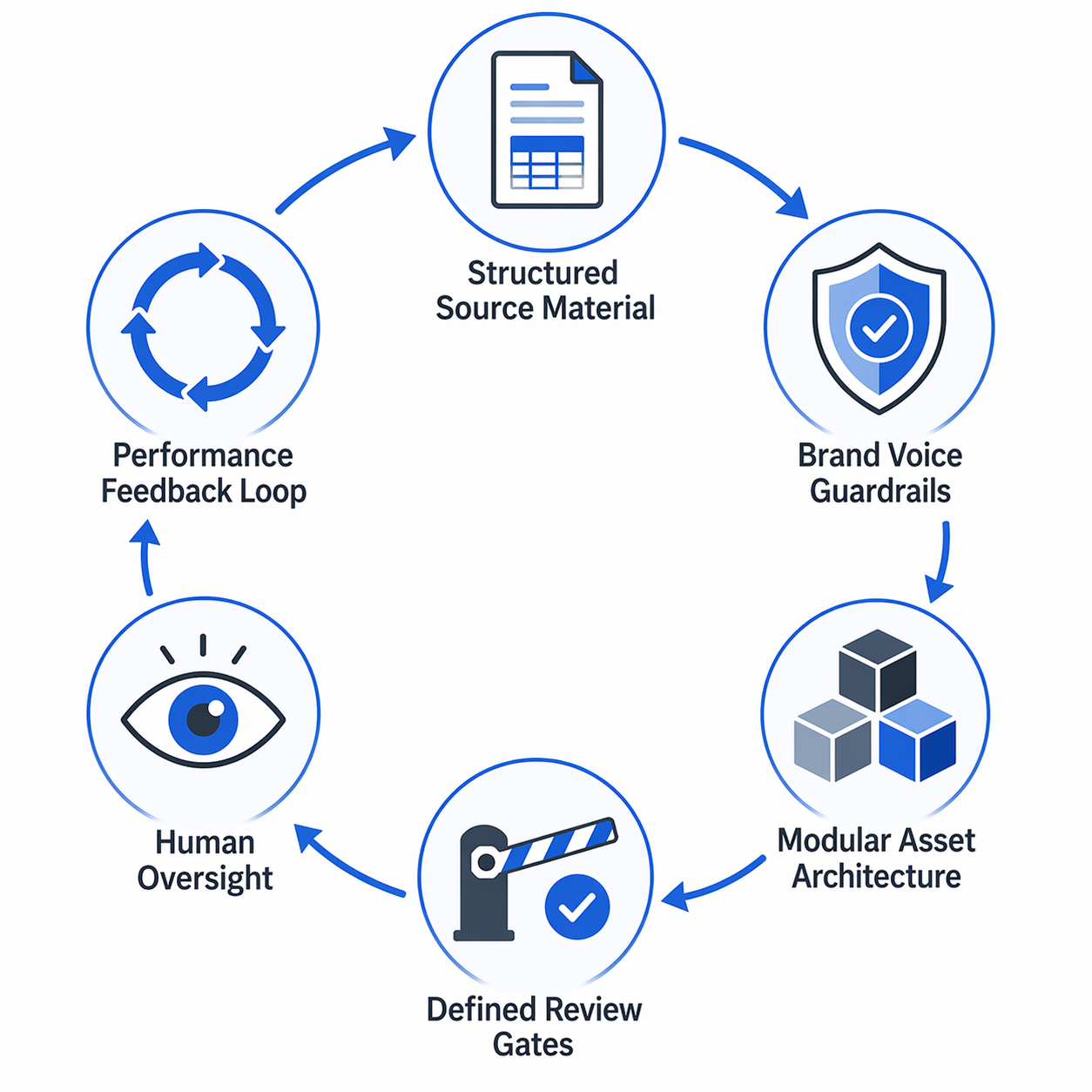
Across these cases, the operating system is not mysterious. It usually has six parts: structured source material, brand voice guardrails, modular asset architecture, defined review gates, human oversight, and a performance feedback loop. This is a practitioner synthesis across the examples, not a finding from one study. It is also the difference between a team that “uses AI” and a team that can actually run AI-assisted campaigns.
| Operating Element | What It Controls | What Breaks Without It |
|---|---|---|
| Structured source material | Audience, offer, objective, channel context, claim boundaries | The model fills gaps with plausible but unfocused output |
| Brand voice guardrails | Tone, vocabulary, forbidden phrasing, proof standards | Assets become generic or inconsistent across channels |
| Modular asset architecture | Which elements can vary by audience, market, format, or test cell | Scale produces volume without readable learning |
| Defined review gates | Who approves brand, legal, product, channel, and performance fit | Work waits in informal review loops or launches with preventable errors |
| Human oversight | Judgment calls, edge cases, taste, escalation, final accountability | The workflow confuses automation with ownership |
| Performance feedback loop | What gets measured, retained, revised, or retired | Each campaign starts from scratch despite previous data |
Superside’s published case material fits this pattern as a production-system case rather than a creative novelty. Its case study hub and related Forrester Total Economic Impact material cite outcomes including 57% faster production, an 85% turnaround improvement for Toast, and 94% ROI in the Forrester study.[6] The relevant operating details are workflow audits, centralized brand foundations, and structured briefs.[6] Again, the number is less interesting than the machinery that made the number plausible.
For more case evidence, the AI advertising examples gallery and the broader 2026 brand results library are useful because they keep the work anchored in campaigns, not tool mythology. The recurring distinction is whether the team can explain how an asset was produced, why a variation exists, who approved it, and what performance data will change next time.
A Repeatable AI Campaign Workflow
A repeatable workflow does not need to be ornate. It needs to be explicit. Prepare the structured source material first: product facts, audience segments, offer mechanics, channel constraints, mandatory claims, prohibited claims, competitive context, and the decision the campaign is meant to influence. Then document the brand and compliance rules in a form the team can actually use, not a PDF nobody opens during production.
From there, build modular assets before generating at scale. Decide which parts are stable and which parts can vary: headline angle, product benefit, proof point, image treatment, CTA, audience cue, market adaptation, or format. Generate inside those constraints. Review through named gates. A creative lead should not be doing legal review by implication. A performance marketer should not become the last line of brand defense because nobody else owned it.
After launch, the feedback loop has to be more specific than “this won” or “this lost.” The team should know which variable changed, which audience saw it, which channel carried it, and whether the result is strong enough to influence the next production round. For channel-specific execution, such as paid social testing on LinkedIn, the B2B LinkedIn AI ad creative testing playbook is where the general operating model becomes more tactical.
This is the part that separates experimentation from execution. The team prepares structured material, documents voice and guardrails, builds modular assets, generates within constraints, reviews through defined gates, launches tests, and feeds performance data back into the next round. AI marketing campaigns work when that operating system surrounds the tool. Without it, AI mostly increases the speed at which inconsistent work is produced.
References
- 2026 Digital Advertising Trends Report, Smartly, 2026.
- iHeartMedia, Jasper, 2025.
- Salomon, Pencil, 2025.
- Currys, Jacquard, 2025.
- Adore Me, Writer, 2025.
- Case Studies, Superside.
Comments
Join the discussion with an anonymous comment.