
What High-Performing AI Ad Teams Do Differently: Workflow Patterns from 10+ Brand Case Studies
Many brands see inconsistent results from AI-generated ads. This article identifies the operational patterns that distinguish high-performing teams, synthesizing evidence from 10+ brand case studies to give you a repeatable workflow framework.
AI generated advertising has made it much easier to produce ads. It has not made it much easier to produce ads that deserve budget.
That gap is where most teams are getting stuck. The generator works. The account still fills up with lookalike concepts, off-brand copy, weak claims, mismatched product shots, and variants nobody has a clean reason to test. Then a few case studies appear with numbers that sound almost unfair: Salomon producing more than 1,600 creatives and more than 1,000 image experiments in 8 weeks without physical shoots; FULLBEAUTY Brands reporting higher ROAS from AI-generated background variations; Kalshi getting a nationally broadcast TV spot made for $2,000 in 48 hours.[1][2]
The useful question is not whether AI can generate more ads. It can. The useful question is why some teams turn that volume into learnings and winners while others turn it into account clutter.
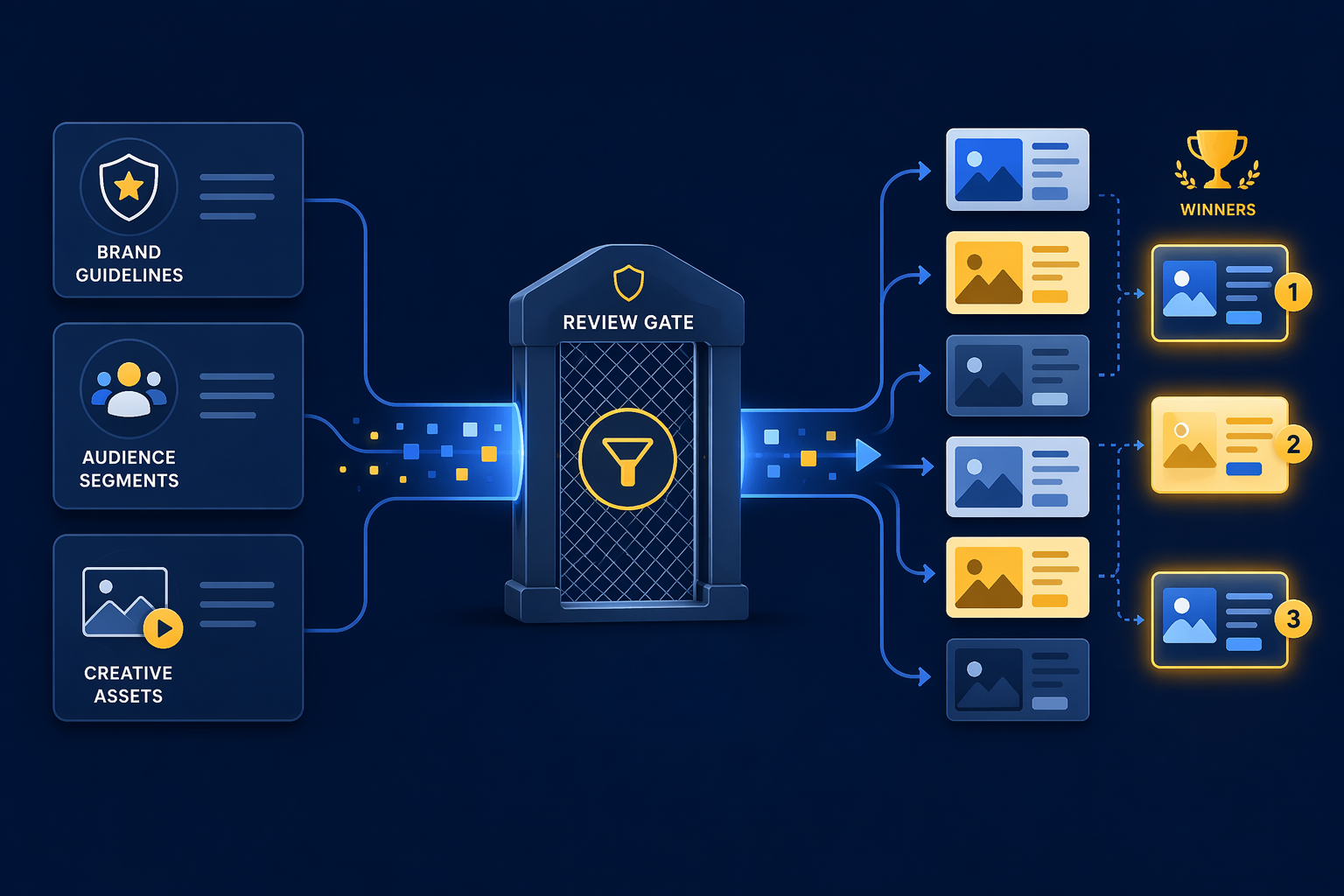
Across the stronger brand examples, the pattern is less glamorous than the results. High-performing teams are not treating AI as a replacement creative department. They are building a creative variety loop: define the inputs, generate within constraints, review before launch, test a high volume of controlled variants, then let the account data identify the small minority worth scaling.
The repeatable pattern: more variants, fewer guesses
The operating model behind the better AI ad teams usually looks like this:
| Workflow layer | What the team controls | What AI is allowed to do |
|---|---|---|
| Inputs | Brand rules, product facts, claims, offers, audience segments, source assets | Work from approved material instead of inventing the campaign |
| Modularity | Hooks, benefits, visuals, backgrounds, CTAs, formats, markets | Recombine known parts into many usable variants |
| Constraints | Channel specs, market rules, visual style, legal/compliance boundaries | Generate inside a narrower box |
| Review | Brand, legal, performance, and channel checks before launch | Produce candidates, not final authority |
| Testing | Budget allocation, naming, measurement, kill rules, scale rules | Feed enough variation into the platform for real selection |
This is the part that gets flattened in most AI creative conversations. The performance mechanism is not “AI made a better ad.” It is that a team created enough structured variation for the media system to find the few ads with real traction.
Admiral Media’s analysis makes that point bluntly: only about 6–7% of ad variants become genuine scale performers, so teams need to test 50–80 or more variants to find 3–5 reliable winners.[3] That number feels much closer to how paid social actually behaves than the usual before-and-after uplift slide. Most variants are supposed to lose. The issue is whether they lose cheaply, cleanly, and in a way that teaches the team something.

Salomon shows why the work starts before generation
The Salomon case is useful because the headline number is large, but the more important detail is upstream. The team produced more than 1,600 creatives and more than 1,000 image experiments in 8 weeks with no physical shoots, but the workflow began with defined visual, market, and channel constraints before generation.[1]
That order matters. If the team had started with a blank prompt and asked for “fresh ad concepts,” the output would have been abundant and hard to govern. Instead, the constraint set narrowed the creative space. AI could vary images and campaign materials, but it was not being asked to rediscover what the brand should look like in every market and format.
For a creative ops lead, this is the difference between useful scale and cleanup work. A thousand variants are only an advantage if they are built from approved visual logic, product context, and channel expectations. Otherwise the review queue becomes the bottleneck, and the account inherits the mess.
Modular source material beats one-off prompting
Unilever’s TRESemmé example points to the same lesson from a different angle. The campaign produced more than 200 ad edits from 12 benefit modules and 5 audience segments.[1] The interesting asset was not a clever prompt. It was the modular campaign structure.
Benefit modules are much easier to govern than fully generated ads. A team can review whether each benefit is accurate, whether the claim language is usable, whether it fits the audience segment, and whether it can survive translation into multiple formats. Once those pieces are approved, AI can recombine them at speed without forcing the team to re-litigate the campaign every time a new version appears.
That is a practical distinction. A prompt-first workflow tends to produce creative objects: an image, a line, a video, a landing-page variation. A modular workflow produces controlled permutations. The second one is much easier to name, QA, launch, compare, and kill.
The same logic applies outside beauty or retail. A team does not need twelve benefit modules because TRESemmé had twelve. It needs enough approved, distinct pieces to create meaningful variation without letting every variant become a new strategic argument.
FULLBEAUTY and Currys: the lift comes from feeding the system better combinations
FULLBEAUTY Brands is a good reminder that AI generated advertising does not always need to mean completely AI-generated ads. In the reported case, the team used AI-generated background variations for catalog-style product imagery. That narrower change was associated with 45% higher ROAS, a 22% higher conversion rate, and a 36% higher CTR.[2]
The mechanism is plain enough to be useful: the core product remained recognizable, while the background variation gave the algorithm more creative combinations to test. The team did not need AI to invent a new brand platform. It needed more usable presentation options than a white-background catalog feed could provide.
Currys is broader, but still process-driven. The reported campaign connected AI language generation to segmentation, compliance controls, and dynamic creative, with a 42% uplift in opens, a 93% uplift in clicks, and a 102% revenue uplift.[2] Those numbers are vendor-reported through Jacquard via GetHookd, so they should not be treated as universal benchmarks. The workflow detail is more transferable than the exact lift.
Segmentation matters because a generic output-volume machine is a fast way to make irrelevant ads. Compliance controls matter because the faster a team generates, the faster it can produce claims or language that should never have reached a platform reviewer, much less a customer. Dynamic creative matters because the variants have somewhere to go; they are not just sitting in a folder waiting for someone to manually assemble the perfect combination.
For detailed breakdowns of each campaign’s individual process, see these AI advertising workflow examples. The pattern across them is consistent: teams get leverage when generation is attached to a system that already knows the audience, the offer, the allowable claim space, and the launch environment.
Adore Me shows the quiet value of training and review gates
Adore Me’s case is less dramatic than a nationally broadcast commercial, which may be why it is more operationally useful. The company reportedly reduced stylist note writing time by 36% and cut marketplace description work from 20 hours per month to 20 minutes by training AI on style guides and keeping human review gates in place.[2]
That is the kind of improvement teams can actually absorb. Style guides are not decorative documents in this workflow. They become input material. Human review is not an embarrassing failure of automation. It is the control point that keeps the system from drifting.
This is especially important for brands with a recognizable voice. If AI is trained only on the internet’s average version of product copy, the output will regress toward blandness. If it is trained or prompted from the brand’s own language, offer rules, product taxonomy, and style expectations, it has a smaller and more useful space to work inside.
The human reviewer’s job also changes. Instead of writing every description from scratch, the reviewer checks whether the generated version is accurate, on-brand, compliant, and worth testing. That is still work. It is just better-positioned work.
Kalshi is the speed example, not the whole lesson
Kalshi’s AI-produced TV commercial is the case most likely to be repeated in conference decks. The company reportedly produced a nationally broadcast TV commercial for $2,000 in 48 hours, a 95% cost reduction versus traditional production, and generated more than 3 million views with more buzz than million-dollar competitor spots.[1]
That is impressive, but it is easy to learn the wrong lesson from it. The lesson is not that every brand should replace production with a two-day AI sprint. The lesson is that speed and cost compression can change what teams are willing to test. A concept that would never survive a six-figure production discussion might be worth testing when the production cost collapses.
There is still a judgment call. Broadcast visibility magnifies brand risk. A cheap ad that misrepresents the product, violates review rules, or looks wrong for the category is not cheap after the cleanup starts. Kalshi is useful as a ceiling case for production compression, not as proof that AI can safely improvise in every brand context.
A minimum viable workflow for AI generated advertising
The common workflow is not complicated. The discipline is in refusing to skip the boring parts.
- Define the test question first. For example: background context, benefit angle, hook, offer framing, format, audience segment, or landing-page alignment. Do not ask AI to vary everything at once unless the account can interpret the result.
- Lock the approved inputs. Use product facts, claim language, audience definitions, offer rules, brand voice notes, visual references, and channel specs before generation starts.
- Build modular components. Separate hooks, benefits, CTAs, visuals, backgrounds, headlines, and segment-specific language so the team can recombine rather than reinvent.
- Generate inside constraints. The prompt or tool setup should narrow the output space by market, channel, brand style, product truth, and compliance boundaries.
- Review before launch. Brand, legal, merchandising, or channel owners do not need to inspect every possible permutation forever, but they do need a gate before spend goes live.
- Launch enough volume to learn. If only a small fraction of variants become scale performers, a five-ad test is rarely a serious read on the system.
- Kill and scale by rules. Decide what gets paused, what gets iterated, what gets promoted, and what becomes source material for the next round.
The review gate is where many teams underbuild. They either review so heavily that AI creates no speed advantage, or they review so lightly that the account becomes the QA environment. The better setup is usually a tiered gate: pre-approve the source modules, sample-check generated combinations, require manual approval for sensitive claims or regulated categories, and let low-risk variants move faster once the system proves stable.
For a deeper governance template, see The AI Creative Advertising Playbook. Tool choice matters, but the workflow will usually decide whether the tool becomes leverage or just another way to make too many mediocre ads.
The uncomfortable part: most variants should lose
A team that expects every AI-generated ad to beat the control is going to misread the channel. The 6–7% scale-performer finding means the majority of variants are not failures in the moral sense. They are the cost of finding the few assets that can carry budget.[3]
That has a direct operating consequence: the team needs clean naming, clean test design, and clean retirement rules. If the account cannot tell which hook, background, segment, or format is responsible for a result, volume becomes noise. If weak variants stay live because nobody owns the cleanup, volume becomes spend leakage.
This is where AI creative work becomes less like brainstorming and more like merchandising a test pipeline. The team needs enough difference between variants to learn something, but not so much uncontrolled difference that every result is impossible to explain.
What the broader ROI data does, and does not, prove
The broader ROI story points in the same direction, with caveats. In an IAB Reality Check discussed by Ad Age, companies seeing 10–20% sales ROI improvements shared three traits: a clear AI vision or strategy, investment of more than 20% of marketing budget on AI, and use of AI for both efficiency and effectiveness.[4]
That does not prove that spending more than 20% of a marketing budget on AI causes a 10–20% sales ROI lift. It does suggest that the stronger performers are not treating AI as a side experiment owned by one curious media buyer. They have intent, budget, and a use case that goes beyond making the same assets faster.
There is also a source-quality issue worth saying plainly. Several of the strongest examples in this space are vendor-published case studies. They are useful for seeing mechanisms, workflows, and reported outcomes, but they are likely to overrepresent successful deployments. A case study library is not the same thing as an independent, controlled, cross-vertical study.
The practical response is not to ignore the cases. It is to copy the parts that are operationally legible: modular inputs, constrained generation, review gates, segmentation, compliance controls, and enough testing volume to find scarce winners.
Where teams usually get into trouble
The failure pattern is usually visible before the campaign launches. The team has a tool, a prompt, and a mandate to “test AI creative,” but no decision about what kind of variation it is trying to learn from. That creates a batch of ads with different copy, visuals, claims, offers, audiences, and formats all changing at once. If one wins, nobody knows why. If all lose, the team decides AI creative does not work.
The governance risk is not theoretical. The same Ad Age discussion cites IAB incident data indicating that 70% of marketers had encountered an AI-related incident, and 40% had to pause or pull ads.[4] For more on that governance gap, see The AI-Targeted Advertising Trap.
The category fit question also matters. A low-consideration ecommerce product with abundant imagery may benefit from rapid visual and message testing differently than a complex B2B offer or high-AOV purchase. For the AOV and category-fit lens, see AI in Advertising Examples. The workflow still applies, but the acceptable risk, review burden, and learning cycle may be very different.
What high-performing AI ad teams actually do differently
The strongest teams are not simply better prompt writers. They are better at deciding what AI is allowed to vary.
They protect the fixed parts: product truth, brand voice, claim boundaries, visual identity, offer rules, channel specs, and compliance requirements. Then they create room for useful variation: backgrounds, hooks, benefits, segment framing, formats, CTAs, edit length, and creative composition.
They also accept that the test pipeline is a filter, not a showcase. The goal is not to admire a large batch of AI-generated assets. The goal is to get enough controlled candidates into market so the account can surface the few that deserve scale.
That is the practical answer to why results are inconsistent. AI generated advertising works best when it is not treated as an output machine. It works best as part of a governed creative variety system: structured inputs, modular assets, constrained generation, human review, and high-volume testing with clear scale rules.
References
- Case Study: The Best AI Advertising Campaigns and Their Impact — Pragmatic Digital
- AI Ads Case Studies: Real Results & Examples — GetHookd
- AI Generated Ad Creative Results — Admiral Media
- AI Advertising: Where Marketers Are Really Seeing ROI — Ad Age
Comments
Join the discussion with an anonymous comment.