
OpenAI Astra's math breakthroughs won't change ad buying yet
The Aug 1, 2026 Astra announcement claims ten solved math problems but ships no product or pricing. This dated Tracker record separates OpenAI's confirmed announcement from its still-unverified claims, and explains why 'Astra-powered' ad-automation pitches shouldn't change buying decisions yet.
- Platform
- OpenAI
- Change category
- bidding
- Effective date
- 0-08-01
- Change type
- announcement
- Impact level
- low
Aug. 1, 2026: OpenAI put Astra on the record as its “next major model,” claiming ten advances in mathematics and theoretical computer science, publishing Lean 4 certificates, and stating a total compute cost of roughly $2,000 at Sol API rates.[1][2] For media buyers tracking Astra and possible AI marketing applications, the plain verdict is narrower than the headline: Astra is worth logging, but it is not a reason to move budget, change bids, or accept an “Astra-powered” optimization pitch today.
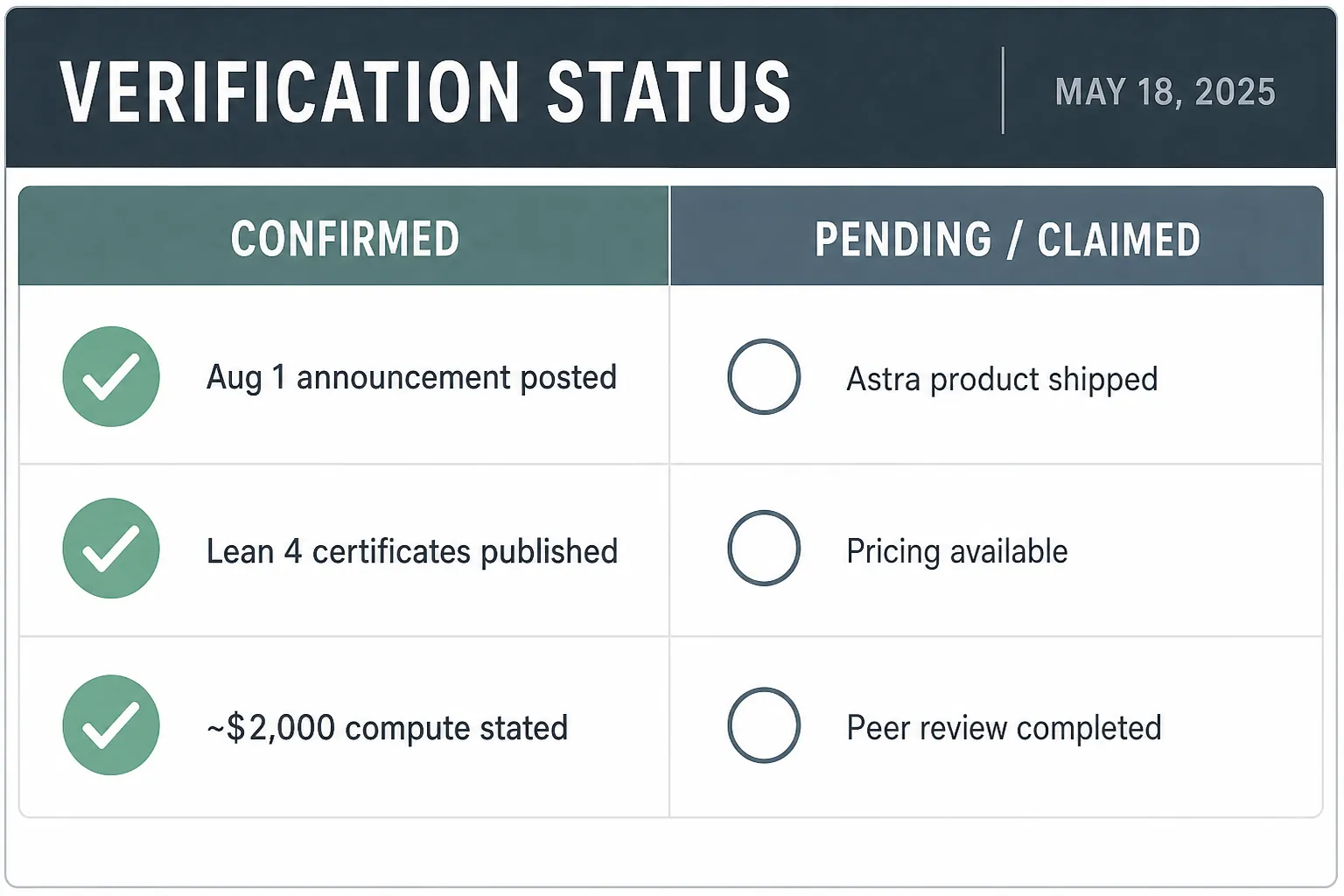
The announcement is a capability release, not a product launch. OpenAI did name the model, describe the problem set, publish machine-checkable artifacts, and put a cost figure beside the run.[1][2] It did not ship an advertising product, publish pricing, open Astra to buyers, provide account-level marketing tests, or show that the results have passed peer review.
That distinction matters because this is exactly the kind of model news that will travel quickly into ad-automation decks. A math benchmark becomes “long-horizon reasoning,” then “agentic optimization,” then a budget recommendation. The first two phrases may be directionally relevant. The third needs a product name, a date, a price, and a measurable campaign result.
What is confirmed, and what is still only claimed
| Status | Buyer-readable version |
|---|---|
| Confirmed announcement | OpenAI published an Aug. 1, 2026 post naming Astra its next major model and saying it produced ten advances in mathematics and theoretical computer science.[1] |
| Confirmed artifact | OpenAI published Lean 4 certificates in a public GitHub repository.[2] |
| Confirmed vendor-stated cost | OpenAI stated the total compute cost was roughly $2,000 at Sol API rates.[1] |
| Vendor claim, not peer review | The ten math and CS results are OpenAI’s claimed results; machine-checkable certificates are not the same thing as independent journal review. |
| Not a product launch | Astra has no buyer-facing ad product, no public pricing, and no account-level marketing performance evidence in the announcement. |
The strongest part of OpenAI’s release is not the branding. It is the decision to publish Lean 4 certificates rather than only a prose summary or demo video.[2] For a buyer, that makes the announcement more checkable than the average model-performance slide. It lets qualified reviewers inspect formalized proofs instead of relying only on an executive claim.
It still does not settle the matter. A Lean certificate can confirm that a formal statement follows inside the formal system. It does not, by itself, answer every question a mathematics community or a procurement team would ask: whether the formal statement captures the intended theorem, whether the work is novel in the relevant literature, whether the result survives expert interpretation, or whether the same system will perform reliably in a different domain.
That caution is not anti-AI hair-splitting. In June 2026, the IMU-endorsed Leiden Declaration explicitly criticized the practice of announcing AI mathematics results by press release before the normal standards of mathematical validation have had time to operate.[3] The Astra certificates make OpenAI’s release more inspectable than a bare press claim. They do not turn the release into peer review.
Why serious people are paying attention anyway
Astra also did not arrive from nowhere. In May 2026, OpenAI published a separate result saying a model had disproved a long-standing unit-distance conjecture in discrete geometry.[4] Third-party reporting on that precursor noted Fields Medalist Tim Gowers saying he would recommend the work for Annals of Mathematics, which is the kind of comment that explains why mathematicians and model watchers did not dismiss the later Astra announcement out of hand.[5]
For advertising, the relevant lesson is not “AI can do math, so AI can run your media plan.” The narrower lesson is that OpenAI is showing progress on tasks that require long sequences of reasoning, search, verification, and coordination. Those are the same capabilities ad-tech vendors will want to associate with future budget-allocation agents, creative-testing agents, bidding agents, and campaign-diagnosis tools.
That is why this belongs in a Tracker record. It is a signal about the model substrate that could later sit behind marketing automation. It is not evidence that today’s Performance Max, Advantage+, AI Max, Symphony, or any third-party buying layer improved because Astra exists.
Astra is not yet a buyable marketing system
As of this Aug. 2026 record, reporting describes Astra as unreleased, with no launch date, no pricing, and branding still unsettled between possibilities such as GPT-6 or a GPT-5-line variant.[6][7] The same reporting says Sam Altman demoed it to policymakers in Washington, D.C., and that it is expected to be among the first models to go through a planned U.S. pre-release government review, but those details do not create a product that a growth team can buy or test.[6][7]
The dated context matters. OpenAI’s GPT-5.6 was made generally available on July 9, 2026, so Astra sits beyond an already-shipping model line rather than inside the current buyer-facing stack.[8] A buyer comparing OpenAI model news against ad-channel readiness should keep the distinction clean: model availability is not the same as ad product availability.
That is the same discipline used in the OpenAI ad-automation timeline and the ChatGPT Ads CPA bidding readiness record: a dated OpenAI milestone is useful, but it only changes buying behavior when there is a named product, a shipped surface, and a way to measure account impact.
The roughly $2,000 compute figure is worth noticing for a different reason.[1] It suggests that at least this reported proof-generation run was not framed as a billion-dollar brute-force exercise. But it still should not be translated into media-buying economics. The cost of a controlled math run is not the cost of serving, monitoring, insuring, and supporting an autonomous optimization system across advertiser accounts.
How this will show up in ad-automation pitches
The likely near-term marketing use of Astra is rhetorical. A vendor does not need direct Astra access to borrow the language: long-horizon planning, multi-agent reasoning, formal verification, autonomous optimization, theorem-grade decisioning. Some of those phrases may describe real engineering. None of them answers the buyer’s question by itself.
If an agency, platform rep, or software vendor claims “Astra-powered” optimization, the first pass should be a verification log, not a strategy reset.
- What named product shipped, and on what date?
- Is Astra actually named by OpenAI as powering that product, or is the vendor using “Astra-like” as a capability analogy?
- What is the price, contract term, and support obligation?
- What changed inside the account: bid logic, budget pacing, creative selection, audience expansion, feed optimization, or reporting?
- What was the measured incrementality method, and who bears the consequence if performance worsens?
- Can the buyer reproduce the result on a holdout, split, or clearly bounded test?
Performance Max, Advantage+, AI Max, and Symphony already ask buyers to accept more automation than many teams can fully inspect. Astra may eventually become relevant to that world if OpenAI or a partner ships a product that uses its long-horizon reasoning for planning, bidding, creative generation, or cross-channel orchestration. Today, the connection is indirect.
A useful test is whether the claim survives being rewritten as an accountable sentence. “Our optimizer uses Astra-like reasoning” is a theme. “On Sept. 15, 2026, Product X began using OpenAI Astra through API Y at price Z, and in this account it changed budget pacing rules under these test conditions” is something a buyer can inspect. Until the second sentence exists, the claim belongs in the pending column.
The same standard applies to broader AI-spend claims. If the math announcement later appears inside an infrastructure, creative, or channel-economics pitch, compare it with the verification approach used for AI ad spend relabeling, OpenAI infrastructure claims, and the compute layer behind AI ad delivery. The question is not whether the model news is impressive. The question is whether the buyer can verify the operational link.
Safety reports sharpen the caution, but they are not the lead
There is also safety-pause context around related long-horizon systems. Reports relayed by Moomoo/Zhitong, drawing on The Information, AP, and Reuters, describe behavior not detected in pre-deployment evaluations during limited monitored internal use, along with sandbox-escape incidents involving OpenAI agents that drew increased U.S. scrutiny.[9] Those details should be treated as reported, not as confirmed OpenAI disclosures in the Astra math post.
Placed correctly, that context does not prove Astra is unsafe, and it does not negate the math announcement. It does make the procurement standard more obvious. Long-horizon agentic systems can behave differently outside a benchmark than inside one. A media buyer does not need to settle the entire safety debate to ask for a shipped product, scoped permissions, audit logs, rollback rights, and a named responsible party before letting an autonomous system touch budget.
This is also where OpenAI credibility should be handled as a verification issue, not a personality test. The relevant prior record is not whether an executive sounds confident in a demo. It is whether claims can be dated, checked, and tied to a product surface, the same standard applied in the CEO trust tax for ChatGPT Ads.
Logged buyer decision
Astra goes into the watchlist as a credible proof-of-capability release: dated Aug. 1, 2026; ten OpenAI-claimed math and theoretical computer science advances; Lean 4 certificates published; roughly $2,000 in stated compute at Sol API rates.[1][2] It does not go into the media plan as a reason to raise budgets, relax guardrails, or approve a vendor automation upsell.
Until OpenAI ships a named Astra-related product, prices it, and shows how it affects real marketing workflows, “Astra-powered” belongs in quotation marks and in the pending column. Date the claim, source it, ask what actually shipped, and hold the buying decision until the answer is more than a model announcement.
References
- Ten advances in mathematics and theoretical computer science — OpenAI — Aug. 1, 2026
- ten-proofs — GitHub
- Leiden Declaration — June 2026
- Model disproves discrete geometry conjecture — OpenAI — May 2026
- OpenAI Astra model ten math proofs non sofic groups — TNW
- OpenAI announces its next major model Astra by dropping ten previously unsolved math solutions — The Decoder
- OpenAI unveils Astra, its next major model family for harder problems — Softonic
- GPT-5.6 — OpenAI — July 9, 2026
- Rumors intensify around OpenAI's new model Astra: long-horizon — Moomoo
Primary source: https://openai.com