
How Sam Altman's Credibility Gap Could Undermine ChatGPT Ads
Sam Altman's documented pattern of misrepresentation creates a structural risk for advertisers buying ChatGPT inventory — one that brand safety controls alone cannot hedge. This article examines the evidence and explains how to factor CEO-level credibility into your ad platform evaluation.
- Platform
- ChatGPT
- Campaign type
- Alpha
- Spend range
- $0k-$250k
- Timeframe
- 0 (alpha)
- delivery rate
- 0% mobile reach
- Verdict
- mixed
- Last reviewed
- 0-07-30
The first serious question about ChatGPT Ads is not whether conversational inventory could be valuable. It could be. A user typing through a problem, comparing options, or asking for a recommendation is giving a platform the kind of intent signal buyers usually pay a premium to reach. The harder question is whether advertisers can trust the operator of that surface to keep paid placement from contaminating the answer environment that makes the inventory valuable in the first place.
That is why Sam Altman’s credibility record belongs in a media plan, not just in a reputation memo. If the ad product depends on answer independence, then the credibility of the executive team making that promise becomes part of the buy. Not the whole decision, and not a substitute for reach, pacing, measurement, or ROAS. But part of the risk model.
The current signal is mixed enough to deserve a careful read. CNBC reported in March 2026 that OpenAI’s ChatGPT Ads alpha had reached only about 5% of mobile users, despite 600% month-over-month growth, and that some advertisers committing $200,000 to $250,000 minimums were frustrated because they could not fully spend against those commitments.[1] That is not a verdict on the product. Alpha inventory is supposed to be constrained. But for a buyer, constrained delivery is not trivia. It affects budget timing, internal expectations, and the story the account team has to tell when a test pitched as strategically urgent cannot pace.
OpenAI’s public positioning tries to meet the obvious concern. In January 2026, the company said it would take a careful approach to advertising and would exclude ads from sensitive categories.[2] That language matters, but it does not close the file. NYU Stern’s Business and Human Rights Center argued that large language models cannot reliably classify sensitive topics across billions of conversations, which turns a policy promise into an execution problem at enormous scale.[3]

This Is Not Ordinary Brand Safety
Most brand safety programs are built for adjacency risk. They ask whether an ad appeared next to violent content, misinformation, adult material, hate speech, tragedy, political extremity, or other categories a brand has decided to avoid. That toolkit is useful, but it is not designed to answer the most important question in conversational advertising: did the commercial layer influence the answer?
A display ad beside a news article can be evaluated as an adjacent unit. A sponsored link in a search result can be labeled, ranked, measured, and challenged through a fairly mature set of buyer expectations. ChatGPT Ads sits closer to the thing the user came for. The answer is the product. The ad surface is valuable because the user believes the answer is useful, responsive, and not quietly bent around whoever paid to be there.
That shifts the burden. The platform has to convince users that the answer remains independent. It has to convince advertisers that any paid unit is separated clearly enough to avoid a trust backlash. And it has to convince buyers that revenue pressure will not gradually soften those separations after the first wave of alpha scrutiny fades.
If those assurances fail, the buyer’s problem is not only that a campaign might underperform. It is that the inventory itself can decay. A conversational ad product has no durable advantage if users begin to suspect that recommendations are steering before they are informing.
| Buyer Control | What It Can Help With | What It Does Not Solve |
|---|---|---|
| Category exclusions | Avoiding defined sensitive or unsuitable topics | Whether the model reliably identifies those topics in fluid conversations |
| Placement reports | Documenting where ads appeared | Whether commercial incentives shaped the answer itself |
| Pacing and delivery checks | Confirming spend and reach against the plan | Whether early scarcity was oversold or misunderstood |
| Creative review | Reducing claims, compliance, and tone risk | Whether user trust in the answer environment is eroding |
The Credibility Record Becomes a Platform Variable
Sam Altman’s credibility history is not relevant here because advertisers need to have a personal opinion about him. It is relevant because OpenAI is asking the market to trust a separation that is difficult for outsiders to verify. The more the platform’s value rests on an internal promise, the more governance credibility matters.
The New Yorker’s April 2026 investigation, based on more than 100 interviews, gives buyers a documented pattern they cannot responsibly treat as gossip. One anonymous former board member described Altman as “unconstrained by truth.” The article also reported that Altman had promised to devote 20% of OpenAI’s compute to superalignment work, while the actual allocation was reportedly closer to 1% to 2%.[4] Those are strong claims, and some of the most damaging details rely on anonymous sources. That matters. It means the claims should be weighted carefully, not repeated as courtroom findings. But anonymity does not make them operationally irrelevant when the reporting is extensive and the risk being evaluated is trust in executive commitments.
The same investigation reported that Ilya Sutskever, OpenAI’s former chief scientist, wrote that Altman’s behavior “does not create an environment conducive to the creation of a safe AGI.” It also reported that Dario Amodei, now CEO of Anthropic, compiled more than 200 pages of notes about Altman’s conduct while at OpenAI.[4] Again, the advertising implication is narrower than the most dramatic AI-governance reading. A buyer does not need to decide the future of AGI to ask a simpler question: when this company says ads will be handled in a way that preserves trust, how much confidence should sit behind that statement?
The WilmerHale inquiry adds a different kind of uncertainty. The New Yorker reported that the external law firm investigated Altman but produced no written report, and that the process was structured so some board members were never fully briefed.[4] That does not prove the worst interpretation. It does mean advertisers do not have a clean, reviewable governance record to lean on. For a normal media buy, that might be too remote to matter. For an ad product where answer independence is the commercial premise, opacity around executive review is closer to the center of the decision.
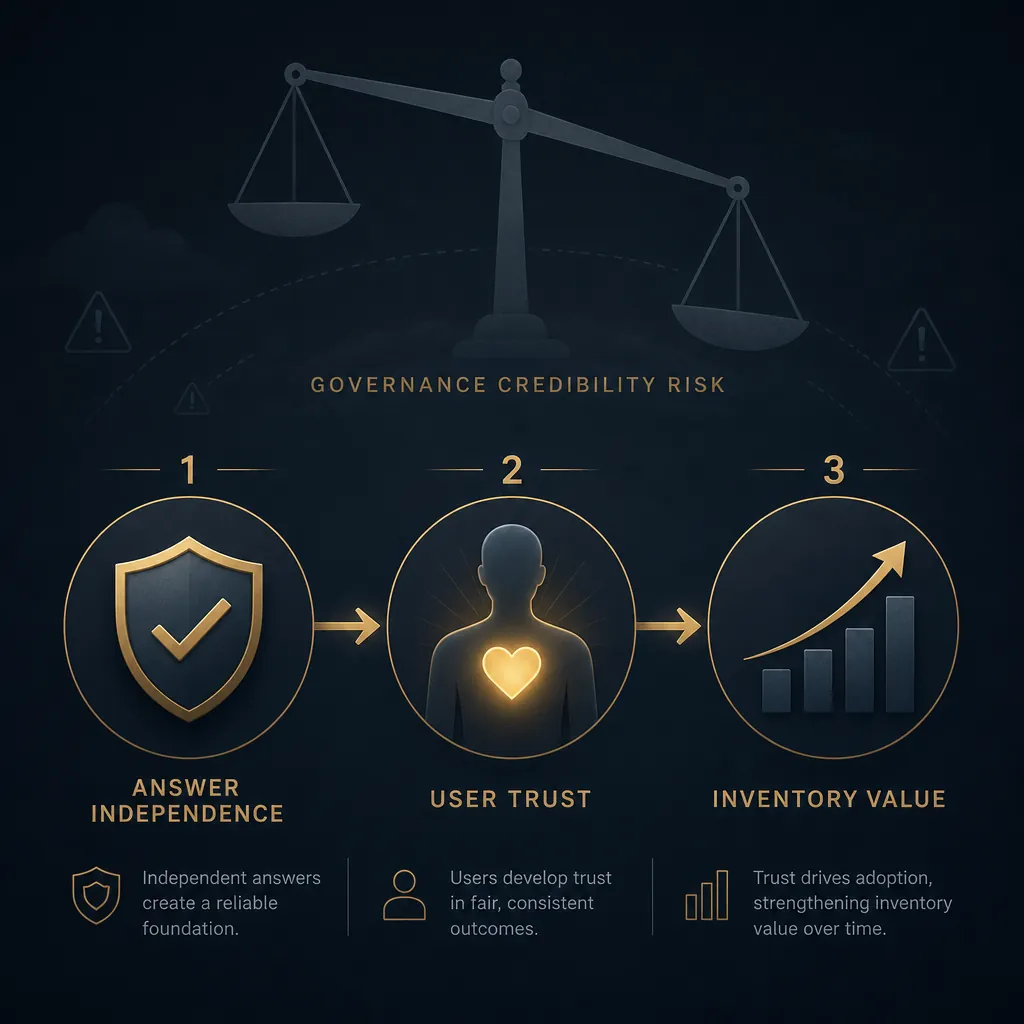
Why CEO Trust Reaches the Media Plan
There is a clean chain here, and it is worth keeping it clean. Answer independence creates user trust. User trust creates repeat use. Repeat use creates inventory value. Governance credibility affects whether advertisers can believe the first link in that chain will hold when the revenue target gets harder to hit.
This is where the usual dismissal of “CEO vibes” misses the point. A buyer is not pricing personality. She is pricing unverifiable platform behavior. If a platform can show clear labeling, strong separation, stable policies, independent audits, usable reporting, and consistent enforcement, the CEO’s reputation matters less. If the product is early, reporting is thin, controls are still forming, and the trust promise depends heavily on management assurances, the CEO’s documented pattern matters more.
Fast Company framed ChatGPT’s ad test as a test of trust in 2026, which is the right category for the issue.[5] The inventory is not just a new unit inside a large consumer platform. It is an attempt to monetize a relationship in which users often treat the answer box as an assistant, tutor, analyst, or recommender. That relationship can produce powerful intent data. It can also make mistakes feel more intimate and manipulation feel more serious.
The revenue context raises the stakes without proving bad conduct. Business Insider reported in January 2026 that Altman had previously called ads a “last resort,” making the ad pivot a documented change in posture.[6] Ars Technica reported the same month that OpenAI was burning through billions, with ad revenue discussed against that financial backdrop.[7] Companies are allowed to change business models. They are also allowed to pursue revenue. But buyers should not pretend revenue pressure is irrelevant to a product whose central promise is that commercial incentives will stay visibly fenced off from answers.
The Performance Marketer’s Objection Is Fair
A performance marketer can reasonably say that ad platforms earn budget through reach, targeting, incrementality, conversion quality, and price. If ChatGPT Ads delivers efficient outcomes, why should a media buyer spend time on boardroom history?
The answer is that the boardroom history does not replace performance analysis. It changes the confidence interval around it. Early campaign metrics can look promising before a marketplace has enough scale, enough adverse cases, enough policy stress, or enough user awareness to reveal the real shape of the risk. That is especially true when the alpha itself is small. A test reaching about 5% of mobile users tells a buyer something about delivery constraints, not enough about scaled user reaction.[1]
There is also a difference between adoption and effectiveness. ChatGPT has cultural reach, but that does not mean a specific ad product has proven advertiser outcomes. Alpha participation can show curiosity. It can show fear of missing out. It can show a desire to learn before competitors do. It does not, by itself, show that the channel can absorb committed budgets efficiently or preserve answer trust as monetization expands.
The strongest case for testing is still real. Conversational context could help brands appear closer to the moment of decision. Some categories may find useful demand signals earlier in the journey than search captures. Buyers who wait for every uncertainty to disappear usually arrive after prices have adjusted. But that argument supports disciplined testing, not oversized commitments built on the assumption that OpenAI’s trust problem is just another brand safety line item.
How to Price the Risk Without Overreacting
The practical move is not to declare ChatGPT Ads unbuyable. That would overstate what the evidence can support. The platform is early, the alpha constraints may change, and OpenAI may build better controls than skeptics expect. The practical move is to stop treating the test like a normal emerging-channel allocation.
- Cap commitments until the platform can show reliable pacing beyond alpha scarcity, especially if minimums are still in the $200,000 to $250,000 range reported by CNBC.[1]
- Ask for explicit documentation of how ads are separated from organic answers, not just category-level brand safety assurances.
- Require reporting that distinguishes ad exposure, answer context, user action, and downstream conversion instead of accepting blended performance narratives.
- Treat sensitive-topic classification as an unresolved operational risk, because policy exclusions depend on classification that outside researchers have questioned at scale.[3]
- Write internal test briefs that name governance credibility as a risk factor, so the client or finance team does not mistake early participation for a low-risk endorsement.
The IO should reflect the uncertainty. Smaller commitments, shorter learning windows, clearer exit rights, and more specific reporting requirements are not signs that a buyer lacks imagination. They are the normal controls for a product whose most valuable asset is trust and whose trust claims sit inside a company with a documented credibility controversy.
There is a procurement lesson here that experimental-channel decks rarely say plainly. First-mover advantage belongs to the advertiser who learns early without becoming the platform’s liquidity solution. If the product cannot spend, cannot report clearly, or cannot explain how commercial incentives are kept out of answers, the buyer should not carry that ambiguity for the sake of being early.
The Trust Condition Behind the Buy
ChatGPT Ads may become a meaningful channel. It may also take longer than the early excitement suggests. The current facts point to a platform with promising intent signals, constrained alpha delivery, ambitious trust language, unresolved classification risk, and a CEO credibility record that makes answer-independence assurances harder to underwrite.
That last factor is not a moral footnote. It is a media-buying variable. Advertisers are being asked to enter a marketplace where the product’s value depends on users believing that answers are not for sale. Until OpenAI can prove that separation through product design, reporting, governance, and scaled performance, buyers should price the trust tax into every ChatGPT Ads commitment.
References
- ChatGPT ads testing, OpenAI, CNBC, March 20, 2026, link
- Our approach to advertising and expanding access, OpenAI, January 2026, link
- OpenAI's New Business Model: Trading Human Rights for Ad Dollars?, NYU Stern Business and Human Rights Center, link
- Sam Altman May Control Our Future. Can He Be Trusted?, The New Yorker, April 13, 2026, link
- ChatGPT's ad test is really a test of trust, Fast Company, 2026, link
- ChatGPT ads OpenAI 2026, Business Insider, January 2026, link
- OpenAI to test ads in ChatGPT as it burns through billions, Ars Technica, January 2026, link
Built on this evidence
No Bidding tactic or Creative record currently cites this case file. Compare it against other results in Benchmarks.
Related benchmark reading
Report a corroborating or contradicting result
Seeing something different in your own account? Feed the data-integrity loop instead of leaving an open comment.