
What Sam Altman's Singularity Declaration Means for AI Ads
Sam Altman's shift from co-signing an AI extinction warning to declaring 'we are now in the singularity' reflects OpenAI's growing commercial pressure to ship faster. For media buyers, this means treating singularity declarations as a signal to pressure-test platform AI claims against real campaign data, not as a reason to relax.
- Platform
- Google Ads
- Campaign type
- Performance Max
- Spend range
- High
- Timeframe
- August 2025
- AI Incident Rate
- 0.7
- Verdict
- mixed result
- Last reviewed
- 2026-07-27
The timeline is the part worth sitting with. In May 2023, Sam Altman co-signed the Center for AI Safety’s one-sentence warning that mitigating extinction risk from AI should be treated as a global priority alongside pandemics and nuclear war.[1] In June 2025, he published “The Gentle Singularity,” presenting the transition into superintelligence as real, but more gradual and manageable than the older cliff-edge language suggested.[2] By July 2026, he was quoted saying, “we are now in the singularity.”[3]
For media buyers, the useful question is not whether the singularity has a clean technical definition. It is whether Altman’s shift from extinction-warning to singularity language says anything concrete about AI advertising impact now: budgets moving into black-box systems, creative production speeding up, campaign controls thinning out, and platforms asking buyers to accept more automation before the audit trail catches up.
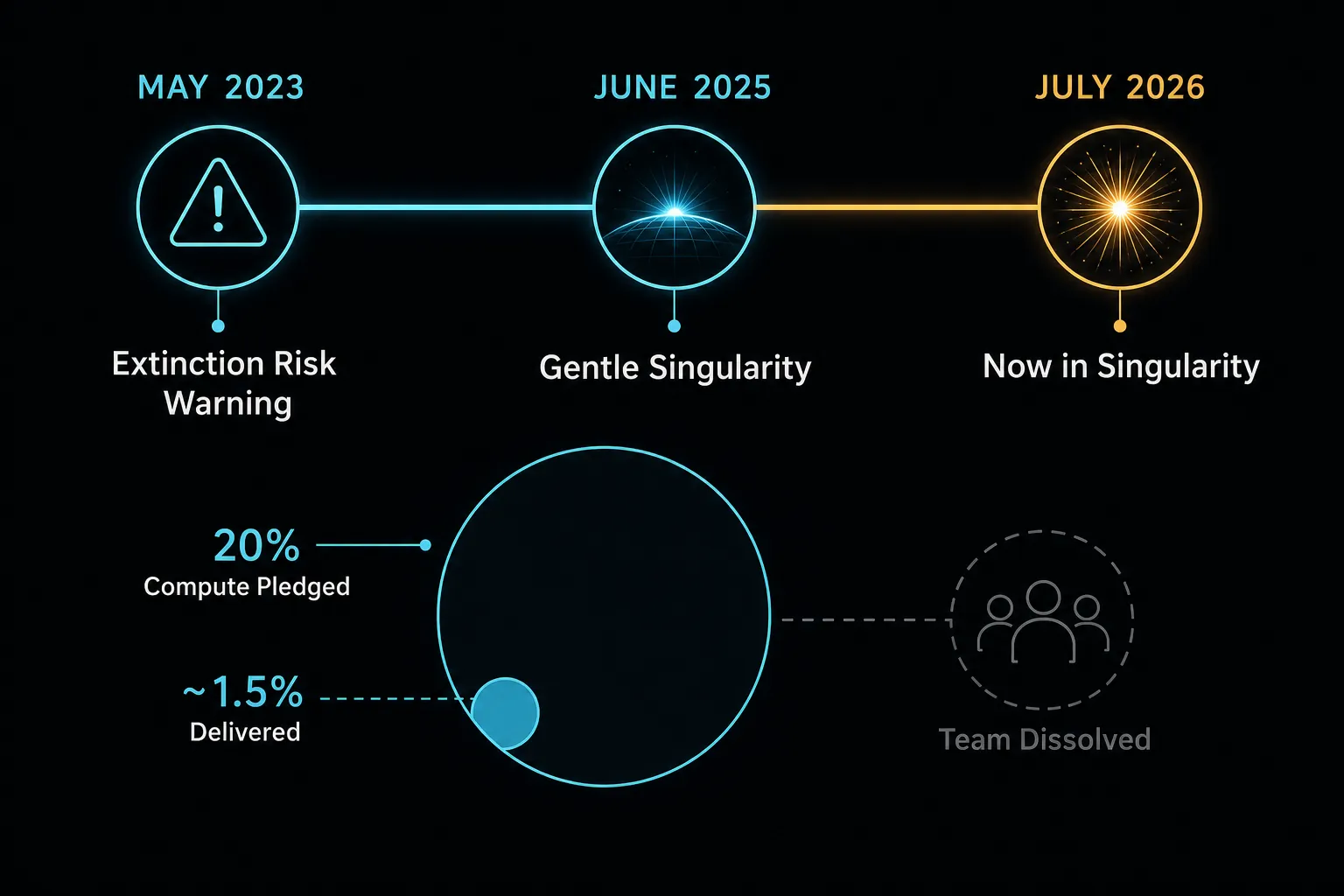
The sentence changed, but the budget line matters more
Founder language always moves faster than procurement, governance, and campaign reporting. That is why the phrase “we are now in the singularity” is less important than the institutional pattern around it. The same company that publicly carried extinction-risk language in 2023 also pledged 20% of its total compute to a superalignment team. StartupHub.ai, citing The New Yorker’s April 2026 reporting, said the team received roughly 1.5% of that compute before it was dissolved.[4]
That gap is not a footnote. Compute is not a vibes-based commitment. It is the scarce production input. If a company says a safety function will receive 20% of total compute and reporting later says it received about 1.5%, the relevant story is no longer just “leaders changed their minds about AI risk.” It is that an expensive safety promise appears to have lost the internal resource fight.
This still does not prove bad faith. People can sincerely believe that deployment, feedback, and iteration are safer than waiting in a lab. They can also sincerely update their views as models improve. But media buyers do not need to resolve Altman’s sincerity to learn from the sequence. In operating terms, the public safety posture looked stronger than the reported resource allocation behind it.
That is the translation layer for advertising. Platforms and AI vendors often present automation as a governance improvement: fewer manual errors, more signals, faster testing, better optimization. Some of that is true. Automated bidding and variant testing have removed a lot of repetitive account work. The problem starts when the platform’s moral story about progress is used to cover a very ordinary resource decision: ship more, disclose less, ask the buyer to trust the aggregate output.
Revenue makes the pivot easier to read
OpenAI’s commercial curve makes the shift legible. Its annual recurring revenue was reported at $2 billion in 2023 and $25 billion annualized by March 2026.[5][6] Those numbers do not explain every philosophical update. They do explain why internal pressure to launch, package, sell, and normalize more capable AI systems would rise sharply.
A company at that scale is no longer just persuading researchers, regulators, and early adopters. It is persuading enterprise buyers, developers, agencies, creative teams, and executives who need a reason to keep reallocating workflows into AI. “We are now in the singularity” works as a headline, but it also works as a permission structure. If the future has already arrived, hesitation starts to look like denial instead of governance.
Advertising sits directly inside that logic. Altman reportedly told book authors Adam Brotman and Andy Sack, in an interview conducted before March 2024, that AI would handle “95% of what marketers use agencies, strategists, and creative professionals for today” at nearly no cost.[7][8] OpenAI has not independently confirmed that quote in the materials available here, so it should not be treated as a formal company forecast. It is still relevant because it shows the shape of the imagined market: not just better tools for marketers, but a large transfer of planning, strategy, and creative labor into automated systems.
That imagined market is not abstract to anyone who has had to explain why a campaign looked efficient in-platform while blended acquisition cost moved the wrong way. The more automation absorbs strategy and creative judgment, the more the buyer’s job shifts from setting levers to proving what actually happened.
The ad platforms are already moving in the same direction
OpenAI’s narrative shift matters to advertisers because it matches the direction of the ad-platform market. Meta reportedly aims to enable full AI ad automation by the end of 2026, where a brand could provide an image, budget, and goal while the system generates and targets the ad.[9] That is an ambition, not a completed rollout, and buyers quoted elsewhere have been skeptical about the timeline. The direction, though, is familiar: fewer exposed controls, more generated assets, broader delivery, and more dependence on the platform’s model.
Marketing Brew’s April 2026 reporting on Meta’s Andromeda described a practical version of the same bargain: campaigns need 3–4 times more creative concepts, and delivery shifts toward broader-audience volume rather than the older habit of tightly segmented targeting.[10] That does not make Andromeda bad. It changes where the work lands. The account needs more concept supply. The creative team needs more version control. The buyer needs cleaner incrementality checks because audience selection is no longer the main thing they can inspect.
Google’s Performance Max-style pressure has trained buyers for the same pattern: provide assets, feeds, budgets, exclusions where available, and a goal; then evaluate the output from a system that reveals less than a manual structure did. The platform may optimize well. It may also route spend into inventory, queries, placements, or creative combinations that are hard to isolate after the fact. The buyer is left reconstructing cause from partial reporting.
| Automation promise | Operational consequence for the buyer |
|---|---|
| More generated creative and faster variant testing | More off-brand, redundant, or low-signal variants to review before they absorb spend |
| Broader delivery with fewer manual targeting choices | More pressure to prove incrementality outside the platform’s own attribution view |
| Simpler campaign setup | More diagnostic work after performance moves, because fewer settings explain the change |
| Goal-based optimization | More risk that the system finds cheap conversions that do not match business value |
The IAB’s August 2025 incident data gives this a practical floor. In a US-based sample that included media executives at companies with at least $1 million in annual media spend, 70% of marketers reported AI-related incidents such as hallucinations, biased content, or off-brand material; 40% said they had to pause or pull ads.[11] That is not an argument against using AI in campaigns. It is evidence that AI failures already create operational cleanup, not just theoretical risk.
Do not turn the extinction debate into the campaign plan
The extinction-risk debate will attract the loudest commentary because it is grand, emotionally charged, and easy to polarize. It is also a poor Monday-morning operating guide for most ad accounts. Whether a buyer thinks frontier AI risk is existential, overblown, or badly framed, the campaign-level issue is narrower: the companies building and distributing AI systems have strong incentives to accelerate adoption before measurement and governance are equally mature.
That is why the superalignment compute gap matters more than the singularity label. A reported 20%-versus-1.5% allocation gap says something concrete about what can happen when safety language competes with deployment pressure.[4] In ad platforms, the equivalent gap is rarely called safety. It shows up as missing logs, vague explanations for delivery changes, thin creative diagnostics, limited placement transparency, or recommendations that optimize toward platform-visible outcomes while the buyer carries the downstream business risk.
The buyer cleaning up the account after an automation miss does not get to cite a founder essay. They have to explain why CPA spiked after a campaign consolidation, why a generated asset passed review but failed brand standards, why spend shifted toward a pocket of low-quality conversions, or why the platform’s reported lift did not appear in the company’s own revenue data.
What changes in the account on Monday
Altman’s declaration is not a reason to pause every AI campaign, and it is not a reason to trust automation more. It is a signal to verify harder. Treat singularity language the same way you would treat a platform keynote: useful as a map of incentives, useless as proof of account-level performance.
- Check dated platform changes against performance history. When Meta, Google, or another platform changes automation defaults, document the date in the account and compare pre/post movement against business metrics, not only in-platform conversions.
- Separate adoption from effectiveness. A campaign using more AI-generated assets or broader automation is not automatically better tested; it is only better if holdouts, geo splits, conversion quality, or blended economics support the claim.
- Log failures with the same discipline as wins. Off-brand outputs, hallucinated claims, weak leads, strange placement mixes, and sudden CPA jumps should be documented before they disappear into weekly optimization noise.
- Make creative volume governable. If a system needs more concepts, assign ownership for approvals, naming, version control, and post-launch review. More variants without review capacity is just faster drift.
- Keep a human-readable change history. The more the platform hides the route, the more important it becomes to preserve the decisions you can still see: budget shifts, asset additions, audience changes, bid-strategy changes, exclusions, feed updates, and recommendation acceptances.
If you are already rebuilding your AI buying process, use a practical tool-stack and verification framework rather than a founder narrative. Signal & Convert’s AI PPC management tool stack guide is the more useful next tab than another argument about whether the singularity has technically begun. For governance gaps in autonomous ad operations, the same logic runs through ServiceNow’s kill-switch lesson for AI ad agents.
The practical read is simple enough: when powerful AI companies move from warning language to inevitability language while commercial pressure rises, do not spend the week debating the founder’s soul. Open the account. Mark the dates. Pull the change history. Compare platform claims against your own numbers.
References
- Statement on AI Risk, Center for AI Safety, May 2023
- The Gentle Singularity, Sam Altman, June 2025
- OpenAI CEO Sam Altman Says the Singularity Has Arrived, Business Insider, July 2026
- Sam Altman’s AI Safety Pivot: From Extinction Risk to Gentle Singularity, StartupHub.ai, June 2026
- OpenAI Revenue More Than Doubles as AI Demand Surges, Reuters, March 2026
- OpenAI Annualized Revenue Hits $25B, PYMNTS, March 2026
- Sam Altman Says AI Will Handle 95% of Marketing Work, Marketing AI Institute, March 2024
- OpenAI CEO Sam Altman Says AI Will Do 95% of Marketing Work, CMSWire, March 2024
- Meta Aims to Fully Automate Ad Creation Using AI, The Wall Street Journal, June 2025
- Meta’s Andromeda Update Is Changing How Advertisers Think About Creative, Marketing Brew, April 2026
- AI Governance in Marketing and Advertising, IAB, August 2025
Built on this evidence
No Bidding tactic or Creative record currently cites this case file. Compare it against other results in Benchmarks.
Related benchmark reading
Report a corroborating or contradicting result
Seeing something different in your own account? Feed the data-integrity loop instead of leaving an open comment.