
What Sam Altman's Gentle Singularity Means for Advertisers in 2026
Sam Altman's 'gentle singularity' essay describes a future of abundant, near-free intelligence, but the ChatGPT ad platform launched in 2026 delivers $3–$5 CPC and a 0.91% advertiser-reported CTR. This article examines the structural gap between the strategic narrative and the operational reality to help media buyers decide whether to test ChatGPT ads this year.
- Platform
- ChatGPT Ads
- Campaign type
- ChatGPT Ads
- Spend range
- $200/day default cap
- Timeframe
- May-July 2026
- CTR
- 0.91%
- Verdict
- mixed
- Last reviewed
- 2026-07-27
Sam Altman’s “gentle singularity” is useful for advertisers in 2026, but not because it tells anyone to move budget into ChatGPT ads. It is useful because it shows how far OpenAI’s strategic story has run ahead of the buying surface. In the essay, Altman describes AI progress that feels gradual from day to day while still compounding into systems that generate “novel insights” in 2026, robots doing real-world work in 2027, and intelligence in the 2030s costing roughly as little as electricity.[1] That is the CEO-level frame. The media-buying surface, as of late July 2026, is a young self-serve ad product that launched May 5, commonly shows $3–$5 CPC guidance, uses a $200/day default cap, and has no minimum spend.[2][3]
That gap matters because Altman’s gentle singularity frame can too easily become a budget sentence before it becomes a platform question. The cleaner 2026 question is not whether abundant intelligence will change advertising eventually. It is whether the current ChatGPT ad product deserves money this quarter. On the closest public field signal available, advertiser-reported ChatGPT ad CTR was 0.91%, compared with a cited 6.4% Google Search benchmark.[4] That 0.91% should not be treated as an official OpenAI benchmark; OpenAI has not published cross-advertiser performance figures.[4] But it is useful enough to change how a test should be framed.

The essay is strategy; the ad product is inventory
Altman’s essay deserves to be read closely because it is not a random AI futurist post. It is the CEO of OpenAI describing how he wants people to understand the next leg of AI development. The “gentle” part is not modesty; it is pacing. His argument is that the world can pass through enormous capability gains while most people experience the change as a series of manageable product improvements, workflow shifts, and cost declines.[1]
For advertising, that framing has a real implication: OpenAI is positioning itself as infrastructure, not a novelty app. If intelligence becomes cheap and embedded, then search, discovery, product research, creative production, and customer support all become contestable surfaces. That is a serious strategic claim. It is just not the same thing as evidence that a May 2026 ad unit should be funded like mature search inventory.
OpenAI’s own advertising page presents ads as part of expanding access, with emphasis on usefulness, relevance, and a user experience that does not break the product.[5] That positioning is important because it shows what the company is willing to say publicly about the ad model. It also explains why the ad product is likely to feel constrained: OpenAI has every reason to avoid turning ChatGPT into a cluttered results page too quickly.
| CEO narrative | Buying-surface reality in July 2026 |
|---|---|
| AI systems become capable of producing novel insights in 2026.[1] | Self-serve ChatGPT ads are live, but still operate with early-platform controls, CPC guidance around $3–$5, and a $200/day default cap.[2][3] |
| Robots begin doing real-world tasks in 2027.[1] | Advertisers are still waiting on confirmed live audience matching and broader targeting depth in Ads Manager. |
| By the 2030s, the cost of intelligence converges toward the cost of electricity.[1] | The paid media decision today is still auction-priced attention, with limited evidence about cross-advertiser performance. |
A buyer can believe the left column and still keep the right column on a short leash. The mistake is collapsing them into one investment thesis: OpenAI will matter, therefore ChatGPT ads are the next search budget. That may become true in some future version of the platform. It is not established by the current product.
The 0.91% CTR is not just a weak creative read
The most important operating number in the current conversation is the advertiser-reported 0.91% CTR. It is not definitive, and it should not be presented as if OpenAI published it as a platform-wide benchmark. But even as a directional signal, it lines up with the interface problem: conversational environments do not create the same click behavior as search result pages.[4]
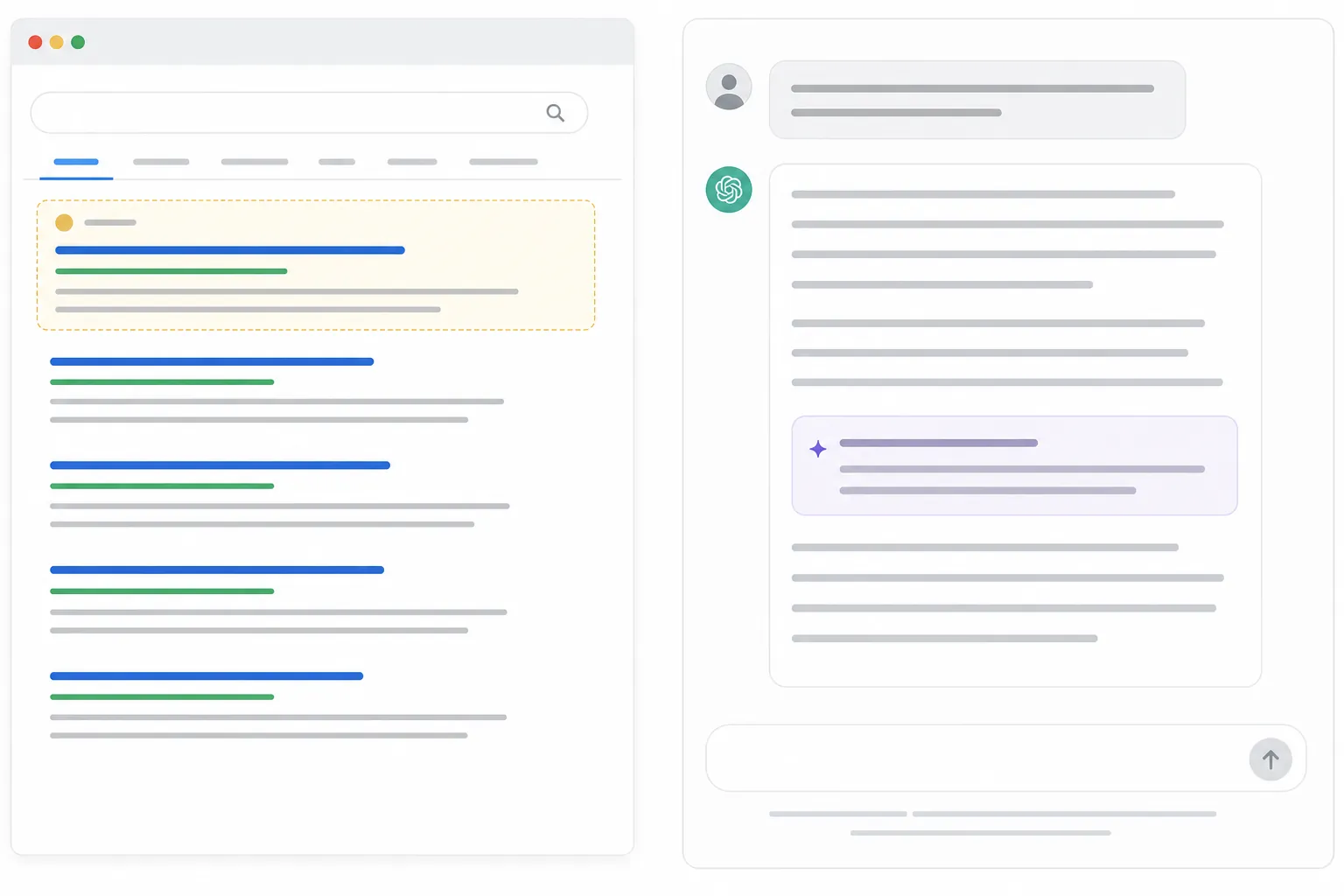
Search ads sit inside a page built for choosing. A user enters a query, scans a stack of options, compares links, and clicks out. The ad has to compete, but the whole environment is designed around outbound selection. ChatGPT is different. The user asks, waits, reads, refines, and often continues the task inside the conversation. A sponsored suggestion in that flow can shape consideration without producing a click. That does not make the impression worthless, but it does make CTR a blunt instrument.
This is where performance teams can burn time chasing the wrong fix. If a conversational ad surface naturally suppresses click-through behavior, then changing the headline, increasing the bid, or adding another $200/day test cell may not make the report look like search. Some creative will perform better than other creative, obviously. But the click ceiling is partly set by the job the interface is doing.
That also changes the measurement brief. A low-click surface can still influence later branded search, direct visits, assisted conversions, sales conversations, or product comparison behavior. Standard analytics will miss some of that because they are built to reward the visible click path. For teams that do test, the companion problem is covered in more detail here: how to measure ChatGPT ads when standard analytics miss results.
The wrong conclusion from 0.91% is “ChatGPT ads do not work.” The better conclusion is more annoying and more useful: if they work, they may work in a way that is harder to prove with normal click-led reporting, while still charging CPCs that make the test feel like performance media rather than cheap brand inventory.
$3–$5 CPC is not experimental money if the learning is vague
The launch terms are friendly enough to get a cautious buyer in the door: no minimum spend, a default $200/day cap, and CPC guidance around $3–$5.[2][3] That is not enterprise-contract friction. A small team can run a contained test without turning it into a procurement event.
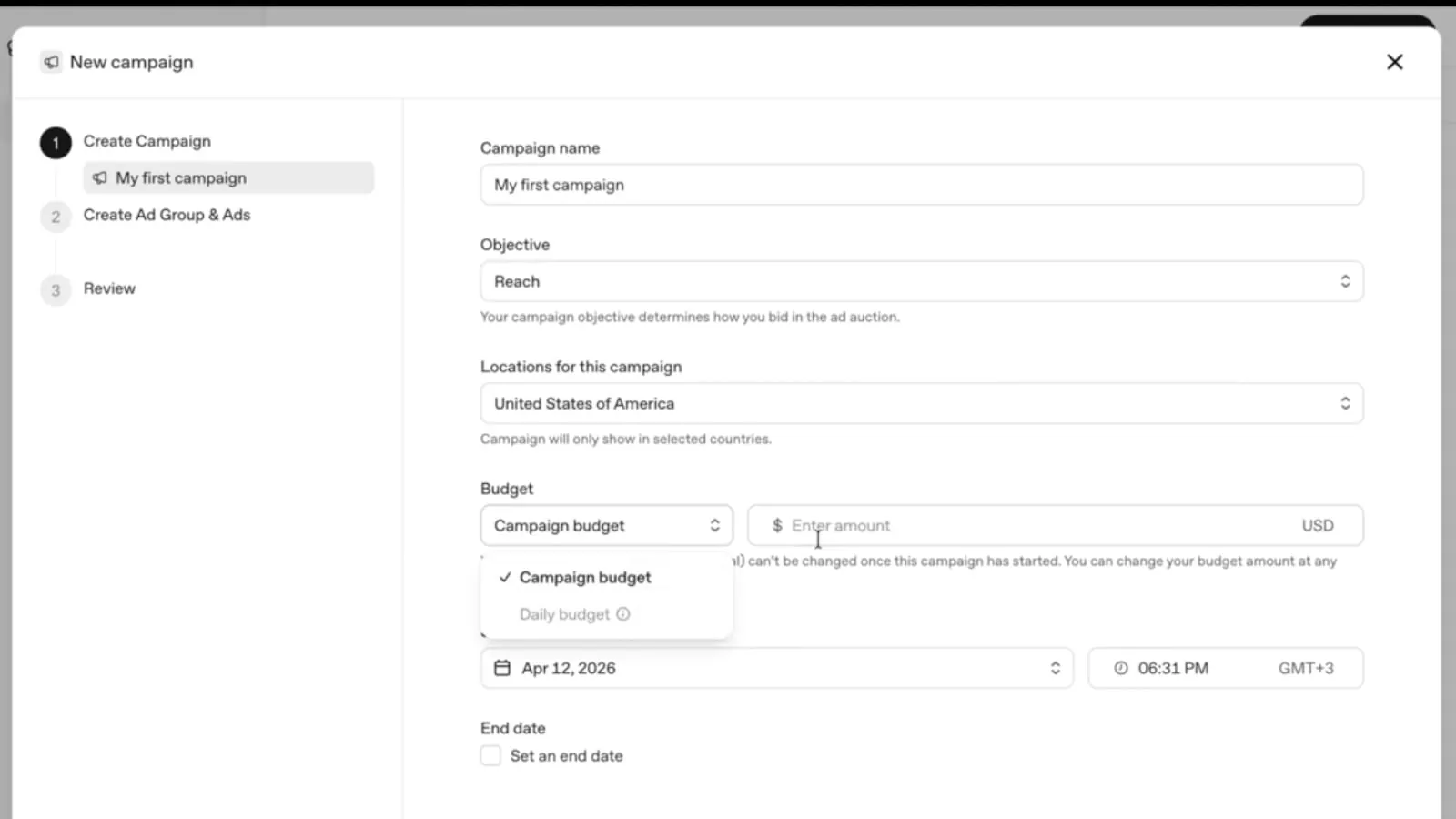
But a low minimum does not make the inventory low-risk by default. At $3–$5 CPC, a $200/day test can produce a thin click sample quickly if CTR is low. The dashboard may spend enough to make the test feel real while still producing too little downstream conversion data to support a confident call. That is the exact zone where founders and CMOs start asking for “directional learning,” and the media buyer has to decide what kind of learning is actually available.
For now, the cleanest learning objective is not “Can ChatGPT ads beat Google Search?” The interface, intent capture, reporting maturity, and click behavior are too different. A better Q3–Q4 2026 test asks narrower questions:
- Which prompts or conversation contexts trigger impressions for our category?
- Do users who are exposed later show movement in branded search, direct traffic, qualified pipeline, or account-level engagement?
- Does the platform produce any click quality that justifies CPCs in the $3–$5 range?
- Can we separate incremental learning from novelty spend?
Those questions are less glamorous than “the next search,” but they are closer to what the product can answer right now.
Targeting is still catching up to the pitch
Targeting is where the platform’s youth becomes hard to ignore. US geo-targeting only arrived in July 2026, according to buyer guides tracking the rollout.[3] Audience matching and AI creative tools appear in OpenAI’s June 17, 2026 Ad Tools Terms, but the research boundary here is narrower: those capabilities are policy-announced, not confirmed live in Ads Manager as of late July 2026.[6]
That distinction is not legal trivia. A capability named in terms does not help a media buyer build a campaign if the control is not available in the interface. “Coming,” “covered by policy,” and “confirmed live” belong in different columns of the planning sheet. If a forecast assumes audience matching, but the test can only run against broader conversational context and limited targeting controls, the forecast is not conservative; it is built on a feature state that does not exist yet.
This is especially important because ChatGPT’s promise sounds like targeting by intent at massive scale. A conversation can contain richer context than a keyword. In theory, that is attractive. In the current operating surface, though, advertisers do not yet have the same mature levers they are used to in Google, Meta, or LinkedIn. The data richness may exist inside the product experience without being exposed as usable buying control.
The data-use clause belongs in the budget conversation
The Ad Tools Terms also create a governance question that should not be buried under platform excitement. The Access Purpose clause allows OpenAI to use uploaded advertiser data for product improvement, a broader use than ad-delivery-only scoping commonly associated with mature ad platforms.[6] For some advertisers, that may be acceptable. For others, especially those uploading customer files, account lists, product feeds, or commercially sensitive conversion data, it needs a deliberate review before launch.
The practical workflow is simple: legal, data governance, and the paid media owner should agree on what can be uploaded, what cannot, and whether the current clause fits the company’s risk posture. That review may feel slow for a $200/day test, but the spend level is not the only risk variable. The data sent to the platform can matter more than the media dollars spent there.
AI ad platforms are asking for trust before they have the same long operating history as the incumbent ad systems. That does not make them unusable. It does mean transparency becomes part of the product, not a footnote. The same issue shows up in other AI platform markets; the broader trust lesson is discussed in Waymo’s transparency premium and AI ad platforms.
The advertising pivot explains the narrative gap
OpenAI’s move into advertising was not framed this way two years ago. Digiday reported the shift from Altman calling ads “uniquely unsettling” in a May 2024 Harvard appearance to OpenAI hiring advertising leadership in 2025 and launching ads in 2026.[7] That timeline is not hypocrisy by itself. Companies with large compute bills and mass-market products often discover that advertising is one of the few business models big enough to subsidize access at scale.
But the pivot does explain why the language can feel uneven. The strategic story is still about abundant intelligence and expanding access. The ad product has to do the less romantic work: pricing inventory, defining acceptable data use, exposing targeting controls, reporting performance, and protecting the user experience from feeling bought. Those jobs mature at platform speed, not essay speed.
That is why the current product can be both strategically important and operationally awkward. OpenAI probably does not need ChatGPT ads to look like Google Search on day one. Advertisers, however, need to know when they are paying for early access to a future market versus buying a channel that can clear normal performance hurdles today.
How to treat ChatGPT ads in a 2026 media plan
The useful implication of the gentle singularity frame is not “increase budget.” It is “watch the surface closely.” If OpenAI is right about intelligence becoming cheaper, more capable, and more embedded, then conversational discovery will matter. Brands should want to understand how they appear inside AI-mediated consideration. That is a learning agenda, not a blank check.
A responsible 2026 test should be constrained. Set a budget that can be lost without raiding proven channels. Define what evidence would justify continuation before the campaign starts. Keep click-through expectations lower than search. Track assisted signals outside last-click analytics. Do not assume audience matching, AI creative tooling, or expanded targeting is live until the control appears in the actual Ads Manager account.
The test also needs an internal translation layer. When leadership asks whether ChatGPT ads are “the next search,” the answer should separate three claims: OpenAI may become a major discovery layer; ChatGPT ads may become valuable inventory; the July 2026 product has not yet proven that it deserves search-like budget treatment. Those are not the same claim, and they should not share the same line item.
So yes, Sam Altman’s gentle singularity has advertising implications. It says the environment around advertising may be changing in a serious way. It does not say that a low-click, early-stage conversational ad surface with limited confirmed targeting should be funded on the strength of the story. In 2026, ChatGPT ads are testable. They are not yet proven. Fund them as a constrained learning bet, not as a proxy for believing in the singularity.
References
- The Gentle Singularity, Sam Altman, June 10, 2025.
- ChatGPT Ads 2026 Guide, Digital Applied, 2026.
- ChatGPT Ads Guide, Optimum7, 2026.
- ChatGPT Ads Report 0.91% CTR, But Advertisers Question Performance, Search Engine Journal, 2026.
- Our approach to advertising and expanding access, OpenAI, 2026.
- Ad Tools Terms, OpenAI, June 17, 2026.
- From hatred to hiring: OpenAI’s advertising change of heart, Digiday, 2026.
Built on this evidence
No Bidding tactic or Creative record currently cites this case file. Compare it against other results in Benchmarks.
Related benchmark reading
Report a corroborating or contradicting result
Seeing something different in your own account? Feed the data-integrity loop instead of leaving an open comment.