
The $32B AI Ad Spend Bubble Is Mostly a Relabel
The headline $32B in US AI ad spend for 2026 masks an uncomfortable truth: more than 80% of that money is existing search budgets being relabeled, not new value creation. This article breaks down the numbers and shows which ad dollars are most vulnerable when the AI investment bubble corrects.
- Platform
- Google Ads
- Campaign type
- Search
- Spend range
- High (industry-wide)
- Timeframe
- 0
- CTR
- 0%
- Verdict
- mixed
- Last reviewed
- 0-07-29
The cleanest way to understand the AI-bubble impact on digital ad spend is to start with the number that will make it into budget decks: US AI ad spending is projected to reach $32.03 billion in 2026. That is a real forecast. It is also a bad shortcut if it gets treated as proof that advertisers have found a new $32 billion AI-native media channel.
The composition matters more than the label. In eMarketer’s forecast, reported by Forbes, more than 80% of that 2026 AI ad spend is search-adjacent: traditional paid search listings appearing alongside AI Overviews, rather than ads inside AI-native environments such as ChatGPT Ads.[1] That means the headline number is mostly a classification event sitting on top of an existing auction, not a clean read on incremental demand.
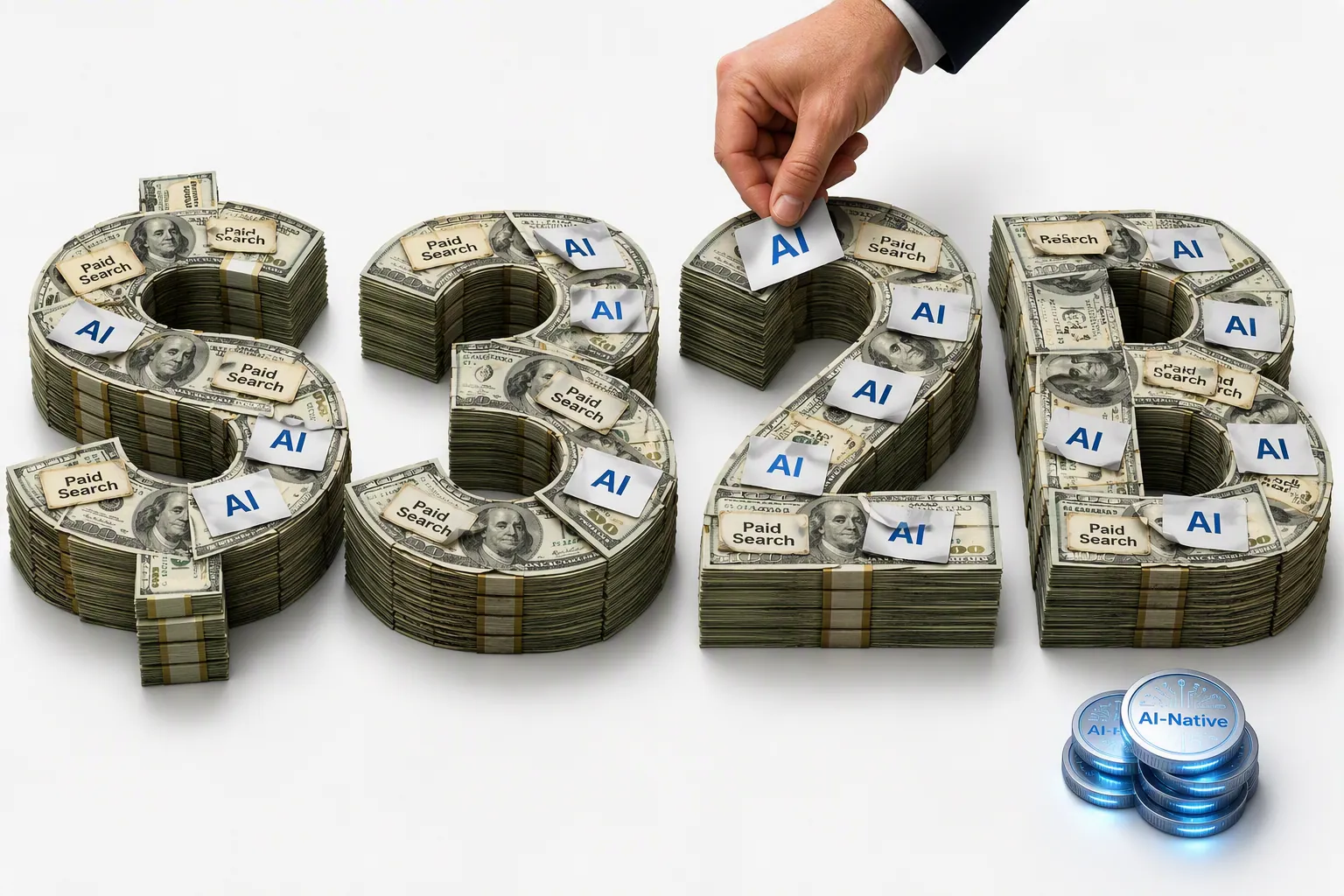
That distinction is not semantic. If a paid-search budget was already buying commercial intent on Google, and that same budget is now counted as AI ad spend because AI Overviews sit near the placement, the budget did not become less defensible overnight. But it also did not become a new growth engine. The AI label changes the reporting category before it proves a new performance curve.
What the $32.03 Billion Actually Contains
A useful budget question is not “Is AI ad spend growing?” It clearly is, at least by the forecasted category definition. The useful question is “Which line item would finance recognize if the AI label disappeared?” For most of the 2026 number, the answer appears to be paid search.
The eMarketer/Forbes split puts the bulk of the dollars into ads that run through familiar paid-search mechanics. They are attached to search behavior, search auctions, and search teams. They are “AI” because of the surrounding interface and the analyst classification, not because the advertiser has necessarily moved budget into a new AI-native ad product.[1]
| Spend Type | What It Means For Budget Review |
|---|---|
| Search-adjacent AI ad spend | Existing paid-search spend counted as AI-related when ads appear near or within AI-influenced search experiences, including AI Overviews. |
| AI-native ad spend | Newer inventory where the ad experience is native to an AI assistant or AI-first environment, such as ChatGPT-style placements. |
| Incremental AI-driven spend | Dollars that can be defended because they produced new reach, new intent capture, or measurable incremental performance rather than a reporting-category change. |
This is where the forecast becomes fragile. A media buyer can defend a paid-search budget on conversion volume, marginal CPA, query coverage, and incrementality tests. Those are ordinary arguments. What is harder to defend is a second story layered on top: that the same dollars should now be valued as exposure to a new AI advertising market.
The forecast does not become meaningless because of that. Search experiences are changing. AI Overviews can alter screen real estate, click behavior, and the competitive context around paid placements. But the numbers support a narrower conclusion: much of the 2026 “AI ad spend” pool is search money being counted under an AI umbrella, not proof that advertisers have shifted tens of billions into new AI-native media.
The Relabel Does Not Fade Quickly
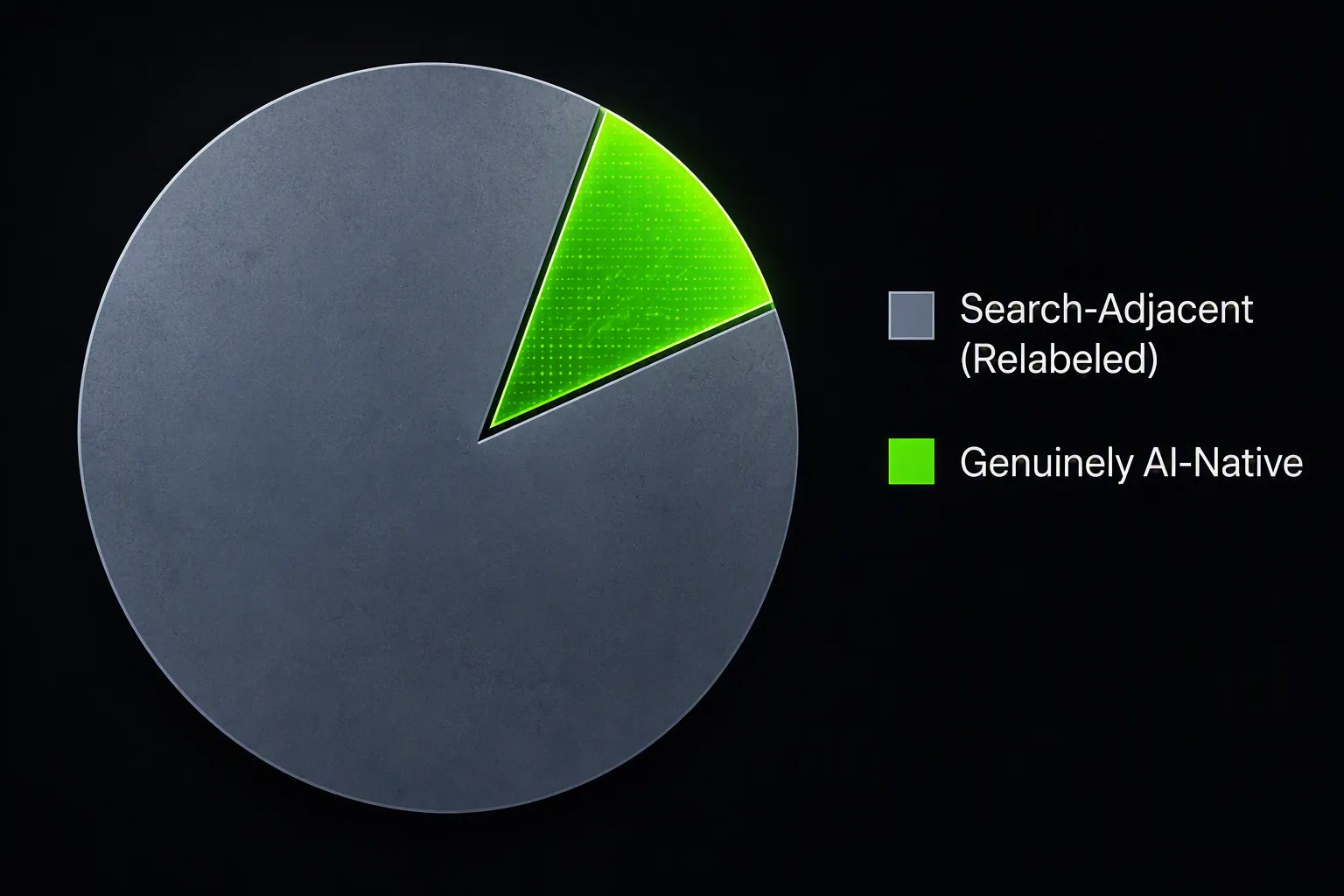
The most important detail in the forecast may be the 2030 mix. Even by 2030, eMarketer expects search-adjacent formats to represent 58.6% of all US AI ad dollars.[1] In other words, the category is not forecast to become mostly AI-native after a short transition period. Search-adjacent spend remains the majority share years into the forecast.
That makes the 2026 headline look less like the early innings of a brand-new channel and more like the paid-search category expanding its perimeter. It is still material for platforms. It is still material for search teams. It is just not the same as saying a new ad channel has already earned $32.03 billion of distinct budget.
For 2027 planning, this affects how a growth lead should talk to finance. If the same campaigns, auctions, and conversion paths are now reported as AI ad spend, the plan should say so. A budget line can be AI-influenced without being incremental. A placement can sit next to AI-generated content without creating a new media channel.
The risk is not that search-adjacent spend has no value. The risk is that a relabeled budget gets defended with the wrong evidence. If the dollars are search dollars, defend them with search evidence. If the dollars are AI-native dollars, defend them with AI-native evidence. Mixing the two lets a smaller emerging channel borrow the credibility of a much larger incumbent one.
ChatGPT Ads Are Real, But They Do Not Carry the Headline
The AI-native side of the market is not imaginary. ChatGPT Ads and similar formats matter because they could change how commercial intent is captured when users ask, refine, compare, and decide inside an assistant. That is a different environment from a search results page. It deserves its own measurement work.
It also deserves proportion. Digital Applied’s 2026 advertising statistics cite a roughly $500 million annualized ChatGPT Ads run rate in early 2026, with advertiser-reported CTRs as low as 0.91% compared with a 6.4% Google Search benchmark.[2] Those figures do not settle the product’s future; early ad formats are often uneven, and advertiser-reported data is not the same as a platform-published benchmark. But they do keep the market size in frame.
Digital Applied also projects AI-native search advertising at $3.2 billion in 2028, still less than 2% of total search ad spend.[2] That is a growth market, not the center of a $32.03 billion 2026 headline. The difference matters because the headline can make AI-native advertising sound far more budget-proven than it is.
A practical reading is simple: test AI-native placements as emerging inventory, not as a solved replacement for paid search. The early case for the channel is about learning curves, measurement, assistant-context relevance, and possible future intent capture. The current case for most reported AI ad dollars is still paid search.
That is why the ChatGPT Ads story should not be ignored, but it should not be allowed to backfill the entire category narrative. For more on the narrower ChatGPT Ads measurement issue, Signal & Convert’s coverage of ChatGPT Ads CTR and CPC data is the better frame than treating every AI-ad forecast as the same market.
Flat Budgets Make the Label More Tempting
The relabeling problem becomes more consequential when marketing budgets are not expanding fast enough to absorb every new executive priority. Gartner’s 2026 CMO Spend Survey is useful context here because it points to budget pressure and allocation tension around AI rather than a blank-check environment.[3]
In that setting, a category label can do real political work. “AI ad spend is growing” sounds like a company is funding a new strategic capability. “Paid search is being counted differently because the search interface changed” sounds like a reporting clarification. Both can describe the same dollars, but they will behave differently in a budget review.
The paid-search manager ends up with the awkward question: why is AI ad spend up if the search budget is flat? The honest answer may be that the campaign mix did not change much. The reporting perimeter did. That answer is less exciting, but it prevents the team from promising a new source of growth where the evidence only supports a familiar source of performance.
Where the Bubble Risk Enters the Media Plan
The macro AI bubble discussion matters after the spend anatomy is visible, not before. Yale Insights’ 2026 analysis frames the bubble risk around overbuilt AI infrastructure and correction dynamics.[4] Wired’s bubble coverage places AI inside a broader market narrative of exuberant capital expectations.[5] Oliver Wyman’s January 2026 analysis focuses on how an AI bubble burst could shake financial markets.[6]
Those are not media-mix models. They do not prove that a specific search campaign should be cut. What they do provide is the environment in which weakly defended AI-labeled budgets become exposed. When capital markets stop rewarding AI adjacency on its own, internal budget reviews usually get less patient with adjacency stories too.
The vulnerable dollars are not necessarily the dollars spent through AI-related interfaces. The vulnerable dollars are the ones whose AI identity depends more on platform or analyst labeling than on new performance evidence. If a campaign is still winning because it captures high-intent search demand at an acceptable marginal cost, it can survive without the AI wrapper. If it needs the AI wrapper to sound strategic, it is weaker than the headline implies.
That is the difference between budget durability and category momentum. Category momentum can make a forecast grow. Budget durability decides which dollars remain after the board asks what is incremental, what is experimental, and what was already in the plan under another name.
A Useful 2027 Budget Test
For 2027 planning, the test should be operational rather than philosophical. Take every dollar labeled AI ad spend and ask which one of these claims can be defended without category hype:
- It reaches inventory the brand could not previously buy.
- It captures intent that was not available through existing search or social placements.
- It improves incremental performance after accounting for cannibalization.
- It changes the customer journey enough to require a distinct measurement plan.
- It is mostly an existing campaign being reported under an AI-influenced category.
Only the first four arguments support a durable new budget story. The last one may still support spending, but it supports spending as search, not as a separate AI growth engine.
This is also where teams should separate platform roadmap conversations from budget justification. A platform may be right that AI will reshape discovery. An analyst may be right to create a category for AI-influenced ad formats. Neither point proves that this year’s search-adjacent dollars are incremental.
The most careful media plans will probably keep three lines separate: core paid search affected by AI interfaces, AI-native tests, and proven incremental AI-driven spend. That separation does not make the deck look as dramatic as one large AI number. It does make the budget easier to defend when the market stops rewarding anything with an AI label.
The Dollars Most Likely to Be Reclassified
If the AI investment bubble corrects, the likely outcome for digital ad spend is not a clean collapse of AI advertising. The more plausible budget event is a classification cleanup. AI-native tests may be trimmed, expanded, or moved based on performance. Search-adjacent dollars may simply be moved back into the paid-search bucket.
That is why the $32.03 billion figure is both worth taking seriously and worth taking apart. It tells marketers that AI-influenced ad environments have become large enough to affect reporting, planning, and platform narratives. It does not tell them that $32.03 billion of new AI-native value has been created.
The fragile spend is the spend whose story depends on being called AI. Search budgets that keep producing profitable demand will continue to be defended as search budgets. Truly new AI-native formats will have to earn their own line items. The exposed middle is the oversized category claim: familiar paid-search money dressed as proof that AI advertising has already become a massive new channel.
References
- AI Ad Spending Will Reach $32 Billion In 2026, And Paid Search Teams Are Already Running It, Forbes, July 14, 2026.
- Digital Advertising Statistics 2026: 180+ Data Points, Digital Applied.
- Gartner 2026 CMO Spend Survey, Gartner, May 11, 2026.
- This Is How the AI Bubble Bursts, Yale Insights, 2026.
- AI Is the Bubble to Burst Them All, Wired.
- How An AI Bubble Burst Could Shake Global Financial Markets, Oliver Wyman, January 2026.
Built on this evidence
No Bidding tactic or Creative record currently cites this case file. Compare it against other results in Benchmarks.
Related benchmark reading
Report a corroborating or contradicting result
Seeing something different in your own account? Feed the data-integrity loop instead of leaving an open comment.