
Map Altman's singularity milestones to ad automation deadlines
Sam Altman's singularity declaration projects exponential acceleration through 2030, but his own timeline contradicts his gentle framing. This article maps his milestones against Meta and Google's actual ad-platform automation changes, giving media buyers a dated checklist of defaults to challenge and milestones to track through Q4 2027.
- Platform
- Meta, Google
- Change category
- creative
- Change type
- default-on change
- Impact level
- high
The useful question in Sam Altman’s latest singularity warning is not whether the word “singularity” belongs in an ad account review. It is whether his dated milestones line up with the automation deadlines media buyers already have to manage. On that narrower question, the risk for advertisers is less abstract than it sounds: 2026 is already a year of default-on creative changes, forced campaign migration, and platform promises that the machine will soon build more of the ad system itself.
Altman framed the shift as “gentle” and gradual, but the calendar he put around it is not gentle from an operator’s seat. His published sequence moves from agents doing real cognitive work in 2025, to systems producing novel insights in 2026, to robots acting in the physical world in 2027, and toward “intelligence too cheap to meter” by 2030.[1] Business Insider reported the declaration as Altman saying the singularity has arrived in July 2026.[2] That public timeline is landing at the same time Meta and Google are removing familiar manual surfaces from paid media workflows.
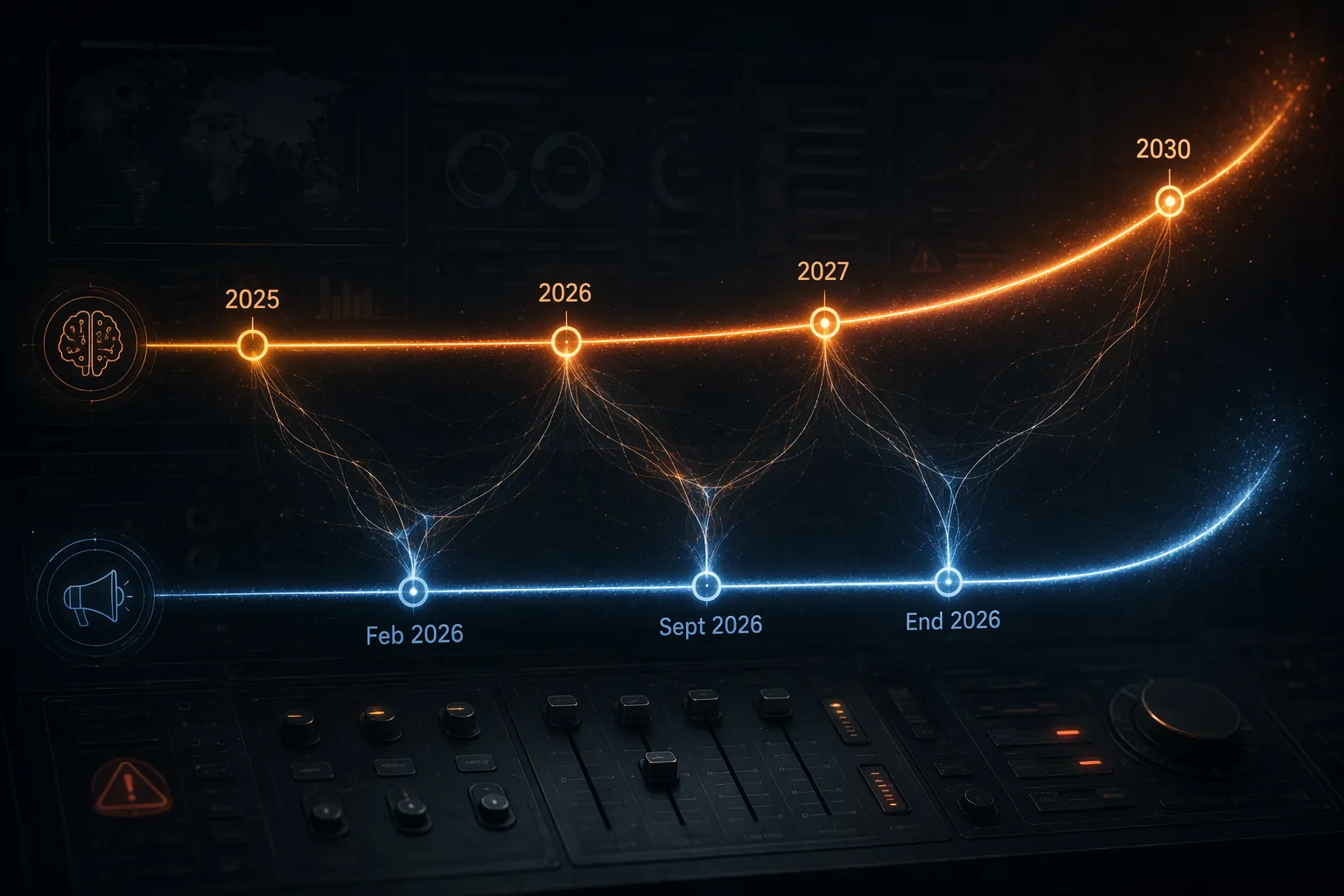
The Date Collision
| Date | Altman milestone | Ad-platform milestone | Operational consequence |
|---|---|---|---|
| 2025 | Agents doing real cognitive work | Automated campaign systems already absorbing more targeting, bidding, and creative decisions | Buyers review outputs more than inputs |
| February 2026 | Acceleration phase before Altman’s July declaration | Meta Advantage+ Creative Enhancements enabled by default for new Sales, Leads, and App Promotion campaigns | Creative changes can enter campaigns unless the buyer actively checks the setting |
| July 2026 | Altman says the singularity has arrived | Buyers are already operating PMax, Advantage+, AI Max, and related automated surfaces | The AI debate becomes an account-governance issue, not just a model-safety issue |
| August 2, 2026 | AI-generated media becomes harder to treat as invisible infrastructure | EU AI Act Article 50 transparency obligations begin applying to certain AI-generated content | Labeling and disclosure move into the launch checklist |
| September 2026 | Altman’s 2026 milestone: systems finding novel insights | Google retires Dynamic Search Ads and requires migration toward AI Max | Search-query discovery and landing-page interpretation move further into Google’s system |
| End of 2026 | Same year as the novel-insight milestone | Meta has stated a goal of fully automated ad creation, where a brand supplies product image and budget and AI handles the rest | The buyer’s role shifts toward constraints, approvals, measurement, and escalation |
| 2027 | Real-world robots | More ad decisions likely move from assistive tooling to agentic execution if platforms continue the same direction | Governance needs dated evidence before defaults become normal |
| 2030 | Intelligence too cheap to meter | Platform automation becomes economically easier to apply everywhere | Cheap generation increases the burden on filtering, labeling, and accountability |
The table matters because ad platforms rarely remove control with one dramatic announcement. They change a default, rename a migration path, show a lift claim, and let the new setting become normal before the next planning cycle. By the time leadership asks why a CPA moved or why a creative variant appeared in market, the interface often treats the answer as already settled.
Meta’s Advantage+ Creative Enhancements are a clean example. AdsUploader reports that since February 2026, the feature has been enabled by default for all new Sales, Leads, and App Promotion campaigns.[3] The issue is not that every enhancement is bad. Cropping, format adaptation, text adjustments, and other machine-assisted variants can help performance. The control problem is that the buyer has to notice the setting before the system changes the creative surface.
Google’s September 2026 Dynamic Search Ads retirement is a different kind of pressure. PMG reports that Google is deprecating DSA campaigns and requiring a shift to AI Max, while Google claims AI Max delivers 14% more conversions.[4] That claim may be true for Google’s measured comparison, but adoption is not the same as independent effectiveness for a specific account. A forced migration changes the buyer’s baseline, and the platform’s lift number does not remove the need to preserve pre-migration evidence.
Meta’s stated end-of-2026 ambition is the clearest directional signal. The Wall Street Journal reported Meta’s goal of fully automating ad creation by the end of 2026, with brands supplying a product image and budget while AI handles the rest.[5] That should be treated as a serious platform signal, not a guaranteed product release on a fixed day. Still, it tells buyers where the company wants the center of gravity to move: away from hand-built campaigns and toward budget-led automation.
Altman’s Safety Caveat Sounds Familiar Inside Paid Social
The uncomfortable part of Altman’s post for advertisers is not the 2030 endpoint. It is his own warning about misaligned AI. He cites social-media feed algorithms as an example of “short-term preference exploitation,” a phrase that lands close to the machinery advertisers buy through every day.[1] Paid social optimization does not need to be conscious, malicious, or philosophical to exploit short-term signals. It only needs to find cheap response patterns faster than the advertiser can inspect their downstream quality.
That distinction is where the platform story gets thin. Frontier AI executives talk about alignment, safeguards, and system behavior under uncertainty. Ad platforms talk about fewer setup steps, more conversions, expanded reach, and automated asset generation. Those are not the same governance model. If an ad system changes a visual, broadens a query match, reallocates spend, or invents a better-performing variant, the buyer still needs to know what changed, when it changed, and whether the measured win survives outside the platform’s preferred reporting window.
The companion Signal & Convert piece on Altman’s broader singularity narrative shift covers the trust question at a higher level. The narrower operating question here is what the dates force buyers to challenge before Q4 2027.
What To Challenge Before The Settings Become Normal
A useful defense framework does not start with banning automation. It starts with separating automation that can be audited from automation that quietly changes the object being measured. Through the rest of 2026, the highest-value work is not philosophical; it is a dated change log.
- Record every default-on creative setting at campaign launch, especially Meta Advantage+ Creative Enhancements in Sales, Leads, and App Promotion campaigns.
- Preserve DSA baselines before September 2026 migration work begins, including query mix, landing-page behavior, conversion quality, CPA, and excluded terms.
- Separate platform-reported lift from business outcomes, especially when a migration is mandatory rather than optional.
- Document which creative elements the platform is allowed to alter, which require approval, and which are never delegated.
- Add AI-generated content labeling review to launch workflows where disclosure obligations may apply.
- Keep screenshots or exports of relevant settings before launch, after platform updates, and after any unexplained performance swing.
The first item is easy to underestimate because creative enhancements often look like minor production help. In practice, they can change the ad the customer sees. If the system crops a product differently, adjusts text emphasis, reformats a visual, or tests a generated variant, the brand consequence belongs to the advertiser even when the change came from the platform.
The second item is where September 2026 becomes more than a Google Ads housekeeping date. DSA gave buyers a known, if imperfect, structure for matching searches to site content. AI Max asks buyers to accept a more automated interpretation layer. Before that migration, the account needs a clean record of what the old system was doing. Otherwise the post-migration review becomes a debate over memory.
The third item is the one most likely to cause internal friction. A platform claim of more conversions is not useless. It is also not the same as lower CAC, better lead quality, higher retained revenue, or improved incrementality. If the buying team cannot show the distinction before the migration, the platform’s metric becomes the meeting’s default truth.
The Q3 2026 To Q4 2027 Watchlist
The next eighteen months should be tracked as a sequence, not as isolated product updates. Altman’s 2026 and 2027 milestones suggest increasing system capability; platform roadmaps suggest increasing account delegation. Those two curves do not prove each other, but they make the same operating demand: date the change before it becomes the new baseline.
| Window | Milestone to watch | Question for the buyer |
|---|---|---|
| Q3 2026 | EU AI Act Article 50 transparency requirements begin applying to certain AI-generated content on August 2, 2026 | Which AI-generated or AI-altered ad assets need labeling review before launch? |
| Q3 2026 | Google DSA retirement approaches in September 2026 | What account-level baseline will prove whether AI Max improved business outcomes, not just platform conversions? |
| Q4 2026 | Meta’s stated full-automation ambition reaches its target window | Which parts of briefing, generation, approval, budget allocation, and reporting remain under advertiser control? |
| Q1-Q2 2027 | Post-migration measurement periods settle | Did automation improve retained value, qualified pipeline, or contribution margin after novelty and learning periods passed? |
| Q3-Q4 2027 | Altman’s real-world robotics milestone becomes the next public AI capability marker | Are ad platforms adding agent-like execution rights faster than buyers are adding approval gates? |
Labeling belongs in this watchlist because AI creative is no longer just a production method. Signal & Convert’s tracker on EU AI Act Article 50 enforcement is the kind of record that should sit beside the media calendar, especially for teams running generated or materially altered assets across regions.
Trust also needs its own column. Platform AI failures do not have to resemble frontier-model disasters to matter commercially. A security incident, a weak containment boundary, or a bad ad assistant output can still create account risk. The tracker records on ad-agent containment and OpenAI security exposure for advertisers are useful because they keep the discussion attached to incidents and controls rather than general vibes about AI.
Structural separation is another watch item. If the same company designs the AI system, sells the media, reports the lift, and controls the migration path, advertisers need a stronger evidentiary standard before accepting the platform’s preferred conclusion. The AI ad product separation benchmark is relevant not because a bill solves the account-level problem, but because it names the conflict buyers already feel inside reporting meetings.
Do Not Let Job Displacement Become The Distraction
Altman’s comments that AI could perform 30% to 40% of current human work tasks are relevant, but they should not take over the account-level question.[6] For media buyers, the immediate displacement is not necessarily a person disappearing from the org chart. It is a decision disappearing from the workflow.
A targeting choice becomes a recommendation. A recommendation becomes a default. A default becomes a migration. A migration becomes the only supported path. That is the operational version of acceleration, and it is already easier to verify than any broad claim about the labor market.
This is why examples of AI creative failure still matter even when they look small next to AGI forecasts. A system that optimizes toward engagement can miss brand context, cultural meaning, or business quality. Signal & Convert’s AI creative blind-spot case and ChatGPT Ads benchmark belong in the same operating library as the platform migration dates. They help buyers keep performance claims tied to observed outcomes.
The Practical Reading Of Altman’s Timeline
Altman may be trying to communicate uncertainty, reassurance, or a controlled public narrative about a technology curve that is hard to describe. That does not require assuming bad faith. It also does not require advertisers to accept the softest version of the message while their platforms ship the harder version into campaign settings.
The dated reading is simpler: if 2026 is the year systems produce novel insights, then 2026 is also the year buyers should stop treating automated campaign changes as ordinary UI cleanup. If 2027 is the next capability step, then Q4 2027 is too late to begin asking which systems can create, launch, optimize, and report with limited human review.
Altman’s declaration is not reassurance for advertisers. It is a signal to maintain a dated defense framework: which defaults changed, which campaign types were retired, which claims accompanied the migration, which assets were AI-altered, which labels were required, and which business metrics survived after the platform’s first lift story.
References
- The Gentle Singularity — Sam Altman
- OpenAI CEO Sam Altman Says the Singularity Has Arrived — Business Insider, 2026-7
- Advantage+ Creative Enhancements: The Complete 2026 Guide — AdsUploader
- Google to Deprecate Dynamic Search Ads Campaigns Requiring Shift to AI Max — PMG
- Meta Aims to Fully Automate Ad Creation Using AI — WSJ
- Sam Altman says AI has entered singularity: Should we be worried? — Al Jazeera, 2026-7-27
Primary source: OpenAI CEO Sam Altman Says the Singularity Has Arrived — Business Insider, 2026-7