
Cracker Barrel's rebrand backlash exposes a fatal AI ad blind spot
Cracker Barrel's rebrand backlash cost $94M in a single day and revealed that AI-managed ad platforms interpret viral outrage as positive engagement. This article explains why Performance Max and Advantage+ lack brand sentiment detection, how the 'engagement trap' works, and what media buyers can do about it.
- Platform
- Google Ads0 Meta
- Creative type
- AI image ads
- Failure type
- brand sentiment blind spot
- Last reviewed
- 0-07-27
Cracker Barrel’s paid ad performance problem did not start with a bad click. It started with a brand event that changed what a click meant.
On Aug. 19, 2025, Cracker Barrel announced a rebrand that removed the “Old Timer” figure from its logo. The backlash moved quickly from design criticism into political outrage. By Aug. 21, the company had lost $94 million in market capitalization in a single day, with the intraday loss reported near $200 million; broader market-cap erosion from its July 2025 peak was reported at about $594 million, or 55% of value.[1][2] The operating signal was not much prettier: foot traffic fell 8% immediately after the rebrand announcement, compared with a 1% decline in the first half of the month.[3] On Aug. 26, Cracker Barrel reversed the logo change and restored the Old Timer mark.[1]
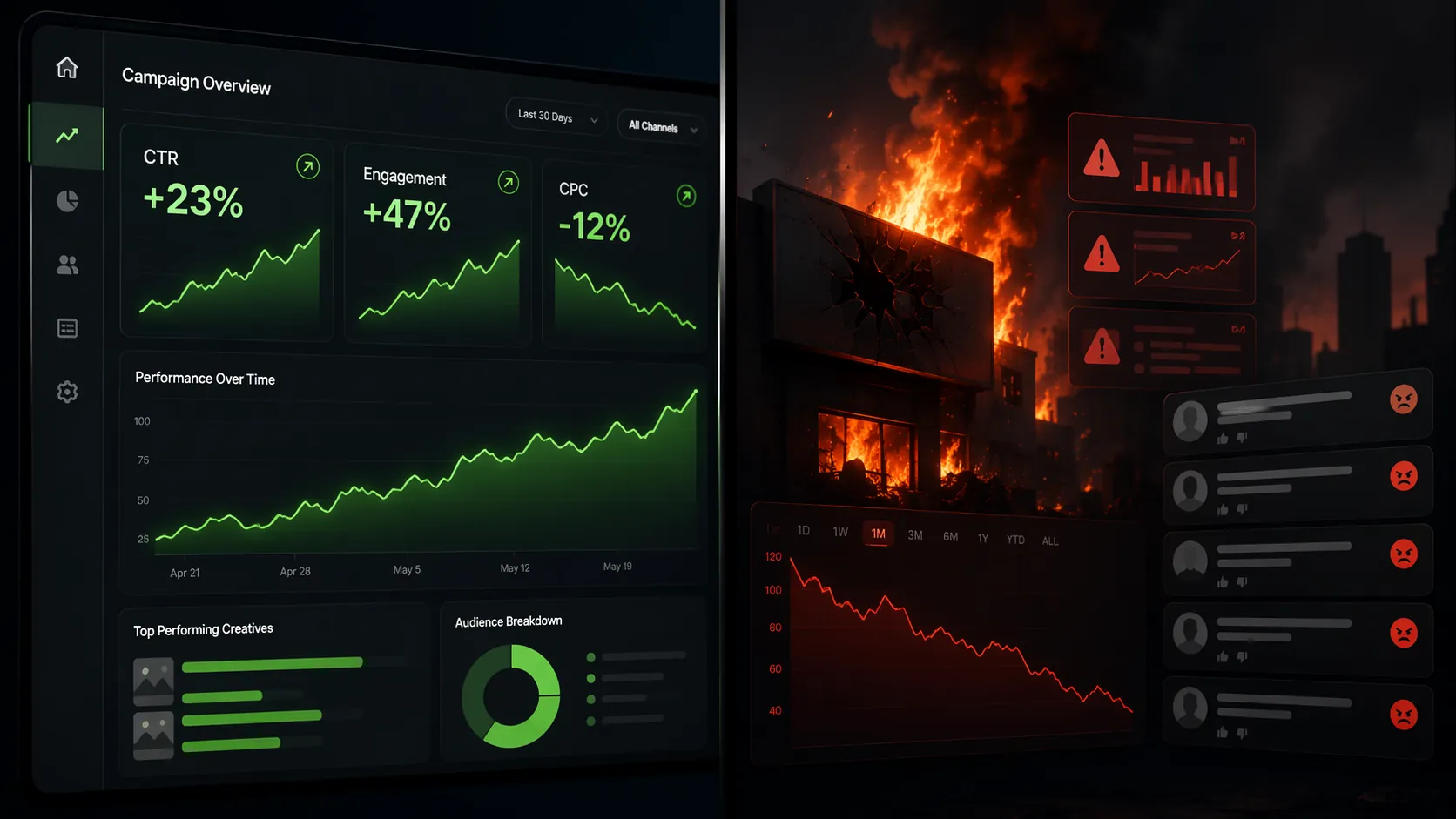
That is the setup for the real media-buying question: if Performance Max, Advantage+, or similar AI-managed campaigns were live during the Cracker Barrel rebrand backlash, what were they optimizing toward while outrage was peaking?
There is no public campaign log from Cracker Barrel’s crisis window. No disclosed ROAS, CPA, CTR, spend, placement mix, audience expansion, creative-variant performance, or conversion-path data has been published. So the useful claim is narrower than the easy one. We cannot say that Google or Meta increased Cracker Barrel’s spend into hostile inventory. We can say that the public business shock exposed the exact condition where AI-managed ad systems become dangerous if the buyer has not already defined a manual override.
The engagement trap: when outrage looks like demand
A platform dashboard can look calm in a crisis because it is not measuring the thing the brand is losing. It can measure impressions, clicks, comments, shares, view-through conversions, landing-page visits, store-direction taps, add-to-cart events, and purchases. It can also learn from patterns around those actions. What it does not natively understand is that a sudden spike in attention may be powered by people who are angry, joking, boycotting, brigading, quote-posting, or trying to make the brand more visible for the wrong reason.
That is the engagement trap. Hostile attention produces many of the same machine-readable signals as interest. A user who comments “never eating there again” has still commented. A user who clicks to see the new logo has still clicked. A user who shares a boycott post has still expanded reach. If the campaign objective is fed by engagement-adjacent or conversion-adjacent signals, the system may treat the crowd as an audience worth finding more of, not as a reputational hazard that should reduce authority.
The bot estimate around Cracker Barrel makes that failure mode uglier, while still needing careful handling. Bullseye Strategy CEO Maria Harrison told Nation’s Restaurant News that roughly 45% of X posts criticizing the logo were bot-generated, based on the agency’s analysis.[4] That is not a peer-reviewed measurement of every platform, and it is not proof of how any paid campaign optimized. But for a media buyer, it is exactly the kind of distorted signal that turns a green dashboard into a liability. If a large share of visible criticism is automated or coordinated, then the platform may be learning from a crowd that is not even a clean proxy for human demand.
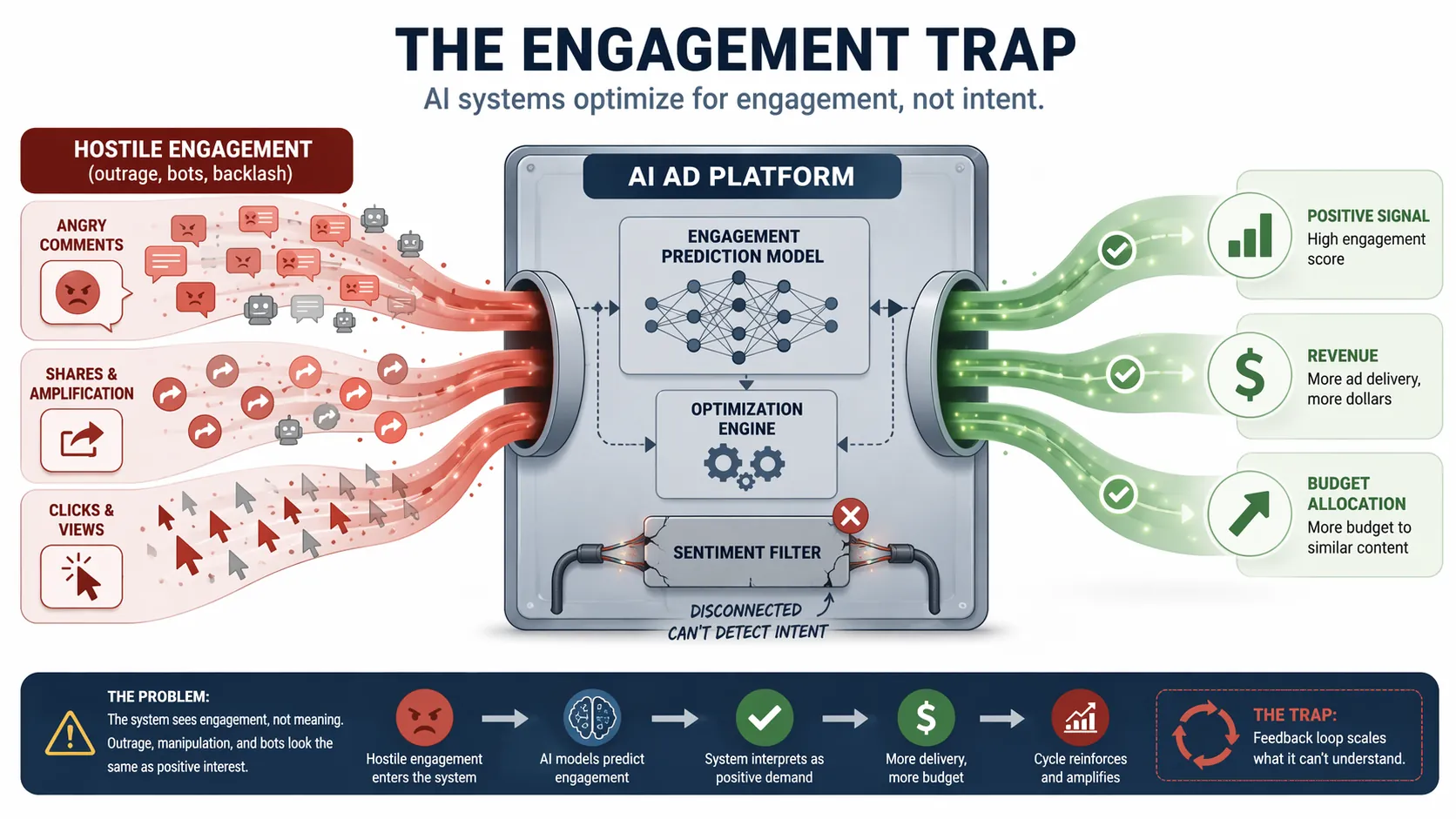
This is where normal performance habits become risky. In a regular week, cheaper reach and rising engagement can be useful. In a brand crisis, the same movement can mean the campaign has found the cheapest possible way to keep the controversy alive. A lower CPM is not a win if the discount exists because the brand has become free entertainment. A higher CTR is not a win if users are clicking to inspect the thing they hate. A comment surge is not a win if the comment field is now a public complaint queue.
The Cracker Barrel numbers matter because they put a business consequence next to the signal problem. This was not a vague “sentiment dipped” episode. The market reaction was measurable, the traffic decline was measurable, and the reversal happened within a week. A paid system operating through that window would have needed a way to know that more attention was not automatically better. Native platform optimization does not give buyers enough confidence that such a distinction would be made on its own.
Why Performance Max and Advantage+ are exposed in this kind of incident
Performance Max and Advantage+ are not broken because they automate. They are exposed because they automate across too many decisions at the exact moment when a human needs to narrow the system’s authority.
Google describes Performance Max as a goal-based campaign type that can serve across Google inventory from one campaign, using advertiser inputs such as conversion goals, assets, audience signals, and feeds to help optimize performance.[5] Meta’s Advantage+ products similarly reduce manual control over combinations of audience, placement, budget distribution, and creative delivery in favor of system-led optimization.[6] That abstraction is the point of the product. It is also the problem during a brand incident.
When a brand is stable, the buyer usually wants the machine to find pockets of efficient demand that a manual build would miss. When the brand is suddenly politicized, the buyer needs to know which placements are carrying the controversy, which audiences are arriving for hostile reasons, whether remarketing pools are being polluted, whether creative is being shown next to crisis content, and whether conversion quality has changed. The most automated campaign types are often the least generous with that kind of diagnostic visibility.
The missing feature is not a nicer dashboard label. It is native brand-sentiment detection tied to authority. A crisis-aware system would need to recognize that the brand’s name, logo, executives, product, or campaign asset is now attached to negative public attention; distinguish hostile engagement from likely demand; suppress expansion into controversy-driven pockets; and give the buyer a hard pause or containment mode before the optimizer treats the spike as useful learning. Public platform documentation does not establish that Performance Max or Advantage+ has that kind of crisis-pause trigger for brand sentiment.
That distinction matters because “brand safety” controls are not the same as “my brand has become the unsafe topic.” A placement can be technically eligible. A user can be real. A click can be valid. The failure is contextual: the reason attention exists has changed faster than the campaign’s learning system can morally or commercially interpret it.
Creative automation adds a second failure surface
Meta’s Advantage+ Creative Enhancements deserve separate attention because the Cracker Barrel incident was, at the surface level, a visual identity crisis. Reports and advertiser guidance have described Advantage+ creative tools as applying automated modifications to approved creative, including adjustments intended to improve delivery or performance.[7][8] In ordinary retail work, that may be tolerable. During a seven-day identity flux — new logo on Aug. 19, restored Old Timer logo on Aug. 26 — it becomes another place where platform optimization can create brand confusion.
The risk is not that Meta invents a scandal by itself. The risk is smaller and more operational: cropped logos, reformatted assets, adjusted backgrounds, generated variations, or mixed creative treatments can keep the wrong identity in rotation after the company is trying to reverse course. If the paid team is already waiting on final approved assets from brand, legal, and comms, an on-by-default creative enhancement layer is one more thing to shut off before diagnosing performance.
The same logic applies outside Meta. Any system that can combine, resize, rewrite, enhance, or dynamically assemble assets should lose that freedom during a brand correction. The issue is not taste. It is version control under public pressure.
The Bud Light precedent is useful, but only up to a point
Bud Light is the obvious comparison because it showed how quickly a consumer brand can become a political object and suffer severe financial damage. In 2023, the backlash around Bud Light was widely reported alongside a market-cap loss of about $4 billion for parent company Anheuser-Busch InBev, and Fox Business later reported a shared agency connection through Viral Nation in its coverage of Bud Light and Cracker Barrel.[9]
That comparison should not be stretched into a universal template. Bud Light was not a logo rollback story, and Cracker Barrel’s public paid-media data is not available. The useful overlap is narrower: both cases show how a brand can be pulled into a politicized attention cycle faster than campaign governance usually moves. Once that happens, the paid team is no longer just buying demand. It may be buying distribution for the backlash unless someone takes control away from the optimizer.
What the media buyer should override first
The buyer does not need to settle the cultural argument before acting. The threshold is simpler: if brand mentions, executive names, product names, campaign assets, or logo terms are moving through hostile social and news cycles while traffic or conversion quality is deteriorating, automation should lose authority until the signal environment is clean enough to trust again.
The override should be written before the incident, not improvised in the comments section. A practical version looks like this:
| Control area | Crisis action | Reason |
|---|---|---|
| Campaign authority | Pause or heavily cap broad automated prospecting, including PMax and Advantage+ structures that cannot be audited quickly. | Stops the system from expanding into outrage-driven traffic while the team checks whether attention still maps to demand. |
| Brand and bottom-funnel demand | Isolate branded search, store-location, loyalty, and high-intent remarketing into tighter structures where queries, audiences, and creative can be reviewed. | Keeps essential demand capture live without letting broad automation use the crisis as a learning event. |
| Creative automation | Disable auto-enhancements, dynamic creative assembly, text variations, generated backgrounds, and logo-altering treatments. | Prevents stale, modified, or mixed identity assets from continuing after brand or comms changes direction. |
| Reporting | Temporarily demote CTR, CPM, engagement rate, view-through lift, and platform-reported blended ROAS as decision metrics. | These can improve when outrage increases attention, even if commercial intent is worsening. |
| External signal monitoring | Track social sentiment, news velocity, branded search query quality, store traffic, CRM complaints, cancellation/refund patterns, and customer-service volume. | The ad platform is not the only source of truth during a brand crisis. |
| Restart rules | Require human approval to reopen broad automation, with documented thresholds for sentiment stabilization, conversion quality, and approved creative versioning. | Prevents the campaign from snapping back into the same distorted signal pool. |
The awkward part is that some of these moves will make the dashboard look worse. Pausing broad automation can raise reported CPA. Removing cheap hostile reach can reduce engagement. Killing creative enhancements can reduce the number of variations eligible for delivery. That is the cost of not letting the platform optimize against a contaminated signal environment.
This is also where attribution discipline matters. Crisis-period ROAS is easy to misread because organic outrage, news coverage, search spikes, and paid delivery all move at once. The same measurement problem shows up in the Taco Bell crisis attribution breakdown, where last-click reporting can reward the channel closest to the noise rather than the channel creating durable demand. If an AI campaign claims efficiency while store traffic, conversion quality, or customer sentiment is deteriorating, the platform number should be treated as a lead, not a verdict.
The override needs an owner
A crisis protocol that requires five executives to approve a pause is mostly theater. The person watching the account needs pre-cleared authority to move spend into containment when the trigger conditions are met. That does not mean the media buyer owns the brand response. It means the buyer owns the decision not to let campaign automation amplify a mess while the brand team is still deciding what to say.
A clean containment model should define who can pause, who can approve emergency creative, who can reopen automation, and which evidence is required. The mechanics are close to broader ad-agent risk containment: reduce autonomy, preserve logs, separate high-risk actions from routine delivery, and require explicit human approval before the system regains scope. The ad-agent containment playbook is a better model for this than a generic brand-safety checklist because the central problem is delegated authority.
The buyer should also keep a short incident record: timestamp of the public trigger, campaign status at discovery, actions taken, spend paused, creative disabled, exclusions added, reporting metrics demoted, and restart approval. That record is not bureaucracy. It is how the team avoids arguing later about whether the platform “performed” when the business was visibly absorbing damage.
The control boundary
Cracker Barrel’s rebrand backlash is not evidence that AI bidding is useless. In stable conditions, automated campaign systems can remove waste, find demand pockets, and reduce the manual drag of media buying. The problem is narrower and more serious: when a brand becomes the object of viral hostility, the platform may keep seeing usable signal because the platform was built to optimize measurable response, not to judge whether the response is commercially toxic.
That is the fatal blind spot for media buyers. Performance Max and Advantage+ do not need to hate the brand to hurt it. They only need to keep treating attention as learnable while the reason for attention has turned hostile. The manual override is the line where automation stops being trusted by default and starts having to earn its authority back.
References
- Cracker Barrel loses $94 million in market value after logo backlash — CBS News, 2025.
- Cracker Barrel rebrand backlash analysis — Terakeet, 2025.
- Cracker Barrel says customer traffic fell after logo change — Reuters, 2025.
- Cracker Barrel logo backlash was amplified by bots, agency analysis says — Nation’s Restaurant News, 2025.
- About Performance Max campaigns — Google Ads Help.
- About Advantage+ shopping campaigns — Meta Business Help Center.
- Meta Advantage+ Creative Enhancements guidance — Mamba Digital.
- Meta Advantage+ Creative Enhancements advertiser report — Hyper AI.
- Cracker Barrel and Bud Light agency connection investigation — Fox Business, 2025.
This is a record of what happened and what was tested, not legal advice. Compliance determinations require qualified counsel.