
Taco Bell's Crisis Deal: Why Last-Click ROAS Misleads
When foot traffic drops 30% overnight and a promotion relies on organic reach, standard last-click ROAS becomes structurally misleading. This article replaces it with share velocity, foot-traffic recovery slope, and loyalty signups as the metrics that matter during a brand crisis.
- Platform
- Creative type
- video
- Last reviewed
- 0-07-25
The first thing to measure in Taco Bell’s July 2026 crisis deal is not the deal. It is the floor falling out underneath it. Visits were already down 16.9% on July 15, when the investigation first entered the news cycle; down 19% on July 16, after CDC and FDA confirmation; and down roughly 30% to 31% on July 17, when the outbreak was officially linked to Taco Bell in public coverage based on Placer.ai foot-traffic data cited by CNN and People.[1][2]
That sequence changes the measurement question before any creative enters the frame. A restaurant brand losing nearly a third of visits in a matter of days is not operating inside a normal attribution window. The baseline is not stable. Search behavior, news exposure, store avoidance, operational reassurance, app usage, and investor reaction are all moving at once.
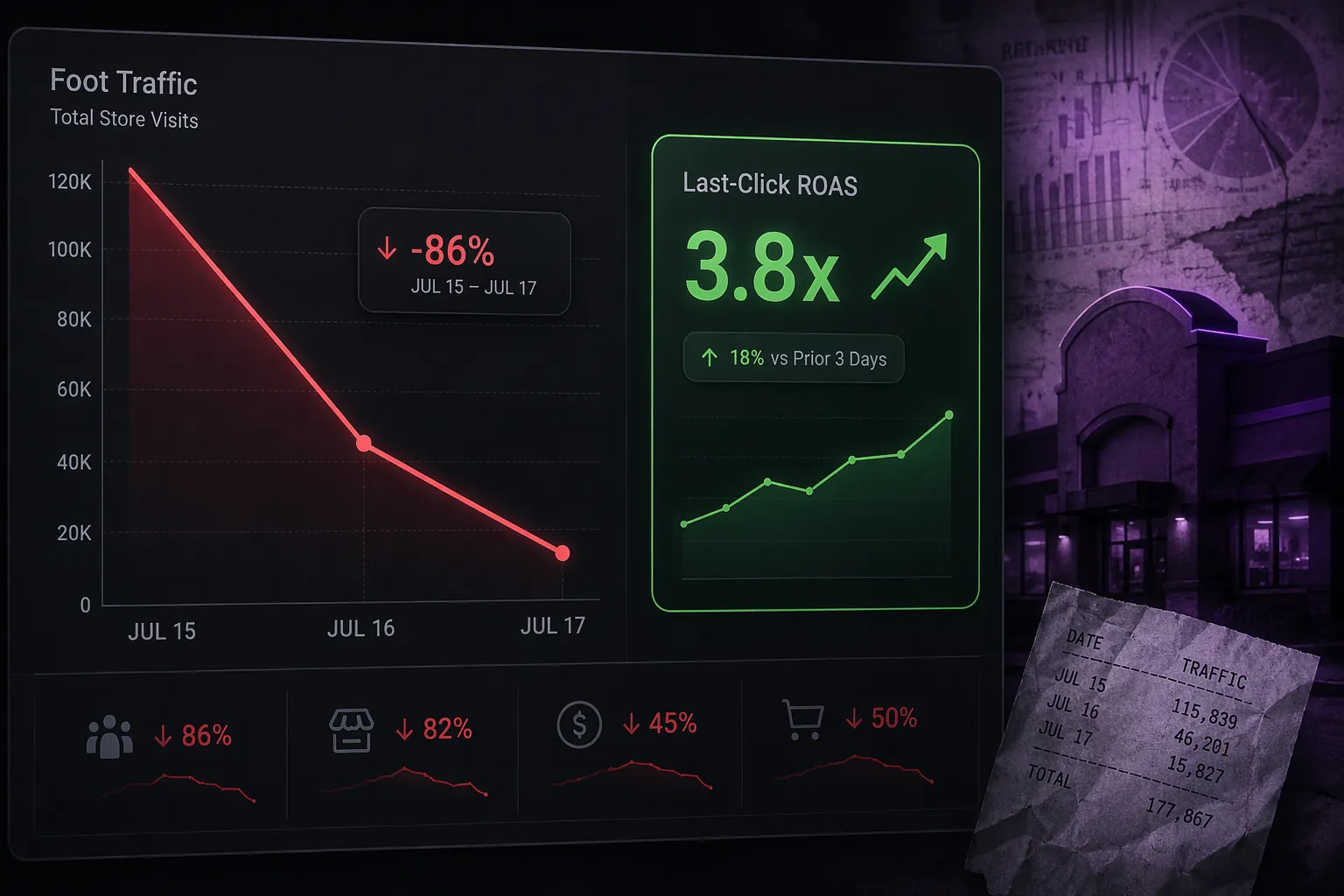
One date correction matters before the analysis starts: the documented promotion in the available record is the July 22, 2026 $1 lettuce-free Enchirito offer, not a 2025 promotion. It arrived after the visit collapse, not before it.
The Promotion Entered A Moving Baseline
The public mechanics were simple. Taco Bell promoted a $1 lettuce-free Enchirito, normally priced at $4.29, through an Instagram Reel with comments enabled and no disclosed paid boost.[1] USA Today also reported a separate $1 Nacho Fries offer that was app-exclusive.[3]
As a piece of crisis creative, the Enchirito made sense. It answered the lettuce problem directly, used a familiar Taco Bell menu object, and gave people a low-friction reason to talk about the brand without asking them to ignore the outbreak. It was culturally fluent in the way Taco Bell’s best social work often is: fast, self-aware, and built for circulation.
As a paid-media case study, though, it is a trap. There is no disclosed incremental paid spend for the Reel. There is no public holdout market. There is no clean pre-period. There is no normal demand curve to compare against. A last-click order, an app session, or a store visit after July 22 can be counted, but it cannot honestly be isolated as the effect of the Enchirito.
| Record field | What the public record supports |
|---|---|
| Platform | Instagram Reel for the Enchirito; owned app for the Nacho Fries offer |
| Spend | No disclosed paid boost for the Enchirito promotion |
| Timeframe | Promotion announced July 22, 2026, after the July 15-17 traffic decline |
| Primary visible action | $1 lettuce-free Enchirito; separate app-exclusive $1 Nacho Fries |
| Useful metric family | Share velocity, recovery slope, app capture, loyalty signup volume |
| Attribution verdict | Last-click ROAS is structurally misleading because the demand baseline was already collapsing |
Why A Clean ROAS Number Would Be False Precision
A normal performance readout wants a source of truth: spend, clicks, conversions, revenue, ROAS. That discipline is useful when the outside world is not rewriting the denominator every few hours. In this case, the denominator was the problem. The July 17 visit drop meant that any post-promotion lift would be measured against an abnormal trough, not against routine demand.
Suppose, hypothetically, a dashboard showed a strong last-click ROAS on July 22 and July 23 from users who tapped through from Instagram or opened the app. That number would still mix several behaviors: people responding to the deal, people checking whether lettuce had been removed, people returning as the news cycle cooled, loyal customers deciding the risk had passed, and people who would have bought anyway once the operational response landed.
The Placer.ai data is valuable because it gives a directional daily shape to the traffic shock, but it should not be treated as audited sales. It is mobile-device panel traffic, not same-store revenue. As of July 25, 2026, Yum had not released actual sales data for the July 17-22 period in the available materials. That distinction matters: a visit recovery curve can tell a media buyer whether demand is repairing; it cannot tell them the check size, margin, or total revenue impact.
The stock chart adds context, not attribution. Yum! Brands shares fell roughly 9% to 10% over the crisis week and then partially recovered after the lettuce-removal announcement, according to reporting summarized in People.[2] The cleaner read is that investors treated the operational response as the primary signal. The $1 Enchirito may have helped the brand sound responsive, but the market movement should not be credited to a menu promotion without evidence that separates it from the food-safety action.
The Paid-Media Infrastructure Was Not The Story
MediaRadar’s Taco Bell profile lists under $100 million in digital and national TV advertising in the prior year, with a decreasing year-over-year trend.[4] That is useful for scale, but it has a boundary: MediaRadar’s figure covers digital and national TV, not necessarily local broadcast, out-of-home, in-store media, or every other channel a franchise system may touch.
Still, the figure supports the practical read. The crisis response visible to consumers did not look like a fresh, heavy paid-media push. It looked like Taco Bell using existing social and owned-channel infrastructure quickly: a Reel for attention, comments for participation, the app for the Nacho Fries conversion path, and a loyalty frame from leadership.
That matters because the campaign math changes when distribution is mostly organic. A paid campaign can at least start with impressions bought, audiences targeted, and spend controlled. Organic crisis response starts with volatility. The message spreads because people decide to share it, mock it, defend it, question it, or use it as proof that the brand is listening. Those actions are measurable, but they do not behave like auction media.
The Metric That Deserves To Move Up The Dashboard
Taco Bell’s own social philosophy makes the Enchirito response easier to read. Nicole Weltman, the brand’s head of social, told Marketing Brew in November 2025 that shares are Taco Bell’s most valuable social metric because “that means we hit our goal of resonating with fans.”[5]
In normal reporting, shares can get treated as soft engagement. In a crisis where paid boost is undisclosed and brand avoidance is the main behavioral risk, share velocity becomes more serious. It shows whether the message is traveling through people rather than through media budget. It also shows whether the creative gave customers a socially acceptable way to re-enter the conversation.
That does not mean a share equals trust, a store visit, or a sale. It means share velocity is a better first diagnostic than last-click ROAS for this specific job. If the Reel spread faster than Taco Bell’s normal baseline, and if the comments did not turn into a second-wave reputational problem, the creative did one part of the work it was built to do. It created message movement at a moment when silence would have left the story to food-safety coverage and old Taco Bell jokes.
AdAge’s crisis analysis pointed to a brand-specific disadvantage: Taco Bell already carried longstanding jokes about stomach problems, which meant the outbreak’s “blast radius” could extend beyond affected restaurants to the whole chain.[6] A ROAS dashboard does not capture that kind of brand-equity exposure. A social-sharing and sentiment read will not solve it either, but it at least watches the channel where the joke can mutate.
A Better Crisis Dashboard For This Case
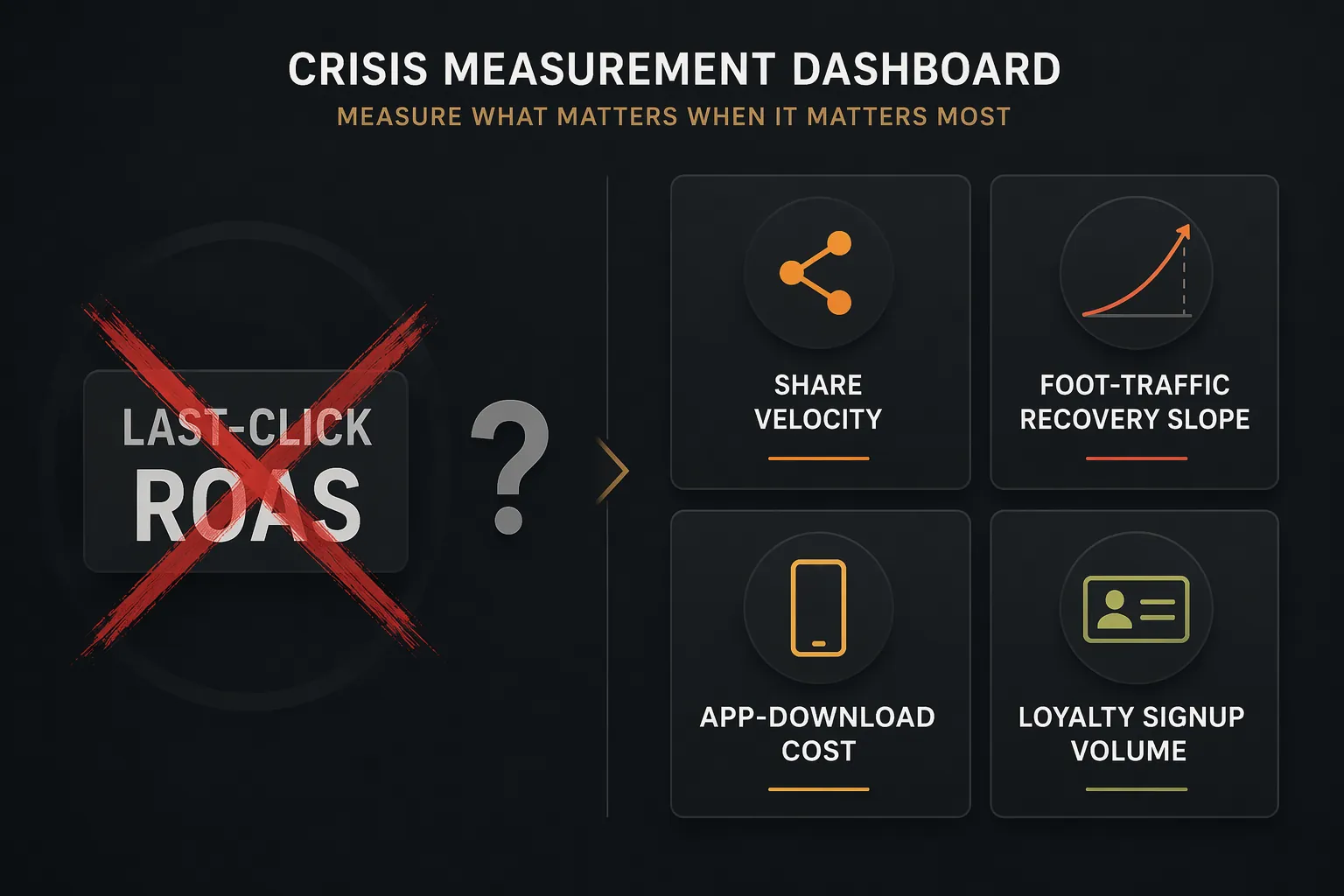
The replacement dashboard should not pretend to produce one magic answer. It should separate signal types and keep each one honest about what it can and cannot prove.
- Share velocity: Did the Enchirito message spread faster than Taco Bell’s normal social baseline, and did sharing accelerate without requiring a disclosed paid boost?
- Foot-traffic recovery slope: After the July 17 trough, did directional visits recover faster than the crisis baseline would have suggested, using Placer.ai as panel-based directional data rather than sales?
- App capture: For the app-exclusive Nacho Fries offer, did app downloads, offer redemptions, or owned-audience growth improve at an acceptable cost where those figures are available?
- Loyalty signup volume: Did the crisis window produce new identifiable customers Taco Bell could message again, rather than only discounted one-time visits?
- Comment and sentiment containment: Did the social response keep conversation participatory, or did it give critics a new place to concentrate food-safety complaints?
The recovery-slope metric is the most important one for the business question. If visits are down about 30% to 31%, the operator needs to know whether demand is coming back, how quickly, and whether the slope changes after concrete actions: lettuce removal, leadership reassurance, the Enchirito Reel, app-exclusive offers, and the natural decay of the news cycle. The promotion is one marker on that curve. It is not the curve.
The app metric is narrower but cleaner. The Nacho Fries offer being app-exclusive gives Taco Bell a path to owned-audience capture that a public Instagram Reel does not. Even there, the question should not stop at day-one attributed orders. A crisis discount that brings in an app install, a loyalty signup, or a reachable customer record can be more valuable than a discounted basket that disappears into anonymous store traffic.
The leadership message belongs in the same measurement environment. Sean Tresvant’s LinkedIn line, “We aren’t entitled to your loyalty. We earn it one meal at a time,” was cited in coverage around the promotion window.[1] That is not offer copy. It is a trust-repair signal. Once a CEO is framing the problem as earned loyalty, a pure transaction dashboard is already too small.
What A Media Buyer Can And Cannot Claim
A defensible claim would sound modest: Taco Bell used a fast organic social response and owned-app offer mechanics during a period of severe traffic pressure. The Enchirito creative was well matched to the operational issue because it removed lettuce from the product promise and gave the audience something easy to share. If share velocity, app capture, and visit recovery improved after the response, those are useful signs that the brand’s recovery system was working.
An indefensible claim would be cleaner and worse: the $1 Enchirito delivered a specific ROAS. That claim would require a stable baseline or a test design that the public materials do not show. It would also need to separate the promotion from the lettuce-removal announcement, the CEO’s loyalty language, the broader media cycle, the chain’s existing social audience, and the natural rebound that often follows an acute traffic shock.
There is no hidden benchmark waiting to be calculated from the public facts. The absence of a neat ROAS number is not a reporting failure; it is the lesson. The more precise move is to say which signals are directional, which are attributable, and which are merely correlated with the recovery window.
That is why this belongs as a foundational Signal & Convert record in the ai-creative category. The visible action is creative and social: a fast Reel, a lettuce-free product hook, a comment-enabled distribution path, and an app-exclusive companion offer. The real value is as a failure case for attribution. When brand traffic is in freefall and the campaign runs mainly on organic reach, the question is not “what was ROAS?” It is whether the recovery curve, sharing behavior, and owned-audience capture improved faster than the crisis baseline would suggest.
References
- Hungry for customers, Taco Bell is offering $1 lettuce-free deals — CNN, July 22, 2026.
- Cyclosporiasis Outbreak Has Impacted Restaurant Traffic, Stocks at Taco Bell and Other Chains — People, July 23, 2026.
- Taco Bell promoting $1 lettuce-free deal amid cyclospora outbreak — USA Today, July 22, 2026.
- Taco Bell Advertising Profile — MediaRadar.
- The secret sauce behind Taco Bell's sustained social engagement — Marketing Brew, November 2025.
- Why Taco Bell's food safety crisis is a brand test — AdAge Substack, July 23, 2026.
This is a record of what happened and what was tested, not legal advice. Compliance determinations require qualified counsel.