
How the EU AI Act’s Article 50 Will Affect Your Ad Accounts
The EU AI Act's Article 50 takes effect August 2, 2026, requiring ad platforms to label AI-generated content. This tracker details what actually changes on each platform — which creatives are scanned, labeled, or rejected — so you can prepare your paid campaigns before the deadline.
- Platform
- EU
- Change category
- policy
- Effective date
- 0-08-02
- Change type
- policy shift
- Impact level
- high
Status as of July 27, 2026
Published and last reviewed July 27, 2026. Article 50 of the EU AI Act still appears scheduled to apply on August 2, 2026, six days from today. The May 2026 Omnibus process extended some high-risk AI system deadlines, but the reviewed legal sources say Article 50 remained on schedule; formal adoption details were still an item to watch, so minor timing changes should not be treated as impossible.[1][2]
For paid advertising, the short version is operational rather than philosophical: ordinary human-made ads are not suddenly in danger because someone edited footage, corrected color, checked grammar, scheduled posts, or used analytics. The assets that need attention are AI-generated or synthetic creative — AI avatars, synthetic voiceovers, AI-generated video, manipulated likenesses, and AI-generated product imagery that could be mistaken for real content.[3]

Platform enforcement matrix
This is the part to keep open next to Ads Manager, Google Ads, TikTok Ads Manager, and YouTube Studio. Article 50 may be the legal trigger, but the immediate effect is coming through disclosure prompts, metadata scans, automated classifiers, labels, rejections, monetization reviews, and account-level penalties.
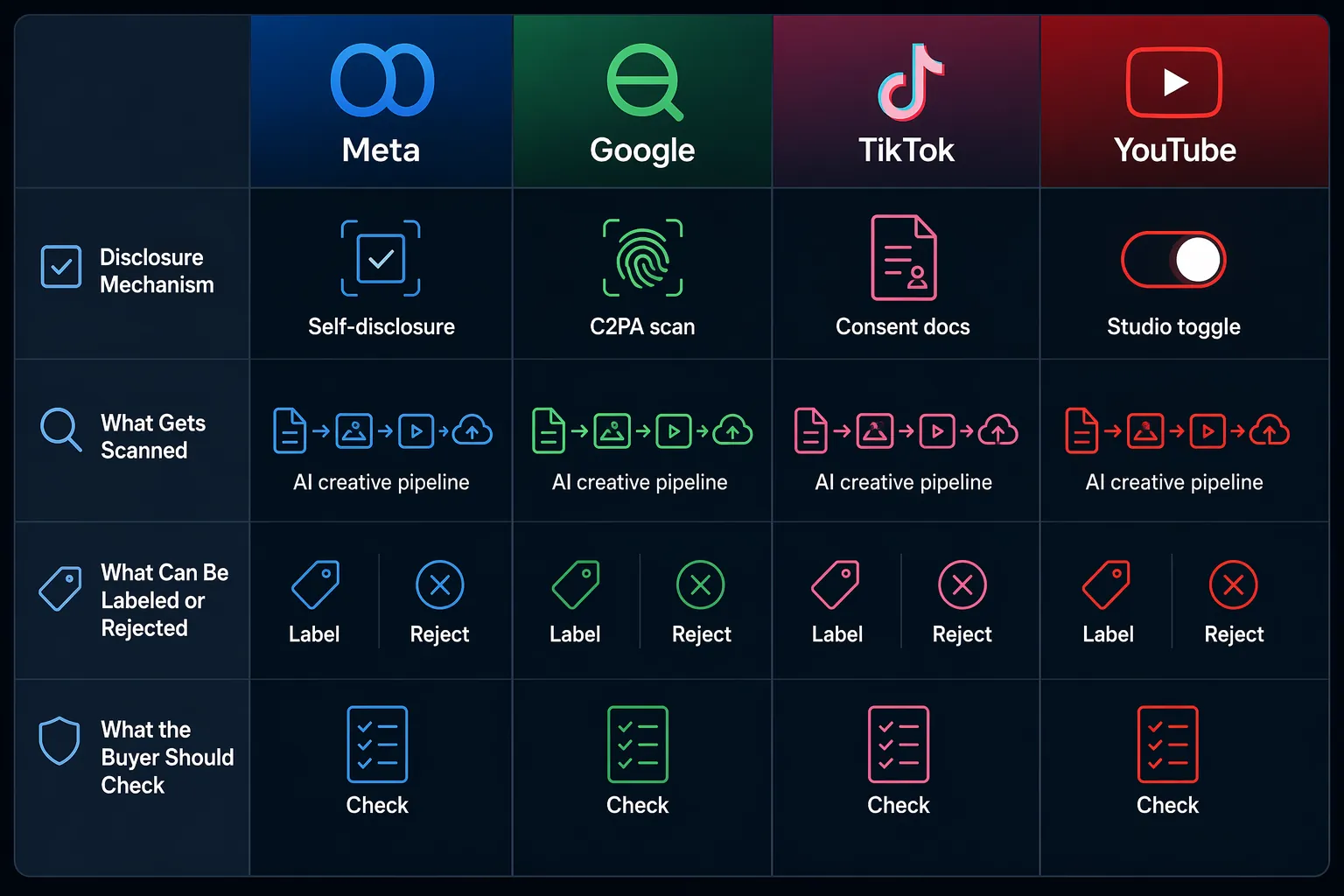
| Platform | Disclosure mechanism | What gets scanned | What can be labeled | Rejection or penalty exposure | Account check before August 2 |
|---|---|---|---|---|---|
| Meta | Advertiser self-disclosure in Ads Manager, including a checkbox for AI-generated or altered content.[4][5] | C2PA metadata signals and Meta’s automated AI-content classifiers.[5] | Ads can receive a visible “Made with AI” label, including where the advertiser did not self-disclose but Meta’s systems detect AI-generated content.[5] | Misdisclosure can lead to ad rejection and, under repeated or serious enforcement conditions described in platform-policy trackers, account suspension risk.[4][5] | Open live and scheduled ads; verify whether any avatar, synthetic voice, generated product render, or materially altered person has been disclosed in the ad setup. |
| Google Ads | Platform disclosure requirements for synthetic or AI-generated content, with enforcement tied to Google’s labeling and integrity systems.[4] | C2PA metadata and platform AI-content detection systems.[4] | AI-generated or synthetic creative can be labeled when detected or disclosed.[4] | Non-compliant assets can be rejected, and AuditSocials describes Google enforcement exposure through a three-strike system.[4] | Check asset-level creative, not only campaign settings. Confirm whether generated product images, voiceovers, and video variations retain metadata and meet disclosure rules. |
| TikTok | AI-generated content labeling rules, with stricter documentation expectations when real people or likenesses are involved.[4] | Uploaded video, metadata, platform classifier signals, and content that appears synthetic or manipulated.[4] | TikTok can apply AI-content labels; the platform has already labeled more than 1.3 billion videos, which makes this less theoretical than a policy PDF.[4] | AuditSocials describes distribution reduction and other penalties for non-compliant AI content; consent documentation can matter where real people are represented.[4] | Pull any ads using AI avatars, cloned voices, face swaps, synthetic testimonials, or realistic human likenesses. Confirm consent documentation before scaling. |
| YouTube | Creator-side disclosure through YouTube Studio for altered or synthetic content.[4] | Video upload signals, disclosure toggle status, metadata, and platform detection systems.[4] | Videos and ads can be labeled as altered or synthetic where disclosure or detection triggers apply.[4] | YouTube exposure is not limited to paid approval. AuditSocials flags monetization risk where synthetic-content disclosure is mishandled.[4] | For paid placements built from channel videos, confirm the Studio disclosure toggle and monetization status before attaching spend. |
Where ordinary ads are not suddenly at risk
The cleanest way to avoid over-compliance panic is to separate production tools from synthetic creative. A human-shot product demo that was trimmed, captioned, color-corrected, and scheduled with normal marketing software is not the same account problem as a synthetic founder voiceover or an AI avatar delivering a testimonial. Billo’s ad-creative guidance draws that boundary directly: standard editing, color correction, grammar checking, analytics, and scheduling sit outside the Article 50 concern set for ad teams.[3]
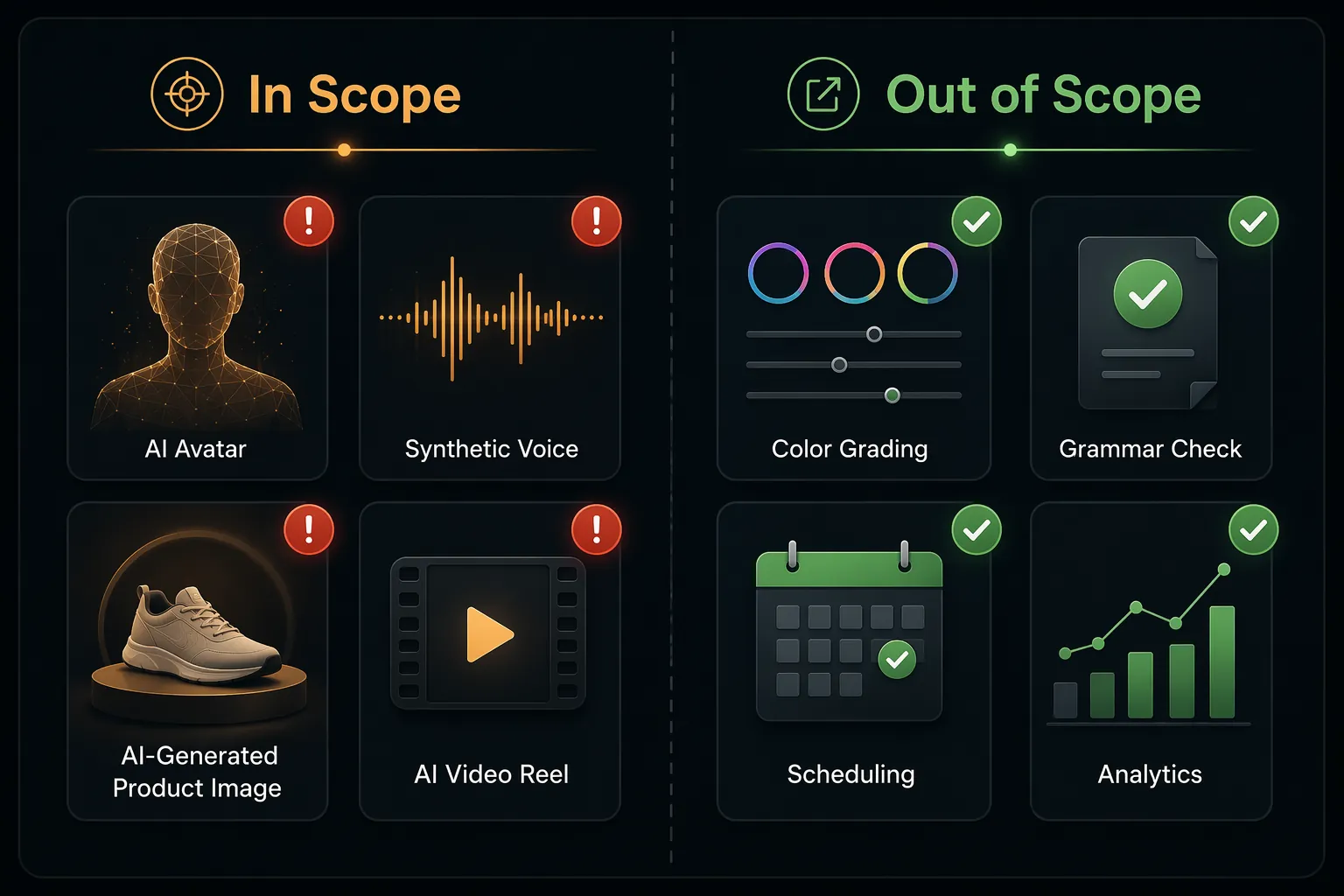
The assets that should move into an audit queue are the ones where the viewer may reasonably think they are seeing or hearing something real: a person speaking, a product image that appears photographed, a testimonial delivered by a human-like presenter, a scene that looks like captured footage, or a voice that sounds like a real person. The platform may care even before a regulator does, because the enforcement gate is often an upload scan or disclosure field.
| Creative use | Tracker treatment | Why it matters in the account |
|---|---|---|
| AI avatar presenter | Audit and disclose where platform rules require it. | Looks like a human spokesperson; likely to trigger platform synthetic-content checks. |
| Synthetic voiceover or cloned voice | Audit, disclose, and confirm consent where a real person’s voice or likeness is implicated. | Voice can be treated as synthetic or manipulated media, especially when it imitates a real person. |
| AI-generated product image | Audit if it could be mistaken for a real product photo or materially changes what is being sold. | Creates approval and misrepresentation risk if the asset presents an unreal product state. |
| AI-generated video scene | Audit and disclose where required. | Video uploads are scanned by the major platforms and can receive labels. |
| Color grading, cropping, captioning, compression | Do not treat as Article 50 synthetic creative by default. | Routine post-production is outside the main scope described in ad-creative guidance.[3] |
| Grammar checking, reporting, analytics, scheduling | Do not route into creative-disclosure review by default. | These are workflow tools, not AI-generated ad creative.[3] |
That distinction matters because blanket disclosure is not a harmless productivity hack. If a team starts marking every touched asset as AI-generated, the account becomes harder to QA, reviewers lose the signal they need, and clients start asking why labels appeared on otherwise normal creative. The better audit is narrower: identify synthetic elements that a viewer would experience as content, not tools that helped the team finish the file.
Platform notes that matter inside the account
Meta: the checkbox is only one layer
On Meta, the buyer-facing step is simple enough to miss: the Ads Manager disclosure checkbox for AI-generated or altered content. The uncomfortable part is that the checkbox is not the only enforcement layer. Common Thread describes Meta using C2PA metadata scanning and automated classifiers, with a “Made with AI” label triggered when disclosed content or detected content meets the platform’s conditions.[5]
That creates a practical failure mode: the buyer launches an ad without selecting the disclosure, the asset passes initial trafficking, and the label appears later because platform systems classify the creative as AI-generated. Whether that becomes a rejected ad, a client escalation, or just a reporting footnote depends on the asset and the account state, but it is not something to discover after budget has already moved.
The Meta audit should start with active and scheduled creative, not the asset library as a whole. Look for realistic AI spokespeople, generated product scenes, synthetic UGC, altered faces, and voice-led videos. If the creative lead used generative tools only for thumbnails, background cleanup, or resize variations, do not automatically assume disclosure is required; check the final asset against the platform’s altered-content criteria.
Google Ads: metadata and strikes make asset hygiene matter
Google’s account risk is more procedural. AuditSocials identifies C2PA scanning and a three-strike enforcement exposure for non-compliant AI-content disclosures.[4] That makes asset hygiene more important than it used to be. The final file, the retained metadata, the disclosure status, and the campaign destination all need to tell the same story.
A common trafficking gap is version control. One editor exports a compliant labeled video; another compresses a shorter cut for paid social; a third uploads a variant into Google Ads without the same disclosure review. The campaign manager sees a familiar filename and assumes the asset cleared. The platform sees a fresh upload and scans it on its own terms.
Before August 2, Google Ads accounts should be checked at the asset level: videos, image assets, Performance Max creative, Demand Gen assets, and any AI-generated product imagery. The relevant question is not whether the campaign used AI somewhere in production. It is whether the served creative contains synthetic or generated content that falls into the disclosure category.
TikTok: consent documentation is part of the media plan
TikTok is the strictest account environment in the reviewed platform comparison because it combines labeling with consent expectations where real people or likenesses are involved. AuditSocials also notes reduced distribution penalties and reports that TikTok has already labeled more than 1.3 billion videos.[4]
That number should change how teams treat “test” creative. If a synthetic UGC concept uses an AI avatar, a face that resembles a real creator, or a voice that imitates a person, it should not be trafficked as a quick learning asset while paperwork catches up. The consent document is no longer a legal-folder afterthought; it is part of launch readiness.
For TikTok campaigns reaching EU audiences, the pre-launch check should include three files or confirmations: the source of the synthetic element, the disclosure status in the account workflow, and any consent documentation for real people represented or imitated. If those cannot be found quickly, the buyer should not be the person forced to guess at 6:45 a.m. on launch day.
YouTube: paid media can inherit a Studio problem
YouTube is easy to mishandle because the disclosure action may sit upstream from the buyer. AuditSocials describes YouTube’s Studio toggle for altered or synthetic content and flags demonetization risk when synthetic-content disclosure is mishandled.[4] If the paid team promotes a video from a brand channel, the relevant control may already have been set — or missed — before the media buyer ever builds the campaign.
That makes ownership worth clarifying. The person uploading to YouTube Studio needs to know whether a video contains an AI presenter, synthetic voice, or generated scene. The person building the paid campaign needs confirmation that the toggle was handled and that monetization status has not changed. A green light in the media plan is not enough if the channel-side upload was never reviewed.
Legal notes that affect campaign work
Article 50 is a transparency obligation, not a ban on AI in ads. The practical effect is that certain AI-generated or manipulated content must be disclosed so users are not misled about what they are seeing or hearing. Legal commentary on the 2026 advertising environment also points to meaningful penalty exposure, including regulatory fines that can reach up to €15 million or 3% of global annual turnover for relevant infringements.[1][6]
For this week’s campaign work, the platform consequence will usually arrive first. A regulator may never look at a given ad. Meta, Google, TikTok, or YouTube can still scan the upload, apply a label, reject the asset, reduce distribution, suspend monetization, or escalate account enforcement. That is why this tracker treats platform behavior as the day-to-day enforcement layer and the legal text as the reason that layer is tightening.
The industry is not entering this from a clean operating state. IAB’s August 2025 fieldwork reported that 70% of respondents had encountered AI-related incidents, while only 6% believed existing safeguards were sufficient.[7] Those figures should be read as directional pressure, not a current 2026 incident forecast. They do explain why the deadline is landing in accounts where many teams already use AI but have not fully standardized review, disclosure, and documentation.
What to audit before August 2
The fastest useful audit is not a brand-wide AI inventory. Start with the ads that can spend money in the EU after August 2: active campaigns, scheduled launches, approved-but-paused ads likely to be reactivated, evergreen retargeting, and any automated campaign type that can pull from a shared asset pool.
- Pull every live, scheduled, and reusable paid asset that contains a human-like presenter, synthetic voice, generated scene, generated product visual, altered face, or AI-made testimonial format.
- Mark each asset as clearly out of scope, needs platform disclosure review, or do not launch until documentation is confirmed.
- In Meta Ads Manager, verify the AI-generated or altered-content disclosure state for affected ads and watch for any appended “Made with AI” labels after review.
- In Google Ads, check the final uploaded asset versions and metadata-sensitive workflows, especially where one creative concept has many cropped, compressed, or localized variants.
- In TikTok Ads Manager, confirm consent documentation before scaling synthetic creator, likeness, cloned voice, or avatar-led ads.
- For YouTube placements, confirm the YouTube Studio altered-or-synthetic disclosure status and monetization state before attaching or increasing paid spend.
- Add a launch note that records who reviewed the asset, what disclosure decision was made, where supporting consent or source documentation lives, and when the check happened.
A lightweight review log is more useful than a long policy memo. If an ad is rejected or labeled unexpectedly, the buyer needs to know whether the creative was reviewed, which platform setting was selected, and whether the issue is the asset itself, the metadata, the disclosure, or missing consent documentation.
Open items this tracker is watching
The Article 50 date still appears live in the reviewed materials, but the Omnibus process is not a reason to stop checking. The sources reviewed for this entry say some high-risk AI system deadlines were extended while Article 50 stayed on schedule; they also leave room for adoption-status updates that could clarify or slightly shift implementation details.[1][2]
The more immediate volatility is platform-side. Disclosure wording, classifier behavior, label placement, appeal paths, strike thresholds, and account penalties can change quietly. This Tracker entry was last reviewed July 27, 2026 and should be rechecked against live platform interfaces before major EU campaign launches after August 2.
The working judgment for now is narrow: Article 50 is already becoming real through platform scanning and labeling pipelines, but the burden is concentrated on AI-generated ad creative. If the asset is ordinary human-made creative with routine production or workflow assistance, keep it moving. If it uses an AI avatar, synthetic voice, generated product image, AI-made video scene, or manipulated likeness, verify the disclosure setting before spend is the thing that finds the problem.
References
- EU AI Act 2026 Updates: Compliance Requirements and Business Risks, LegalNodes
- AI Act Update: EU Resolves to Change Rules and Extend Deadlines, Latham & Watkins
- The EU AI Act: What the August 2026 Deadline Means for Your Ad Creative, Billo.app
- Cross-Platform AI Content Labeling Requirements 2026, AuditSocials
- Every Meta Ads Change in 2026, Common Thread
- AI in Advertising: A Regulatory Lookahead for 2026, Charles Russell Speechlys
- AI Adoption Is Surging in Advertising, but is the Industry Prepared for Responsible AI?, IAB
Primary source: https://eur-lex.europa.eu/eli/reg/2024/1689