
What NVIDIA price targets signal for media buyers
NVIDIA price-target headlines are analyst opinions built from checkable inputs, not facts. This dated decode maps each named target to its underlying inputs — hyperscaler capex, data-center revenue, inference demand, and custom-chip competition — and shows media buyers what those inputs signal about AI ad-platform feature velocity and auction costs, as a demand-signal read, not investment advice.
- Platform
- Cross-platform
- Change category
- bidding
- Change type
- default-on change
- Impact level
- Low
A dated target snapshot, before the Q2 print
As of Aug. 26, 2026, before NVIDIA’s Q2 FY27 results due after the close, every NVIDIA stock price target in this article is a pre-print opinion, not a fact about where the stock “should” trade. The useful question for media buyers is narrower: when an NVIDIA stock price target moves on AI demand, which input moved, and could that same input change the speed or cost of AI ad-platform automation?
The cleanest current snapshot to use is MarketBeat’s dated view rather than a blended average from several aggregators. MarketBeat showed a consensus target of $305.94 from 54 analysts, with a range of $218 to $500, based on the Aug. 18 close of $219.74. That range is wide enough to make the average less interesting than the assumptions underneath it. [1]
This is a demand-signal read, not investment advice. For the earnings-event numbers themselves, use the live NVIDIA earnings AI ad-tech tracker. For the narrower claim that NVIDIA earnings immediately change ad costs, use the pre-print ad-cost claim-check, because that transmission is indirect, lagged, and often partially offset.

The number is the least reusable part of a price target
A 12-month price target usually starts with an earnings estimate and applies a valuation multiple. Change the revenue ramp, margin assumption, supply constraint, customer mix, or multiple, and the target moves. That does not make the target useless. It makes the target a compressed version of several arguments that should be separated before anyone in paid media treats the headline as a signal.
FXOpen’s Aug. 12 snapshot, using S&P Global data, showed a different consensus and range than MarketBeat, which is exactly why those ranges should not be blended into one fake consensus. It is still useful for named-target context and for the bear-case evidence on custom chips and customer concentration. [2]
| Published target | Analyst or firm view | Stated or implied method in the available materials | Checkable input | What a media buyer can actually watch |
|---|---|---|---|---|
| $500 | Baird / Tristan Gerra | Street-high raise from $300 after Q1 FY27, tied to an inference-share thesis. | Whether inference demand is becoming a larger, durable share of NVIDIA revenue rather than only a training-cycle story. [1][2] | Faster inference capacity can support more real-time model use in ad products, but it does not prove lower CPMs or CPAs. |
| $400 | Melius | High-end bullish target in the published spread; the materials here do not provide enough method detail to assign a precise driver. | Whether Q2 guidance, Data Center growth, and hyperscaler capex keep supporting an above-consensus earnings ramp. [1][2] | Treat it as a high-conviction demand view unless the underlying assumptions are published and testable. |
| $350 | Cantor Fitzgerald; Bank of America | Upper-band targets in the published spread. | Data Center revenue, networking growth, hyperscaler capex, and management commentary on supply and demand. [1][2] | A bullish infrastructure read, not a direct forecast for Advantage+, Performance Max, AI Max, or Amazon Ads auction prices. |
| $330 | Wedbush | Above-consensus target in the published spread. | Whether demand commentary supports continued earnings revisions after the Q2 print. [1][2] | Useful only if the revision is tied to compute demand that ad platforms also consume. |
| $315 | Wells Fargo; Bernstein | Moderately above the MarketBeat consensus. | Whether NVIDIA’s reported demand supports a premium multiple without requiring the most aggressive inference assumptions. [1][2] | A sign that analysts can remain constructive without needing the $500-style upside case. |
| $300 | Citi | Near the MarketBeat consensus. | Whether the print lands near current revenue and EPS expectations. [1][2] | The target is less informative than whether estimates move after management’s Q2 commentary. |
| $288 | Morgan Stanley | Below the MarketBeat consensus but still inside the broad bullish cluster. | The same demand inputs, with less room for multiple expansion or upside revision. [1][2] | A reminder that strong AI demand and a less aggressive stock target can coexist. |
| $285 | Goldman Sachs | Below the MarketBeat consensus. | Whether the earnings base rises enough to offset any compression in valuation multiple. [1][2] | Watch the estimate change, not the label attached to the target. |
| $280 | JPMorgan | Below the MarketBeat consensus. | Potentially more restrained assumptions on upside, multiple, or durability of demand; the available materials do not provide a full model. | Relevant as a caution against reading one high target as the market view. |
| $275 | UBS | Lower-band named target among the institutional views listed here, though still above the Aug. 18 MarketBeat reference close. | Whether post-print revisions broaden or concentrate around a smaller set of bullish assumptions. [1][2] | If lower targets rise because Data Center and capex inputs improve, that matters more than the target level itself. |
The table is deliberately unsatisfying if what someone wanted was a yes-or-no stock answer. It is more useful for an ad operator because it separates the investable opinion from the operating input. A media buyer does not need to know whether Baird’s multiple is right. A media buyer does need to know whether the inference, capex, and Data Center assumptions behind that view also point to faster AI feature shipping inside Meta, Google, Amazon, or Microsoft.
Hyperscaler capex is the bridge from Wall Street models to ad-platform roadmaps
The most practical input for paid media is not the target range. It is hyperscaler capital expenditure, because Meta, Alphabet, Amazon, and Microsoft are both large AI-infrastructure buyers and operators of ad or cloud systems that increasingly shape campaign automation.
REX Shares put combined hyperscaler capex at $166.0 billion in Q2 2026, up 87% year over year and 27% quarter over quarter, with Meta’s $31.08 billion quarter described as the largest swing. The same source showed Q2 FY27 NVIDIA consensus clustered around roughly $91.85 billion to $92.07 billion in revenue and about $2.08 to $2.09 in EPS, against NVIDIA’s own guide of $91.0 billion plus or minus 2%. It also noted that NVIDIA’s 13-quarter beat streak had compressed from 22.8% above guide to a 2.5%–5.6% range. [3]
That compression matters more than the theater around the target. If NVIDIA beats by less, analysts may still raise estimates if the forward capex and demand commentary improves. If NVIDIA beats but hyperscaler capex guidance becomes more selective, the ad-tech read changes. Spend on compute is the budget pool from which ad-platform model training, inference capacity, measurement systems, and automation defaults are funded.
FXOpen’s capex summary put FY26 guidance at $130 billion to $145 billion for Meta, $195 billion to $205 billion for Alphabet after a July-call raise, roughly $200 billion planned for Amazon, and about $30.9 billion per quarter for Microsoft. Those are not ad-product commitments, but they are a better upstream signal than a target headline because they describe the compute spending environment around the platforms where buyers actually place budgets. [2]
The uncomfortable part is that higher capex can point in two directions at once. It may fund better models, more automation, faster creative generation, broader query matching, and more efficient delivery systems. It may also create pressure to recover infrastructure cost through ad load, auction density, pricing, cloud contracts, or platform fees. For the auction-cost mechanism, the more relevant operating companion is the capex and ad-prices tracker, not the target table.
Data Center revenue says whether demand is still broadening
NVIDIA’s Q1 FY27 print is the hard demand base that made the target spread plausible. The company reported record revenue of $81.6 billion, up 85% year over year; Data Center revenue of $75.2 billion, up 92% year over year; and Data Center networking growth of 199% year over year. [4]
For ad-tech interpretation, the Data Center segment matters because it is where AI infrastructure demand shows up most directly. Networking growth matters because AI systems do not scale only by adding accelerators. They need clusters, bandwidth, memory systems, and orchestration. A strong accelerator number with weak networking would tell a different story than broad infrastructure growth.
That distinction is useful when reading post-print analyst notes. If a target rises because the analyst increased Data Center revenue assumptions and cited broad networking demand, the ad-platform read is that the infrastructure buildout remains deep enough to support more model deployment. If a target rises mostly because the analyst expanded the valuation multiple without new operating evidence, there is less to translate into campaign tools.
Inference demand is the bullish ad-tech link, with two caveats
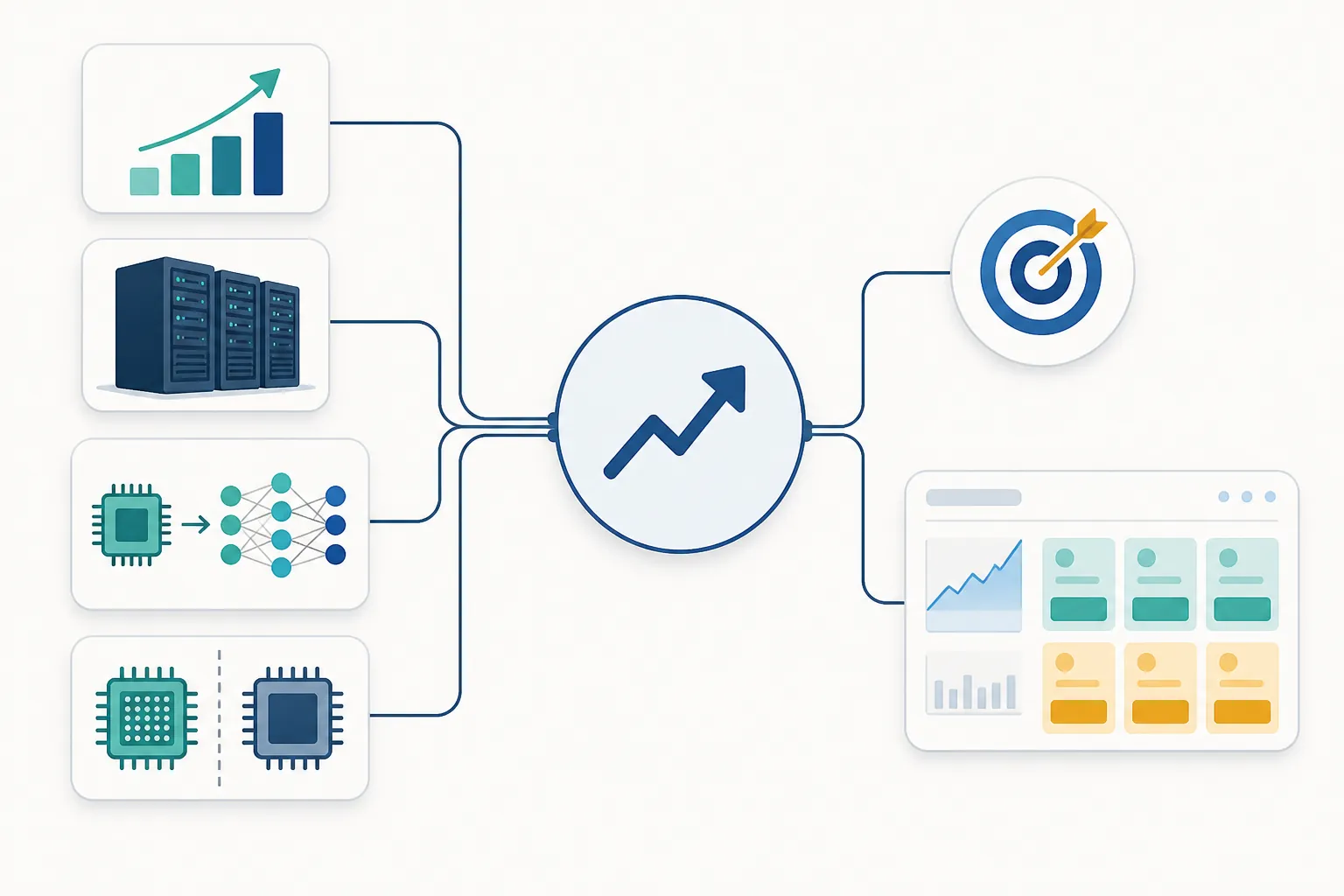
The cleanest bullish argument for media buyers is inference. Training builds or updates models; inference runs them. Ad platforms need inference for ranking, retrieval, creative assembly, bid prediction, budget pacing, audience expansion, measurement, and conversational interfaces. If inference demand expands faster than expected, it can support faster rollout of automation products and more frequent model refreshes.
That is why Baird’s $500 target is worth reading as more than a loud number. In the available materials, the raise is tied to a thesis that NVIDIA can capture more inference share after Q1 FY27. The useful media-buyer translation is not “NVIDIA up means ads get cheaper.” It is: if inference capacity is a durable bottleneck that NVIDIA helps relieve, platforms may have more room to ship AI features that depend on real-time model calls.
The first caveat is cost recovery. More inference can mean better tools, but someone pays for the compute. A platform can absorb the cost, offset it with efficiency, charge advertisers through product packaging, recover it through auction mechanics, or use it to defend margins elsewhere. A stock target does not tell you which path a platform will choose.
The second caveat is evidence quality. Dan Ives has been quoted with a Buy rating, a $300 target, a $250 end-of-2026 base case, a “12-to-1” demand-to-supply claim, and a view that only 15% of AI spending has gone through. Those figures should be treated as analyst opinion, not verified operating data. The firm attribution also conflicts across sources, so the safer use here is to label it as Ives’ quoted view rather than turn it into a firm-wide fact. [5]
For campaign operators, the test is not whether the phrase “AI demand” appears in an analyst note. The test is whether the note names the type of demand. Training demand, inference demand, sovereign AI demand, cloud resale demand, and networking demand do not map to ad products in the same way. Inference is the one most directly connected to real-time ad delivery, but even there, platform behavior decides how the economics reach the auction.
Custom chips are not a side note for ad buyers
The simple version of the story says NVIDIA demand rises, ad-platform AI improves, and everyone moves on. The operating version is messier because the largest ad platforms are also motivated to own more of their compute stack.
The dated bear-case evidence is specific. Alphabet’s TPU 8i was announced in April 2026 with Google claiming roughly 80% better inference per dollar. Amazon has Trainium. Meta has Broadcom-related custom-silicon work and reported TPU talks. FXOpen also cited customer concentration in NVIDIA’s Q1 FY27 revenue: three direct customers represented 21%, 17%, and 16% of revenue, or more than half combined. [2]
None of that proves NVIDIA loses the AI infrastructure market. It does mean ad-platform AI velocity may not equal unlimited NVIDIA upside. If Google can run more ad-serving inference on TPUs, the signal for Performance Max or AI Max may be different from the signal for NVIDIA gross demand. If Amazon shifts more workload to Trainium, Amazon Ads may still gain automation capacity even if a future NVIDIA estimate is less aggressive. If Meta’s custom silicon handles specific ranking or recommendation workloads, Advantage+ feature velocity may become less tightly tied to external GPU allocation.
That is why customer concentration deserves more attention than it gets in target-headline coverage. Concentration can make revenue more powerful in the near term and more fragile if a few large buyers alter mix, timing, or architecture. For media buyers, it also identifies whose infrastructure decisions deserve watching. The question is not just whether platforms are buying more compute. It is whether they are renting, buying, building, or vertically integrating the compute behind the campaign systems advertisers are asked to trust.
The custom-chip thread is also where NVIDIA overlaps with broader platform verticalization. If that is the concern, the better adjacent reads are the NVIDIA chip-export and ad-costs tracker and the AI ad-tools verticalization note, because those are closer to the ownership question than a single price target.
What to check after the print
After NVIDIA reports Q2 FY27, the target table will change. Some analysts will revise targets quickly. Aggregator averages will move. A high target may get higher, a low target may come up, or the whole range may widen. That first motion is not the part to overread.
The better sequence is to ask which input moved:
- Did Data Center revenue or Data Center networking change the view of broad AI infrastructure demand?
- Did hyperscaler capex guidance rise, narrow, or shift toward owned silicon?
- Did management or analysts separate inference demand from training demand?
- Did customer concentration become more or less important to the forward model?
- Did custom-chip evidence become a real estimate change or remain a cautionary paragraph?
Those inputs can then be compared with the things buyers can observe in-platform: rollout speed for Advantage+, Performance Max, AI Max, Amazon Ads automation, and Microsoft ad tools; changes to default settings; fewer or more manual controls; creative-generation quality; query expansion behavior; and auction metrics in the account. If auction costs move, the operating audit belongs in-account first, with help from the AI and digital ad-costs guide and the AI bubble paid-ads budget note, not in a target upgrade headline.
Price targets are unstable opinions built from estimates and multiples. The inputs underneath them are reusable operating signals. For media buyers, that is the only part of the NVIDIA target spread worth carrying back into a budget meeting.
References
- NVIDIA Stock Forecast and Price Target, MarketBeat
- Analytical NVIDIA Stock Price Targets, FXOpen, Aug. 12, 2026
- Nvidia Earnings, REX Shares
- NVIDIA Announces Financial Results for First Quarter Fiscal 2027, NVIDIA
- Dan Ives Is Still Bullish on Nvidia: We’re in the 3rd Inning of the AI Revolution and Demand Is Outpacing Supply 12-to-1, 24/7 Wall St., July 27, 2026
Primary source: https://www.marketbeat.com/stocks/NASDAQ/NVDA/price-target/