
AI Market Research Tools
A sourced guide to the documented limitations of AI market research tools — from synthetic data accuracy ceilings to demographic bias — helping practitioners evaluate tool investments with realistic risk assessments.
Marketing Categories
⚠ Notable Limitations
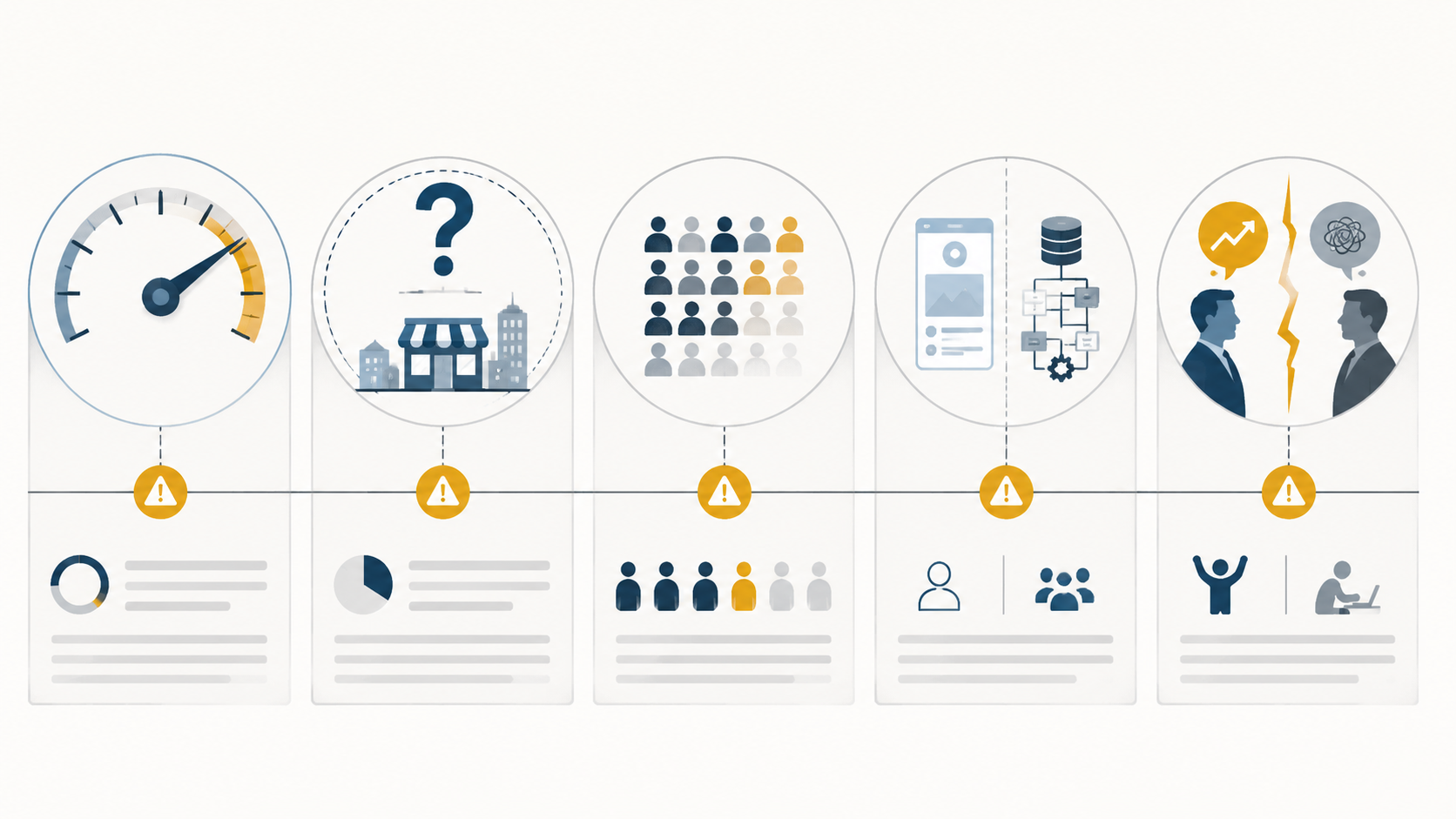
Synthetic accuracy ceiling, hallucination in niche markets, demographic bias, self-service vs enterprise quality gap, executive-practitioner trust gap
Market research AI tools now belong in the evaluation set for almost any modern insights, growth, or demand generation team. They can compress transcript review, summarize competitor messaging, scan public sources, generate hypotheses, and give a team something better than a blank slide before a planning meeting. The procurement question is no longer whether they are useful. It is where their outputs are strong enough to defend.
Five limitations deserve to sit in the buying discussion before a vendor dashboard gets turned into next quarter’s strategy: synthetic data accuracy ceilings, hallucination in niche markets, demographic bias in simulated opinions, the quality gap between self-service and professional-grade workflows, and a perception gap between executives and practitioners. None of those makes the category unusable. They do change which claims a tool should be allowed to make.
| Limitation | Where It Matters Most | Procurement Implication |
|---|---|---|
| Synthetic accuracy ceiling | Simulated respondents, digital twins, pricing tests, product-choice experiments | Ask for benchmark results against real samples before using outputs for decision-grade claims |
| Hallucination in niche markets | Local competitors, small B2B categories, regional market sizing, account-specific research | Require source provenance and spot checks before outputs enter sales, strategy, or positioning work |
| Demographic bias | Segment-level conclusions, political or values-sensitive categories, older or religious audiences | Check whether the tool can represent the population you actually sell to |
| Self-service versus enterprise quality gap | Methodology design, sample control, interpretation, governance | Do not price a lightweight assistant as if it replaces controlled research |
| Executive-practitioner perception gap | Adoption, trust, change management, budget defense | Plan how caveats will be communicated before leadership sees polished outputs |
The Synthetic Respondent Problem Is Not Just Philosophical
The most important limitation is also the easiest to understate in a sales conversation. Digital twins and simulated respondents can reproduce some human response patterns well enough to be useful for exploration. They can test rough message reactions, simulate preference patterns, and help teams see where a survey or interview guide may need sharper hypotheses. That is different from saying they can replace human evidence when the decision depends on the size, direction, or stability of an effect.
Columbia Business School’s discussion of generative AI in market research, along with a Harvard Business Review article on AI tools transforming the field, cites research in which digital twins reached about 85% to 88% relative accuracy when reproducing human responses, while capturing only about half of experimental effects.[1][2] That figure should not be treated as a universal benchmark for every vendor or every market. The underlying methodology and sample design still need to be checked before a buyer uses it as a procurement standard. But it is a useful caution: even when simulated respondents look directionally impressive, the missed effects are not a rounding error.

Missing experimental effects matters because many research decisions are not asking, “Can this tool sound like a plausible customer?” They are asking whether one message lifts purchase intent more than another, whether a new feature changes willingness to pay, whether a product concept performs differently in one segment, or whether a pricing move creates unacceptable demand loss. A synthetic average can be tidy while the actual decision variable is unstable.
Pricing research is the clearest warning case. The same Columbia and HBR coverage notes that LLM-generated demand curves from simulated price experiments produced implausible results.[1][2] For a team deciding whether to raise prices, bundle features, or reposition an offer, an implausible demand curve is not a minor caveat. It can send finance, product, and sales into a plan that no real buyer population supports.
That does not mean synthetic research has no place. It means the acceptable use case should be named. Synthetic outputs can help a team prepare better human research, pressure-test survey wording, explore possible objections, or generate early hypotheses. They are much harder to defend as the sole basis for price elasticity, segment sizing, or product-market fit claims. For a deeper treatment of those failure patterns, the narrower discussion of synthetic customer research risks is the right companion piece.
Hallucination Gets Worse When the Market Is Small, Local, or Poorly Documented
General-purpose AI tools are often strongest where public evidence is abundant: broad category trends, large competitors, common buyer objections, public messaging, and well-covered consumer behaviors. They become more fragile when the team asks for facts about a narrow industrial niche, a local competitor set, a private-company market, or a region where reliable public data is thin.
Factors.ai, in a second-hand synthesis of practitioner community discussions rather than a formal survey, describes a recurring complaint: ChatGPT-style tools can confidently make things up for niche B2B markets, including specifics about local competitors, company counts, and regional market data.[3] The attribution matters. This is practitioner-community evidence, not a controlled measurement of hallucination rates. Still, it reflects a procurement-relevant failure mode: the output often looks most authoritative when the reviewer has the least immediate basis to verify it.
The practical control is not to ban these tools from niche research. It is to change the standard of proof. If the tool is summarizing public competitor claims, the buyer should ask whether each claim links back to a retrievable source. If it is estimating market size, the team should separate sourced figures from model inference. If it is describing a local competitive landscape, someone needs to spot-check the names, locations, and business status before the output becomes a slide.
This is where a tool profile matters more than a category label. A product that is useful for open-web discovery, such as the kind of use case discussed in the Perplexity AI marketing research tool profile, should still be evaluated on source traceability, not just fluency. A fluent synthesis with weak provenance creates extra work for the practitioner who has to defend it.
Demographic Bias Changes Which Customers the Tool Appears to Understand
Bias in AI market research tools is not only a fairness issue. It is also a measurement issue. If simulated opinions overrepresent certain educational, ideological, or cultural patterns, the output can make one audience seem more representative than it is and make another audience look like an exception.
The Columbia and Stanford-linked research discussed in the HBR coverage found that LLM-simulated opinions skewed liberal and well educated, systematically underrepresenting older, religious, and politically conservative demographics.[1][2] That finding should be applied carefully; it does not prove every model, prompt, or tool will produce the same skew in every study. It does show why a buyer should ask how the tool handles population representation before accepting segment-level claims.
The risk is highest when the research question depends on differences between groups. A broad synthesis of common product complaints may tolerate some demographic imprecision. A messaging test for retirees, a values-sensitive brand study, a regional political-adjacent category, or a religious community segment cannot. In those cases, the tool is not just summarizing opinions; it is implicitly deciding whose opinions count.
A useful vendor answer is not “our model is unbiased.” A useful answer explains sampling logic, weighting, respondent sourcing, validation against real data, and where synthetic or AI-assisted components enter the workflow. If those controls are absent, the safer position is to treat the output as hypothesis generation rather than evidence about the market.
Self-Service Tools and Enterprise Workflows Are Not Selling the Same Assurance
A free or low-cost AI research assistant can be excellent value if the job is scanning, summarizing, clustering, or drafting. It becomes a problem when the organization quietly asks it to carry the same evidentiary burden as a controlled research program. The price difference is not only about interface polish. It usually reflects differences in methodology control, sample quality, governance, security, interpretability, and support.
Outset’s 2026 discussion of AI market research tools draws a useful line between what free or cheap tools can deliver and what professional research requires, including methodology design, sample quality, and interpretability.[4] That distinction is not vendor-neutral in the way an academic paper would be, but it is commercially realistic. A tool that helps a marketer prepare for a meeting is not automatically a tool that can support board-level customer evidence.
The pricing context reinforces the point. The market spans free tools, middle-tier platforms often described around the $50 to $150 per month range, and enterprise systems cited around $25,000 to $100,000 or more per year; traditional outsourced research is still commonly framed around $15,000 to $50,000 per project.[5][6][7] Those figures should be verified at the time of purchase because tool pricing changes quickly. The useful takeaway is the expectation gap: a lightweight subscription may reduce desk-research time, while an enterprise platform is more likely to be judged on whether it can govern a defensible research process.
That does not make the cheaper tool a bad buy. It may be exactly right for competitor monitoring, first-pass synthesis, content research, or internal brainstorming. The mistake is letting the lower-cost tool drift into decision-grade research without adding validation. The AI tools for market research validation framework is useful here because the evaluation should follow the decision, not the demo.
The Trust Gap Inside the Organization Is a Research Risk Too
AI adoption can look successful from the top of the organization while feeling much less settled to the people producing the work. That matters because research only creates value when stakeholders trust both the answer and the path used to reach it.
Qualtrics’ 2026 Market Research Trends Report, based on 3,000 researchers, found that 95% of researchers use AI tools. In the same report, only 44% of individual contributors said their organization relies more on research, compared with 72% of C-suite leaders.[8] That is not a simple anti-AI finding. It is a warning that executives may see adoption and assume confidence, while practitioners see unresolved questions about quality, interpretation, and organizational use.
The perception gap becomes visible after the dashboard is shared. Leadership may ask for a faster recommendation because the tool has already produced a polished readout. The insights manager may know the sample is thin, the source trail is incomplete, or the synthetic output has not been benchmarked. If those caveats are introduced late, they can sound like defensiveness rather than responsible interpretation.
This is why AI research governance is partly a communication problem. A team needs shared language for exploratory outputs, validated findings, and decision-grade evidence. The AI market research decision framework helps separate automation candidates from decisions that still need stronger human evidence.
Match the Tool to the Claim It Is Being Asked to Make
The cleanest evaluation question is not “Which market research AI tools are best?” It is “What kind of claim will this tool be used to make?” A tool can be strong for one claim type and risky for another.
| Claim Type | AI Output Can Usually Help With | Needs Stronger Validation Before Use |
|---|---|---|
| Exploratory synthesis | Summarizing transcripts, reviews, competitor pages, public objections | Claims about prevalence, causality, or market size |
| Hypothesis generation | Generating possible segments, motivations, objections, and research questions | Treating generated segments as real without customer evidence |
| Competitive intelligence | Scanning public messaging and surfacing positioning patterns | Private-company facts, local market counts, and unsourced competitor claims |
| Synthetic respondent research | Pre-testing ideas and identifying possible response patterns | Pricing sensitivity, demand curves, experimental effects, and final product decisions |
| Executive-ready insight | Drafting narratives and organizing evidence | Recommendations that require representative samples, controlled methods, or accountable interpretation |
This framing also makes ROI discussions more honest. A tool that saves analyst hours on synthesis can justify itself without pretending to replace custom research. A platform that claims to reduce or replace human sampling needs a higher validation burden. The companion piece on AI market research ROI for leadership should be read with that distinction intact.
How to Buy and Use These Tools Without Overclaiming
The operating discipline is straightforward, though not always convenient: keep the speed gains, but make the uncertainty visible before the output becomes strategy. The following controls are usually more useful than a generic vendor scorecard.
- Benchmark synthetic outputs against real samples before using them for pricing, product, or segmentation decisions.
- Run small human validation alongside AI-generated findings when the recommendation affects budget, positioning, roadmap, or sales strategy.
- Require source provenance for niche-market, local-market, and competitor-specific claims.
- Keep humans in the interpretation loop, especially when findings appear counterintuitive, unusually clean, or conveniently aligned with the preferred strategy.
- Label outputs by use case: exploratory, directional, validated, or decision-grade.
- Communicate caveats in the first readout, not after leadership has already adopted the conclusion.
The same logic applies to hallucination controls. Teams that need a broader record of documented AI failures in marketing can use the AI hallucination case registry to set review standards for public claims, citations, and factual assertions.
AI market research tools are worth buying when the team is clear about the work they are allowed to do. They can accelerate synthesis, improve preparation, widen scanning, and make research teams faster. The damage comes from unspoken limitations: a simulated effect treated as a measured one, a hallucinated market fact promoted into a sales narrative, a biased synthetic audience mistaken for the customer base, or a polished executive dashboard that practitioners do not trust enough to defend.
References
- The AI Tools That Are Transforming Market Research, Harvard Business Review, 2025.
- How Gen AI Is Transforming Market Research, Columbia Business School.
- 10 AI Market Research Tools Worth Using (Not Just Hype), Factors.ai.
- 14 AI Market Research Tools Worth Using in 2026, Outset, 2026.
- Sai by Simular pricing research, Simular.ai.
- AI market research tools pricing research, Jotform.
- GWI Spark pricing research, GWI.
- The 4 Market Research Trends Shaping 2026, Qualtrics, 2026.

Comments
Join the discussion with an anonymous comment.