

AI Advertising Agency
This guide provides a repeatable framework for marketing leaders to separate genuine AI-native ad agencies from those adding AI as a label, match agency type to specific advertising needs, and ask the right questions in evaluation meetings.
Marketing Categories
⚠ Notable Limitations
Requires careful human oversight; automation can amplify errors without governance
The awkward part of evaluating an AI advertising agency in 2026 is that the first question has become almost useless. If you ask, “Do you use AI?” the answer will almost certainly be yes. The more expensive mistake is stopping there.
One adoption snapshot makes the problem clear: 91% of US agencies actively use generative AI, while the dominant use cases remain much narrower—86% use it for brainstorming and 61.4% for content drafting. The same source reports lower use in areas where operational differentiation should be easier to see: about 31% for SEO and 25.7% for data optimization.[1]
That does not mean the category is fake. It means the label has collapsed. A traditional agency with a few AI-assisted drafting habits, a paid media shop using machine learning for forecasting, an AEO/GEO specialist optimizing for LLM visibility, and an enterprise partner rebuilding creative operations can all appear under the same search term. They are not interchangeable.
The useful evaluation question is more specific: where has the agency rebuilt the delivery system around AI, and where has it simply added AI to the vocabulary of the pitch?
Start with the bottleneck you are actually buying against
Before comparing decks, name the advertising constraint that created the search. The right agency model changes depending on whether the problem is creative volume, media allocation, search visibility, or cross-functional operating design.
| If the bottleneck is… | You are probably evaluating… | What should improve if the agency is real |
|---|---|---|
| Creative testing is too slow or too expensive | AI creative agency | More usable asset variations, faster review cycles, clearer learning from creative tests |
| Paid media decisions are too reactive | Predictive paid media shop | Earlier spend-shift recommendations, stronger forecasting discipline, tighter feedback between performance data and budget moves |
| Organic discovery is moving into AI answers and LLM citations | AEO/GEO specialist | Better visibility in AI-generated answers, more deliberate citation strategy, measurement beyond classic rank tracking |
| Teams, tools, approvals, and reporting are fragmented | Enterprise transformation partner | Redesigned workflows, governance, handoffs, and measurement systems across functions |
This framing also prevents a common procurement error: hiring the most impressive AI demo instead of the agency built for the constraint that is costing the business money. If your paid social team cannot produce enough compliant variations, a model-heavy media forecasting pitch may be interesting and still not solve the problem. If your category is losing visibility inside AI answers, a creative volume shop may create more assets without changing discovery.
For a broader pre-screening process across marketing vendors, this advertising-specific guide pairs well with a general AI marketing agency evaluation framework. Here, the focus is narrower: advertising operations, campaign learning loops, and proof quality.
The five places where real capability shows up
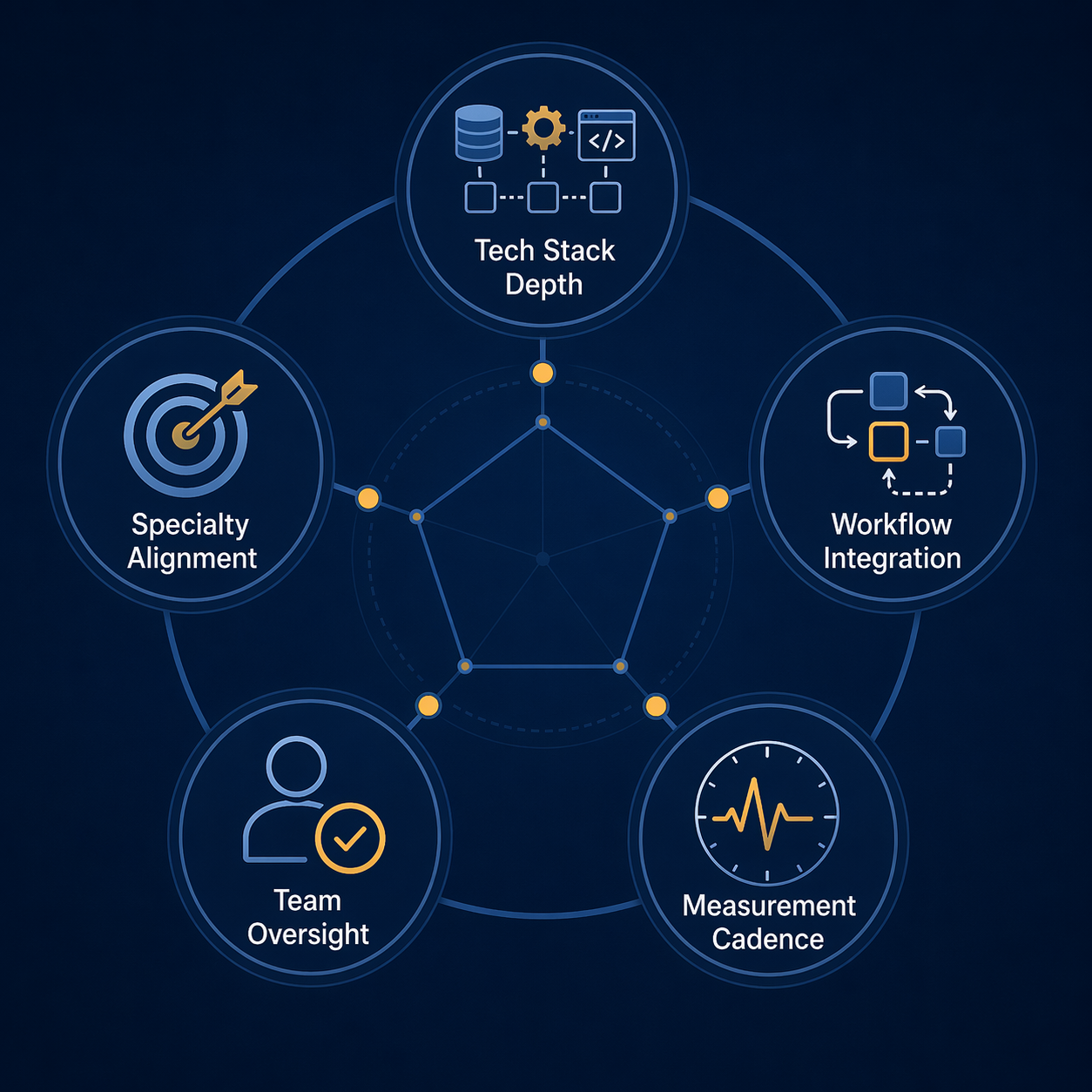
A credible AI advertising agency should be able to explain how work moves. Not just the tools it has licensed, and not just the outcomes it wants to be associated with, but the operating path between brief intake, asset or audience development, campaign launch, measurement, optimization, and human review.
1. Tech stack depth
A vague answer sounds like: “We use AI across strategy, creative, and optimization.” A useful answer names the systems involved, what each system does, what data it can access, what it cannot access, and which steps are automated versus assisted. Volado Labs draws a practical distinction here: real AI-first agencies can identify specific tools, pipelines, and automations, while surface-level shops tend to stay at the level of general AI claims.[2]
In a pitch meeting, ask:
- Which AI tools are used at each stage of campaign delivery?
- Which steps are automated, which are AI-assisted, and which remain fully human?
- What data sources feed the system, and what permissions are required?
- What happens when the model output is wrong, off-brand, noncompliant, or strategically weak?
The answer should be concrete enough that your team can picture the workflow. If the agency cannot describe the machinery behind the promise, you are buying a claim, not an operating model.
2. Workflow integration
AI can sit outside the process as a faster drafting assistant, or it can change the process itself. The difference is visible in handoffs. Who receives the brief? What is structured before generation begins? How are variants created? Who approves them? How are tests named, tagged, launched, and compared? Where do learnings go after a campaign ends?
A bolt-on workflow usually creates scattered outputs: disconnected drafting notes, disconnected creative options, manual naming conventions, and reporting that looks the same as it did before. An integrated workflow creates fewer mystery steps. The agency can show how an insight becomes a test, how a test becomes a launch, and how performance results feed the next round of creative or media decisions.
3. Measurement cadence
If AI is supposed to make advertising faster or smarter, the reporting system should capture more than final campaign performance. Ask how the agency measures cycle time, asset throughput, test velocity, forecast accuracy, approval delays, and learning reuse. Otherwise, “AI improved performance” becomes impossible to separate from seasonality, budget changes, channel mix, or a stronger offer.
The reporting rhythm matters as much as the dashboard. Weekly optimization meetings, creative test readouts, model-assisted recommendations, and post-campaign learning libraries each serve different decisions. An agency that cannot tell you when learning happens is unlikely to operationalize that learning consistently.
4. Team oversight
Human review should not appear as a soothing sentence near the end of the deck. It should have a location in the workflow. That means named review moments, defined escalation paths, and clear accountability for strategic judgment, brand fit, claims substantiation, compliance, and final launch approval.
The strongest agencies are not always the ones promising the most automation. In advertising, poorly governed automation can simply produce more wrong things faster. When the work touches targeting, claims, customer data, or regulated categories, the governance layer deserves the same scrutiny as the creative demo. For a deeper look at that risk, see the AI-targeted advertising governance gap.
5. Specialty alignment
Specialty fit is where many shortlists go sideways. A good AI creative agency, a good predictive media shop, and a good AEO/GEO specialist may all have sophisticated AI capabilities. They just apply them to different problems. The agency’s operating model should match the job you need done, not the most current phrase in its positioning.
There are also cases where an agency is not the right answer. If the need is primarily tooling, workflow standardization, or internal enablement rather than outsourced execution, compare the agency option against platform or hybrid models. The agency-versus-platform decision is a separate buying question, and this AI marketing companies comparison may be the better starting point.
Use the quadrant to avoid comparing unlike agencies
Digital Agency Network’s AI agency quadrant is useful because it separates agencies along two dimensions: AI Integration, from augmentation to transformation, and Value Focus, from creativity to efficiency. That produces four broad models: AI creative agencies, AEO/GEO specialists, predictive paid media shops, and enterprise transformation partners.[3]
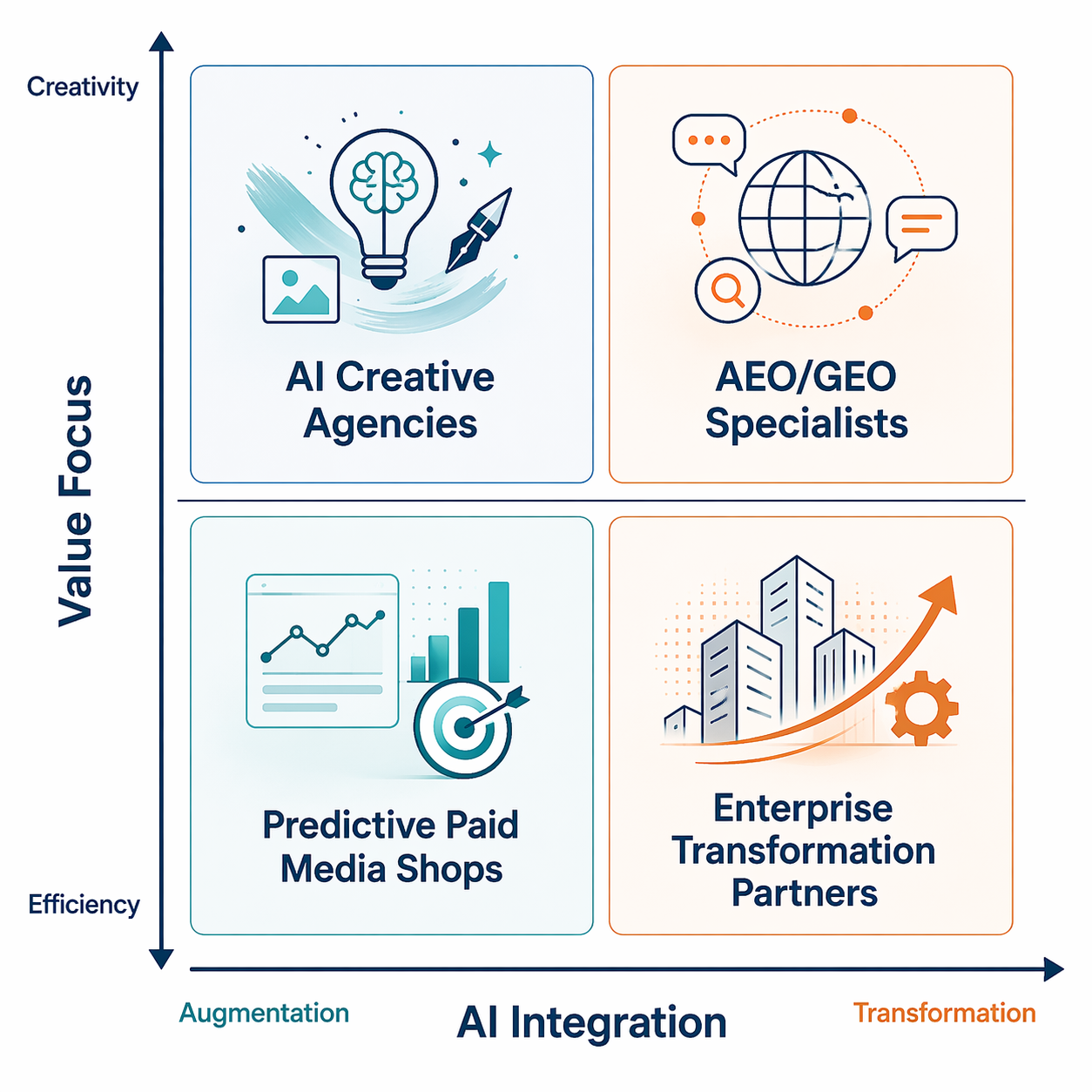
The quadrant is not a ranking system. It is a guardrail against category confusion.
AI creative agencies
This model fits when the business needs more creative variation, faster production, or a more disciplined test-and-learn loop across formats, audiences, and offers. The useful evidence is not just that the agency can generate images or copy. It is whether the agency can maintain brand consistency, version assets against a test plan, route approvals efficiently, and connect performance data back to the next creative batch.
The buying questions should stay operational:
- How do you turn one brief into a structured creative testing matrix?
- How many variants are strategically distinct versus cosmetic?
- Who checks brand, legal, claims, and channel fit before launch?
- How do creative learnings get reused instead of buried in a slide deck?
Predictive paid media shops
This model fits when the problem is budget movement, performance volatility, or delayed optimization. The agency should be able to explain how it forecasts shifts, what signals it uses, how recommendations are reviewed, and how often spend changes are made. “We optimize with AI” is too thin. Forecasting should have a decision path.
A predictive shop should also be clear about the boundary between model recommendation and media accountability. If the model suggests reallocating spend, who approves it? What level of confidence is required? What happens when a forecast is wrong? How is forecast accuracy reviewed over time?
AEO/GEO specialists
This model fits when the growth question is no longer only “Where do we rank?” but “Where are we cited, summarized, or omitted when AI systems answer buyer questions?” The adoption gap is part of the opportunity: while generative AI use is broad across agencies, reported use for SEO is much lower than brainstorming or drafting.[1]
Evaluation should focus on the specialist’s method for entity coverage, source credibility, content structure, citation monitoring, and LLM referral measurement. Classic SEO skill still matters, but AEO/GEO work adds a different visibility layer. Ask what the agency can measure directly, what it can only infer, and how it separates durable visibility gains from short-term volatility in AI answer behavior.
Enterprise transformation partners
This model fits when the work is larger than campaign execution. The problem may be fragmented martech, inconsistent governance, slow creative approvals, disconnected reporting, or teams duplicating work across brands and regions. The deliverable is not simply better ads; it is a redesigned operating system for producing, approving, launching, and learning from advertising.
These engagements require different proof. A case study about lower CPA may be relevant, but it is not enough. You need to see change-management capability, workflow design, stakeholder mapping, governance documentation, and a realistic implementation plan. The more enterprise the engagement, the more dangerous it is to confuse AI capability with organizational adoption.
What the market signals do—and do not—prove
There is enough market pressure to take the category seriously. Basis reports that 87% of agency professionals believe the traditional agency model is broken or will fundamentally change within three to five years.[4] That is an attitude signal from agency professionals, not proof that any specific AI agency will outperform your incumbent.
The same caution applies to case studies. They are useful for understanding what a capability type looks like in practice, but many are self-reported, promotional, or published by firms with a commercial interest in the category. Treat them as directional evidence unless independently audited.
Creative volume: Monks and Headspace
RZLT cites a Monks campaign for Headspace in which the agency produced 460 custom assets and reported a 62% higher conversion rate along with a 13% lower cost-per-signup.[5] That is the kind of example worth discussing in an evaluation meeting because it points to a real operating question: how does the agency generate high-volume variation without losing control of brand, message, compliance, and test structure?
The claim should not be generalized into “AI creative agencies drive 62% higher conversion.” The narrower lesson is better: ask the agency to show the production system behind its volume claims and how it connected asset variation to measurable learning.
Predictive media: Wpromote
RZLT also describes Wpromote as using machine learning to forecast spend shifts before performance drops.[5] The interesting part is not the phrase “machine learning.” It is the shift from reactive optimization to earlier decision support. If an agency claims a similar capability, ask to see the forecast-to-action loop: signal inputs, recommendation timing, human approval, budget-change rules, and review of forecast accuracy.
AEO/GEO: NoGood, SteelSeries, and Optimist
Omniscient Digital cites AEO/GEO-oriented results including NoGood achieving a 23x year-over-year AI search traffic increase for SteelSeries and Optimist seeing 49x growth in LLM referral revenue.[6] These are striking numbers, but they come from a source operating in the same commercial ecosystem, so they should be treated as directional rather than independently verified.
They are still useful because they show what a different proof pattern looks like. For AEO/GEO work, the evidence should move beyond rankings and into AI search traffic, LLM referrals, citation presence, and the quality of prompts or answer contexts where the brand appears.
The meeting questions that separate system from theater
A polished pitch can hide a shallow operating model. The best defense is to ask questions that force the agency to describe work at the level where delivery actually happens.
| Evaluation area | Ask this | A credible answer includes | A weak answer sounds like |
|---|---|---|---|
| Tech stack | Which tools and systems are used from brief to reporting? | Named tools, data access, model roles, automation boundaries, failure handling | “We use best-in-class AI tools across the process.” |
| Workflow | Show how a brief becomes launched campaigns and learnings. | Inputs, handoffs, approvals, launch steps, naming conventions, feedback loops | “AI helps us move faster.” |
| Measurement | What AI-specific operational metrics do you track? | Cycle time, asset throughput, test velocity, forecast accuracy, approval lag, learning reuse | “We report on ROAS and CPA.” |
| Oversight | Where does human review occur, and who owns final judgment? | Named review gates, escalation paths, compliance checks, strategic accountability | “Everything is reviewed by our team.” |
| Specialty fit | Which advertising problem are you best built to solve? | A clear primary model and honest limits outside that model | “We handle the full funnel with AI.” |
| Proof quality | Which results are independently verifiable, and which are case-study claims? | Clear distinction among audited data, platform data, self-reported results, and projections | “Our clients see transformational performance.” |
Do not rush past evasive answers. If the agency cannot explain the delivery mechanics during sales, it is unlikely to become more specific after the contract is signed.
Market size explains urgency, not vendor quality
The broader advertising market gives agencies plenty of incentive to reposition. JPMorgan projects US ad spend at $414.7 billion and cites digital as 69% of global ad spend.[7] McKinsey has projected that AI search could represent $750 billion in revenue by 2028, based on a US consumer panel and projection model.[8]
Those numbers explain why every agency wants an AI story. They do not tell you whether the agency across the table has a working system. Macro momentum is not a substitute for stack clarity, workflow evidence, reporting discipline, oversight design, and fit to your actual advertising constraint.
Cost and speed claims need the same restraint. Some agency materials publish aggressive price or volume benchmarks, but single-agency pricing anecdotes do not establish a market rate. If cost compression is part of the pitch, ask what is cheaper because the workflow changed, what is cheaper because scope changed, and what still requires senior human judgment. For a fuller cost and speed comparison, see AI marketing agency versus traditional agency economics.
A shortlist discipline for choosing an AI advertising agency
The cleanest shortlist process starts before the first vendor call:
- Define the advertising bottleneck: creative volume, paid media forecasting, AEO/GEO visibility, or enterprise workflow transformation.
- Match the bottleneck to the right agency model instead of comparing every AI-positioned agency against the same scorecard.
- Force specificity around tools, pipelines, automations, data inputs, and human review gates.
- Check whether reporting captures the promised operational improvement, not only final media metrics.
- Separate proof types: audited results, platform data, self-reported case studies, directional examples, and market projections.
The right agency is not the one with the loudest AI positioning. It is the one whose system fits the problem you need solved and whose team can show how that system works before you inherit it.
References
- How Ad Agencies Can Use AI to Win Clients and Protect Margins, StackAdapt
- AI Marketing Agency vs Traditional Agency: What's Actually Different, Volado Labs
- AI Agency Types 2026: The 4 Models Redefining Marketing and Automation, Digital Agency Network
- Top AI Advertising Platforms for Agencies in 2026, Basis
- Best AI Marketing Agencies in 2026: The Definitive Guide by Specialty, RZLT
- The 5 Best AI Marketing Agencies For B2B (2026 Update), Omniscient Digital
- How Advertising Agencies Compete in 2026: AI and Platforms, JPMorgan
- New Front Door to the Internet, McKinsey

Comments
Join the discussion with an anonymous comment.