

AI Marketing Agency
This article compares the cost structure, speed, and margins of AI-native marketing agencies versus traditional agencies, using sourced data to show where each model excels and where the differences are most pronounced.
Key Integrations
Marketing Categories
⚠ Notable Limitations
Not suited for brand strategy, crisis management, or regulated industries without strong human oversight
The useful question is not whether an AI marketing agency can be “as creative” as a traditional agency. That debate gets vague fast. The cleaner comparison is operational: where does the work sit, what does it cost to produce, and how much human review is required before a client can safely use the output?
A traditional agency usually scales by adding billable capacity: more copywriters, designers, strategists, account managers, producers, and revision time. An AI-native agency scales by standardizing workflows, generating first-pass work and variants through software, then concentrating human time around prompts, QA, strategy, client communication, and exceptions. That one architectural difference explains most of the gap in cost, speed, margins, and pricing.
The 2026 benchmark spread is large enough that buyers should not treat it as a minor tooling difference. Fractional Growth Exchange puts AI agency gross margins at 60–80% versus 30–50% for traditional agencies, with AI agencies breaking even in 1–3 months compared with 6–12 months for traditional agencies. The same source estimates AI agency revenue per employee at $200K–$400K+ versus $80K–$150K for traditional firms.[1] Digital Agency Network’s 2026 pricing guide reports that AI agencies often charge 30–50% less for comparable production deliverables, including traditional content retainers at $8K–$15K per month versus AI retainers at $3K–$7K per month for similar volume.[2]
| Comparison point | AI-native agency benchmark | Traditional agency benchmark | What the number is really measuring |
|---|---|---|---|
| Gross margin | 60–80%[1] | 30–50%[1] | How much delivery cost remains after the agency pays for production capacity |
| Break-even timeline | 1–3 months[1] | 6–12 months[1] | How quickly the operating model can cover its fixed delivery base |
| Revenue per employee | $200K–$400K+[1] | $80K–$150K[1] | How much client revenue each full-time employee can support |
| Production pricing | Often 30–50% lower for comparable production deliverables[2] | Higher labor-based retainers[2] | How much of the client fee is paying for human production hours |
| Content retainer example | $3K–$7K per month for similar volume[2] | $8K–$15K per month[2] | A practical view of the monthly buyer-side price gap |
| Ad variant production example | $8–$40 in tool spend plus under one hour of human review[3] | $500–$2,000 for one creator-shot variant[3] | The difference between software-assisted variation and human-shot production |
These are benchmarks, not audited financial statements. Several sources in this market are agency-adjacent, and actual pricing will move with category, reputation, geography, scope, and tolerance for risk. Still, the pattern is consistent: AI-native agencies are not simply discounting the same work. They are changing the cost category of a large share of production.
The cost difference starts with payroll substitution
Agency economics are unforgiving because payroll is both the product and the constraint. In a traditional model, the agency sells access to people’s time, then tries to keep those people utilized without overloading them. Every new client increases the need for production hours, account coordination, internal review, and revision handling. If the agency sells too much, quality drops. If it hires ahead of demand, margin drops.
That is why the payroll replacement example matters. Fractional Growth Exchange describes a model where roughly $35K in monthly payroll for copywriters, designers, and account managers is replaced by about $2K in AI tool subscriptions plus about $7K in part-time contractor support, with comparable output made possible through structured QA.[1] The point is not that humans disappear. The point is that the full-time production bench shrinks, and the remaining human labor is applied at different points in the workflow.
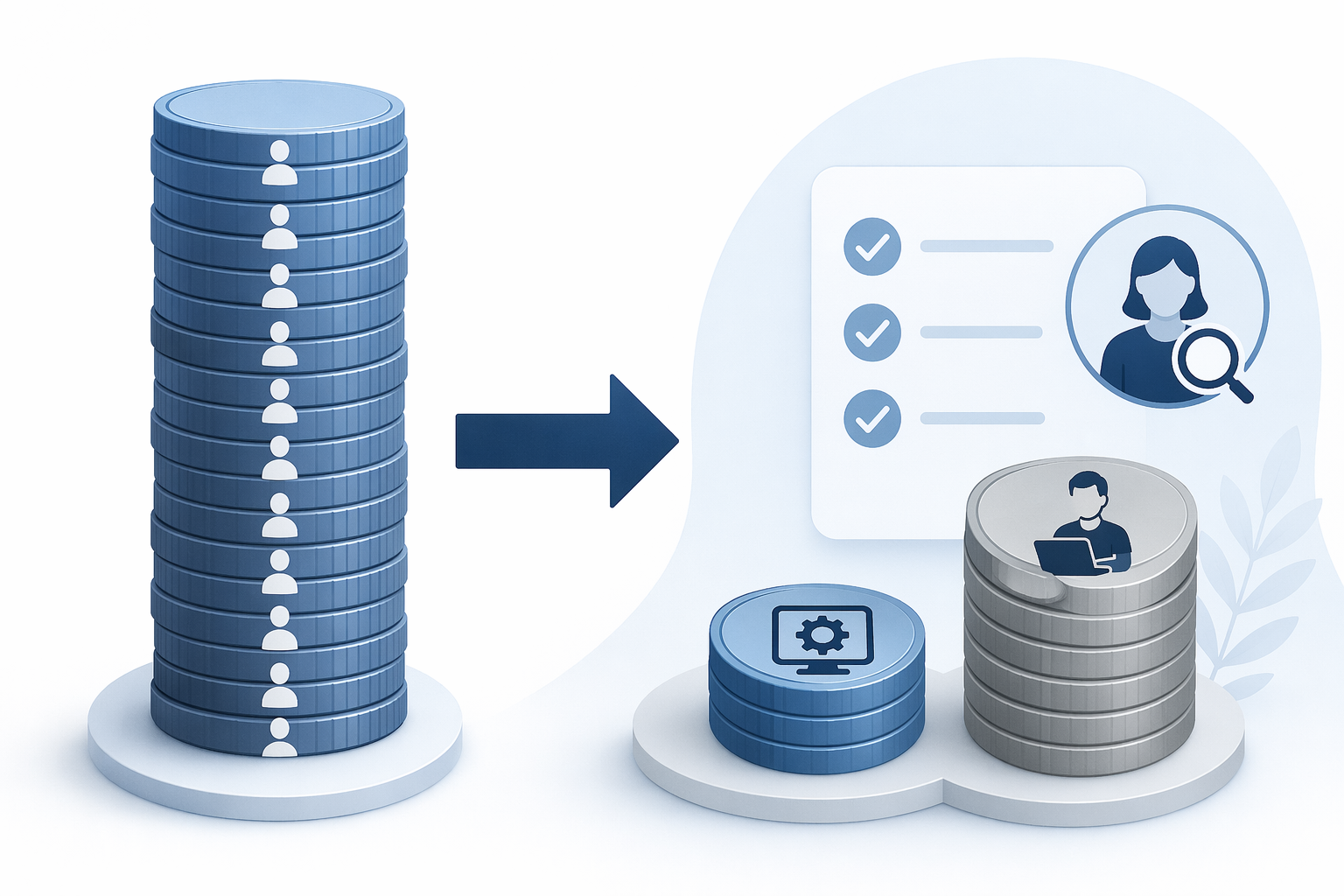
In the traditional version, a blog post, landing page, ad set, or email sequence tends to pass through a chain: brief intake, strategist framing, copy draft, design draft, account review, client review, revisions, and final packaging. In the AI-native version, the first-pass draft and many of the variants are generated by tools. Human time moves toward prompt design, source selection, editing, factual checking, brand fit, compliance review where needed, and client explanation.
That shift changes the margin math. A salaried specialist is a fixed or semi-fixed cost whether client work is smooth or messy. A software subscription is more elastic across volume, especially for repeatable assets. Part-time contractor support can be added around bottlenecks. If the agency has disciplined QA, it can push more production volume through a smaller permanent team. If it does not, the margin advantage can become a hidden liability: errors, bland work, rework, client churn, or account managers quietly absorbing the review burden.
That last part is where many AI agency pitches under-explain the model. “We use AI” is not an operating system. The operating system is the sequence of inputs, model use, human checks, escalation rules, brand memory, compliance boundaries, and client approval gates. Without that structure, the agency has only moved the mess earlier in the process.
Why lower retainers can still produce higher agency margins
For buyers, the obvious benefit is price. Digital Agency Network’s 2026 pricing guide places comparable AI-driven production retainers meaningfully below traditional retainers, with the 30–50% lower range appearing across comparable production deliverables.[2] The Remarkable Agency also reports 2026 AI marketing agency cost benchmarks by engagement type, reinforcing that AI-assisted services are commonly packaged into lower monthly tiers than traditional full-service engagements.[4]
But lower client price does not automatically mean lower agency profit. If a traditional agency charges $12K per month and consumes most of that fee through employee time, management layers, and revision cycles, its gross margin can be thinner than an AI-native agency charging $6K with a much lower delivery cost. That is the uncomfortable part for legacy firms: the buyer may pay less while the AI-native vendor keeps a healthier margin.
This is not magic. It is the substitution of variable software-assisted production for salaried production hours. In traditional agency terms, AI agencies are compressing the draft, variant, and assembly work that used to fill calendars. The remaining labor is more concentrated and, ideally, more senior: QA, editorial judgment, strategy, account interpretation, and exception handling.
The practical buyer-side question is whether the deliverable can tolerate that production architecture. A batch of paid social variants, product-description rewrites, SEO refreshes, or lifecycle email drafts may benefit from exactly this kind of throughput. A brand repositioning, investor-sensitive announcement, crisis response, or regulated claims review probably should not be treated as an output-volume problem.
Speed is mostly a revision-loop story
AI agencies are often described as faster because models generate quickly. That is true, but incomplete. The bigger speed gain comes from reducing the number of human handoffs required before the first reviewable version exists.
In a traditional production flow, the work waits for the right person’s queue. Copy waits for strategy. Design waits for copy. Account review waits for both. Revisions wait for whoever owns the next pass. Those waits are not signs of incompetence; they are the natural drag of specialized labor and client-service controls.
In an AI-native workflow, first-pass assembly can happen earlier and in parallel. The agency can generate multiple angles, formats, headlines, hooks, or creative versions before a specialist spends much time polishing. Human review then narrows the field rather than producing every option from scratch.
BattleBridge’s 2026 comparison makes the production-level spread concrete: one creator-shot ad variant is listed at $500–$2,000, while an AI pipeline variant is listed at $8–$40 in tool spend plus under one hour of human review.[3] That comparison should not be stretched into a claim that AI creative always performs as well as creator-shot work. It says something narrower and still important: when the task is producing more variants for testing, the cost and time floor can collapse.
This matters most in channels where learning depends on variation. Paid social, landing page tests, email subject lines, product copy, and short-form content all punish teams that can only afford a small number of polished attempts. If AI lets the agency review twenty usable directions instead of manually building three, the media or content team has more surface area to test. The human job becomes deciding which versions are on-brand, legally safe, strategically coherent, and worth putting in front of customers.
Where AI-native agencies are structurally advantaged
The best-fit work is production-heavy, repeatable, and reviewable. “Reviewable” is the key word. If a capable human can evaluate the output against a clear brief, brand guideline, source set, or performance objective, the AI-assisted model has room to work.
- Content refreshes where the topic, audience, and SEO intent are already known.
- Paid media creative variants where speed and volume improve testing capacity.
- Lifecycle email drafts and segmentation variants that still receive human QA.
- Landing page iterations based on an existing offer, message hierarchy, or campaign brief.
- Reporting summaries, first-pass insights, and client-ready packaging of recurring performance data.
Darkroom’s 2026 framing of an AI marketing agency emphasizes the use of artificial intelligence across marketing workflows such as content, creative, targeting, and optimization.[5] That broad definition is useful, but buyers need to push past the label. An agency that uses ChatGPT occasionally is not the same as an agency whose delivery model, staffing plan, QA system, and pricing are built around AI-assisted production.
The difference shows up in handoff risk. In a real AI-native model, the agency should be able to explain who writes the prompt, what source material the model can use, who reviews accuracy, who checks brand fit, who approves final claims, and what happens when the output falls outside the normal workflow. If those answers are vague, the buyer may be looking at an ordinary agency with an AI sales deck.
For a deeper vetting process, use the companion guide on how to evaluate an AI digital marketing agency. The structural economics only help if the agency can prove that its workflow is controlled, repeatable, and inspectable.
Where traditional agencies still earn their cost
Traditional agencies are easiest to criticize when they defend routine production hours as irreplaceable craft. That defense gets weaker every year for deliverables that are templated, variant-driven, or heavily dependent on first-pass assembly. But there are still categories where the traditional model’s cost structure is not just overhead. It is part of the risk control.

Brand strategy and positioning are the clearest examples. A positioning engagement is not valuable because a team can generate many taglines. It is valuable because the team can read the market, understand internal politics, interpret customer tension, make tradeoffs, and help leadership commit to a direction. AI can support research synthesis and option generation, but the accountable judgment still sits with people.
PR and crisis management are similar. The work is not merely drafting a statement. It involves stakeholder sequencing, legal coordination, media relationships, timing, tone, and escalation judgment. A faster draft is useful; a careless draft can be expensive.
Luxury and high-touch accounts also resist pure throughput logic. In those environments, the client often pays for taste, restraint, senior attention, and relationship depth. The deliverable may be small, but the expectation around judgment is high. The agency’s job is not to produce more; it is to know what not to produce.
Regulated industries add another boundary. Healthcare, finance, insurance, legal, and other compliance-sensitive categories may still use AI-assisted workflows, but the review layer needs to be stronger, slower, and more accountable. The savings from faster production can disappear quickly if claims are wrong, disclosures are missing, or approval trails are weak.
How to choose by work type, not agency ideology
The cleanest buying decision is rarely “AI agency or traditional agency?” It is usually a split by work type. Put high-volume, reviewable production into an AI-native or AI-enabled workflow. Keep ambiguous, reputation-sensitive, compliance-heavy, or executive-facing work closer to senior human teams.
| Work type | Better default fit | Why |
|---|---|---|
| Ad creative variants for testing | AI-native agency | The value comes from volume, speed, and disciplined review before launch. |
| SEO content refreshes | AI-native or hybrid agency | Existing intent, structure, and performance data make the work easier to brief and check. |
| Email and lifecycle campaign drafts | AI-native or hybrid agency | Variants can be generated quickly, while humans review offer logic, segmentation, and brand voice. |
| Brand positioning | Traditional or senior strategy-led team | The hard part is judgment, tradeoff management, and leadership alignment. |
| PR and crisis response | Traditional specialist agency | Relationship depth, timing, legal coordination, and reputational judgment matter more than draft speed. |
| Regulated industry campaigns | Traditional or tightly governed hybrid team | AI may assist production, but compliance review and approval trails need to dominate the workflow. |
| Luxury or high-touch brand work | Traditional or boutique senior team | Taste, restraint, and client trust can matter more than production efficiency. |
A practical hybrid model often looks like this: a senior strategy team owns positioning, message architecture, campaign direction, and final judgment; an AI-native production partner turns approved direction into content, variants, and reporting assets; the client keeps clear approval rights over claims, brand voice, and sensitive messages. That structure uses AI where the economics are strongest without pretending every marketing problem is a production problem.
This also gives buyers a cleaner way to compare proposals. A traditional agency charging more for senior strategic work may be worth it. A traditional agency charging more for routine variant production deserves scrutiny. An AI agency charging less for production may be a strong fit. An AI agency promising strategic equivalence without showing its senior review process deserves the same scrutiny.
The margin advantage is real, but it has to be governed
The 2026 data points in one direction: AI-native agencies can operate with higher gross margins, faster break-even timelines, higher revenue per employee, and lower buyer-side production pricing than traditional agencies.[1][2] The mechanism is not mysterious. Repetitive production moves from salaried specialists into software-assisted workflows, while humans concentrate around review, judgment, and client handling.
That makes AI-native agencies structurally advantaged for production-heavy marketing work. It does not make them automatically better partners for every marketing problem. The more a project depends on taste, trust, compliance, stakeholder management, or reputational judgment, the less useful the pure cost comparison becomes.
For many buyers, the right answer is not to replace one agency ideology with another. It is to move repeatable production into AI-assisted workflows, keep strategic and high-touch work under senior human control, and verify that any agency calling itself AI-native can show the operating system behind the claim.
References
- AI Agency vs. Traditional Marketing Agency: Key Differences — Fractional Growth Exchange, 2026.
- AI Agency Pricing Guide 2026: Models, Costs & Comparison — Digital Agency Network, 2026.
- The True Cost of a Marketing Agency in 2026: Agency vs. AI vs. In-House — BattleBridge, 2026.
- How Much Does an AI Marketing Agency Cost in 2026? — The Remarkable Agency, 2026.
- What Is an AI Marketing Agency? Definition, Benefits, and Examples — Darkroom Agency, 2026.

Comments
Join the discussion with an anonymous comment.