

How to Evaluate an AI Digital Marketing Agency: The Real Criteria for 2026
Marketing managers face a landscape of agencies claiming AI expertise. This article provides five specific, verifiable criteria to separate genuine AI-native agencies from those simply rebranding, with concrete evaluation questions for procurement conversations.
Two agencies can use the same words in a pitch deck and still sell very different delivery systems. That is the procurement problem in 2026: the labels have become cheap, but the operating model has not. If you need a taxonomy first, the site’s AI digital agency types framework is the cleaner way to place a vendor before you start scoring the pitch.
The five questions that matter before the contract is signed
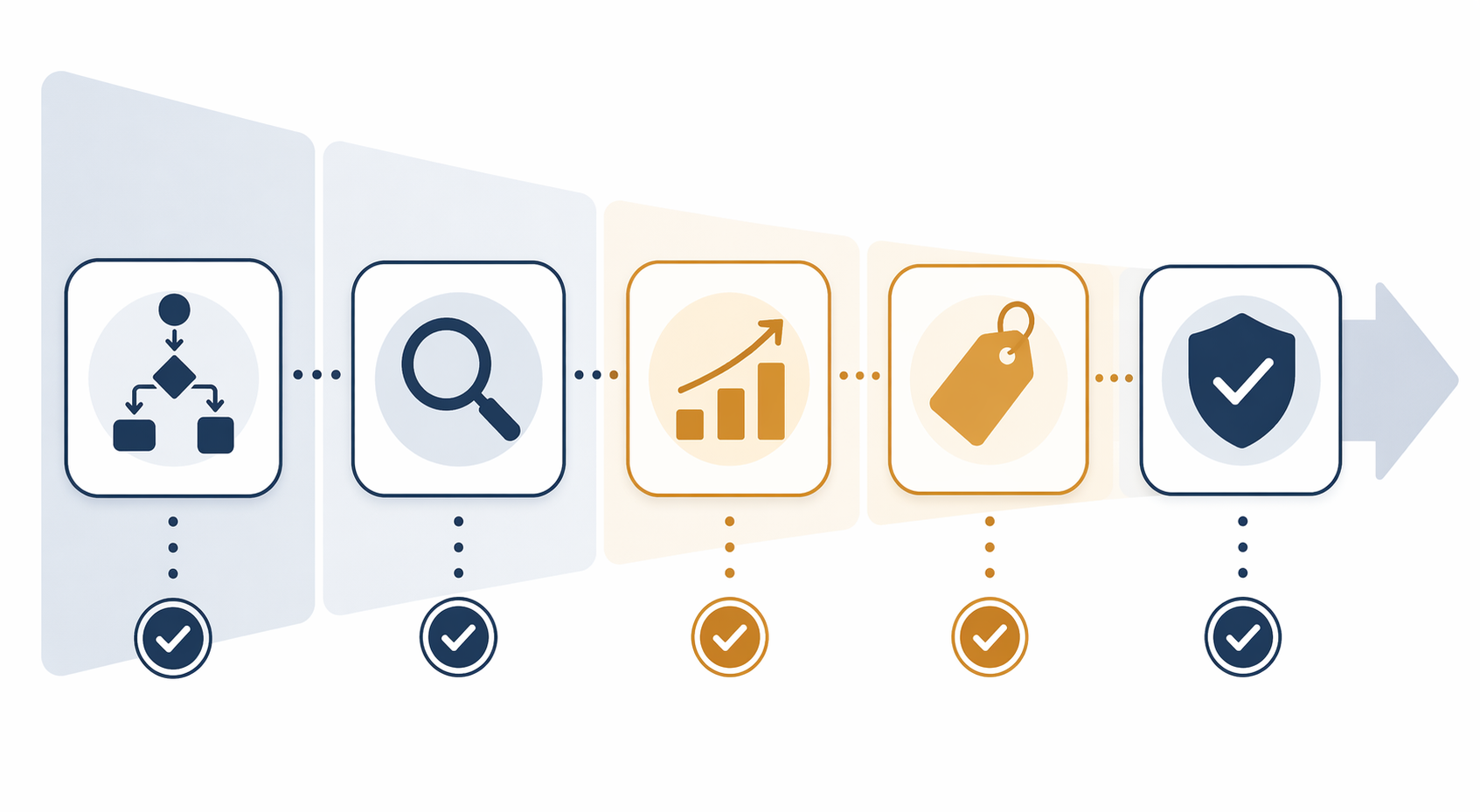
The useful filter is not “which agency sounds most AI-native?” It is whether the agency can answer five practical questions without drifting back into marketing language: how the work moves, where it shows up in AI search, what business result it influenced, how the price is built, and who has authority to stop a bad output.
- Workflow depth: can they show how AI changes the delivery chain, not just the copy draft?
- GEO/AEO capability: can they name the AI-search surfaces and queries where a client actually appears?
- Revenue attribution: can they connect the work to pipeline, SQLs, or revenue instead of impressions and word count?
- Pricing transparency: can they explain what the price covers and why it is structured that way?
- Human QA: can they show who reviews, where the review happens, and who can override the model?
1) Workflow depth: ask how work moves, not what tools they use
This is where the polished deck usually gives itself away. A rebranded traditional shop will talk about AI-assisted drafting, faster production, and “AI-assisted” workflows, but the handoffs stay the same: strategist, copy lead, editor, approver, reporting deck. BattleBridge’s contrast is useful because it describes a different structure altogether — a single-operator model in which one operator plus AI systems can replace five or six humans touching one process [1].
That does not mean every good agency should look identical to BattleBridge. It does mean the agency should be able to show where the workflow changed. Ask them to walk through one asset from brief to publish: who touches it, where the model drafts or revises, where humans intervene, and where the process can be stopped. If they only describe a productivity layer on top of the old approval chain, they are selling acceleration, not a rebuilt delivery model.
A practical discovery question is: “What work disappears because of AI, and what work remains human?” The answer should be operational, not philosophical. If the agency cannot describe the exact sequence, it is hard to believe it has changed the economics of delivery.
2) GEO/AEO capability: ask for named search surfaces and named appearances
This is where the category gets especially noisy. The market now throws around GEO, AEO, LLM SEO, and AI search optimization as if the terminology itself were proof of capability. It is not. The stronger test is whether the agency can name the surfaces where it has influenced visibility — ChatGPT, Perplexity, or Google AI Overviews — and the queries tied to those appearances [2].
That matters because buyers are already starting their research there. Omniscient, citing G2’s 2026 AI Search Insight Report, says 51% of B2B buyers start with AI chatbots [2]. That does not prove every agency needs a separate AI search program, and it does not mean classic SEO has stopped mattering. It does mean a vendor claiming AI-search expertise should be able to show evidence, not just vocabulary.
The question to ask is specific: “Which client names appear in which AI surfaces, for which queries, and what changed to cause that visibility?” If the answer stays at the level of keyword clusters, content depth, or “we optimize for the model,” you are probably hearing SEO with a new label rather than a demonstrable GEO/AEO practice.
3) Revenue attribution: make them leave vanity metrics behind
A lot of AI agency case studies still stop at the easy numbers: impressions, content volume, response time, or output velocity. Those can be useful internally, but they are not enough for leadership review. Automaton’s comparison piece is valuable precisely because it frames ROI in business terms rather than production theater [3].
The procurement question is not whether the agency can make content faster. It is whether it can trace that work to pipeline influence, SQLs, or revenue with a time window you can defend in front of finance. Ask for one case study that shows the measurement path end to end: what was attributed, what was influenced, what was merely correlated, and what evidence the agency used to separate those categories.
This is also where polished ambiguity becomes expensive six months later. If the only proof available is a busier editorial calendar, the agency has not actually solved the problem leadership will care about.
4) Pricing transparency: the refusal to explain the model is part of the signal
Pricing in this category is messy, and the mess is informative. Some agencies publish pricing pages or range guidance; others keep everything behind a discovery call and then present “custom” as if that were a strategy. Digital Agency Network, Hashmeta, and Fractional Growth Exchange all show how wide the published pricing conversation is, which is exactly why pricing logic matters more than a single number [4][5][6].
The useful expectation is not a universal rate card. It is a pricing model you can understand. Published ranges in the market span from roughly $2,500–$10,000 per month for SMB retainer work to $50,000–$200,000+ per month for enterprise retainers, while narrow production-heavy work can land materially below a conventional full-service team; mixed engagements are usually more realistic when priced at about 40–70% of traditional cost rather than at the lowest headline claim [1][3][4][5][6].
The practical question is simple: what is cheaper because AI is doing real work, and what still costs what it costs because a human is doing it? If the agency cannot explain whether pricing tracks headcount, output volume, model usage, or review load, it is not ready to be compared with transparent competitors.
5) Human QA: ask who can stop the system
This is the part that sounds boring until it fails. Automation looks clean in a deck, but the real question is where judgment enters and whether it has authority. Automaton, citing McKinsey, says roughly 77% of AI pilots fail to show measurable return, largely because production tooling is applied to non-production problems without human judgment structures [3]. The sourcing limitation matters here: it is a second-hand citation, not an independently verified McKinsey report in this brief.
The procurement test should be concrete: who reviews the output, at what stage, by what standard, and with what power to override the model? A real QA protocol can name the reviewer, the checkpoint, the exception process, and the fallback if the model drifts. If the answer is just “we have humans in the loop,” that phrase has become too cheap to mean much.
Brand voice failures are one visible symptom, which is why documented cases of AI brand voice inconsistency are worth keeping close when you are evaluating this part of the stack. The important point is not that AI is unreliable in general; it is that the agency must show the control system that keeps your account from inheriting its mistakes.
By the time a vendor can answer these five questions with actual process detail, the pitch has moved out of the slogan zone. The real distinction in 2026 is not which agency says “AI” most often, but which one can verify the workflow, the search surface, the attribution path, the pricing logic, and the human override before you sign.
References
- BattleBridge, “AI Marketing Agency vs. Traditional Agency: The Real Difference in 2026” — BattleBridge — https://battlebridge.com/blog/ai-marketing-agency-vs-traditional-agency-the-real-difference-in-2026/
- Omniscient Digital, “The 5 Best AI Marketing Agencies For B2B (2026 Update)” — Omniscient Digital — https://beomniscient.com/blog/best-ai-marketing-agencies/
- Automaton, “AI Marketing Agency vs Traditional Agency: ROI Comparison” — Automaton — https://automatonagency.com/insights/ai-marketing-agency-vs-traditional-agency-roi
- Digital Agency Network pricing guide — Digital Agency Network — https://digitalagencynetwork.com/ai-agency-pricing/
- Hashmeta AI pricing — Hashmeta AI — https://www.hashmeta.ai/en/ai-seo/ai-marketing-pricing
- Fractional Growth Exchange, “AI Agency vs. Traditional Marketing Agency” — Fractional Growth Exchange — https://www.fractionalgrowthexchange.com/blog/ai-agency-vs-traditional-marketing-agency

Comments
Join the discussion with an anonymous comment.