

AI Digital Agency
Most AI digital agencies promise speed and cost savings, but they introduce four categories of risk — data privacy exposure, content homogenization, automation over-reliance, and expectation mismatches — that traditional agency partnerships don't. This article provides a vetting framework based on governance practices, not tool claims, helping senior marketers evaluate agency partners with evidence-based criteria.
Marketing Categories
The pitch usually sounds reasonable at first: an AI digital agency can produce more assets, test more variants, cut production time, and reduce cost. For a senior marketing team being asked to do more with the same headcount, that is not a trivial promise.
The real question is not whether the agency uses AI. Most serious marketing teams already do, in some form. The question is what could break when AI enters the workflow, and who is accountable when it does.
That distinction matters because “AI agency” now covers very different operating models. Some agencies are genuinely AI-native: they have rebuilt research, creative production, media testing, reporting, and approval workflows around AI-assisted systems. Others are traditional shops with a few subscriptions, a refreshed sales deck, and a loose claim that they have “proprietary AI workflows.” The risk profile is not the same.
A rebranded traditional agency may overstate capability. An AI-native agency may move faster than the client’s internal review, legal, brand, or security process can absorb. Both can be useful. Both can create messes. The buyer’s job is to separate tool usage from governance.
Speed is the sales case. Governance is the operating case.
Most AI agency pitches spend too much time on the visible layer: tools, dashboards, asset volume, turnaround time, and examples of polished output. Those are not irrelevant. They are just insufficient. A fast production system without clear data boundaries, review gates, brand controls, and escalation rules can hand the client a larger pile of work to inspect, correct, defend, or explain.
The market is still immature enough that buyers should not assume deep operational integration just because an agency sounds fluent. Superside’s 2026 Overcommitted Report says only 2% of creative teams have fully integrated AI into their workflows, a useful signal even with the caveat that it is vendor-published and not independently verified in the materials here.[1]
That does not mean most agencies are bluffing. It does mean a buyer should ask for proof of process before accepting claims of transformation. A good AI digital agency should be able to show how work moves from input to model-assisted production to human judgment to client approval. If it can only name the tools, the buyer has learned very little.
For a related agency-specific screen, see How to Evaluate an AI Advertising Agency: Distinguishing Real Capability from Rebranding. The same basic principle applies here: capability is evidenced by operating behavior, not by AI vocabulary.
The four risks worth vetting
The hidden risks of working with an AI digital agency usually cluster into four categories. They are not abstract ethics-deck risks. They show up in ordinary marketing operations: a strategist pastes confidential context into an online tool, a campaign sounds like everyone else’s campaign, an automated recommendation misses a market shift, or leadership expects AI to remove work that still requires judgment.
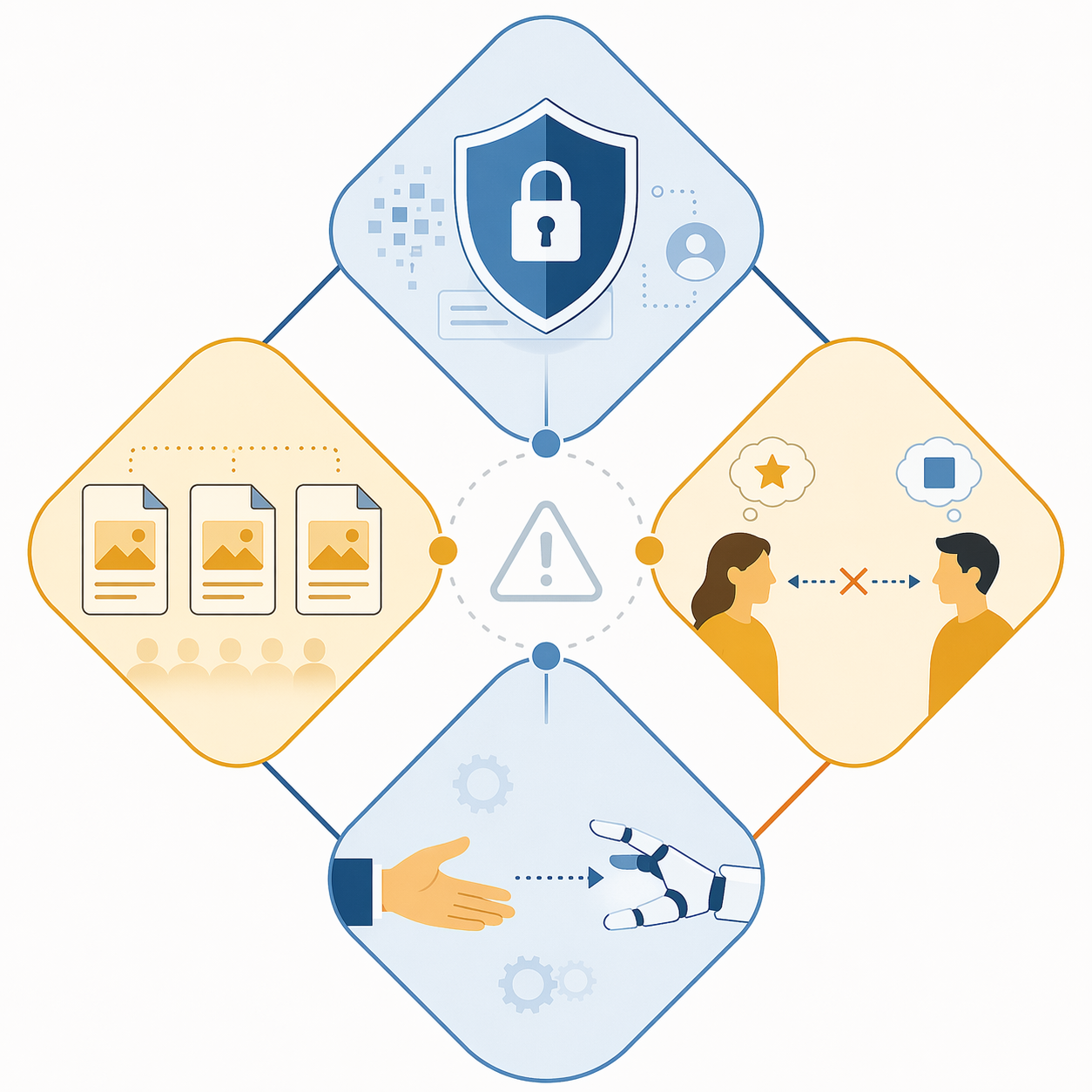
| Risk category | What can go wrong | What a serious agency should show |
|---|---|---|
| Data privacy exposure | Client data, campaign plans, customer details, or internal strategy are entered into tools without clear controls. | AI usage policy, data classification rules, approved tool list, access controls, and client-specific handling boundaries. |
| Content homogenization | AI-assisted output becomes competent but generic, with weak brand voice and similar patterns across clients. | Brand voice system, human editorial review, examples of rejected outputs, and testing criteria beyond production volume. |
| Automation over-reliance | The agency follows model outputs or automated recommendations when market behavior changes or context is missing. | Override rules, senior review points, strategy refresh cadence, and documented cases where humans changed the machine-assisted path. |
| Expectation mismatch | The client expects AI to eliminate strategic work, review time, or uncertainty; the agency sells speed without explaining tradeoffs. | Clear scope, assumptions, review responsibilities, quality thresholds, and realistic performance language. |
Data privacy exposure is the hardest risk to see in a portfolio
A portfolio can show whether an agency produces attractive work. It rarely shows where client data went while that work was being produced.
This is the first place to slow the pitch down. An AI-assisted workflow may touch campaign briefs, audience segments, CRM exports, interview transcripts, competitive strategy, product roadmap context, media performance data, customer complaints, sales objections, or unpublished launch plans. Some of that information is harmless in isolation. Some of it is exactly the material a client would never want casually pasted into a public online tool.
Digital Agency Network identified data privacy violations as a top concern for agencies using AI and warned that online AI tools can be a source of data theft and spyware.[2] That claim should not be stretched into “all AI tools are unsafe.” The practical reading is narrower and more useful: buyers need to know which tools are approved, which data is allowed inside them, and what the agency forbids.
A serious agency should be able to answer these questions without improvising:
- What categories of client data are never entered into AI tools?
- Which AI tools are approved for client work, and who approves additions to that list?
- Are team members allowed to use personal AI accounts for client work?
- How does the agency separate data between clients?
- What happens when a client provides regulated, sensitive, or contract-restricted information?
- Can the agency provide a written AI data handling policy before kickoff?
The last question is doing more work than it appears. If the agency has no written policy, every project depends on individual judgment under deadline pressure. That is not a governance model; it is hope with a login.
Risk appetite will vary. A B2C apparel brand testing public social copy may accept more AI-assisted experimentation than a healthcare, financial services, legal, cybersecurity, or enterprise B2B company handling sensitive customer or product information. A solo consultant may not have the same documentation stack as a 50-person agency. But even a small shop can say, clearly, what it will not put into a model and how it handles client material.
The evidence to request
Ask for artifacts, not reassurance. The useful evidence is mundane: an AI acceptable-use policy, a sample project workflow, a data classification table, a list of approved tools, a security questionnaire response, or contract language that explains AI tool usage. If the agency says the policy is “internal,” ask for a redacted version. If it cannot share even the structure, assume the structure may not exist.
Content homogenization is not a taste problem
The least dramatic AI failure is often the most expensive one: the work is fine. The copy is grammatical. The design is clean. The campaign rationale sounds plausible. Nothing is obviously broken, and yet the output could belong to almost any brand in the category.
Marketers saw this risk early. In Neil Patel’s 2023 survey of 1,000 U.S. digital marketers, 12.1% said they were concerned that AI-generated content sounds too similar across different websites and sources.[3] The caveat matters: this is U.S.-only survey data from 2023, and it measures reported concern, not actual content performance. Still, it is directionally useful because the concern maps directly to what clients now see in review cycles: generic polish.
The problem is not that AI cannot support distinctive work. It can help generate angles, variants, outlines, edits, and production drafts. The problem begins when the agency treats first-pass fluency as market-ready quality. Brand voice, category tension, customer language, competitive positioning, timing, and cultural context still need human pressure.
This is where an agency’s review workflow matters more than its model choice. Fractional Growth Exchange argues that credible AI agencies route every deliverable through experienced marketers before it reaches the client.[4] That is the right standard to test in conversation: not “Do humans review it?” but “Which humans, at which stage, against which criteria?”
A weak answer sounds like: “Everything is reviewed by our team.” A stronger answer names the stages. For example: strategy lead approves the brief, editor checks voice and claims, channel specialist reviews format and platform fit, account lead verifies client context, and only then does the client see the work. The point is not bureaucracy. The point is that someone with judgment has the authority to stop a competent-looking asset before it becomes the client’s problem.
How to test for sameness before signing
Do not only ask for the agency’s best AI-assisted samples. Ask for the system behind them.
- Ask to see how the agency builds a brand voice guide for AI-assisted production.
- Ask for before-and-after examples showing raw AI-assisted output and the human-edited final version.
- Ask what types of AI output the agency commonly rejects.
- Ask how the agency prevents two clients in the same category from receiving structurally similar messaging.
- Ask who owns final editorial judgment when speed and brand nuance conflict.
The most revealing artifact may be a rejected draft. Agencies are comfortable showing what worked. Mature teams can also explain what they refused to ship.
Automation over-reliance shows up when the market moves
Automation is useful when the problem is repetitive, the inputs are clean, and the decision rules are stable. Marketing rarely stays in that condition for long.
Digital Agency Network points to abrupt shifts in consumer behavior, using COVID-19 as the canonical example of a change that AI models can struggle to handle.[2] That is a fair operational warning. Models and automated systems are often better at extending patterns than interpreting a break in the pattern. When demand changes, sentiment changes, regulation changes, or a category conversation turns, the agency needs a human mechanism for noticing that the old assumptions are no longer safe.
Neil Patel’s 2023 survey also found that 14.5% of respondents cited over-dependence on AI as their biggest concern.[3] Again, this is a reported concern from a specific sample and time period, not proof that a given AI agency will over-automate. But it is enough to justify sharper vetting, especially when an agency sells “set it and scale it” as though marketing judgment were mainly a bottleneck to remove.
The buyer should look for override design. Who can pause an automated campaign recommendation? Who reviews performance anomalies? How often are assumptions refreshed? What external signals are monitored beyond platform data? When does the strategist step back in?
A practical test is to ask the agency to walk through a hypothetical disruption. Keep it simple: a competitor cuts price, a customer complaint starts spreading, a new compliance interpretation affects ad claims, or an economic event changes purchase urgency. The agency does not need to predict the future. It needs to show where the workflow stops, who evaluates the change, and how quickly live work can be adjusted.
This is also where the skills issue becomes visible. AI tools can accelerate a weak operator’s output, but they do not automatically create the judgment to know when the output is wrong for the moment. For more on that gap, see Why Your AI Marketing Tools Are Underdelivering.
Expectation mismatch is created before the work begins
Some AI agency failures are born in the proposal. The agency promises faster production. The client hears lower total effort. The agency promises more variants. The client hears better results. The agency promises AI-assisted strategy. The client hears fewer senior people needed.
Those are different promises.
A responsible AI digital agency should separate production efficiency from performance certainty. AI may help produce more creative options, build faster first drafts, summarize research, generate reporting narratives, or identify patterns. None of that guarantees positioning quality, channel-market fit, legal acceptability, sales impact, or brand trust.
Hashmeta’s 2026 checklist for choosing an AI marketing agency emphasizes practical evaluation areas such as goals, expertise, transparency, customization, data privacy, integration, scalability, communication, pricing, and case studies.[5] The useful lesson is not that buyers need a ten-part procurement ritual. It is that expectation-setting has to be explicit: what the agency is optimizing for, what the client still owns, and what AI does not solve.
Before signing, the client should know:
- Which parts of the engagement are AI-assisted and which are human-led.
- Whether AI changes pricing, timelines, or simply the agency’s internal margin.
- How many review rounds are expected and who participates.
- What quality bar must be met before work reaches the client.
- What performance claims are assumptions rather than guarantees.
- What happens if AI-assisted work creates rework for the in-house team.
That last point deserves attention. The cost of a poor AI workflow often lands inside the client organization. Brand, legal, product marketing, sales, and channel owners become the cleanup crew. A cheaper agency fee is not cheaper if internal teams spend the saved budget in review time.
Ask for the workflow, not the tool stack

Tool questions are easy to answer and easy to overvalue. An agency can name advanced tools and still have weak controls. It can use ordinary tools and have excellent discipline. The better line of questioning follows the work.
| Weak vetting question | Better vetting question |
|---|---|
| Which AI tools do you use? | Which tools are approved for which types of client data, and where is that policy documented? |
| Can AI make our content faster? | What review gates prevent fast content from becoming generic or off-brand? |
| How much can we automate? | Where do humans override automated recommendations, and who has authority to pause work? |
| Can you show AI-generated samples? | Can you show raw drafts, edits, rejected outputs, and the final approval path? |
| Will AI reduce cost? | Which costs decrease, which review responsibilities remain, and what assumptions are built into the estimate? |
The agency does not need a perfect answer to every question in a first conversation. It does need a coherent operating model. If every answer depends on “our team just knows how to handle that,” the buyer is being asked to trust undocumented habits.
The artifacts that separate maturity from theater
Procurement theater is easy to create: a long questionnaire, a few generic security answers, a polished slide on responsible AI. Useful friction is more specific. Ask for artifacts that would exist only if the agency has actually operationalized AI.
- AI data handling policy: what can and cannot be entered into AI systems.
- Approved tool list: which platforms are allowed for which tasks.
- Workflow map: where AI assists, where humans review, and where clients approve.
- Brand voice protocol: how the agency translates client voice into prompts, examples, rules, and review criteria.
- Quality control rubric: how outputs are judged before delivery.
- Escalation rules: what happens when AI output is inaccurate, risky, off-brand, duplicative, or strategically weak.
- Expectation document: what AI is expected to improve and what it is not expected to solve.
If the engagement includes paid media, creative testing, or production at scale, it is worth reviewing a governed workflow model before the statement of work is finalized. The AI Creative Advertising Playbook offers a useful structure for thinking about those handoffs.
How to read agency proof without being dazzled by it
Case studies are useful, but AI agency case studies often blur together three different claims: the agency used AI, the work was produced faster, and the business result improved. Those claims should be separated.
A case study that proves production efficiency does not automatically prove strategic quality. A case study that shows more variants does not automatically show better learning. A case study that reports performance improvement may not isolate AI as the cause. The buyer does not need to be cynical; just precise.
When reviewing proof, ask what changed because of AI:
- Did cycle time decrease?
- Did the number of creative or message variants increase?
- Did review time increase or decrease?
- Did senior strategy time move earlier in the process or disappear from it?
- Did the client’s internal team spend less time clarifying, correcting, or rewriting?
- Were results measured against a relevant baseline?
If the agency can answer only with output volume, it has proved productivity, not necessarily partnership quality. For realistic ranges of AI marketing outcomes, see What Companies Actually Get from AI Marketing.
Red flags that should slow or stop the deal
Not every weakness is disqualifying. A small agency may have a lightweight policy. A new AI-native shop may still be refining documentation. But some answers create unnecessary risk for the client.
- The agency refuses to explain where client data goes.
- Team members are allowed to use personal AI accounts for client work without restrictions.
- The agency claims its AI workflow is proprietary and therefore cannot be described at the process level.
- Human review is mentioned, but no one can identify who reviews what.
- The agency cannot show how brand voice is encoded, checked, or protected.
- Every efficiency claim is framed as a client benefit, but review responsibilities are vague.
- The agency treats AI-assisted production as a substitute for strategy, customer understanding, or channel expertise.
- The pitch promises speed and cost savings but avoids tradeoffs.
The most important red flag is not the use of AI. It is casualness around AI. A partner that moves quickly can be valuable. A partner that moves quickly without boundaries transfers risk downstream.
A defensible buyer standard
The standard does not need to be complicated. A good AI digital agency can explain five things in plain operational terms:
- Data boundaries: what information enters AI systems, what never does, and how access is controlled.
- Human review: which experienced people inspect work before the client sees it.
- Quality controls: how the agency prevents generic, inaccurate, off-brand, or strategically weak output.
- Adaptability practices: how the agency notices market shifts and overrides automation.
- Expectation discipline: what AI is expected to improve, what remains uncertain, and what the client still needs to review.
If an agency can show those practices with real artifacts, AI becomes an operating advantage rather than a fog machine. If it can only name tools and promise speed, the buyer has not found a partner. They have found an automation wrapper.
References
- Overcommitted Report — Superside — 2026 — https://www.superside.com/blog/ai-powered-agencies
- Problems AI Can Cause in Digital Agencies: What to Watch Out For — Digital Agency Network — 2023 — https://digitalagencynetwork.com/problems-ai-can-cause-in-digital-agencies-what-to-watch-out-for/
- Disadvantages of AI in Marketing — Neil Patel — 2023 — https://neilpatel.com/blog/disadvantages-of-ai-marketing/
- AI Agency vs Traditional Marketing Agency — Fractional Growth Exchange — 2026 — https://fractionalgrowthexchange.com/blog/ai-agency-vs-traditional-marketing-agency
- How to Choose an AI Marketing Agency: 10-Point Checklist for Success — Hashmeta — 2026 — https://hashmeta.com/blog/how-to-choose-an-ai-marketing-agency-10-point-checklist-for-success/

Comments
Join the discussion with an anonymous comment.