
How to Build an AI Topic Map for Content Strategy: A Step-by-Step Guide
Learn what an AI topic map is, how it differs from a keyword list, and follow a repeatable 5-step process to build one using tools like ChatGPT and Google NotebookLM — no dedicated platform required for your first pass.
A keyword export is not a content strategy. It is a raw material pile: terms, volumes, difficulty scores, intent labels, maybe a few SERP features if the tool was feeling generous. Useful, yes. Decisive, no.
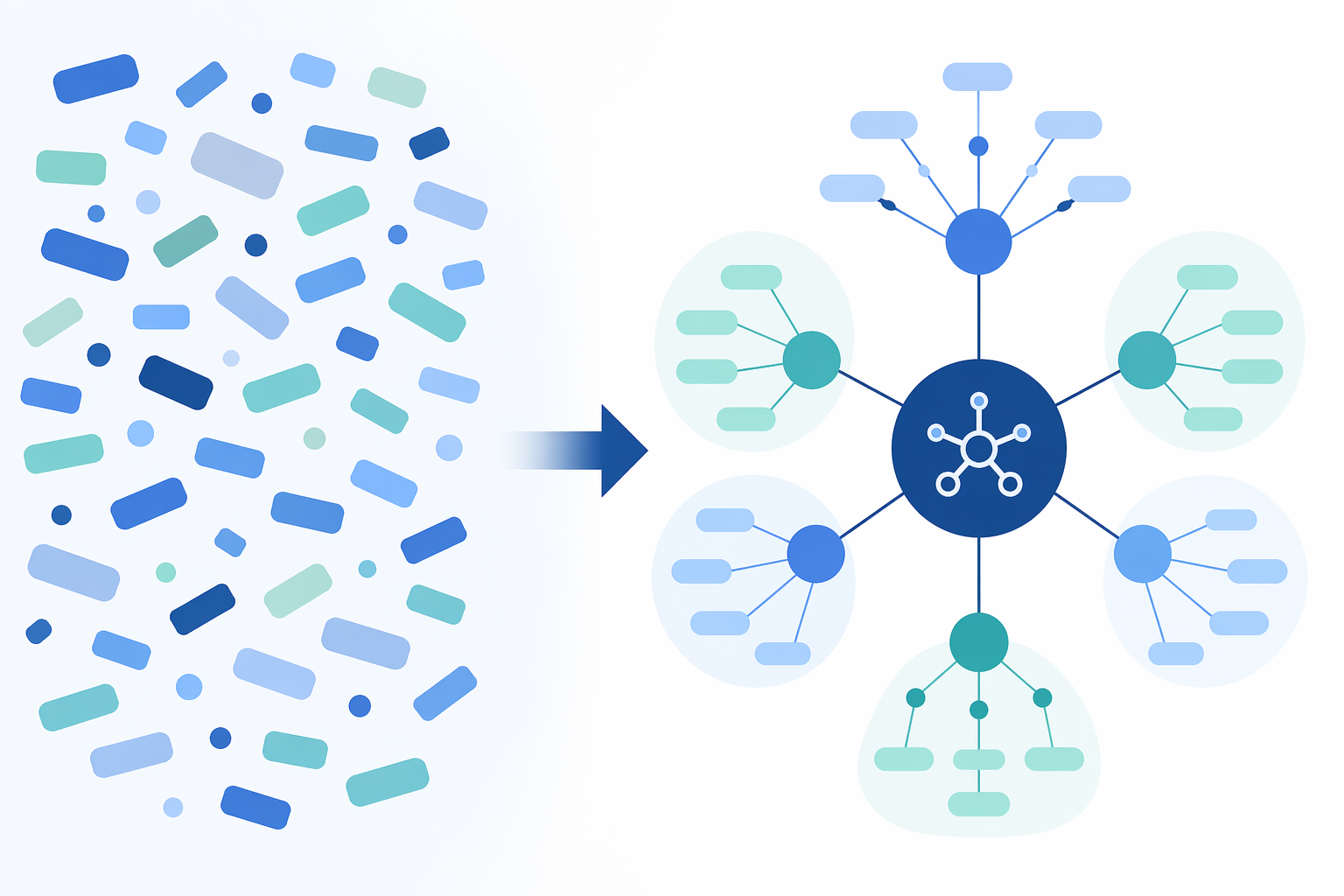
An AI topic map for content strategy starts one level higher. It shows the territory a brand should be known for, the entities that belong inside that territory, the pillar pages that can carry authority, the spoke articles that prove coverage, and the places where search engines or AI answer systems may need a better source to cite.
That distinction matters because topic mapping has moved beyond grouping near-duplicate keywords. Conductor describes its AI Topic Map as a way to see how large language models perceive a site's topical authority and brand presence across topics, not just how one URL ranks for one query. MarketMuse approaches the same problem through topic modeling, generating related concepts around a seed topic so a strategist can judge coverage, gaps, and cluster depth rather than stare at isolated keyword rows. [1][2]
The first useful version does not require a dedicated topic intelligence platform. For a first pass, ChatGPT, Google NotebookLM, your existing keyword data, and a sober competitive SERP review are enough to build a working map. It will not be perfect. It should not be treated as a canonical data warehouse. But it can help a team choose what to publish, what to ignore, and how to defend that choice in a planning meeting.
Keyword List, Topic Cluster, AI Topic Map: The Difference That Changes the Work
A keyword list answers: what are people searching? A topic cluster answers: which related pages should support a pillar? An AI topic map answers a more operational question: what content territory can we credibly own, and which pages would prove that ownership to search engines, readers, and AI answer systems?
| Asset | What it usually contains | What it helps decide | Where it fails |
|---|---|---|---|
| Keyword list | Queries, volume, difficulty, intent, current rank | Which search terms may deserve attention | It does not show authority, entity coverage, or architecture |
| Topic cluster | One pillar topic with supporting spoke articles | How to organize related content around a central page | It can become a tidy diagram with no prioritization logic |
| AI topic map | Root topic, entity boundaries, pillars, spokes, scores, internal links, AI citation opportunities | What to publish, what to skip, how to sequence work, and how to refresh the roadmap | It is only as good as the source material, scoring discipline, and human review behind it |
The map is not more strategic because it has more nodes. It is more strategic because it forces boundaries. A useful map says, “This belongs in our content territory,” “This is adjacent but not ours,” and “This topic looks tempting in the spreadsheet but will not help us build authority.”
That last sentence is where most bloated keyword universes quietly die. If a topic map cannot help you say no, it is decoration.
The Five-Step Workflow
The workflow is simple enough to run this week, but it needs discipline in the first three steps. The map becomes useful before it becomes beautiful.
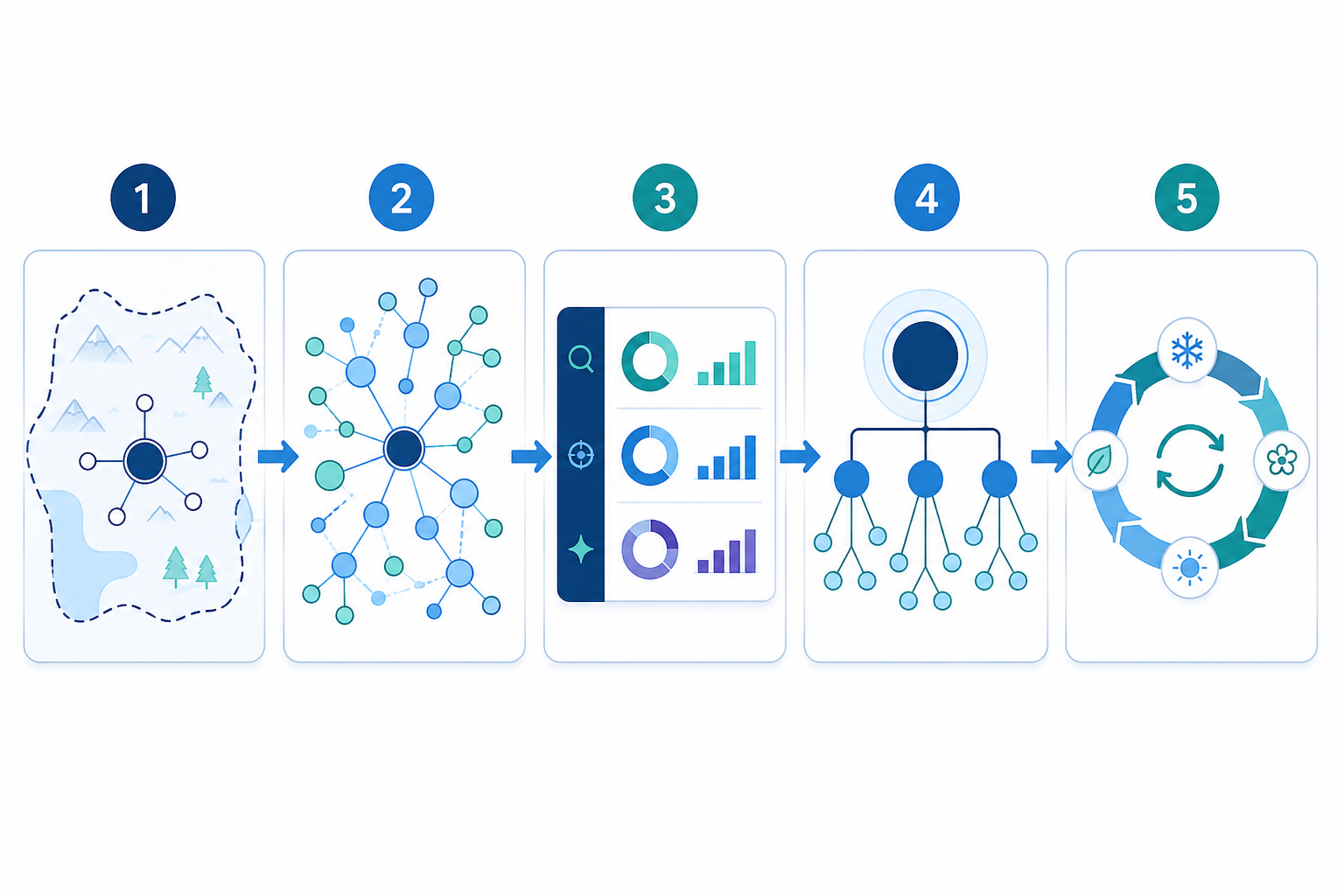
- Define the content territory: root topic, audience, entity boundaries, and exclusions.
- Generate the topic model: use AI to expand, group, and pressure-test the territory.
- Score candidate topics: separate audience demand, competitive gap, and AI citation opportunity.
- Visualize the architecture: choose pillars, spokes, and internal link paths.
- Operationalize the map: turn it into briefs, a calendar, and a quarterly refresh routine.
Step 1: Define the Content Territory Before You Ask AI for Ideas
Do not start by asking ChatGPT for “100 topics about customer retention” or “a full topic cluster for marketing automation.” That produces a pile of plausible headings. It does not produce a strategy.
Start with a territory statement. It should be narrow enough to constrain the map and broad enough to support more than one pillar. A good working format is:
We want to build authority around [root topic] for [audience] who need to [job/problem], with content focused on [included entities] and excluding [out-of-scope entities].For a hypothetical B2B SaaS company selling customer education software, the root topic might be “customer education strategy.” Included entities could be onboarding programs, product academies, certification, LMS integrations, activation metrics, support deflection, and customer success enablement. Exclusions might include K-12 education, employee training, and generic instructional design unless those topics directly support the buyer's decision.
Those exclusions are not housekeeping. They protect the map from becoming a landfill. Without them, AI tools will happily drift into every semantically related topic that sounds reasonable. The strategist's job is to decide which relationships matter for this brand, this audience, and this quarter.
Build the boundary document
Create a short source document before generating anything. It should include the root topic, target audience, product or service boundaries, priority business outcomes, current high-performing URLs, known competitors, and obvious non-goals. If you already have sales notes, customer questions, product messaging, or support themes, include those too.
- Root topic: the broad authority area the brand wants to own.
- Core entities: people, products, problems, methods, metrics, tools, and concepts that belong in the territory.
- Adjacent entities: related topics that may deserve a page only when they support the root topic.
- Excluded entities: topics that should not enter the map unless there is a clear strategic reason.
- Commercial connection: the point at which the topic helps a reader make progress toward a buying, adoption, or implementation decision.
This is also where the May 2024 Google API leak is worth treating carefully. Analysis of the leaked documentation has pointed to site-level attributes such as siteFocusScore and siteRadius, which suggest Google has ways to evaluate how concentrated a site is around a core subject. The weighting and operational use are not confirmed, and Google cautioned that the leaked documentation lacks context. The practical takeaway is narrower: topical concentration is worth designing for, but the leak is not a recipe book for rankings. [3]
Step 2: Generate the Topic Model With AI, Then Make It Prove Its Work
Once the territory is bounded, AI becomes useful. ChatGPT can expand the topic universe quickly. NotebookLM can ground that expansion in uploaded source material instead of relying only on model memory. Neither tool should get to decide the strategy; both can shorten the distance between messy inputs and a reviewable map.
Upload or paste the boundary document, existing keyword exports, top-performing content URLs, customer research, sales call themes, product positioning, and a small set of competitor pages. In NotebookLM, use sources you trust: your own site, approved messaging, research notes, and selected competitor pages. Then ask for entity extraction, topic grouping, and missing-coverage suggestions.
Using only the source material provided, identify the core entities, adjacent entities, recurring audience problems, and candidate content topics related to [root topic]. Group the topics into possible pillar areas. For each topic, explain why it belongs in the territory and which source material supports it. Flag any topic that seems adjacent or out of scope.That last instruction matters: “flag any topic that seems adjacent or out of scope.” If the model cannot separate central topics from attractive distractions, the map will look comprehensive while quietly wasting production capacity.
ChatGPT is better for iterative expansion and restructuring. Ask it to generate multiple grouping options, not one definitive answer. One model might organize the territory by buyer journey. Another might organize it by use case. A third might organize it by entity type. The point is not to accept the first taxonomy. The point is to see which structure creates publishable decisions.
Create three alternative topic models for this content territory:
1. Organized by audience problem.
2. Organized by product or solution use case.
3. Organized by entity relationship.

For each model, list the likely pillar topics, supporting spoke topics, and topics that should be excluded. Then recommend the model that would be easiest to turn into a 90-day content roadmap.
If you want a more tactical prompt pattern for clustering from seed keywords, use an AI keyword clustering prompt template as a companion workflow. Just do not mistake the cluster output for the finished topic map. Clustering is one input; strategy starts when you decide what belongs, what leads, what supports, and what gets cut.
What the first model should contain
The first-pass model should not be a beautiful diagram yet. A spreadsheet is usually better because scoring comes next. Create one row per candidate topic and add these columns:
| Column | What to capture |
|---|---|
| Candidate topic | The article, guide, glossary page, comparison, template, or pillar idea |
| Topic type | Pillar, spoke, glossary, comparison, template, case study, or refresh |
| Parent pillar | The larger authority area this topic supports |
| Primary entity | The main concept, product, role, problem, or method the page should clarify |
| Search intent | Informational, commercial, navigational, transactional, or mixed |
| Audience job | The practical task the reader is trying to complete |
| Existing URL | Current page to refresh, consolidate, or protect |
| SERP competitors | Pages currently shaping the visible answer set |
| Notes | Why this topic belongs, or why it may be risky |
MarketMuse's discussion of topic modeling is useful here because it treats a seed topic as the start of a semantic field, not as a single target phrase. Its models can surface dozens of related terms around a topic, which is helpful when you are testing whether a proposed pillar has enough conceptual depth to support multiple pages. [2]
Step 3: Score Candidate Topics Separately, or the Map Will Lie to You
This is where a topic map becomes a planning document. Do not collapse everything into one vague “priority” score too early. A topic can have strong demand and a terrible competitive gap. Another can have low search volume and high AI citation potential. A third can be strategically necessary because it supports a pillar, even if it will never be the traffic hero.

Use three separate scores first: demand, competitive gap, and AI citation opportunity. Then create a combined priority score only after the individual judgments are visible.
Demand: Is there a real audience pull?
Demand is not just search volume. It is the evidence that enough people care about the problem, ask it in recognizable language, and would benefit from a page your team can credibly publish.
- Search volume and trend direction from your SEO tool.
- Paid search presence, which can signal commercial interest.
- Sales and support frequency: how often the topic appears in real conversations.
- Content utility: whether a reader can take a concrete next step after reading.
- Business relevance: whether the topic connects to a product, service, workflow, or buying decision.
A low-volume topic can still earn a high demand score if it appears constantly in sales calls and sits near a buying decision. A high-volume topic can earn a low score if it is broad, educational, and commercially irrelevant. The map should reflect the market you serve, not the biggest number in the export.
Competitive gap: Can we add something the visible results do not already satisfy?
Competitive gap analysis starts with the SERP, but it should not end with domain authority envy. Open the top results and look for the shape of the answer. Are they all definitions? Are they listicles? Are they product pages pretending to be guides? Are they old? Are they thin on examples, data, workflows, or decision criteria?
Score the gap higher when your team can publish something materially better: a clearer process, a stronger template, fresher examples, better internal expertise, or a more useful comparison. Score it lower when the top results already satisfy the intent and your version would only rearrange the same advice.
| Gap signal | What it suggests |
|---|---|
| Top results are broad and generic | A focused, practitioner-level page may compete |
| Results ignore a key audience segment | An audience-specific or use-case-specific spoke may be valuable |
| Results lack examples or templates | A practical asset can create differentiation |
| Results are dominated by strong specialist sites | The topic may still belong, but sequencing matters |
| Your site already has a related page ranking on page two | Refresh or consolidate before creating a new URL |
This is also where content mapping methods from seoClarity are useful: compare current coverage against the topics your audience needs and the topics competitors already answer, then separate missing pages from underperforming pages. A missing topic and a weak existing URL are different production tasks. [4]
AI citation opportunity: Would an answer engine need this page?
AI citation opportunity belongs in the scoring model because search visibility is no longer limited to classic blue-link rankings. Third-party seoClarity research reported that AI Overviews appeared on 48% of Google queries as of February 2026 and reached 2 billion monthly users. Treat those as industry-tool estimates, not Google-published numbers, but do not ignore the workflow implication: more informational queries now have an answer layer sitting above or alongside traditional results. [5]
AI answer systems tend to reward pages that are easy to extract from: clear structure, direct answers, original or well-attributed statistics, definitions, comparisons, steps, and evidence near the top of the page. Position Digital's 2026 AI SEO statistics reported that 44.2% of LLM citations come from the first 30% of text, and that content with statistics sees 28–40% higher visibility in AI search. Those figures do not prove that adding numbers magically earns citations; they do suggest that buried evidence is wasted evidence. [6]
Score AI citation opportunity higher when the topic has a question-answer shape, weak existing AI-visible sources, a need for current statistics, or a format that can provide concise extractable explanations. Score it lower when the topic is purely navigational, highly brand-specific, or better served by a product page than an explanatory resource.
If you are still sorting out the difference between optimizing for traditional search and being discoverable in AI-generated answers, the deeper issue is covered in ChatGPT and AI discovery content strategy. For this workflow, the important point is simpler: citation potential is not the same thing as search volume, so it deserves its own column.
A practical scoring model
Use a 1–5 score for each dimension at first. You can make it more sophisticated later. The goal is not statistical purity; the goal is to make tradeoffs visible before the roadmap meeting.
| Score | Demand | Competitive gap | AI citation opportunity |
|---|---|---|---|
| 1 | Little evidence of audience need | SERP is strong and fully satisfies intent | Unlikely to be cited or summarized by AI systems |
| 3 | Moderate search or customer evidence | Some openings in angle, freshness, or format | Could be cited if structured well |
| 5 | Clear search, sales, or support pull | Visible results leave a meaningful content gap | Strong question-answer shape with evidence or statistics needed |
If your organization wants a weighted score, keep the formula visible. Averi's 2026 GEO framework, for example, describes scoring models that weight SEO at 40%, GEO at 35%, and AEO at 25%, tied to its view that AI search channels are approaching economic importance comparable to traditional search by late 2027. That is a vendor framework, not an independent standard, but the weighting is directionally useful for teams that have been treating AI visibility as an afterthought. [7]
Example combined score:
(Demand x 0.40) + (Competitive gap x 0.30) + (AI citation opportunity x 0.30)

Optional adjustment:
+1 if the topic supports a priority pillar
-1 if the topic is outside the defined territory
Do not let the formula overrule judgment. If a topic is outside the content territory, it does not become strategic because it scored well. That is how teams end up publishing impressive-looking content that makes the site harder to understand.
Step 4: Turn the Map Into Pillars, Spokes, and Link Paths
After scoring, the architecture gets easier. You are not arranging all possible topics. You are arranging the topics that belong in the territory and have enough reason to exist.
A healthy pillar usually supports a manageable set of spokes. Digital Applied's 2026 topic cluster methodology, drawing on Ahrefs-style pillar guidance, frames 8–20 subtopics per pillar as a practical range. Fewer than that may mean the pillar is too narrow or premature. Much more than that may mean you are hiding multiple pillars inside one overstuffed hub. [3]
| Architecture element | Use it when | Common mistake |
|---|---|---|
| Pillar page | The topic is broad, durable, and can support many useful spokes | Making every high-volume keyword a pillar |
| Spoke article | The topic answers a specific problem, comparison, use case, or sub-entity | Creating thin spokes that repeat the pillar |
| Glossary or definition page | The entity needs a clean explanation and can support internal links | Publishing definitions with no path to deeper content |
| Template or tool page | The reader needs an artifact, not another explanation | Treating a template as a blog post with a download attached |
| Refresh or consolidation | An existing URL already partially owns the topic | Launching a competing page and splitting signals |
Draw the map in whatever tool the team will actually use: Miro, FigJam, Whimsical, a spreadsheet, a Notion database, or a deck. The format matters less than the decisions it preserves. Each pillar should show its supporting spokes, the primary entity each spoke clarifies, the target reader job, the score, and whether the page is new, refreshed, consolidated, or deprioritized.
Make internal links part of the map, not an afterthought
Architecture becomes real when links are planned. Averi's 2026 content engine data reports that posts with 15 or more contextual internal links consistently outrank posts with fewer links, with a median of 18 internal links for number-one ranking posts. That is vendor-reported content engine data, so it should not be treated as a universal law. It is still a useful reminder that lonely pages rarely behave like part of a cluster. [7]
For planning, use simple thresholds. A spoke article should usually include 3–5 contextual internal links: back to the pillar, across to closely related spokes, and forward to commercial or implementation pages where appropriate. A pillar page can target a larger link set, often 25–45 internal links when the cluster is mature, because it is supposed to act as the hub.
- Every spoke should link to its parent pillar with descriptive anchor text.
- Every pillar should link out to its highest-priority spokes, not just list them at the bottom.
- Closely related spokes should link laterally when the reader's next question is obvious.
- Commercial pages should receive links only where the reader has enough context to evaluate the offer.
- Old pages should be added to the link plan before new content is published.
This is the moment when the topic map stops being a research artifact and starts behaving like site architecture. The best-looking map in the deck is useless if the published pages do not reinforce each other.
Step 5: Operationalize It as a Quarterly Planning System
A topic map should feed production. Otherwise, it becomes one more strategy artifact people praise once and ignore by the next sprint.
Turn the scored map into three working views: a brief pipeline, a content calendar, and a refresh queue. The brief pipeline contains the next pages to produce. The calendar sequences them by capacity and dependency. The refresh queue protects existing URLs that already have authority but need better coverage, structure, links, or AI extractability.
| Operating view | What it answers | Who uses it |
|---|---|---|
| Brief pipeline | Which article, pillar, template, or refresh should be briefed next? | Content strategist, SEO lead, editor |
| Monthly calendar | What can we realistically publish this month? | Managing editor, content manager, stakeholders |
| Refresh queue | Which existing URLs need consolidation, updates, or stronger internal links? | SEO lead, editor, web team |
| Quarterly map review | Has the territory changed, and did the last set of pages perform? | Content lead, SEO lead, product marketing, demand generation |
For briefs, the topic map should supply the parent pillar, target entity, intent, score rationale, internal links, competing URLs, AI citation angle, and required evidence. If your brief process is still ad hoc, connect the map to an AI content brief playbook so the research actually reaches the person drafting the page.
For calendar planning, do not simply publish the highest score first. Sequence by dependency. A pillar may need to go live before several spokes. A refresh may need to happen before a new article because the existing URL already has links and impressions. A bottom-of-funnel comparison may deserve an early slot if sales needs it, even if it does not produce the highest traffic forecast.
A quarterly refresh cadence is enough for most teams building a first-pass map. Review what shipped, what ranked, what earned impressions, what appeared in AI answers if you track that, and which topics became less relevant. Averi reports that quarterly updated maps can feed briefs scoring 80+/100 on combined SEO and GEO metrics and that those articles rank 2.3x faster than lower-scoring content; those are self-reported platform outcomes, not a guarantee for other teams. [7]
To connect the quarterly map to execution, use a monthly content calendar workflow. The map decides the territory and priorities; the monthly calendar decides what the team can actually ship.
When ChatGPT and NotebookLM Are Enough, and When They Are Not
The minimum viable stack is enough when you are mapping one to five pillars, working with a small team, and trying to prove the method before buying another platform. It is also enough when the real bottleneck is decision quality, not data integration.
A dedicated platform becomes more useful when the map spans many product lines, markets, or languages; when multiple teams need shared workflows; when you need ongoing rank, content inventory, and competitive tracking in one place; or when leadership expects repeatable reporting across quarters. SlateHQ's 2026 roundup of AI topic cluster tools is useful for seeing the range of tool categories, from clustering and optimization to broader content intelligence platforms. [8]
If the choice is between buying software and finally making publish-or-ignore decisions, make the decisions first. If the team already knows the bottleneck is optimization depth, compare specialist tools such as Surfer and MarketMuse in a content optimization platform comparison. If the bottleneck is broader production and governance, use a guide to choosing an AI content creation tool before procurement turns into taxonomy theater with invoices.
A First-Pass AI Topic Map Template
A usable map can live in a spreadsheet with one tab for the territory, one for candidate topics, one for pillar architecture, and one for quarterly review. Start plain. Add automation only when the team is using the map consistently.
| Tab | Required fields |
|---|---|
| Territory | Root topic, audience, included entities, adjacent entities, excluded entities, business connection |
| Candidate topics | Topic, type, parent pillar, entity, intent, demand score, gap score, AI citation score, combined priority |
| Architecture | Pillar, spokes, URL status, target internal links, source pages to link from, commercial link path |
| Production | Brief owner, writer, editor, due date, publish date, refresh date, status |
| Quarterly review | Traffic, impressions, rankings, conversions where available, AI visibility notes, next action |
The map should leave a traceable rationale. Six months from now, someone should be able to see why a page was created, which pillar it supported, what gap it targeted, and whether it still deserves a place in the architecture.
That is also the practical bridge between SEO and AI visibility. A strong topic map helps a team build pages that answer human tasks, reinforce topical authority, and give answer systems clearer material to extract. For teams working across classic search and generative discovery, that same logic supports dual-channel content optimization without turning every article into a checklist of channel hacks.
The Standard That Matters
A first-pass AI topic map does not need to predict every ranking outcome. It needs to make better content decisions visible.
If the map helps the team choose a pillar, identify missing spokes, separate demand from competitive gap, account for AI citation opportunity, plan internal links, and refresh the roadmap quarterly, it is already doing strategic work. If it only renames a keyword export with prettier clusters, send it back.
References
- AI Topic Map — Conductor Features — Conductor.
- Creating Content Clusters With Topic Modeling — MarketMuse.
- Topic Cluster Content Architecture: The 2026 SEO Method — Digital Applied, 2026.
- Content Mapping: A Complete Guide + Free Template — seoClarity.
- seoClarity AI Overviews Impact research, 2026 — seoClarity, 2026.
- Position Digital AI SEO Statistics, 2026 — Position Digital, 2026.
- State of AI in Marketing (2026): 7 Trends Reshaping the Industry — Averi, 2026.
- 12 Best AI Topic Cluster Tools for SEO in 2026 — SlateHQ, 2026.

Comments
Join the discussion with an anonymous comment.