
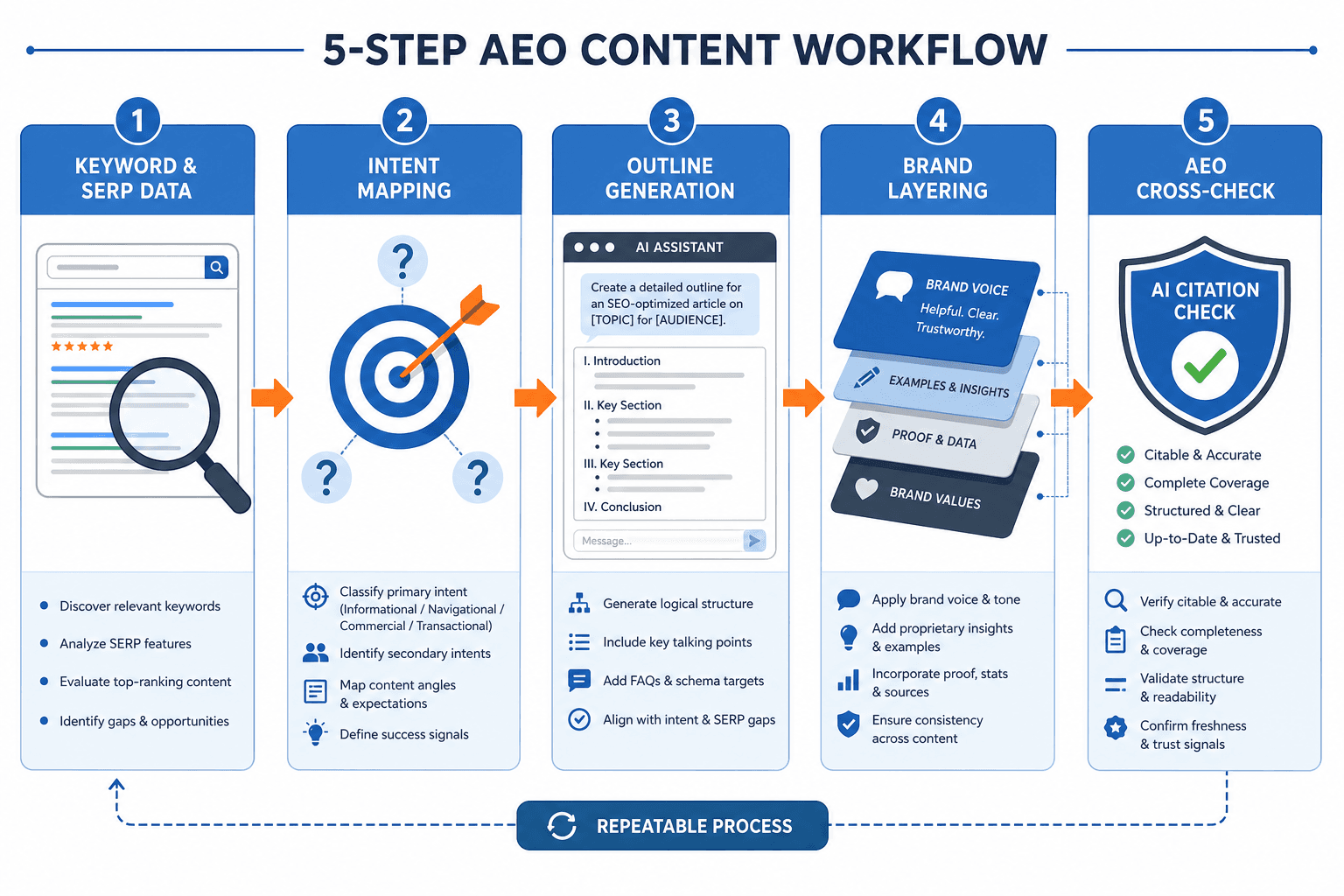
The AI Content Brief Playbook: A 5-Step Workflow Combining ChatGPT and SEO Tools
This playbook provides content marketing managers and SEO specialists with a repeatable, staged workflow that integrates ChatGPT for research and drafting with dedicated SEO tools for SERP data, keyword clustering, and AEO citation gap analysis. It cuts brief creation time while improving content ranking outcomes.
Why ChatGPT-Only Briefs Fall Short (and Tool-Only Briefs Miss Context)
If you have been generating content briefs by feeding a keyword into ChatGPT and asking for an outline, you have likely noticed a pattern: the output reads well, but it rarely matches what is actually ranking on page one. That is not a limitation of the model — it is a limitation of the input. ChatGPT has no live access to current SERP layouts, featured snippet opportunities, People Also Ask groupings, or competitor heading structures. It generates plausible structures based on its training data, which may be months or years old.
On the other side, relying exclusively on SEO tools like SurferSEO, Clearscope, or Frase produces data-rich briefs that identify keyword clusters, word count targets, and term frequency. But those briefs often lack narrative flow, audience nuance, and the kind of structural reasoning that makes a piece of content readable rather than merely optimized. The tool tells you what terms to include, but it does not tell you how to build a compelling argument around them.
The solution is not to pick one approach over the other. It is to build a staged pipeline where each tool does what it does best: SEO tools supply the ground-truth data from the current search landscape, and ChatGPT synthesizes that data into a structured, audience-aware outline. The rest of this playbook walks through exactly how to set up that pipeline.
The 5-Step Playbook: Combining ChatGPT and SEO Tools for Briefs That Rank
The following five-step workflow is designed for content marketing managers and SEO specialists who already use ChatGPT casually but lack a repeatable process. Each step has a clear owner — either an SEO tool, ChatGPT, or a human editor — and a defined output that feeds into the next stage. The total time for a single brief, once the workflow is practiced, lands under 30 minutes.
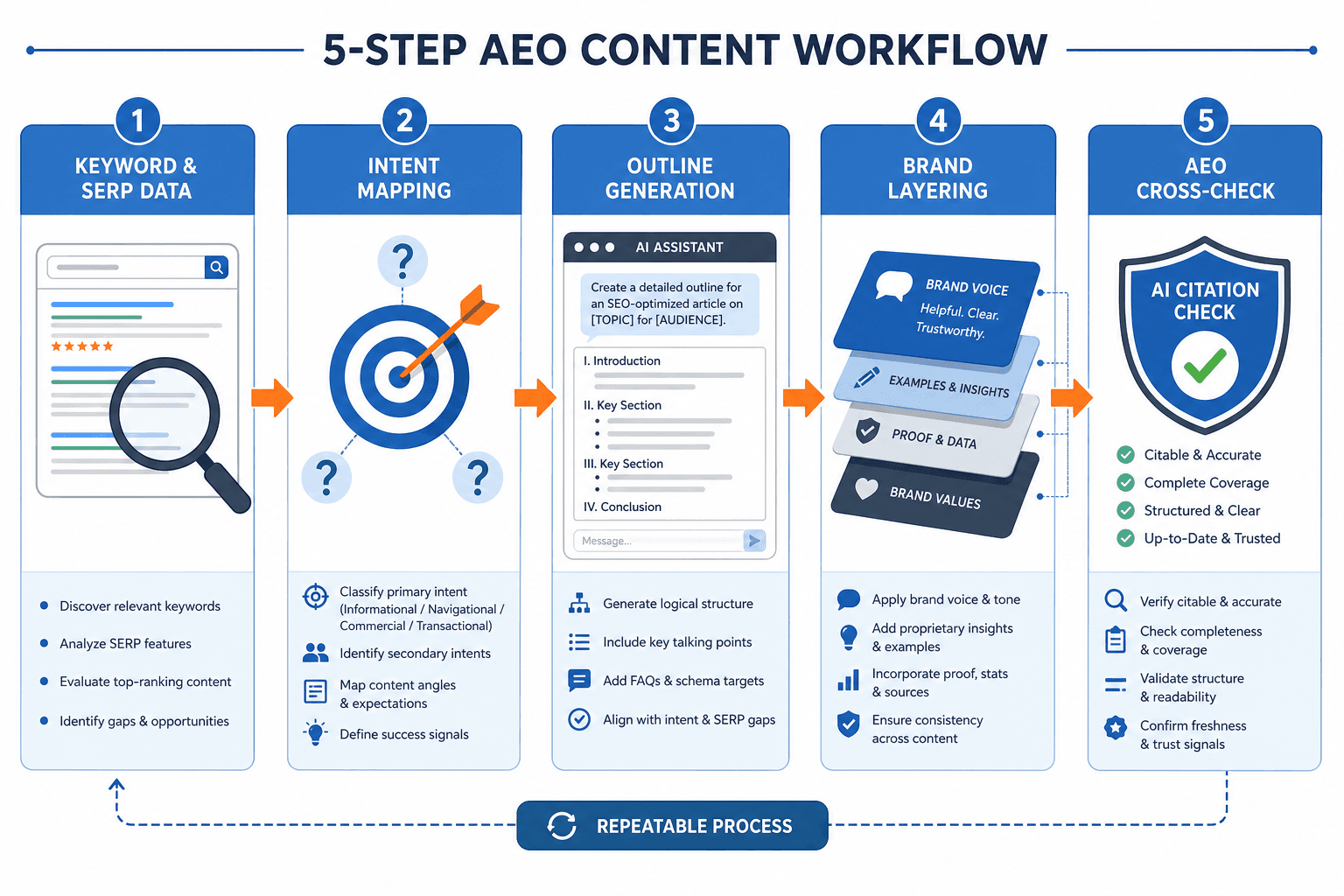
Step 1: Keyword and SERP Intelligence Gathering
This step belongs entirely to your SEO toolset. Do not ask ChatGPT for keyword suggestions or SERP analysis — the model cannot see the current search results page, and any data it generates will be inferred from its training cutoff rather than the live index.
Use a dedicated tool to collect the following data points for your target keyword:
- Current top-ranking URLs and their titles
- SERP features present (featured snippets, People Also Ask boxes, video carousels, AI Overviews)
- Keyword cluster variations and related long-tail queries
- Estimated search intent (informational, commercial, navigational, transactional)
- Content gap areas — topics that competitors are not covering well or at all
Tools like SurferSEO, Clearscope, and Frase all export this data in structured formats. Gauge differentiates itself by generating recommendations from AI citation gap data rather than keyword rankings alone — a capability that becomes critical in Step 5. For now, the goal is a clean export of what the SERP actually looks like today.
Step 2: Search Intent Mapping and Gap Analysis
With your SERP data in hand, move to ChatGPT for synthesis. The model excels at pattern recognition across competitor structures — it can ingest the headings, subheadings, and key points from the top 5 to 10 ranking pages and identify what they collectively cover and, more importantly, what they miss.
Feed ChatGPT the following inputs in a single prompt:
- The target keyword and its confirmed search intent (from Step 1)
- The list of top-ranking URLs and their primary headings
- Any SERP feature data (e.g., "this query triggers a featured snippet and a People Also Ask box with these 4 questions")
- A request to identify content gaps — topics or angles that the top results do not address
The output should be a structured gap analysis: a list of themes that are underserved in the current SERP, along with recommendations for how your brief can fill those gaps. This is where the human editor's judgment is essential — ChatGPT may surface gaps that are irrelevant to your audience or brand positioning. Filter accordingly.
Step 3: Structured Outline Generation with a Prompt Framework
This is the step where most practitioners go wrong. A prompt that says "Write an outline for a blog post about [keyword]" produces generic, low-utility output. The research from Originality.ai is clear: prompts with frontloaded context are rated 60%+ more useful than prompts stating only the topic.
Build your prompt with the following components:
- Target keyword and confirmed search intent
- Target audience description (job role, knowledge level, what they need to accomplish)
- Competitor heading structures (paste the actual H2s and H3s from top-ranking pages)
- Content gaps identified in Step 2
- Format constraints (word count range, required sections, tone)
- A request to explain why each section is included — this forces the model to justify its structure rather than defaulting to formulaic headings
You are a senior content strategist. Create a detailed content brief outline for the keyword "[target keyword]" with commercial intent.

Target audience: B2B marketing managers at mid-sized companies (50-500 employees) who are evaluating AI writing tools for their team. They need to justify the purchase to their CMO.

Here are the H2s from the top 5 ranking pages:
[Paste competitor H2s here]

Content gaps identified: [Paste gaps from Step 2]

Requirements:
- 1500-2000 words
- Include a comparison table
- End with a decision framework, not just a conclusion
- For each H2 section, explain why it serves the reader's decision process
- Flag any sections where we need original data or expert quotesStep 4: Brand Layering and Claim Policy Injection
The outline from Step 3 is structurally sound but brand-neutral. This step adds the editorial guardrails that prevent the final content from sounding like it was written by a generic AI. Two layers need to be applied: brand voice guidelines and a claim policy.
Brand voice guidelines should be documented separately and referenced in every brief. At minimum, the brief should specify:
- Tone (professional, conversational, authoritative, friendly)
- Vocabulary preferences (industry jargon allowed or avoided, preferred synonyms for key terms)
- Sentence structure patterns (short declarative sentences, varied length, or formal construction)
- Internal linking requirements (2-4 intentional internal links per post, as recommended by BlogSEO)
The claim policy is a separate document that tells the writer — whether human or AI — what standard of evidence is required for different types of statements. BlogSEO's template recommends a clear rule: sourced facts must be cited, or the statement must be rewritten as a best practice or opinion. This prevents the AI from fabricating statistics or attributing claims to nonexistent studies.
If your content needs to comply with FTC AI disclosure rules, the claim policy should also specify how and where AI-generated content is labeled. The June 2026 deadlines for role-by-role compliance mean that disclosure is no longer optional for most marketing teams.
Step 5: AEO/GEO Cross-Check for AI Citation Signals
Traditional SEO briefs optimize for Google's organic ranking algorithm. But the search landscape has shifted. AI Overviews, Gemini, and other generative answer surfaces now sit between your content and a significant portion of your potential traffic. A brief that ignores these surfaces is incomplete.
The data from Frase.io is striking: AI-sourced traffic surged 527% year over year between early 2025 and early 2026. LLM visitors convert at 4.4 times the rate of average organic search visitors, according to a June 2025 Semrush study. And after Google's January 2026 Gemini 3 switch, roughly 42% of previously cited domains were replaced, with the overlap between top-10 organic ranking and AI Overview citation collapsing from 76% to between 17% and 38%.
To cross-check your brief for AI citation readiness:
- Verify that the brief includes FAQPage schema as a structured data recommendation. Frase's data identifies FAQPage as the schema type with the strongest signal for AI Overview citation, with 6-10 questions per page as the optimal band.
- Check that the outline includes answer-first structures — direct, concise answers to likely user questions placed near the top of relevant sections.
- Use a tool like Gauge to identify citation gaps: topics where competing content is being cited by AI Overviews but your brief does not address them. Gauge is currently the only content brief tool that generates recommendations from AI citation gap data rather than keyword rankings alone.
- Confirm that the brief's word count and section depth align with the citation patterns in your niche. AI Overviews tend to cite content that provides comprehensive, authoritative coverage of a specific subtopic rather than shallow coverage of many subtopics.
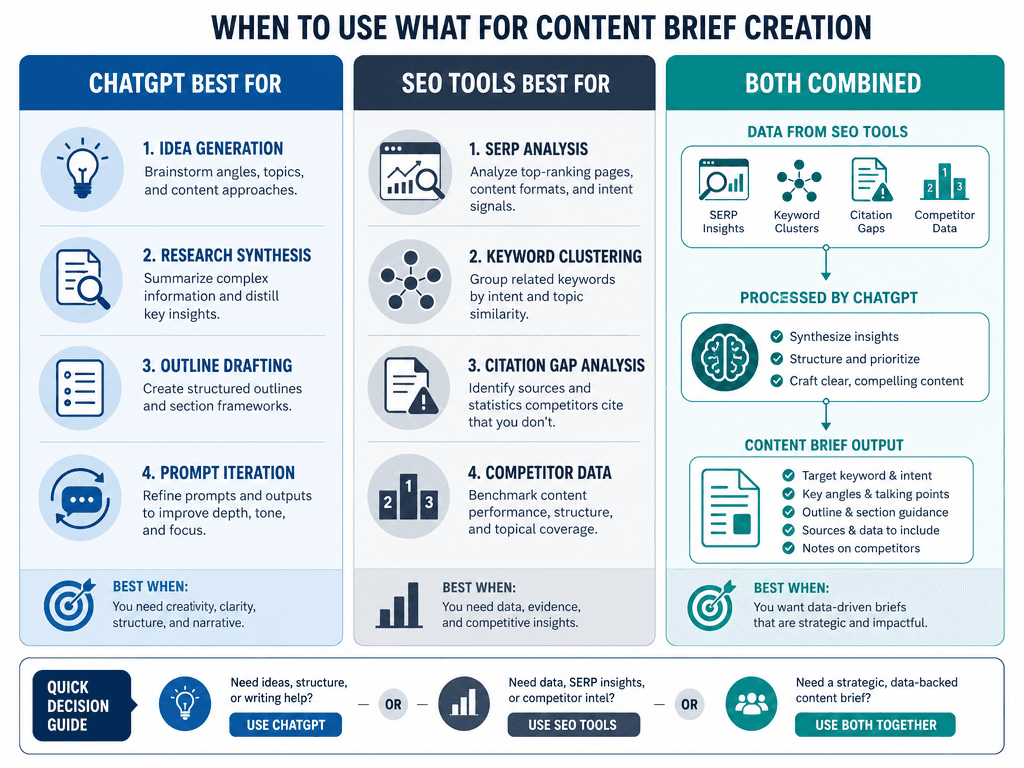
Tool Comparison Matrix: When to Use ChatGPT vs. SEO Tools vs. Both
Not every task in the brief creation pipeline benefits from both tools. The matrix below maps each common task to the appropriate tool or combination, based on the strengths and limitations documented in the sources.
| Task | Best Tool | Why |
|---|---|---|
| Keyword research and clustering | SEO tool (SurferSEO, Frase, Clearscope, Gauge) | Requires live search data; ChatGPT cannot access current SERP or keyword volumes |
| SERP feature identification | SEO tool | ChatGPT cannot detect featured snippets, People Also Ask, or AI Overview presence in real time |
| Competitor heading structure extraction | SEO tool (for data) + ChatGPT (for synthesis) | Tool extracts the raw headings; ChatGPT identifies patterns and gaps across competitors |
| Content gap analysis | ChatGPT + human editor | ChatGPT surfaces potential gaps from competitor data; human editor filters for relevance and brand fit |
| Outline generation | ChatGPT (with frontloaded context) | Produces structured, reasoned outlines when given sufficient context; tool-only briefs lack narrative flow |
| Brand voice application | Human editor + documented guidelines | ChatGPT output is generically toned; brand voice requires explicit guidelines and human review |
| Claim policy enforcement | Human editor + policy document | AI cannot reliably distinguish between sourced facts and hallucinations; policy must be applied manually |
| AEO/GEO citation gap analysis | Gauge (AI citation data) + ChatGPT (brief adjustment) | Gauge identifies citation gaps from AI Overview data; ChatGPT restructures brief to fill those gaps |
| Internal link selection | Human editor + site CMS | Requires knowledge of existing content inventory and topical relationships that AI does not have |
For a deeper comparison of how ChatGPT and Claude handle content tasks specifically, see our ChatGPT vs. Claude for Content Marketing Teams guide. Teams that prefer a marketing-focused interface may also want to evaluate Jasper AI as an alternative to ChatGPT for the outline generation step.
Common Mistakes That Waste the Workflow
Even with a clear pipeline, practitioners frequently make errors that undermine the quality of the final brief. The following mistakes appear consistently across the source material and practitioner reports.
- Skipping the SERP data step entirely. Generating a brief from ChatGPT alone means the outline is based on the model's training data, not the current search landscape. The result is a brief that looks reasonable but fails to compete with pages that are actually ranking.
- Using ChatGPT for keyword research. The model will generate plausible-sounding keywords, but they may not reflect actual search volume, competition level, or user intent. SEO tools exist for this task.
- Failing to inject a claim policy. Without explicit instructions about sourced facts, AI writers will fabricate statistics, attribute quotes to the wrong people, and invent study results. The claim policy is not optional — it is the primary defense against hallucination in the final content.
- Treating the AI-generated outline as final. The outline from Step 3 is a draft. It needs human editing for brand voice, strategic alignment, and structural logic. Publishing content from an unedited AI brief produces generic, low-trust content.
- Ignoring AI citation signals. Briefs optimized exclusively for Google's organic algorithm miss the growing traffic from AI Overviews and other generative answer surfaces. The AEO/GEO cross-check in Step 5 is not an afterthought — it is a necessary adaptation to the current search environment.
- Overloading the brief with data. A brief that contains every possible keyword, every competitor heading, and every SERP feature becomes unreadable. The goal is a usable document, not a data dump. Filter the SEO tool output to the most relevant signals before feeding it into ChatGPT.
Measuring Brief Quality: What a Good Brief Produces
A well-constructed brief is not an end in itself — it is a means to better content outcomes. The following metrics, drawn from the Growthym case study and broader industry data, provide a framework for evaluating whether your brief pipeline is working.
- Reduced revision cycles. Growthym documented a 25% drop in content revisions after switching to AI-powered briefs. If your writers are consistently reworking sections because the brief was unclear or incomplete, the pipeline needs adjustment.
- Increased content production velocity. The same case study reported a 60% increase in content production within one month. A good brief reduces the time writers spend on research and structural decisions, allowing them to produce more content at the same quality level.
- Improved SERP rankings. Growthym observed SERP ranking improvements for 40% of targeted keywords. This is the ultimate validation that the brief's keyword targeting, structural decisions, and content depth are aligned with what the search algorithm rewards.
- Stronger AI citation performance. With AI Overviews now a significant traffic source, brief quality should also be measured by citation frequency in generative search results. Gauge's citation gap analysis provides a direct feedback loop: if your content is not being cited, the brief likely missed the answer-first structures or FAQPage schema that AI Overviews prioritize.
- Reduced brief creation time. The Growthym case study showed a reduction from 3 hours to 15 minutes per brief. While your baseline may differ, the trend should be toward faster brief creation without sacrificing completeness. If the pipeline is not saving time, the tool integration is not working as intended.
These metrics should be tracked over a minimum of 10-15 briefs before drawing conclusions about pipeline effectiveness. Individual variations in topic difficulty, competitive density, and writer skill will produce noise in the data. The signal emerges from the trend line, not the single data point.

Comments
Join the discussion with an anonymous comment.