
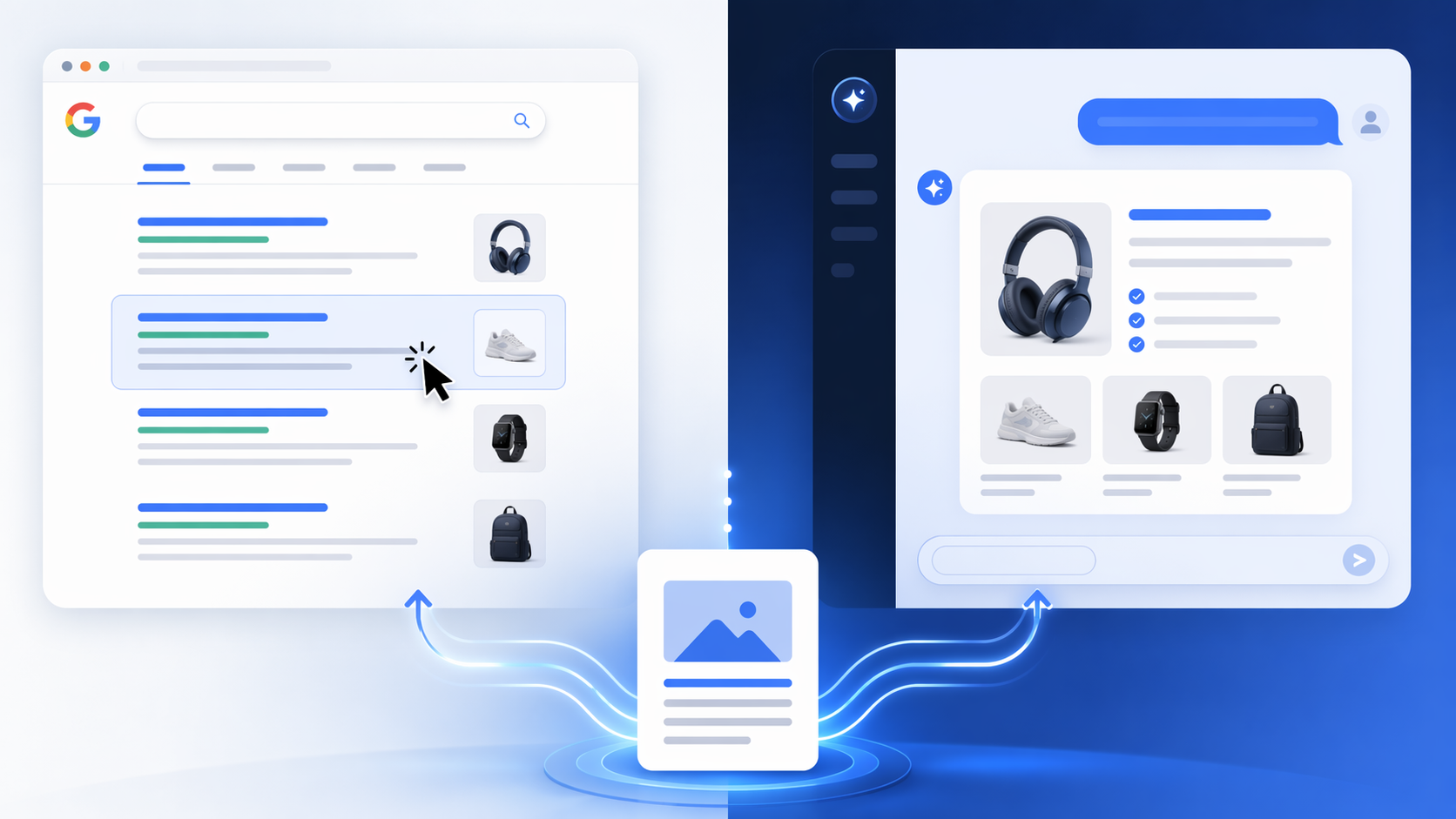
Why Your Affiliate Content Needs a Dual-Optimization Strategy for AI Chatbots and Search
With AI chatbots now intercepting shopping queries that used to land on affiliate review pages, this article provides a practical framework for structuring your affiliate content to be both LLM-citable and SEO-competitive — without betting your traffic on unproven GEO tactics.
Affiliate teams are watching a familiar search journey move into a less familiar box. A shopper who once searched Google for “best prescription glasses online,” opened three review pages, compared prices, clicked an affiliate link, and bought, can now ask ChatGPT, Gemini, or Perplexity to narrow the field in one exchange. That is the immediate tension in ai affiliate marketing: the content may still influence the recommendation, but the visit that used to create the commission may never happen.
The behavioral shift is not hypothetical. Shopping-related queries on ChatGPT grew faster than any other query type between December 2024 and June 2025, according to Sensor Tower data cited by EMARKETER. In consumer shopping use cases, 54% of respondents used generative AI for price comparison, 41% for finding deals, and 41% for reviewing products, based on Wildfire Systems survey data cited in the same report.[1]
That sounds like a threat to affiliate publishers because it is one. It is also a dependency. EMARKETER cited an October 2025 analysis finding that almost 70% of sites cited in ChatGPT mentions of eyewear brand Zenni came from affiliate marketing content. The methodology behind that figure was not fully public, so it should not be treated as a universal benchmark. Still, it points to the uncomfortable middle ground: AI systems may intercept the click while still leaning on the affiliate review ecosystem for product context.[1]
Wirecutter makes the anxiety easier to understand, though not easy to generalize. A GSQi analysis cited by EMARKETER found that Wirecutter’s Google visibility dropped by more than 60% between May and August 2025, and nearly 7 in 10 publishers were concerned about Google’s AI Overviews hurting affiliate businesses.[1] That is a warning signal, especially for review-heavy sites. It is not proof that every affiliate vertical will follow the same curve.
The useful question, then, is narrower than the industry debate around whether generative engine optimization will replace SEO. It will not pay today’s bills to abandon the ranking system that still sends measurable traffic, clicks, and commissions. But it is equally risky to keep producing affiliate pages as if answer engines were not becoming another layer of product discovery.
LLM Visibility Is Not the Same Thing as Affiliate Revenue
Affiliate marketing is built on a trackable action. A reader clicks a link, a cookie or other tracking mechanism records the referral, and the publisher earns if the shopper converts under the program’s rules. AI answers interrupt that clean path. A chatbot can summarize a review, quote a recommendation, mention a brand, or synthesize several publisher opinions without producing the click that creates attribution.
That matters because a citation can be valuable and still not be payable. If a chatbot cites a buying guide but the user later searches the brand directly, opens a retailer app, or buys through a different path, the affiliate publisher may have influenced the purchase without receiving credit. The reporting system sees no session, no affiliate link, and no commission event.
This is why LLM citation should be treated as an emerging visibility signal, not a revenue channel with mature attribution. It can support brand authority, create indirect demand, and possibly drive some referral visits when links appear. It does not yet behave like organic search traffic, where impressions, rankings, clicks, and downstream revenue can be connected with more confidence.
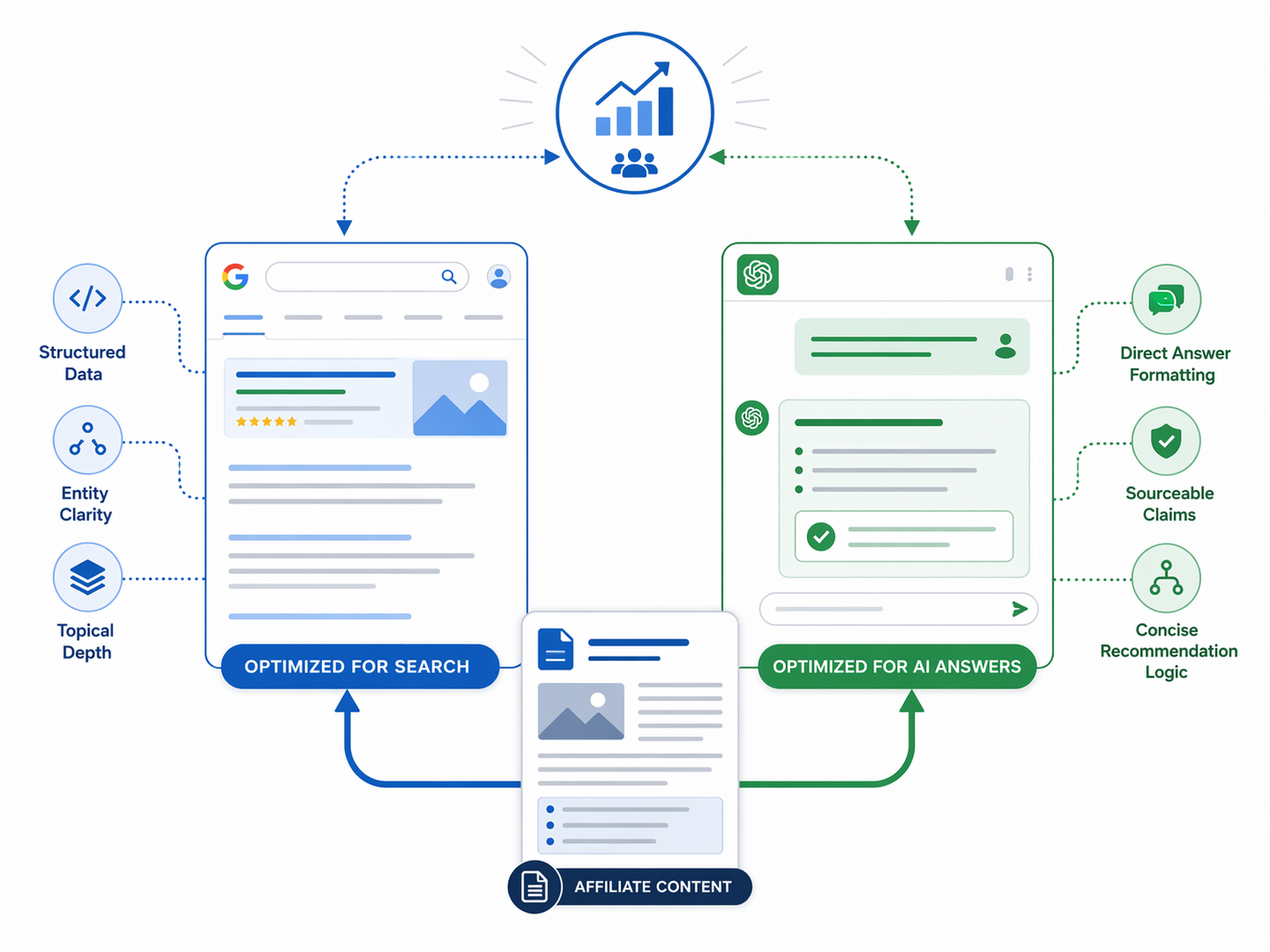
The practical response is dual optimization: keep the page strong enough to rank and convert in search, while making the same content easier for answer engines to understand, extract, and cite. That is less exciting than declaring SEO dead. It is also more useful for anyone responsible for partner revenue this quarter.
What Dual Optimization Changes on the Page
A dual-optimized affiliate page still needs the fundamentals: search intent coverage, credible testing or evaluation criteria, internal links, crawlable structure, fast templates, useful schema, and a conversion path that does not fight the reader. The difference is that the page also has to make its recommendation logic legible outside the page experience.
Search pages can reward depth, completeness, and engagement. AI answer engines often need something slightly different: cleanly stated answers, clearly named entities, extractable comparisons, and claims that can be attributed without forcing the model to infer too much. The content does not need to become thin or robotic. It needs to reduce ambiguity.
| Content Element | What It Protects in Search | What It Helps Answer Engines Extract |
|---|---|---|
| Direct answer block | Matches high-intent queries and featured-answer patterns | Provides a concise recommendation or definition that can be quoted |
| Comparison table | Improves scanning, commercial usefulness, and product differentiation | Gives structured product attributes, trade-offs, and category winners |
| Product and entity consistency | Strengthens relevance across titles, headings, copy, and internal links | Reduces confusion between brands, models, categories, and use cases |
| Sourceable claims | Improves trust and editorial defensibility | Makes it easier to cite a specific reason, test result, or limitation |
| Structured data | Supports eligibility for rich results where applicable | Clarifies product, review, FAQ, author, and organization context |
| Topical cluster depth | Builds authority beyond one commercial page | Gives models repeated, consistent context across related questions |
Start With the Answer the Shopper Actually Needs
Many affiliate reviews still open with context that made more sense when every visit began on a web page. AI-mediated shopping often starts closer to the decision: “Which option is best for small apartments?” “Which plan is cheapest after renewal?” “Which standing desk is best for tall users?” A page that buries the answer behind a long preamble makes both the human reader and the answer engine work harder.
The fix is not to remove nuance. It is to put the answer before the nuance, then show the reasoning. A strong affiliate page can open a section with a plain recommendation, name the best-fit audience, state the main trade-off, and then support the recommendation with testing notes, specs, pricing context, or editorial criteria.
For example, a buying guide should not only say that Product A is the “best overall.” It should specify why: best overall for whom, compared with which alternatives, under what constraints, and with which drawback. That turns a label into a sourceable claim.
- Lead important sections with a one- or two-sentence answer before expanding.
- Name the product, category, use case, and decisive criterion in the same passage.
- Separate “best for,” “avoid if,” and “why we chose it” instead of blending them into one promotional paragraph.
- Keep affiliate disclosure visible, but do not let disclosure language replace recommendation logic.
Use Comparison Tables as Editorial Infrastructure, Not Decoration
Comparison tables are easy to add and easy to misuse. A table that repeats product names, star ratings, and “check price” buttons is mainly a conversion widget. A table that captures decision criteria is a content asset.
For dual optimization, the comparison table should reflect how a shopper narrows the category. That may mean price range, ideal user, main strength, main limitation, warranty, platform compatibility, ingredient type, renewal cost, portability, or setup difficulty. The right columns depend on the category. The test is simple: if a chatbot had to summarize the category from the table alone, would it understand the differences that matter?
The table should also be consistent with the prose. If the table says a product is best for beginners and the review body says it is best for power users, the page has created the kind of conflict that weakens both reader trust and machine extraction. Content teams often inherit these inconsistencies after seasonal refreshes, especially when tables and review copy are updated by different people.
Make Entities Boringly Clear
Entity clarity is one of the least glamorous parts of AI affiliate marketing, and it is also one of the easiest places to create avoidable confusion. Product names change. Retailers use abbreviated model names. Brands reuse names across generations. SaaS tools rename plans. Outdoor gear, beauty products, electronics, and financial products all have their own version of this problem.
A dual-optimized page should use the full product name where precision matters, keep naming consistent across headings and tables, and distinguish the product from the brand, product line, retailer, and category. If a model was replaced, discontinued, reformulated, or bundled differently, say so plainly. That kind of editorial housekeeping helps search engines, answer engines, and readers interpret the page the same way.
This also applies at the cluster level. A site with separate pages for “best meal delivery services,” “cheapest meal kits,” “best prepared meals,” and individual brand reviews should not use those phrases interchangeably if the products are materially different. LLMs learn from patterns across pages; inconsistent taxonomy teaches the wrong pattern.
Turn Recommendation Logic Into Citable Claims
Affiliate content often contains the right judgment but packages it in language that is difficult to cite. “We loved the overall experience” is weak as evidence. “This is the best budget pick because it includes the core features most first-time users need, while leaving out advanced controls that raise the price” is more useful. It gives the answer engine a reason, an audience, and a trade-off.
Claims should be specific without pretending to know more than the review process supports. If the team tested five products, say that. If the ranking is based on hands-on testing, explain the criteria. If it is based on expert review, retailer data, specifications, or partner-provided information, distinguish those inputs. The goal is not to inflate authority; it is to make the basis for the recommendation visible.
This discipline is especially important when AI systems compress multiple sources into one answer. A clear limitation can travel with the recommendation. A vague superlative usually cannot.
Add Structured Data Where It Matches the Page
Schema is not a magic citation switch, but it is still part of the dual-optimization stack. Product, Review, FAQ, HowTo, BreadcrumbList, Organization, and Person markup can help clarify what the page contains and who is responsible for it, when those types accurately reflect the content.
The important phrase is “accurately reflect.” Adding FAQ schema to thin questions that do not help the reader, or review markup to pages that do not contain a defensible review, creates maintenance risk without solving the AI visibility problem. Structured data should reinforce the editorial structure already on the page, not compensate for missing substance.
For scaled affiliate sites, schema also needs governance. If pricing, ratings, availability, or product names are marked up, the update process has to keep markup aligned with visible copy. A mismatch between structured data and the page body is not a clever optimization; it is a quality-control failure waiting to surface.
Build Clusters Around Decisions, Not Just Keywords
Traditional SEO already pushed affiliate teams toward topical authority. AI answer engines make the connective tissue more important. A single “best” page can rank and convert, but a cluster explains the category: what buyers compare, which attributes matter, how products differ by use case, what common trade-offs look like, and when a cheaper option is enough.
That does not mean publishing every long-tail variant as a separate article. It means covering the decision architecture of the category. A useful cluster might include a main buying guide, product reviews, comparison pages, pricing explainers, alternatives pages, setup or usage guides, and update notes when the category changes. The internal links should explain the relationship between those assets, not just pass equity.
This is where content operations matter. If every article in the cluster uses different criteria, different product names, and different category definitions, the site looks less authoritative as the library grows. If the cluster repeats a stable editorial framework while allowing each page to answer its own query, it becomes easier for both search systems and AI systems to understand what the site knows.
A Practical Workflow for Updating Affiliate Content
The safest place to start is not with a sitewide AI rewrite. Start with pages that already matter: high-revenue buying guides, pages losing visibility on review-heavy queries, and category hubs where AI answers are likely to satisfy the shopper before a click. These are the pages where the upside of clearer extraction is meaningful and the downside of careless changes is real.
| Step | Action | Reason |
|---|---|---|
| 1 | Choose a revenue-relevant page or cluster | Avoid spending GEO effort on content that does not affect partner outcomes |
| 2 | Map the shopper questions the page must answer | Align the content with how people ask chatbots for comparisons and recommendations |
| 3 | Rewrite key sections into direct, sourceable answers | Make recommendations easier to quote without removing nuance |
| 4 | Tighten tables, entities, and schema | Reduce ambiguity across product names, attributes, and review criteria |
| 5 | Protect SEO and conversion elements | Keep rankings, affiliate links, disclosures, and commercial UX intact |
| 6 | Track rankings, traffic, citations, and revenue separately | Prevent AI visibility from being confused with affiliate performance |
The second step deserves more attention than teams usually give it. Chatbot shopping prompts are often comparative, constrained, and situational. A search query might be “best robot vacuum,” while a chatbot prompt might ask for a robot vacuum for pet hair, under a budget, that avoids a certain feature, works in a small apartment, and has low maintenance. The page does not need to chase every prompt variation, but it should expose the criteria that allow those answers to be constructed.
When rewriting, preserve the parts of the page that already earn. If a section ranks because it thoroughly explains testing methodology, do not compress it into a bland answer block. Add the answer block above it. If a comparison table drives clicks, improve the criteria without stripping the affiliate path. If a product review converts because it includes detailed caveats, keep the caveats and make them easier to locate.
A useful content refresh might look like this: the top of the guide states the current recommendation and who it is for; the table shows the decision criteria; each product section explains the best-fit use case, proof points, and drawbacks; schema mirrors the visible content; internal links connect to deeper reviews and comparison pages; update notes explain what changed since the last refresh. None of that requires betting the page on speculative model behavior. It makes the page better organized for every reader and every system trying to understand it.
What to Measure Without Fooling Yourself
Measurement is where AI visibility becomes tempting to oversell. Citation tracking tools such as Surfer AI Tracker and Writesonic’s AI Tracker can monitor whether brands, pages, or competitors appear across more than 10 AI platforms. That is useful. It gives affiliate teams a way to see whether their content is entering answer environments that traditional rank trackers miss.
But citation tracking is not affiliate attribution. A dashboard showing that a page is cited in ChatGPT or Perplexity does not show whether a shopper clicked, whether a cookie fired, whether the merchant credited the publisher, or whether the mention changed revenue. It is a visibility metric, not a commission report.
The cleaner measurement model separates four layers:
- Search performance: rankings, impressions, organic sessions, click-through rate, and page-level revenue.
- AI visibility: chatbot citations, brand mentions, source inclusions, and competitor presence.
- Engagement quality: scroll depth, affiliate link clicks, comparison-table interaction, and assisted navigation to reviews.
- Commercial outcome: affiliate clicks, conversion rate, revenue per session, partner-level commission, and unexplained changes in direct or branded demand.
Those layers can move in different directions. A page may gain AI citations while losing Google traffic. It may keep rankings but lose clicks if AI Overviews answer more of the query on the results page. It may receive brand mentions without measurable affiliate revenue. Or it may improve human conversion simply because the refresh made recommendations clearer. Treating all of those outcomes as one “GEO result” hides the real lesson.
A reasonable test should have a defined page set, a before-and-after window, and a small group of comparison pages that are not changed at the same time. It should track both SEO and AI visibility. It should also record the content changes made, because “we optimized for AI” is too vague to diagnose later. Was the lift associated with answer blocks, table changes, schema cleanup, stronger entity naming, fresher product data, or a broader category update?
Where AI Changes the Partner Conversation
Affiliate managers should not treat this only as a content formatting issue. If AI answers influence purchase decisions without firing affiliate links, the partner conversation eventually changes. Publishers will want credit for influence that current tracking cannot see. Brands will want proof before paying for that influence. Networks and platforms will be pressured to explain how they handle assistant-mediated discovery.
OpenAI’s content partnerships show why commerce publishers are watching closely. More than one-quarter of OpenAI’s content partnerships since 2021 have been with publishers that operate scaled affiliate commerce content, according to OriginalityAI data cited by EMARKETER.[1] That does not mean affiliate attribution has been solved. It means commercial content is important enough to be part of the sourcing and partnership conversation.
For now, content teams can only control part of the system. They can make their recommendations clearer. They can protect the click paths that still convert. They can document when AI platforms cite or ignore them. They can bring partners evidence that the discovery layer is changing. They cannot responsibly claim that an LLM mention equals a commissionable referral.
The Work Worth Doing Now
The best near-term strategy is deliberately unglamorous: update the content architecture before chasing a new acronym. Prioritize pages where shoppers need comparison, constraint-based recommendations, and trust signals. Add direct answers where they help. Make product entities consistent. Turn vague endorsements into sourceable reasoning. Use structured data that matches the page. Build clusters that explain the category instead of multiplying thin variants.
Do not strip pages down for bots at the expense of readers. Do not replace tested SEO systems with unproven GEO rituals. Do not report AI citations as revenue. The operating posture is more disciplined than that: preserve what earns, make the content easier for answer engines to cite, and measure AI visibility as a new distribution layer whose commercial model is still unresolved.
References
- FAQ on Affiliate Marketing: How AI, Creators Are Reshaping the Channel in 2026, EMARKETER, Apr 28, 2026.

Comments
Join the discussion with an anonymous comment.