

AI for Real Estate Lead Generation: From Speed-to-Lead to Predictive Targeting
Real estate agents spend heavily on portal leads, but the biggest ROI opportunity in 2026 is AI that compresses response time, qualifies leads around the clock, and predicts sellers before they list. This article breaks down the specific tools, data, and workflows that separate lead gen that scales from lead gen that just costs more.
A paid real estate lead lands in the CRM at 7:40 p.m. The source is recorded, the campaign gets credit, and the dashboard says the lead was captured. But the buyer does not care that the CRM has a new record. The buyer cares who answers while the listing is still open on their phone.
That is where most AI for real estate marketing earns or loses its budget. Leads contacted within five minutes are 21 times more likely to be qualified than leads contacted after 30 minutes, according to the Harvard Business Review speed-to-lead benchmark widely cited in sales operations.[1] Industry lead-gen reporting also puts the average agent response time at more than 15 hours and says 78% of buyers work with the first agent who responds.[2] Put those three facts together and the problem is not abstract. A team can pay for demand, technically capture it, and still hand the client to someone else by waiting too long to act.
That does not make portal leads bad. It makes slow follow-up expensive. If the first human touch comes the next morning, the lead source will look weak, the agent will sound frustrated, and the marketing manager will be asked to find “better leads” when the leak is sitting inside the handoff.
The Lead Gen Workflow AI Actually Changes
The useful version of AI lead generation is not a bigger dashboard. It is a shorter path from inquiry to qualified conversation. For a real estate team, that path usually looks like this:
| Stage | What AI Should Do | What The Team Still Owns |
|---|---|---|
| Lead capture | Collect inquiry data from portals, landing pages, home valuation pages, ads, chat, and database campaigns | Make sure every source pushes into one system without duplicate or missing records |
| Instant response | Send a relevant reply within seconds and keep the conversation open after hours | Set response rules, tone, escalation triggers, and ownership |
| Conversational qualification | Ask about timeline, property intent, financing, location, motivation, and preferred next step | Define what counts as sales-ready instead of accepting every form fill as equal |
| CRM enrichment | Append known property, contact, campaign, and behavior data where available | Audit data quality and avoid fields nobody trusts |
| Lead scoring | Prioritize leads based on engagement, fit, urgency, and intent signals | Review scoring logic and prevent silent disqualification |
| Automated nurture | Send follow-up based on behavior and stage instead of generic drips | Update messaging when market conditions, inventory, or offers change |
| Predictive targeting | Surface homeowners or contacts who may be closer to selling before they raise their hand | Treat predictions as signals, not guarantees |
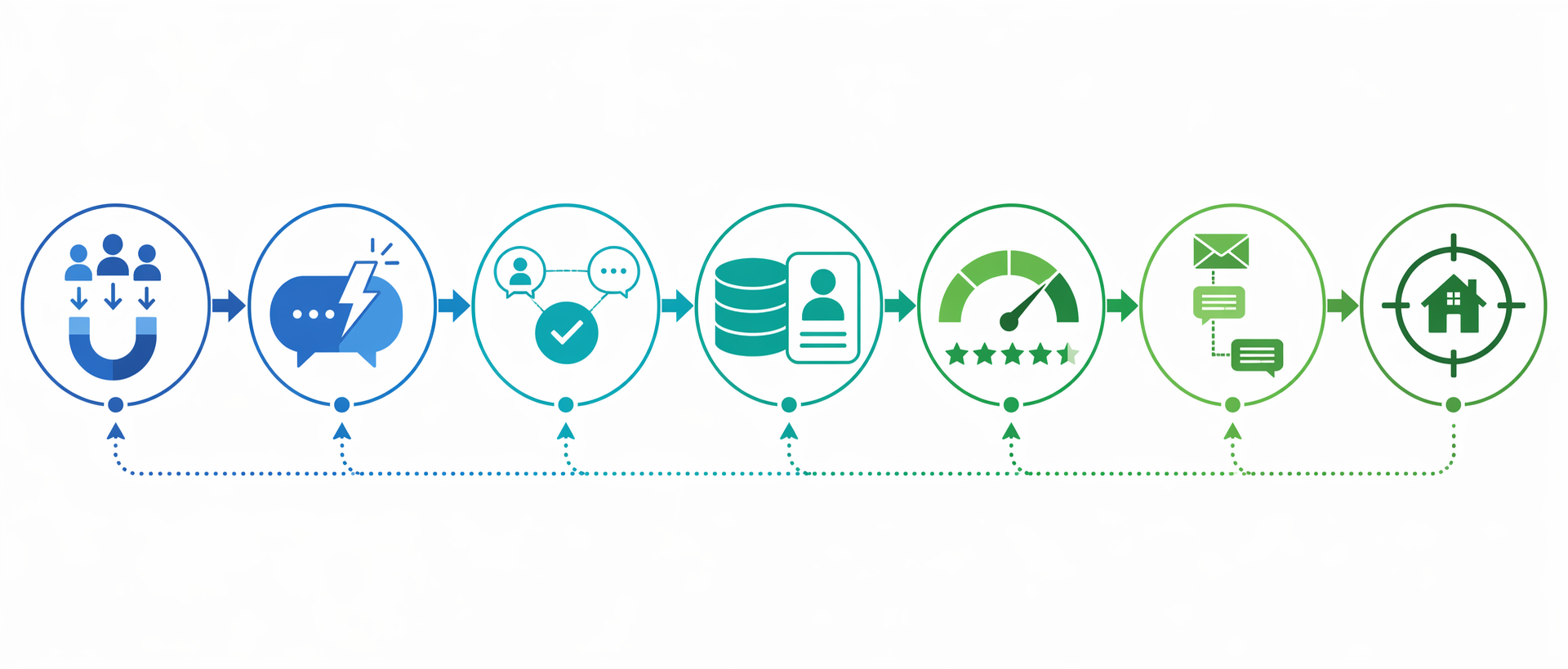
The middle of that workflow is where the economics change fastest. A team does not need AI to invent a new category of prospect before it fixes the paid leads, past clients, valuation requests, and listing inquiries already arriving with no reliable first response.
Response Time Is A Revenue Clock, Not A Service Metric
A buyer inquiry is perishable. The person may be looking at one property, but they are also testing whether the agent, team, or brokerage can reduce uncertainty. If the only immediate reply is an auto-confirmation that says someone will be in touch soon, that is not a conversation. It is a receipt.
Conversational AI changes this because it can respond while the agent is showing property, driving, sleeping, or working another client. Tools such as Roof AI, Lofty’s AI Assistant, and Ylopo sit in this category: they capture the inquiry, ask qualifying questions, and route the lead based on what the person says. The operational value is not that a bot sounds clever. The value is that the first useful exchange happens before the buyer has moved on.
The difference between “captured” and “worked” matters. Captured means the name, phone number, email address, and source landed somewhere. Worked means the system attempted contact, asked why the person inquired, learned whether they are buying, selling, browsing, relocating, financing, or comparing neighborhoods, and then put that record into a next step that an ISA or agent can trust.
That is especially important for the person taking the handoff. A vague “hot lead” often means an agent or ISA has to start from zero: Are they pre-approved? Are they local? Are they six months out? Did they ask about a specific listing or just download a market report? AI qualification should remove that fog before a human takes over.
What A Qualified AI Handoff Should Include
- Inquiry source and exact trigger, such as a property request, valuation form, retargeting ad, open-house follow-up, or database campaign
- Stated intent, including buy, sell, both, invest, relocate, browse, or request information
- Timeline, even if it is broad, because “this weekend” and “next year” should not enter the same queue
- Property context, such as target area, price range, home type, current address, or listing viewed
- Financing or readiness signals when volunteered, without making the conversation feel like a loan application
- Escalation reason, so the agent knows why this lead deserves immediate human follow-up
The team should be able to look at an AI-qualified record and know what to do next. Call now. Send lender intro. Assign to listing specialist. Put into long-term buyer nurture. Invite to a valuation consult. Suppress from aggressive outreach. If the record still requires a human to decode what happened, the automation has only moved the mess from the inbox to the CRM.
The ROI Case Is Strong, But It Needs A Caveat
HousingWire’s 2026 State of AI SEO in Real Estate report, produced with FlyDragon, reports that AI-sourced leads closed at 9.6% within 90 days, compared with 2.4% for Zillow leads; it also reports average GCI of $1,180 per AI-sourced lead versus $240 for Zillow.[3] That is the kind of spread that gets budget attention quickly.
It should not be treated as settled industry law. The methodology has not been independently verified by a third party, and “AI-sourced” can include different workflows depending on the team and vendor. Still, the comparison is useful because it points at the right investment question: not whether AI is fashionable, but whether the system improves response, qualification, routing, and nurture enough to make each existing lead dollar work harder.
For budget planning, that distinction matters more than broad adoption chatter. Some surveys report high AI usage among agents, while NAR’s technology materials distinguish more limited daily use.[4] A one-off ChatGPT prompt for a listing caption is not the same thing as an embedded lead-gen workflow that answers, qualifies, scores, and routes prospects without waiting for office hours.
Teams that want a broader planning lens can connect this workflow to a larger AI sales and marketing budget allocation discussion, but the lead-gen sequence should stay simple: fix lag first, then improve qualification, then decide where new demand spend belongs.
Database Reactivation Belongs Before Another Lead Source
The cleanest bridge between response automation and predictive targeting is database reactivation. Most teams already own a pool of people who once raised a hand: old portal leads, open-house guests, past valuation requests, buyer consultation no-shows, cold database contacts, former clients, and sphere contacts who have gone quiet. The usual failure is not that these people disappeared. It is that nobody has a timely, relevant reason to restart the conversation at scale.
The Lance Loken Group example is useful because it keeps the focus on owned relationships. Using Scout and Fello for AI-powered database reactivation, the team reported generating 10 to 15 seller leads per day.[5] That is an agent-reported case, not a typical-result benchmark. But it shows the operational pattern that matters: AI can scan and message an existing database with seller-oriented timing rather than forcing the team to buy another stream of strangers.
A reactivation campaign does not need to pretend every old contact is ready now. It needs to identify who is willing to talk, who wants a home value update, who is considering a move, who owns a property that may fit a current buyer need, and who should be left in a lower-pressure nurture path. The win is not only more conversations. It is less agent time spent calling stale records with no context.
A Practical Reactivation Sequence
- Segment the database by relationship type, source, last activity, property ownership, and prior intent.
- Use AI to personalize the opening message around a relevant reason to reconnect, such as valuation, neighborhood demand, relocation timing, or a prior search.
- Let the system handle first replies and basic qualification before routing to an agent.
- Create separate follow-up paths for seller-curious owners, active seller prospects, future buyers, renters, investors, and unresponsive contacts.
- Audit outcomes by appointment set, conversation quality, listing opportunity, unsubscribe rate, and agent acceptance.
The last point is not cosmetic. If agents reject the leads because the notes are thin or the timing is wrong, the campaign has not solved the real workflow problem. It has just created another pile of names.
Predictive Seller Targeting Moves The Team Upstream
Inbound buyer leads are visible to every competitor buying the same attention. Predictive seller targeting tries to move earlier, before the homeowner fills out a form, requests a CMA, or interviews listing agents.
Smartzip is the clearest example in the current source set. HousingWire reports that Smartzip’s predictive analytics draws on more than 1 billion data points from more than 25 sources and that the company identifies 72% of listings before they hit the market.[3] That 72% figure is vendor-reported. It is useful as a directional signal, not a guaranteed forecast for every market, price band, or team.

The strategic shift is real even with that caveat. Instead of waiting for homeowners to enter a public marketplace of agent competition, predictive systems use property, ownership, demographic, behavioral, and market signals to estimate which households may be more likely to sell. A brokerage can then focus direct mail, valuation offers, neighborhood reports, agent outreach, and nurture around homes or contacts with stronger seller-intent signals.
The mistake is treating the prediction as a verdict. A high-propensity homeowner is not a listing. It is a reason to test a relevant, compliant outreach path. The system can help decide where to spend attention, but the agent still has to earn the conversation.
Where Predictive Targeting Fits In The Stack
Predictive seller targeting should not be the first AI purchase for a team that still takes hours to answer inbound demand. It belongs after the team can respond instantly, qualify consistently, and route cleanly. Otherwise, predictive targeting will create a more sophisticated top of funnel feeding the same slow middle.
This is where stack sequencing matters. The team needs reliable capture and CRM hygiene before predictive scoring can be trusted. If lead sources are mislabeled, ownership is unclear, duplicate records are common, and agents ignore CRM notes, a predictive model will have trouble turning signals into appointments. For a deeper sequencing view, the same logic appears in the guide to building an AI sales and marketing stack.
What To Measure Before Calling AI Lead Gen A Win
Cost per lead is too blunt for this workflow. A low-cost lead that waits 15 hours for a reply can be more expensive than it looks. A higher-cost lead that gets qualified in seconds and routed to the right specialist can be cheaper than the dashboard suggests.
A team evaluating AI for real estate marketing should separate volume metrics from operating metrics and revenue metrics. Otherwise, more leads will look like growth even when conversion capacity has not improved.
| Metric | Why It Matters |
|---|---|
| Median speed-to-first-response | Shows whether the team has actually compressed the lag that causes lost conversations |
| AI conversation completion rate | Shows whether prospects answer the qualifying questions or abandon the exchange |
| Qualified lead rate by source | Separates raw inquiry volume from leads with intent, fit, and next-step potential |
| Agent acceptance rate | Reveals whether the people receiving AI-routed leads trust the handoff |
| Appointment-set rate | Connects qualification to a real sales action |
| Show rate and consultation quality | Prevents the system from optimizing for easy appointments that do not move |
| Listing opportunities created | Measures whether database and predictive campaigns produce seller conversations |
| Closed revenue and GCI by source | Keeps budget decisions tied to outcomes instead of activity |
| Opt-out, complaint, and suppression rates | Flags whether automation is creating pressure, fatigue, or compliance risk |
The most useful internal report is usually not a pretty AI dashboard. It is a source-by-source view that shows how many leads arrived, how fast they were answered, how many became qualified conversations, how many agents accepted, how many appointments were set, and how much revenue followed. That kind of measurement also makes it easier to defend budget in a leadership meeting, especially when paired with a broader AI marketing ROI accountability process.
Compliance Cannot Be Bolted On Later
AI qualification and predictive targeting create a real compliance obligation. If a system scores, prioritizes, suppresses, or targets people in ways the team cannot explain, the brokerage has not reduced risk by automating the workflow. It may have made the risk harder to see.
Fair housing risk is especially important in real estate. A model that over-targets or under-targets certain neighborhoods, household types, language groups, income proxies, or protected-class-adjacent signals can create problems even when nobody intended discrimination. Teams should review what data is used, how audiences are built, how leads are scored, and whether agents can override or appeal automated prioritization.
The same caution applies to conversational AI. A bot should not invent financing guidance, imply steering, make unsupported claims about neighborhoods, or pressure consumers who have opted out. At minimum, teams need approved scripts, escalation rules, opt-out handling, recordkeeping, and periodic review of actual conversations.
The 2026 Investment Order
For most real estate teams, the budget hierarchy in 2026 should be uncomfortable but clear.
- Fix speed-to-lead first. If inbound inquiries wait hours for meaningful contact, every other acquisition investment is carrying avoidable waste.
- Automate qualification and routing next. Agents should receive context, not mystery records labeled as opportunities.
- Reactivate the owned database before assuming the team needs more strangers. Past inquiries and relationships may be closer to revenue than a fresh portal lead.
- Add predictive seller targeting when the CRM, follow-up process, and compliance review can support it.
- Revisit portal spend after the response and qualification workflow is working, not before.
That order does not promise AI will lower cost per lead for every team. It does something more useful: it forces the budget conversation to start with the operational failure most likely to waste the next dollar. If a lead is only as valuable as the system that catches, qualifies, and routes it, then the first AI investment should be the one that stops paid attention from cooling off in the queue.
References
- The Short Life of Online Sales Leads, Harvard Business Review.
- Real Estate Lead Generation Statistics 2026, Deal Machine OS.
- AI tools for real estate agents, HousingWire, 2026.
- Artificial Intelligence in Real Estate, National Association of REALTORS.
- Agent case reporting on AI-powered database reactivation with Scout and Fello, HousingWire, 2026.


Comments
Join the discussion with an anonymous comment.