
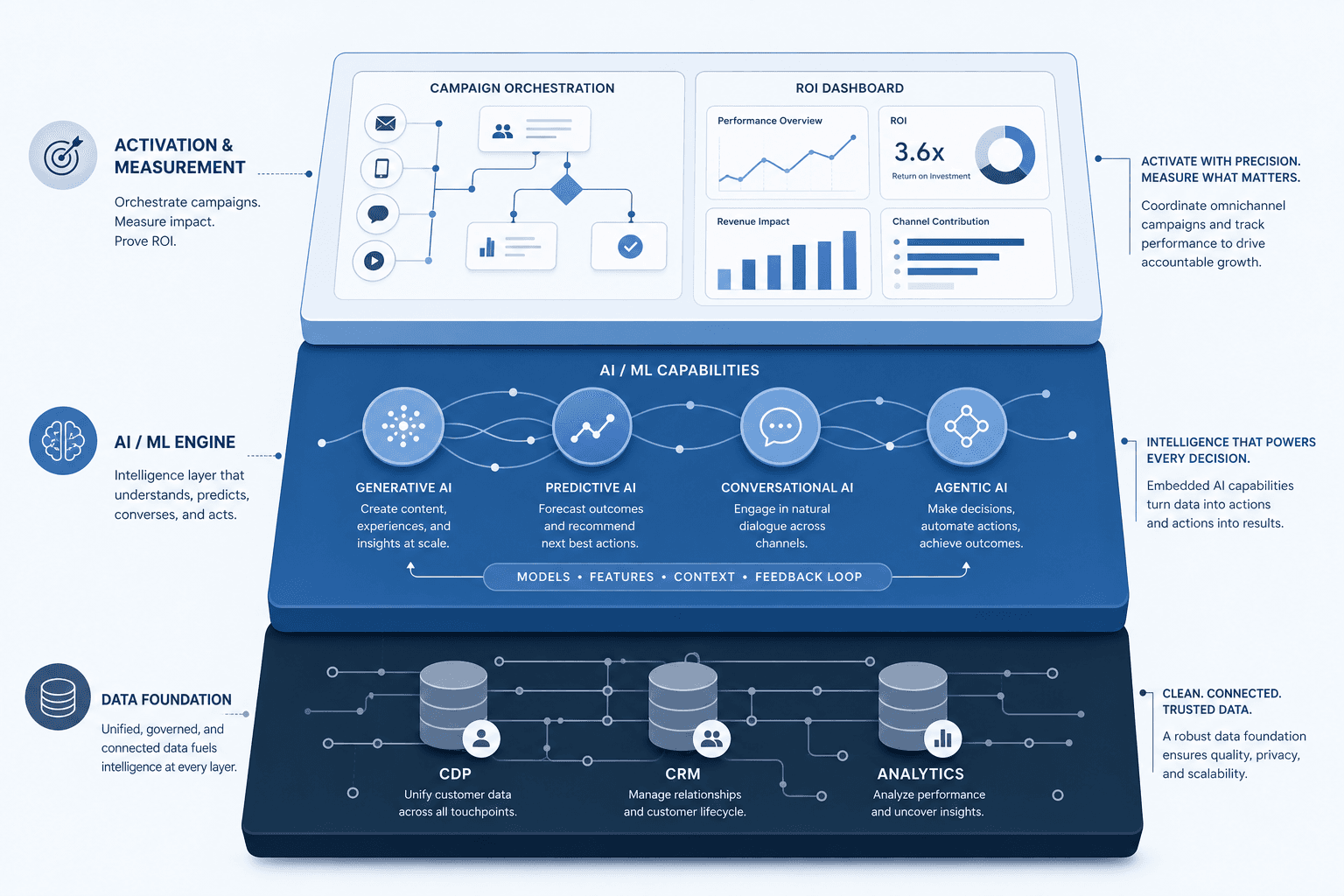
The AI-Driven Marketing ROI Accountability Playbook: How to Measure, Prove, and Defend Value in 2026
A structured, CFO-facing guide for marketing managers and CMOs who need to justify AI tool spend. Covers seven payback models, AI-specific KPI benchmarks, hidden cost breakdowns, and a tiered portfolio framework for presenting ROI to leadership.
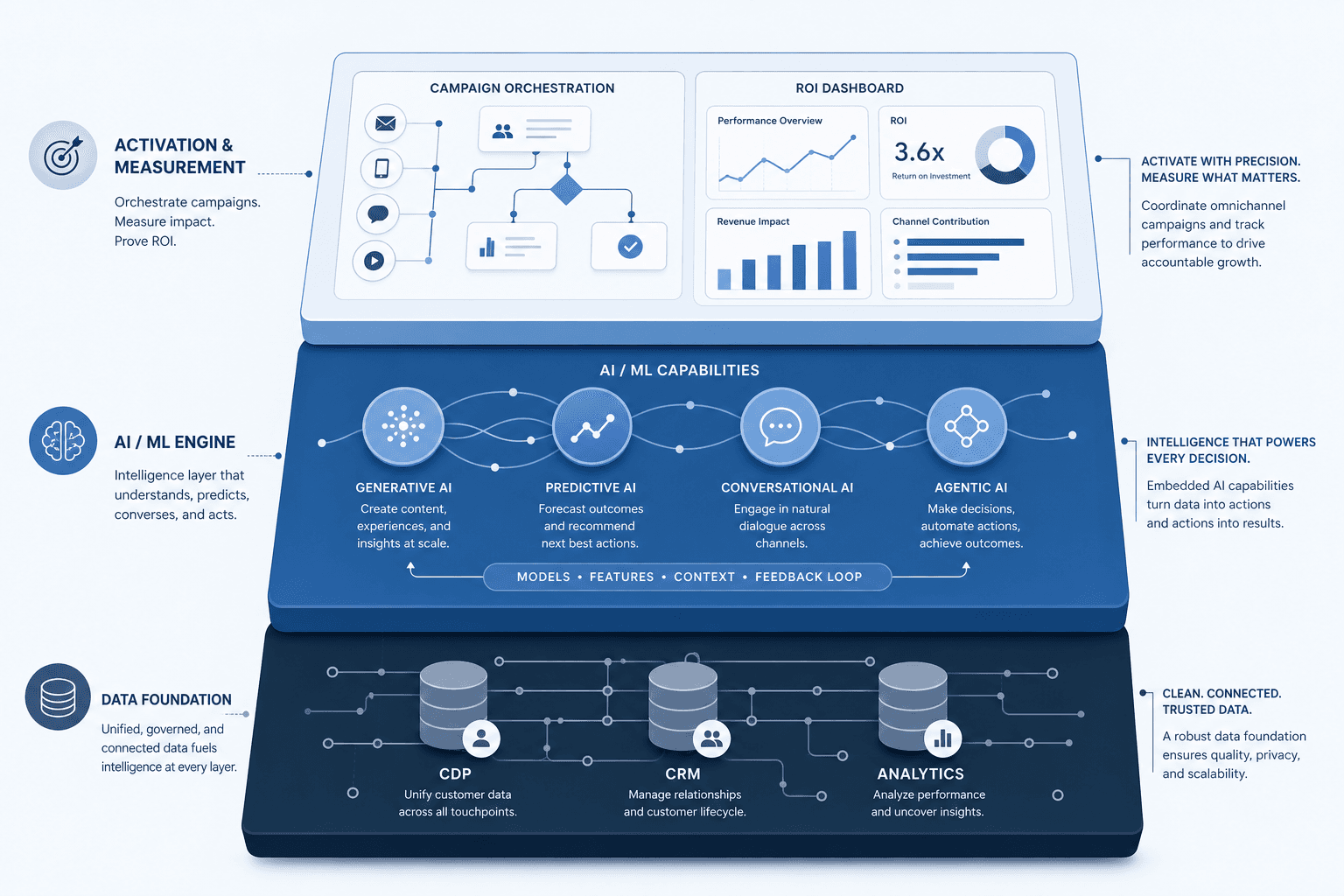
The Gap: High Adoption, Low Proof
The numbers tell a story that should worry every marketing leader. According to Jasper's 2026 State of AI Marketing report, which surveyed 1,400 marketers, 91% now actively use AI in their daily work — a sharp jump from 63% the year prior. Yet the share of marketers who can prove a business outcome from that usage has actually declined, dropping from 49% in 2025 to just 41% in 2026.
This is not an adoption crisis. It is a measurement crisis. Teams have rushed to deploy AI tools — for content generation, ad optimization, personalization, and analytics — without building the measurement infrastructure needed to answer the one question that matters to a CFO: Did this investment produce a return?
The consequences of this gap are tangible. Gartner reports that only about 28% of enterprise AI use cases fully meet their ROI expectations, and roughly 20% fail outright. When programs fail, it is often not because the technology underperformed, but because the organization could not prove the value in terms leadership trusted.
This playbook is designed for marketing managers, CMOs, and demand generation leads who need to justify AI tool spend to leadership with frameworks that survive CFO scrutiny. It is a companion piece to our analysis of why most companies using AI for marketing don't see real ROI, which explores the workflow patterns of the 6% of winners. Here, we provide the measurement framework itself: the payback models, the KPIs, the cost breakdowns, and the presentation structure you need to build a defensible case.
The Seven Payback Models for AI Marketing
The first mistake most teams make is using a single ROI calculation for every AI use case. Content generation, predictive lead scoring, ad optimization, and conversational AI each produce value in fundamentally different ways. Applying a one-size-fits-all model guarantees you will either undercount or overclaim value.
The solution is a taxonomy of seven CFO-grade payback models, each suited to a specific type of AI application. These models are drawn from the AI ROI Measurement Framework published by Digital Applied, and they map directly to the marketing use cases your team is likely running.
| Payback Model | What It Measures | Best Fit for Marketing Use Cases | Example Metric |
|---|---|---|---|
| Cost-Avoidance | Expenses the AI eliminates or prevents | Automating content repurposing, reducing freelance copywriter spend, eliminating low-value manual reporting | $X saved per month in external vendor costs |
| Productivity-Hour | Time saved per employee, converted to cost | AI-assisted content drafting, email sequence generation, social media scheduling | 11–13 hours saved per week per marketer |
| Deflection-Rate | Volume of tasks AI handles that would otherwise require human intervention | Chatbots handling Tier-1 support queries, automated FAQ generation, AI-powered lead qualification | % of queries deflected from human team |
| Revenue-Attribution | Incremental revenue directly tied to AI-driven campaigns or personalization | AI-powered email personalization, dynamic creative optimization in ads, product recommendation engines | 15–30% of revenue attributed to AI in first 6 months |
| Error-Reduction | Cost of mistakes AI prevents (compliance violations, ad misplacements, data entry errors) | Automated compliance checks on ad copy, AI-driven data validation, brand safety filters | Error rate reduced to <2% |
| Time-to-Value | Speed from campaign launch to measurable impact | AI-accelerated A/B testing, automated campaign optimization, real-time bidding adjustments | 30–90 days to first measurable outcome |
| Fully-Loaded TCO | Total cost of ownership including hidden costs (data, talent, governance) | Any AI deployment where infrastructure and maintenance costs are significant | Tool licenses = 15–25% of total cost; data + talent + governance = 75–85% |


Comments
Join the discussion with an anonymous comment.