

AI for Sales and Marketing: Where the Returns Actually Are in 2026
AI adoption in sales and marketing is nearly universal, but value capture is uneven. Based on 2026 data from McKinsey, BCG, and Gartner, this article maps the use cases that deliver measurable ROI and those that consistently disappoint, with a practical decision framework for prioritization.
AI for sales and marketing is no longer an adoption story. It is a value-capture story, and the numbers are uncomfortable in exactly the way revenue teams should care about. Sopro’s 2026 compilation puts AI use at 94% of marketers and 87% of sales teams, and reports that 86% of AI-using sales teams see positive ROI within the first year. The same source cites BCG’s finding that 74% of companies still struggle to achieve and scale value from AI investments, and McKinsey’s latest available State of AI data showing that only about 6% of organizations qualify as high performers with 5% or more EBIT impact from AI.[1]
That is the split that matters in 2026. Broad usage proves that teams have found ways to put AI into workflows. It does not prove that the handoff from marketing to sales is cleaner, that reps are spending more time selling, that lead quality improved, or that a campaign shipped faster without creating downstream cleanup. Even marketing ROI claims need careful handling: Sopro and Zigment both point to large gains from revenue lift and cost savings, including an average 300% ROI figure, but the underlying methods include vendor-originated and self-reported data, so the useful takeaway is directional rather than definitive.[1][2]
The best question, then, is not whether AI helps sales and marketing. It often does. The question is where the return survives a budget review: which workflow changed, which metric moved, who owned the change, and whether the improvement can be repeated after the first pilot.
The ROI map: where AI is actually paying back
The highest-return uses of AI for sales and marketing cluster around a few revenue frictions: finding better-fit accounts, producing campaign assets faster, reducing pipeline drag, and personalizing late-stage buyer experiences. These are not the same kind of return. Marketing teams often see the first measurable lift in production speed, campaign engagement, and cost avoidance. Sales teams usually need a longer read because the payoff runs through conversion quality, selling time, deal velocity, and later-stage movement.
| Use case | Primary return | What to measure |
|---|---|---|
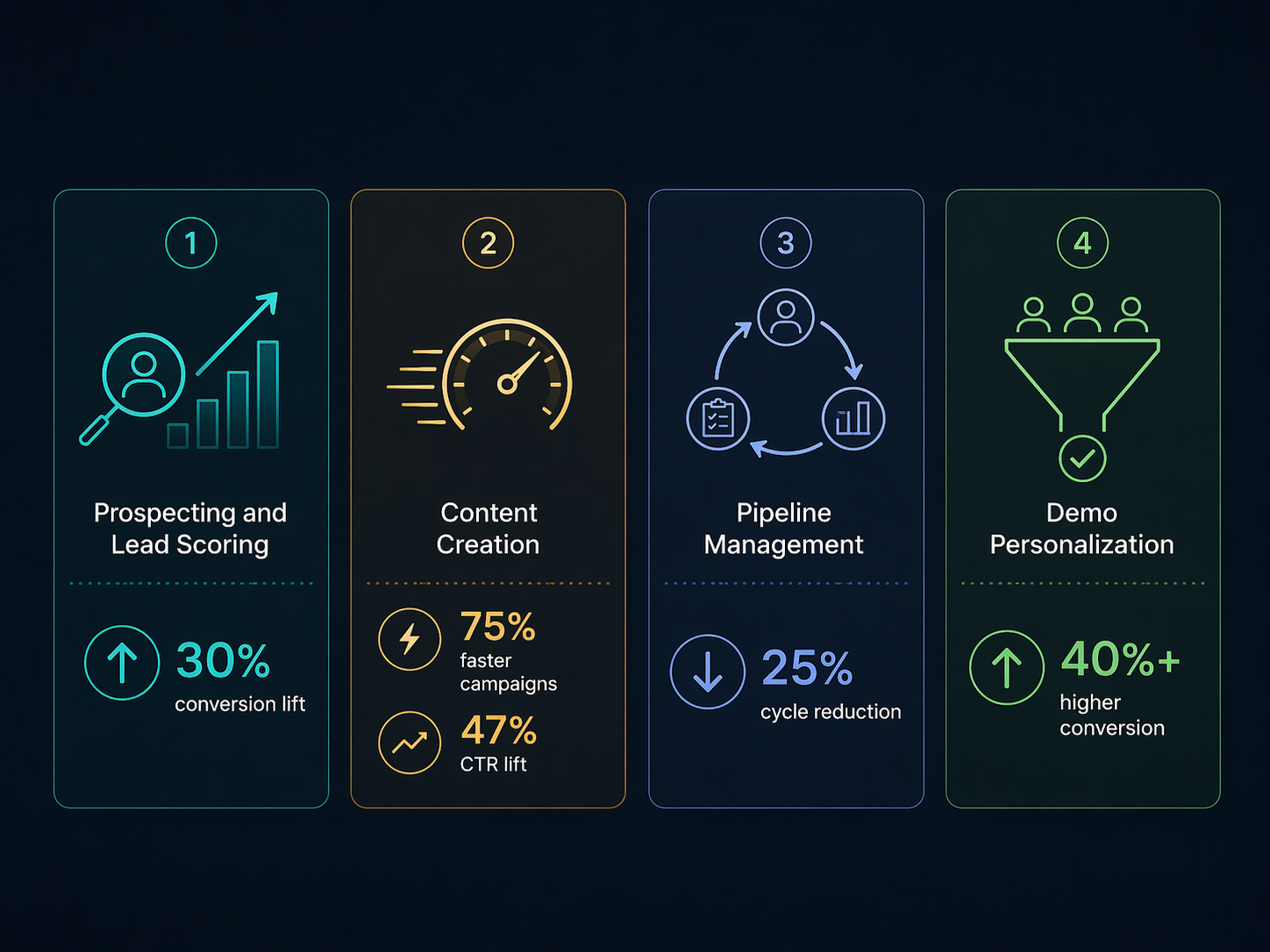
| Prospecting and lead scoring | Better conversion and lead quality | Qualified-account rate, meeting-to-opportunity conversion, disqualification rate, sales-accepted lead rate |
| Content creation | Faster campaign production and improved engagement when tied to strategy | Campaign cycle time, asset reuse, CTR, conversion by content type, review and rework time |
| Pipeline management | Less cycle drag and more rep productivity | Sales cycle length, stage aging, next-step completion, forecast hygiene, rep selling time |
| Demo personalization | Higher later-stage conversion | Demo-to-proposal conversion, proof-of-concept progression, win rate by segment, buyer engagement |
Prospecting and lead scoring: the cleanest early sales case
Prospecting is one of the few sales use cases where the value case can be made without pretending every downstream variable is under control. Sopro reports a 30% conversion lift for AI-assisted prospecting and lead scoring, which is meaningful because the work sits close to a measurable handoff: an account is identified, scored, routed, contacted, accepted or rejected, and either progresses or does not.[1]
The important distinction is lead volume versus lead quality. A model that produces more names is not automatically improving revenue operations. The better implementation reduces wasted rep motion: fewer poor-fit accounts routed to sales, clearer prioritization across intent and firmographic signals, and better matching between campaign responses and sales follow-up. The metric that matters is not how many leads AI generated. It is whether sales accepts more of them, converts more of them, and spends less time sorting through the pile.
This is also where marketing and sales alignment becomes visible. If marketing uses AI to score demand but sales does not trust the score, the system has only created a more sophisticated disagreement. A useful pilot should show the old routing logic beside the AI-assisted logic, then compare acceptance, meeting creation, opportunity conversion, and rejection reasons over the same period. Without that comparison, the team is left with a prettier dashboard and the same argument.
Content creation: fast payback, but only when strategy survives automation
Marketing-side returns can show up faster because AI removes obvious production bottlenecks. Sopro reports 75% faster campaign creation and 47% better click-through rates for AI-supported content creation.[1] Those numbers explain why content is often the first funded use case: the before-and-after workflow is easy to see. Briefs become drafts faster. Variations for segments are cheaper. Email, landing page, ad, and sales enablement versions can be produced without rebuilding the same message from scratch every time.
But this is also the category where teams most easily mistake activity for return. Generic asset volume is a weak business case. If AI produces twice as many articles, emails, and ads but the positioning is unchanged, the audience is poorly defined, and the sales team cannot use the output, the gain may be little more than lower drafting cost. The better measure is campaign cycle time paired with quality controls: approval rounds, rework rate, CTR, conversion rate, sales usage, and whether the asset helped move a known audience to the next step.
This is why campaign ROI should be treated separately from content velocity. Faster shipping is valuable, especially for lean teams, but it needs a second proof point. Did the campaign reach the right segment? Did engagement improve? Did conversion hold after the novelty wore off? For a deeper marketing-side breakdown, see AI for Marketing Campaigns: What the 2026 ROI Data Actually Shows.
Pipeline management: less glamorous, often more defensible
Pipeline management rarely demos as well as a generative content tool, but it is closer to the revenue system. Monday.com’s 2026 guide cites AI pipeline management outcomes including a 25% cycle reduction and a 40% productivity boost.[3] The value comes from reducing the drag that accumulates between stages: stale opportunities, missing next steps, inconsistent notes, unlogged activity, poor forecast inputs, and managers discovering risk too late.
This is not just a sales-management convenience. If AI flags stalled deals, suggests next actions, summarizes calls, updates fields, or highlights forecast risk, the benefit is time returned to reps and earlier intervention for managers. The finance-grade version of this business case does not say “AI improved productivity” and stop there. It shows stage aging before and after, next-step completion, cycle length, forecast changes, and whether reps moved more opportunities without simply carrying a larger, lower-quality pipeline.
The administrative burden is a real opening. Nooks cites Salesforce State of Sales data indicating that sales reps spend only 28% to 34% of their week selling, with the rest absorbed by work such as admin, research, follow-up, and internal coordination.[4] That does not mean every administrative task should be automated. It does mean the ROI ceiling is high when AI removes steps that reps already resent and managers already have to audit.
Demo personalization: strong later-stage upside, narrower applicability
Demo personalization belongs near the top of the sales list, but not for every company. Walnut reports more than 40% higher conversion tied to AI-supported demo personalization.[5] That is plausible as a later-stage lever because the workflow directly affects buyer relevance: the product story, proof points, use cases, and follow-up materials can be matched to industry, role, pain point, or account history.
The catch is that demo personalization needs enough repeatable sales motion to measure. A team with a high volume of similar demos can compare personalized versus standard flows by segment, stage, and rep. A team selling highly bespoke enterprise deals may still benefit, but attribution will be messier. In that environment, demo AI should be judged less by a universal conversion claim and more by whether it shortens prep time, improves stakeholder relevance, and helps more opportunities progress to proposal or proof of concept.
Where AI disappoints: not the obvious failures, the operational ones
The low-value AI use cases are not hard to spot. Generic content created without strategy, automated outreach that ignores fit, and dashboards that summarize bad data more quickly all disappoint for the same reason: they increase activity while leaving the revenue constraint untouched. The more expensive failures are subtler. They happen when the use case is sound, but the operating environment is not ready.
Dirty CRM data turns automation into error at scale
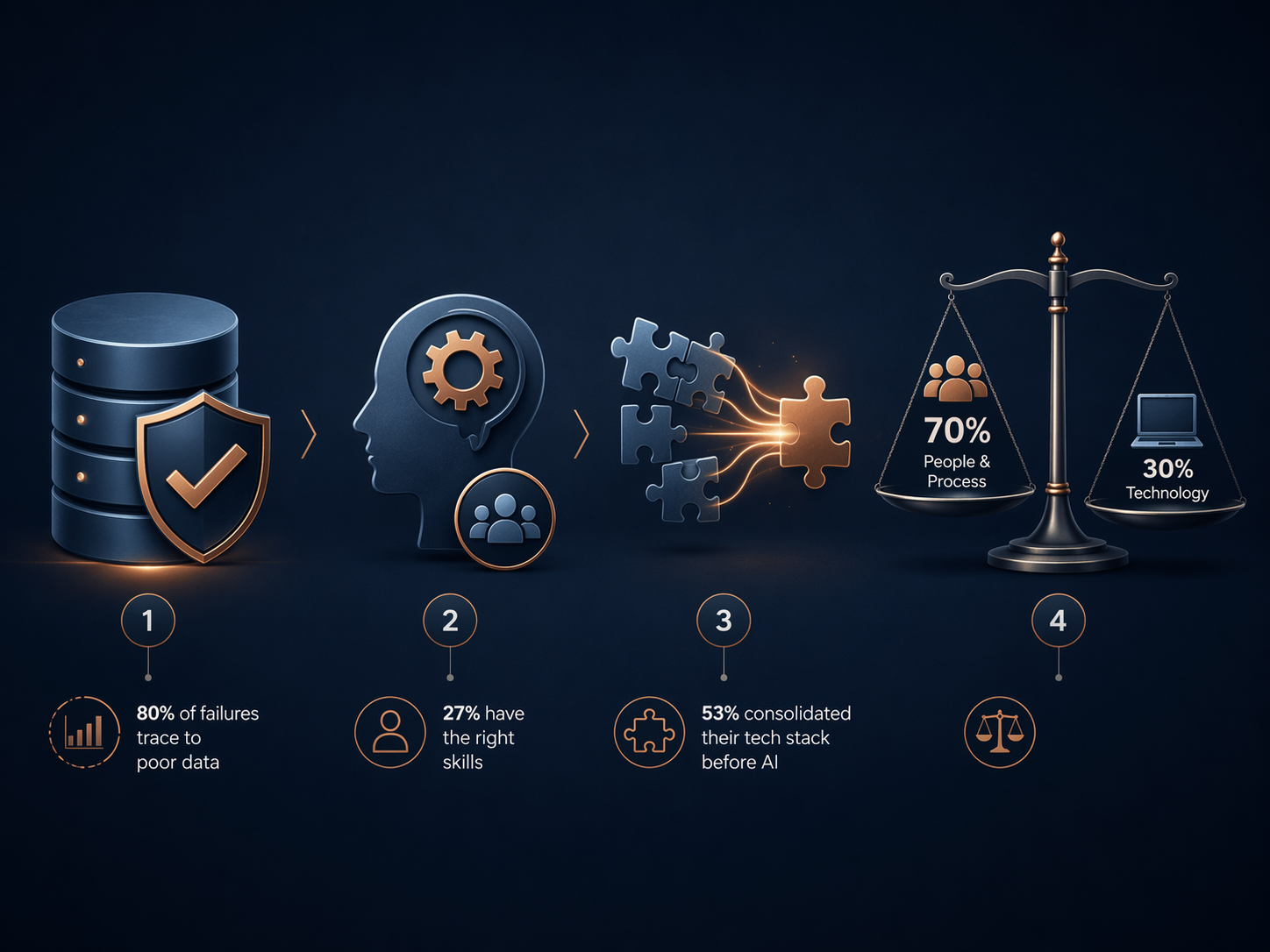
Data quality is not a cleanup task to schedule after the pilot. It is part of the ROI math. Sopro cites Forrester research indicating that 80% of AI failures trace to poor data quality.[1] In sales and marketing, that failure mode is easy to understand: duplicate accounts, inconsistent lifecycle stages, missing firmographic fields, outdated contacts, unclear campaign attribution, and rep-entered notes that vary from useful to unusable.
AI does not make those issues disappear. In many cases, it makes them travel faster. A lead score trained on weak conversion data can prioritize the wrong accounts. A pipeline model fed by inconsistent stage definitions can flag the wrong risks. A content personalization engine using messy segmentation can send technically polished messages to the wrong audience. The cleanup work then lands on the same sales ops and demand gen teams that were supposed to be freed by automation.
Training gaps turn good tools into side projects
Training is often treated as adoption support, but it is closer to risk control. Sopro reports that 70% of employers do not provide AI training and that only 27% of employees have the right skills.[1] Those numbers explain a familiar pattern: a few power users get impressive results, the broader team experiments unevenly, and leadership sees enough anecdotes to keep funding the tool without enough repeatability to prove business impact.
For sales, the gap shows up in trust and workflow discipline. Reps ignore lead scores they do not understand, overwrite suggested next steps, or use AI summaries without checking customer context. For marketing, it shows up in inconsistent prompting, weak review standards, brand drift, and assets that move faster through drafting but slower through approval because reviewers do not trust the output. The issue is not that everyone needs to become a model expert. They do need to know when to use AI, what good output looks like, what must be verified, and which metric the workflow is supposed to improve.
Fragmented stacks make ROI harder to see
AI pilots often look better than scaled deployments because the pilot team can manually bridge gaps that the operating system will not bridge later. Datagrid reports that 53% of successful implementations consolidated their tech stack before deploying AI, and also cites the 70/30 pattern associated with high performers: 70% of resources invested in people and process change, 30% in technology.[6]
That 70/30 split is a useful antidote to tool-first budgeting. If campaign data sits in one system, CRM activity in another, call intelligence in another, and reporting logic in spreadsheets, the AI layer may generate suggestions without a reliable feedback loop. Someone still has to reconcile whether the recommendation led to a better outcome. At scale, that “someone” becomes the hidden cost of the initiative.
This is the same pattern behind the pilot-to-scale gap in marketing AI: strong local wins, weak system-level proof. The issue is explored more directly in The Machine Learning in Marketing ROI Gap: Strong Pilot Returns, Weak Scaling.
A practical prioritization test for 2026 budgets
The right first investment is usually not the flashiest tool. It is the use case where the revenue friction is specific, the feedback loop is short enough to measure, and the team has enough operational control to act on the output. Before funding another AI workflow, a revenue team should be able to answer five questions.
- What business metric should move? Choose a metric close to revenue behavior: sales-accepted lead rate, meeting-to-opportunity conversion, campaign cycle time, stage aging, sales cycle length, demo-to-proposal conversion, or forecast accuracy.
- Is the data clean enough for the decision being automated? The bar does not need to be perfection. It does need to be high enough that the model is not optimizing against duplicate, outdated, or inconsistently defined records.
- Who owns the workflow after launch? AI that affects lead routing, campaign production, or pipeline movement needs an operating owner, not just a software administrator.
- How quickly can the team see whether it worked? Content workflows may show production and engagement changes quickly. Pipeline and conversion improvements may need a longer window, especially in complex sales cycles.
- What training or process change is required before scale? If the answer is “none,” the team is probably undercounting the work.
This test will often push teams toward narrower deployments than leadership originally imagined. That is not a weakness. A prospecting model for one segment, a campaign production workflow for one repeatable motion, or an AI pipeline inspection process for one sales team can create a clearer read than a broad rollout that touches every workflow lightly and proves none of them.
It also helps separate marketing and sales timelines. Marketing AI can often justify itself first through lower production cost, faster campaign launch, and engagement lift. Sales AI usually needs to show that rep time, qualification, and deal movement improved without lowering quality. Blending those into a single “AI ROI” number may satisfy a slide deck, but it hides the operating decisions that make the investment work.
For teams deciding where AI belongs in the broader go-to-market system, the useful conversation is less about tool categories and more about sequencing. The strategic version of that discussion is covered in The Five Decisions That Separate AI Marketing Leaders From Tool Collectors.
The 2026 judgment
The returns from AI for sales and marketing are real, but they are concentrated. Prospecting and lead scoring can improve conversion quality. Content creation can compress campaign production and improve engagement when strategy and review standards are intact. Pipeline management can reduce cycle drag and return time to sellers. Demo personalization can help later-stage opportunities when there is enough volume and consistency to measure the lift.
The weak investments are the ones that fund activity without removing a revenue constraint. In 2026, the better budget argument is not “we need more AI.” It is “this workflow creates measurable friction, our data is ready enough, the owner is clear, the feedback loop is visible, and the team knows how to use the system.” That is where AI stops being dashboard theater and starts showing up in the numbers people actually review.
References
- 75 Statistics About AI in Sales and Marketing for 2026, Sopro
- AI Marketing ROI Statistics 2026, Zigment.ai
- AI Sales Pipeline Management: A Practical 2026 Guide, monday.com
- Mastering AI for Sales Prospecting, Nooks
- AI in Sales: The Complete 2026 Guide, Walnut.io
- Statistics on AI Agents for Sales, Datagrid


Comments
Join the discussion with an anonymous comment.