
The Right Way to Build an AI Sales and Marketing Stack: Why Sequencing Matters More Than Tool Selection
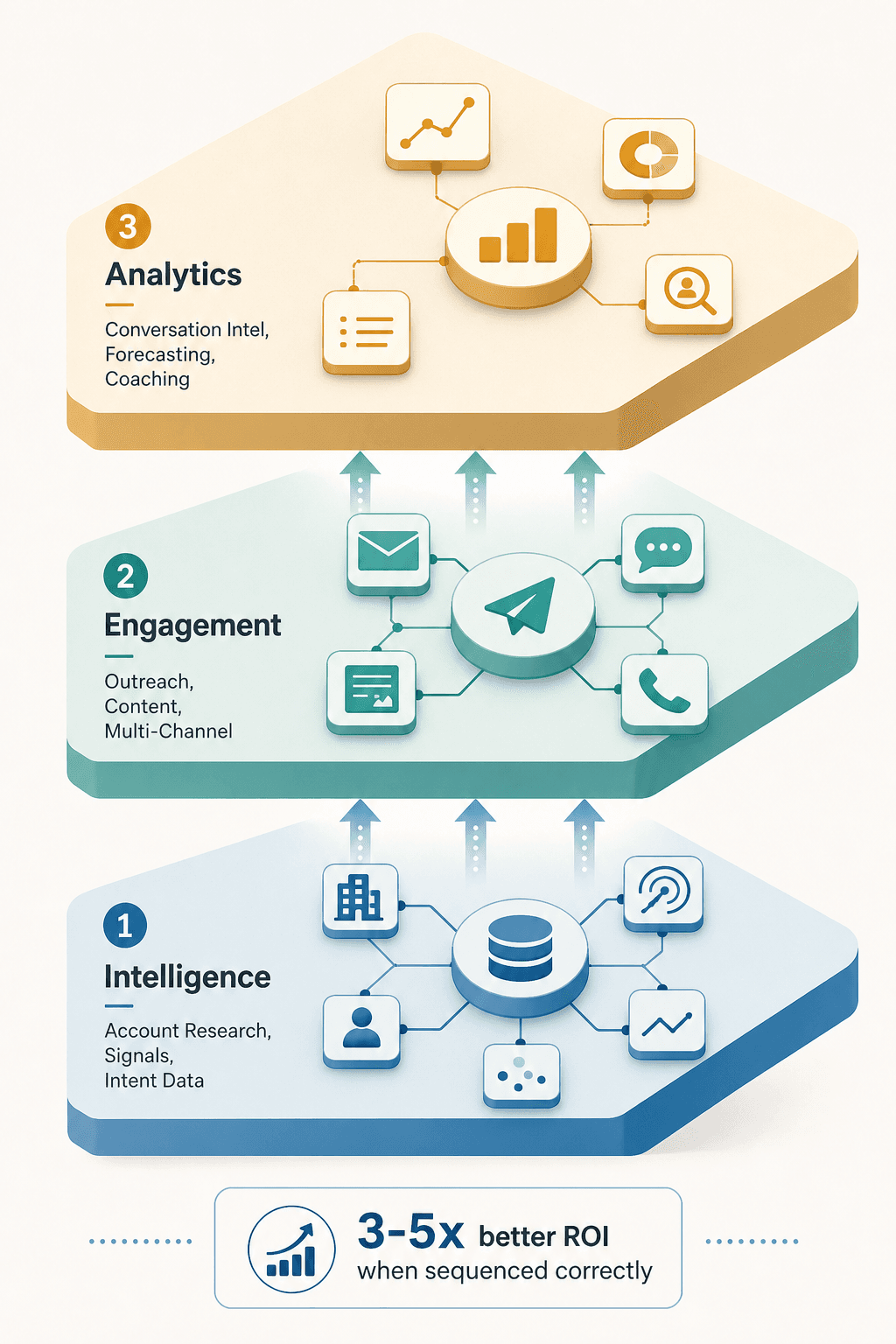
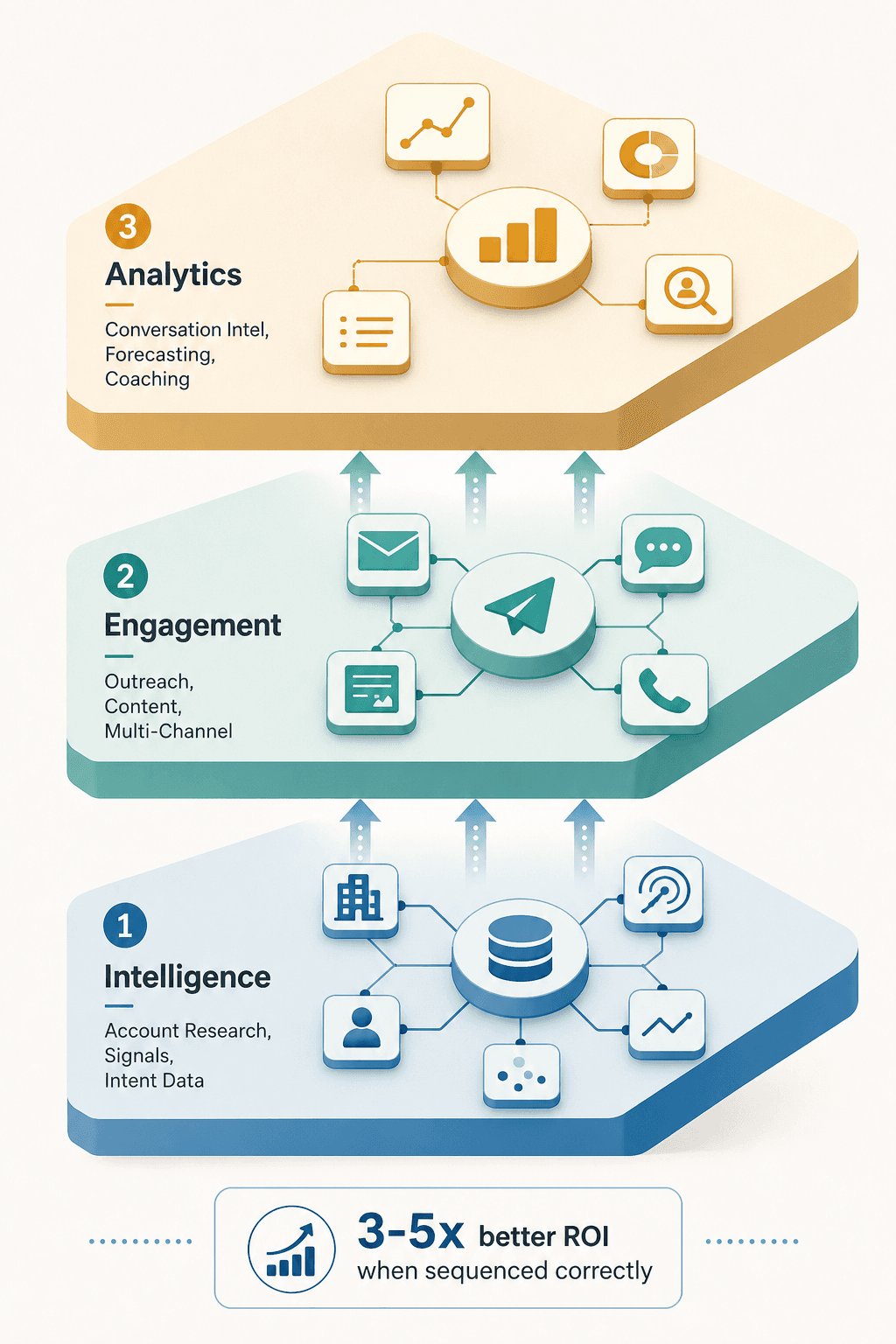
Most B2B teams waste AI budgets by buying outreach tools before establishing an intelligence layer. This guide explains why the correct sequence — intelligence first, engagement second, analytics third — produces 3-5x better ROI, with a concrete decision matrix for your team size and data maturity.
The $300 Billion Problem: Why 95% of Companies See Zero ROI from AI
By mid-2025, global enterprise AI spending had crossed the $300 billion mark. Yet according to MIT research published that year, 95% of companies see zero measurable bottom-line impact from their AI spending. That is not a tool-quality problem. It is a sequencing problem.
The dominant pattern in B2B today is to buy an outreach tool first — an AI email sequencer, a LinkedIn automation platform, a conversational chatbot — because that is where the pain is most visible. Reps need more meetings. Campaigns need to launch faster. The engagement layer promises immediate relief, so it gets the budget.
But engagement tools operating without an intelligence layer are flying blind. They do not know which accounts are in-market, what signals indicate buying intent, or what context a rep needs before a first touch. The result is high-volume outreach that generates activity, not pipeline.
The data bears this out. Teams that sequence their AI investments correctly — intelligence first, engagement second, analytics third — report 3-5x better ROI than those that skip the foundational layer, according to research cited in the Salesmotion 2026 buyer's guide. Meanwhile, 86% of sales teams using AI report positive ROI within the first year when implemented correctly, per Sopro's 2026 survey of over 1,000 organizations.
This article is not another list of AI tools. It is a sequencing framework for the full sales-and-marketing pipeline — account intelligence, multi-channel prospecting, conversation analysis, and forecasting. If you are a B2B marketing manager, Demand Gen lead, or Revenue Operations manager evaluating your next AI investment, the question is not which tool to buy. It is which layer to build first.
Layer 1: Account Intelligence — The Foundation Everyone Skips
The average sales team juggles 13 different tools, yet 70% of B2B reps still missed quota in 2024, according to Salesmotion. That gap exists because most of those tools operate on the same shallow data: a CRM record that is six months stale, a list of accounts from a purchased database, and a spreadsheet of last-touch activities.
Layer 1 — Account Intelligence — solves that by building a persistent, signal-driven understanding of your target accounts before any outreach happens. This layer includes:
- Signal monitoring: Tracking job changes, funding rounds, product launches, regulatory filings, and intent signals from content consumption across your target accounts.
- One-click account briefs: AI-generated summaries of an account's current situation, recent news, technology stack, and known pain points — surfaced inside the CRM or sales engagement platform.
- Buying intent detection: Identifying which accounts are actively researching solutions in your category, based on content engagement, search behavior, and third-party intent data.
- Data hygiene and enrichment: Deduplicating, standardizing, and enriching CRM records so that every field is current and usable by downstream tools.
Without this layer, every engagement tool you buy is operating on incomplete or inaccurate data. The AI email sequencer writes personalized messages to the wrong contact title. The chatbot surfaces a case study for an industry the prospect left two years ago. The LinkedIn automation tool targets accounts that already churned.
The data cost is staggering. According to a CDO Times report cited by Iterable, data issues consume 80% of AI project work and can derail outcomes entirely. Gartner attributes 60% of AI project failures to inadequate data governance. Building the intelligence layer first is not a luxury — it is the prerequisite that determines whether every subsequent tool investment pays off.
Layer 2: Engagement and Prospecting — Powered by Layer 1 Data
Once your intelligence layer is producing clean, signal-rich account data, the engagement layer becomes dramatically more effective. This is where multi-channel outreach — email sequences, LinkedIn touchpoints, paid social retargeting, direct mail, and conversational AI — gets orchestrated based on real signals rather than spray-and-pray volume.
The performance difference is measurable. According to Sopro's 2026 research, AI-driven campaigns launch 75% faster and deliver 47% better click-through rates compared to traditional approaches. Marketing teams deploying AI across multiple functions report an average 300% ROI from revenue and cost savings, per the same source. But these numbers assume the engagement layer is fed by quality intelligence — not that the tools themselves are inherently superior.
What changes when Layer 1 powers Layer 2:
- Email sequences trigger based on intent signals, not calendar dates. A prospect reads three pricing page articles? The sequence escalates to a demo request. No activity in 30 days? The sequence pauses, not pummels.
- LinkedIn outreach references specific recent events — a funding round, a product launch, a leadership change — because the intelligence layer surfaced them in real time.
- Conversational AI chatbots on your website know which account the visitor belongs to and can serve relevant case studies, whitepapers, or pricing pages based on that account's industry and stage.
- Ad targeting shifts from broad demographic segments to account-based audiences built from verified intent data, reducing wasted spend.
The risk of skipping Layer 1 is not just inefficiency — it is that your engagement metrics look good while pipeline remains flat. High open rates and click-throughs on poorly targeted outreach create a false sense of progress. The 70% of reps who missed quota in 2024 were not inactive. They were busy engaging the wrong accounts.
Layer 3: Conversation Intelligence and Forecasting — The Capstone
The top layer of the stack — conversation intelligence and forecasting — is where most teams want to start because it promises the most strategic value: deal prediction, call analysis, rep coaching, and accurate pipeline forecasting. But this layer is entirely dependent on the quality of data flowing up from Layers 1 and 2.
Conversation intelligence tools analyze sales calls and meetings to extract insights: competitor mentions, objection patterns, sentiment shifts, and talk-to-listen ratios. Forecasting models use historical pipeline data and engagement signals to predict which deals will close and when. Coaching platforms surface best practices from top performers and suggest interventions for struggling reps.
All of these capabilities require clean, structured data from the layers below. A forecasting model trained on a CRM with duplicate records, missing stage data, and stale contact information will produce predictions that are worse than a human guess. A conversation intelligence tool that cannot link a call recording back to the correct account and opportunity record generates insights that are untethered from reality.
McKinsey's research on AI in marketing and sales found that organizations investing deeply in this area see sales ROI improve by 10-20% on average. But that figure assumes the foundational layers are in place. When they are not, the analytics layer becomes an expensive dashboard that reports on bad data with high confidence.
The market has already voted on this. According to Salesmotion, 60% of AI sales tools that launched in mid-2024 shut down or pivoted by Q4 2025. Many of those failures were analytics and forecasting tools that promised strategic value but could not deliver because their customers had not built the intelligence and engagement layers first. The tools worked in demos with clean sample data. They failed in production with real CRM data.
The Decision Matrix: Where to Start Based on Your Team Size and Data Hygiene
The correct starting layer depends on two variables: your team's pipeline complexity (small/simple to large/complex) and your data hygiene maturity (low to high). The matrix below maps recommended starting layers for each combination.
| Pipeline Complexity | Data Hygiene: Low | Data Hygiene: Medium | Data Hygiene: High |
|---|---|---|---|
| Small / Simple (1-3 reps, <50 target accounts) | Layer 1: Intelligence. Clean your CRM and build account profiles before any outreach tool. | Layer 1: Intelligence. Focus on intent signal integration and account enrichment. | Layer 2: Engagement. Your data is ready for multi-channel outreach powered by existing signals. |
| Medium (4-15 reps, 50-500 target accounts) | Layer 1: Intelligence. Data cleanup and enrichment is your highest-ROI activity. Do not buy engagement tools yet. | Layer 1: Intelligence. Add signal monitoring and intent detection. Engagement tools will follow in 3-6 months. | Layer 2: Engagement. Your intelligence layer can feed outreach. Consider piloting conversation intelligence in one segment. |
| Large / Complex (15+ reps, 500+ target accounts, multiple segments) | Layer 1: Intelligence. Invest in data governance infrastructure first. 80% of AI project work is data issues. | Layer 1 + pilot Layer 2. Build intelligence at scale while running a controlled engagement pilot in one segment. | Layer 2 + pilot Layer 3. Your data supports full engagement orchestration. Test conversation intelligence in your highest-volume segment. |


Comments
Join the discussion with an anonymous comment.