
How to Allocate Your AI Marketing Budget in 2026
Marketing leaders face a confusing AI spending landscape. This article provides a data-backed framework for allocating AI budget across software, talent, infrastructure, and governance, grounded in the BCG 10/20/70 rule and 2026 benchmarks.
The loudest AI budget signal in 2026 is the wrong one for most marketing teams. Worldwide AI spending is projected at $2.59 trillion, with hardware, services, platforms, and models absorbing enormous capital across the economy.[1] Morgan Stanley, McKinsey, and KKR are all tracking the same broad buildout: data centers, chips, energy, cloud capacity, and enterprise infrastructure are becoming a long-cycle investment theme, not a one-year software fad.[2][3][4]
That matters. It does not answer the CMO’s budget question.
For a marketing leader, the practical question is not whether the world needs more GPUs. It is whether the team’s own AI budget is divided in a way that lets the technology produce useful work: approved content, cleaner audiences, safer claims, faster campaign operations, better measurement, and fewer expensive mistakes hidden inside automation.
The weak budget is easy to spot. It has a confident software line, a vague implementation line, a thin training line, and no one clearly funded to redesign the workflow after procurement signs the contract. It treats AI as a tool purchase when most of the return depends on the operating model around the tool.
Start With The Budget Constraint, Not The Market Forecast
Market forecasts help explain why vendors, cloud providers, consultants, and investors are moving quickly. They do not tell a marketing organization how much to spend on AI-use governance, approval routing, content QA, campaign taxonomy cleanup, or AI literacy for channel managers.
That distinction matters during Q3 and Q4 planning. A marketing team usually has a fixed envelope. If software expands faster than the team’s ability to operate it, the budget becomes fragile. The first visible symptom is rarely a system outage. It is slower approvals, duplicate tools, unclear ownership, off-brand drafts, campaign data that cannot be trusted, or a paid media workflow where automation accelerates spend before anyone understands the decision rules.
So the budget conversation needs to move down one level: from global AI infrastructure to marketing operating infrastructure. The former is about capacity. The latter is about whether the people, data, workflows, permissions, reviews, and measurement loops can absorb AI without creating more risk than return.
The 10/20/70 Rule Is Useful Because It Makes The Hidden Work Visible
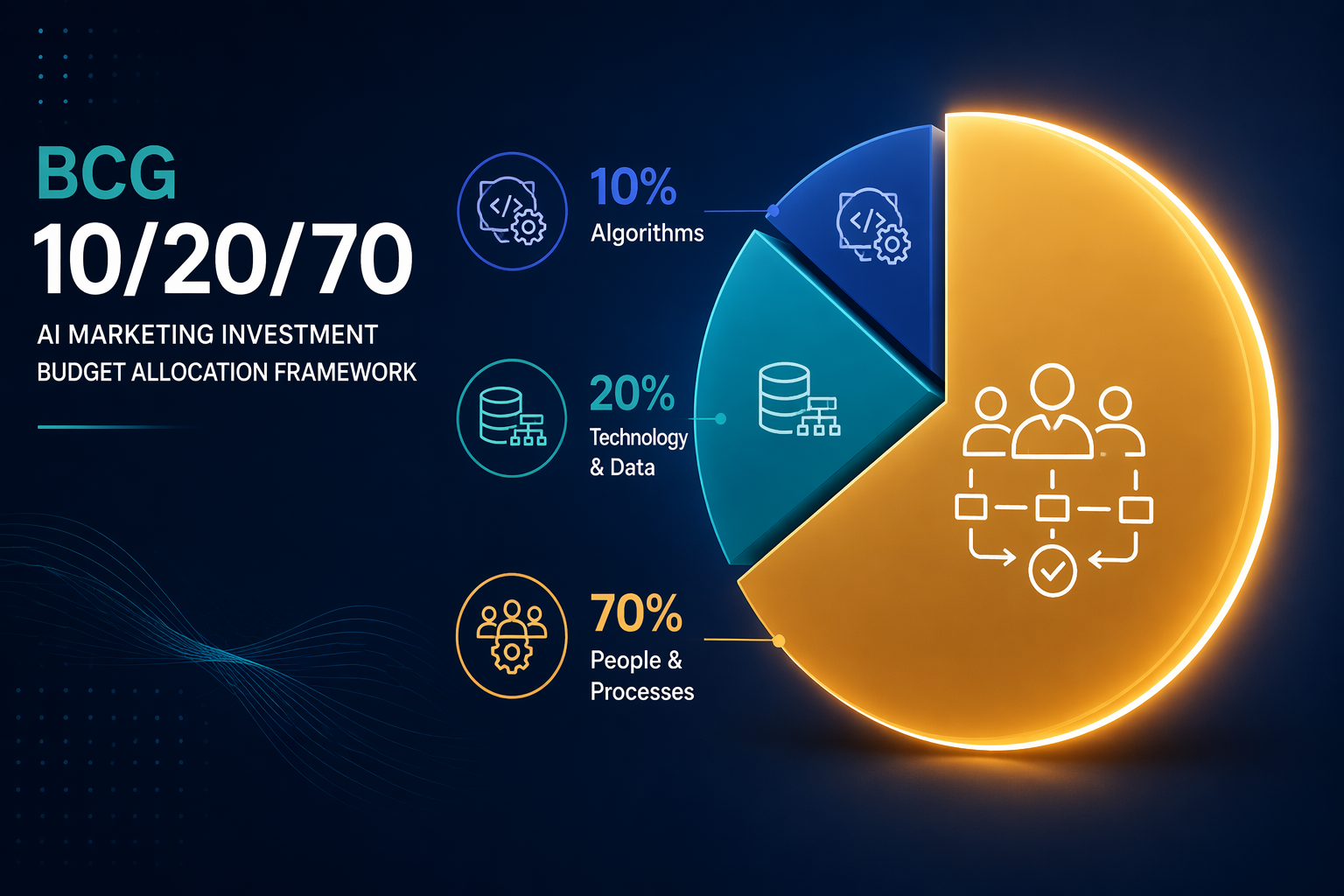
BCG’s widely cited 10/20/70 rule assigns 10% of AI effort to algorithms, 20% to technology and data, and 70% to people and processes.[5] The numbers should not be read as a procurement formula. They are more useful as a warning: the model and the platform are usually not the hardest part of getting value.
In marketing, that 70% is not a soft category. It is the work that determines whether AI output can enter the business without creating rework.
- Content leaders need revised intake, drafting, review, disclosure, and approval flows.
- Brand and legal reviewers need clear standards for AI-assisted claims, image use, substantiation, and tone.
- Paid media managers need controls for automated recommendations, audience changes, bidding decisions, and budget pacing.
- Marketing operations teams need clean permissions, connected data sources, campaign naming discipline, and integration ownership.
- Managers need training plans that change daily behavior, not one-off demos that disappear after launch week.
This is where many AI plans become underfunded while still looking modern. A budget can include a leading model subscription, an AI writing platform, a personalization layer, a sales outreach assistant, and a reporting copilot, yet still fail because no one paid for the workflow changes that let those systems operate safely.
Use Benchmarks As A Diagnostic, Not A Target Table
Presenc AI’s 2026 enterprise AI budget allocation research offers a useful seven-category view: software, cloud infrastructure, talent, implementation, data platforms, governance, and training. The source presents the data as directional benchmarks, not universal targets, and the ranges vary by industry and maturity level.[6]
| Budget category | Directional 2026 range | Closest BCG zone | Marketing interpretation |
|---|---|---|---|
| Software | 30-40% | 10% algorithms / 20% technology and data | AI tools, model access, campaign copilots, content platforms, creative tools, and role-specific applications |
| Cloud infrastructure | 20-25% | 20% technology and data | Compute, storage, data movement, API usage, and environments needed to run AI-enabled workflows |
| Talent | 15-20% | 70% people and processes | Operators, analysts, content leads, marketing ops owners, reviewers, and managers who make the tools useful |
| Implementation | 10-15% | 70% people and processes | Workflow redesign, integrations, rollout support, enablement, testing, and change management |
| Data platforms | 8-12% | 20% technology and data | Customer data infrastructure, taxonomy, audience quality, consent fields, reporting foundations, and access management |
| Governance | 8-12% | 70% people and processes | Policy, review rights, auditability, compliance checks, claim standards, and risk ownership |
| Training | 3-6% | 70% people and processes | AI literacy, role-based playbooks, manager coaching, QA routines, and adoption support |
At first glance, the Presenc AI categories look different from the BCG rule. They are not competing frameworks. One describes where enterprise AI money tends to go. The other explains why the non-software work carries so much of the outcome risk.
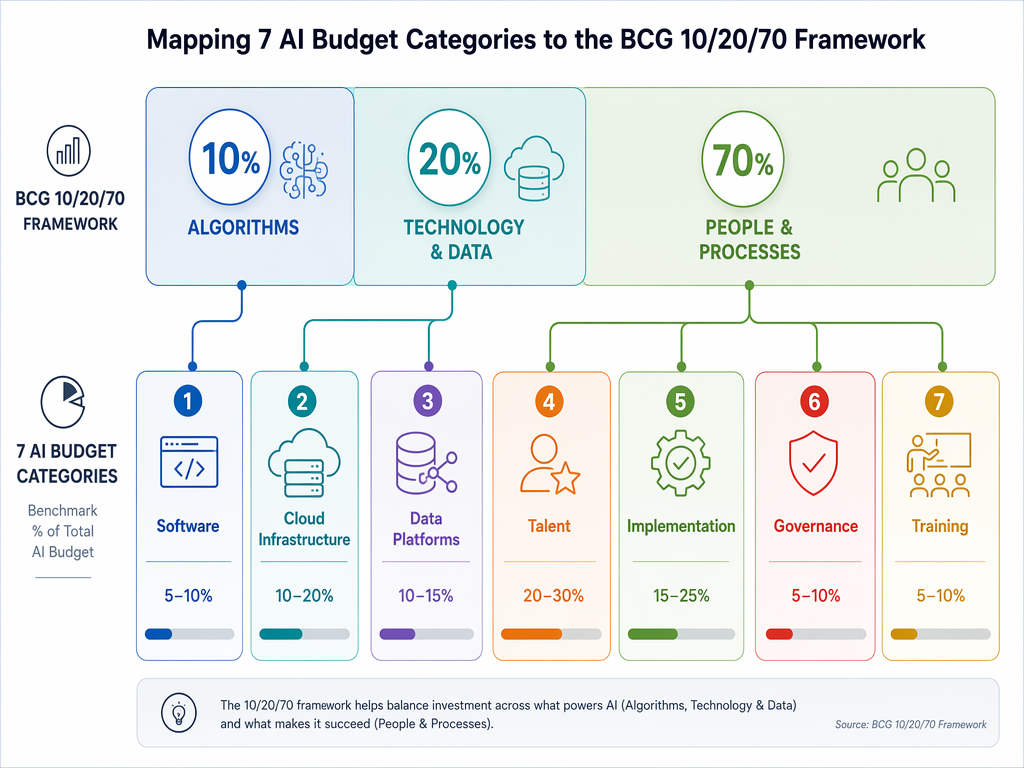
The useful move is to reconcile them. Software, cloud, and data platforms explain the technical base. Talent, implementation, governance, and training explain whether marketing can turn that base into operating capacity. When those second-order lines are squeezed, the budget may still buy access to AI, but it does not buy adoption, quality control, or durable ROI.
The 1.2x Test: A Simple Way To Catch Underfunded Plans
The sharper diagnostic is the talent-to-software ratio. The benchmark indicates that programs below roughly 1.2x talent-to-software spend systematically underperform: for every $1 spent on AI software licenses, at least $1.20 should be allocated to the people who operate, oversee, train on, and adapt the tools.[6]
That ratio is not a magic threshold. It is a planning test. If a team proposes $500,000 in AI software and only $150,000 for training, workflow redesign, implementation, governance, and operator time, the burden of proof should shift. The plan needs to explain why this particular team can capture value with so little investment in the work that makes adoption real.
The test also prevents a common accounting mistake. Many teams count software licenses as AI investment but treat the content lead’s review redesign, the ops team’s data cleanup, and the channel manager’s training time as free. They are not free. They are the budget, whether they appear as line items or as overloaded staff capacity.
What Belongs In The 70%
The 70% people-and-process allocation is easiest to dismiss when it is labeled “change management.” In a marketing budget, it should be translated into specific work packages with owners.
Approval Chains
AI changes the volume and shape of content moving through review. If the team can generate more landing page variants, email drafts, ad copy, sales enablement snippets, and social posts, then the old approval flow may become the bottleneck. Budget has to cover revised routing, clearer review criteria, escalation rules, and QA standards.
Without that work, “time saved” in drafting becomes time lost in review. The content team produces more first drafts, brand reviewers see more uneven work, legal reviewers receive more questionable claims, and campaign launch dates do not improve.
Creative Direction
Generative tools can multiply creative options, but they do not replace creative judgment. Someone still decides which concepts fit the brand, which messages are overused, which claims need evidence, and which audience assumptions are lazy. If that judgment is not funded, the team may get more assets without stronger campaigns.
The budget line here is not just for designers or writers. It includes creative briefs, prompt libraries, review rubrics, brand examples, rejected-output libraries, and the time senior marketers spend turning scattered experiments into repeatable patterns.
Campaign Operations
AI can speed campaign setup, audience segmentation, personalization, and performance analysis. It can also hide bad spend if no one understands the rules behind automated recommendations. Paid media managers need time and tooling to inspect changes, monitor budget pacing, compare recommendations against business constraints, and document overrides.
This is where AI budget overlaps with operating discipline. If campaign names, UTMs, audience definitions, conversion events, and CRM fields are inconsistent, AI will not politely fix the mess. It will often make the mess faster.
Data Hygiene And Permissions
Marketing teams usually want AI to work across content, CRM, analytics, advertising, web, and lifecycle systems. That means access decisions become budget decisions. Who can connect which source? Which customer fields can be used? Which prompts can include campaign performance data? Which outputs can be stored? Which vendors can touch regulated or sensitive information?
The cost sits in data mapping, permission cleanup, integration design, security review, and ongoing administration. These items rarely make a slide look visionary. They are also the work that prevents AI from becoming another disconnected layer on top of an already fragmented martech stack.
Training That Changes Behavior
Training is a small line in the directional benchmark, only 3-6% of AI spend, yet AI literacy and training show the strongest correlation with realized ROI across enterprise surveys.[6] That is not surprising inside a marketing team. The difference between a casual user and a trained operator shows up in prompt quality, review discipline, source handling, personalization judgment, and the ability to know when not to use the tool.
A useful training budget is role-based. A lifecycle marketer does not need the same curriculum as a brand reviewer. A demand generation manager needs to understand campaign analysis and spend controls. A content lead needs drafting, editing, claim review, and editorial governance. A marketing ops owner needs integration, permissions, taxonomy, and auditability.
For teams building a phased rollout, a 90-day AI marketing strategy roadmap is often a better training companion than a generic certification path, because it ties enablement to decisions the team must actually make.
Governance Is Now A Budget Line, Not A Policy Memo
Presenc AI’s benchmark places governance at 8-12% of AI spend, up from 3-5% in 2024. The increase is tied to EU AI Act enforcement, agent-runtime audit requirements, and CFO compliance concerns.[6] For marketing, those drivers are not abstract regulatory noise. They affect what teams can generate, publish, personalize, store, and prove after the fact.
Governance spending should cover practical controls: approved use cases, restricted use cases, disclosure standards, claim substantiation, human review rules, vendor review, audit logs, incident response, and ownership for model-assisted decisions. If AI agents are taking actions across systems, runtime auditability becomes part of campaign infrastructure, not an IT side project.
This also changes ROI conversations. A team may be able to generate more content at lower marginal cost, but if the process increases legal review load, brand risk, customer trust issues, or compliance exposure, the budget has not captured the full cost. The governance line is where those costs become visible before they become incidents. For a deeper look at the customer-facing side of this problem, see the AI-generated marketing trust gap.
Where Software Still Deserves Real Money
None of this argues for starving the software line. The AI platforms and models market is itself growing quickly; Gartner reported 63% growth in 2026 for AI platforms and models.[7] Marketing teams need capable tools, and weak tooling can waste talent just as surely as weak adoption can waste software.
The discipline is to buy software against a workflow, not against a category label. A content platform should map to a content operating model. A media optimization tool should map to spend controls and performance review. A personalization engine should map to data readiness and consent. A reporting copilot should map to metric definitions and decision rights.
GrowthMarketer’s five-layer AI marketing infrastructure model is useful here as one practitioner’s way to organize the stack: creative production, landing pages, outreach, content, and tracking.[8] It should not be treated as an industry standard, but it does help expose a procurement trap. A team can buy tools in all five layers and still lack the operating tissue between them.
Before adding another tool, ask what layer it changes, what workflow it touches, what data it needs, who approves its output, and how its performance will be measured. If the answer is “the team will figure that out after purchase,” the software line is moving faster than the budget’s operating logic.
For teams comparing tools by role rather than by vendor category, a role-based AI marketing tool guide can keep procurement closer to actual work.
A Defensible 2026 Allocation Model
A useful AI marketing budget model does not copy benchmark percentages blindly. It starts with the team’s use cases, maturity, risk profile, and integration burden, then checks whether the proposed allocation passes the 10/20/70 and 1.2x tests.
- Define the AI use cases that will receive budget: content production, lifecycle personalization, paid media optimization, sales enablement, analytics, research, or workflow automation.
- Group each cost into software, cloud infrastructure, talent, implementation, data platforms, governance, or training.
- Map those costs back to the BCG zones so people-and-process work is not hidden inside vague operating assumptions.
- Calculate the talent-to-software ratio, including training, implementation support, governance labor, and operator capacity.
- Stress-test the plan against the highest-risk workflows: claims, customer data, paid spend, personalization, compliance, and executive reporting.
The output should be a budget that makes tradeoffs explicit. A mature enterprise with complex data environments may need more cloud, data platform, and governance investment. A smaller marketing team adopting AI for content and campaign operations may need less infrastructure but proportionally more training, workflow redesign, and review capacity. A regulated company should expect governance to carry more weight than a low-risk internal productivity program.
The point is not to make every team look average. It is to make every deviation explainable.
What To Cut When The Budget Gets Tight
When finance asks for a smaller number, the easiest cuts often damage the plan the most. Training looks optional. Governance looks slow. Implementation looks like consulting overhead. Workflow redesign looks like internal time. Those are precisely the lines that keep software from becoming shelfware or risk.
A better first cut is duplicate functionality. Many teams can reduce overlapping writing tools, redundant meeting assistants, isolated research copilots, or niche applications that do not connect to approved workflows. The second cut is low-accountability experimentation: pilots with no owner, no success metric, no adoption path, and no decision date.
Experimentation still matters, but it needs a container. A small test budget with clear entry and exit criteria is healthier than scattered spending that quietly becomes permanent. If a pilot cannot say which workflow it improves, which metric it changes, who will operate it, and what happens after the test, it is not infrastructure investment. It is tool drift.
Teams that need a broader cross-functional view can compare this model with an AI sales and marketing budget allocation framework, especially where marketing AI depends on sales operations, CRM quality, and revenue team adoption.
Measure ROI Where The Work Actually Changes
AI ROI measurement should follow the workflow, not the vendor promise. If a tool claims to save writing time, the budget owner should ask whether launch frequency increased, review time decreased, content quality held, or the team simply created more drafts for the same reviewers. If a media tool claims optimization gains, the team should inspect spend quality, conversion definitions, incrementality assumptions, and human override patterns.
The strongest measurement plans pair productivity metrics with control metrics. Faster asset production should be paired with approval rework, brand exceptions, claim escalations, and performance by content type. Faster audience creation should be paired with consent quality, suppression accuracy, unsubscribe behavior, and revenue contribution. Faster reporting should be paired with metric consistency and decision cycle time.
For use-case-level evidence, the AI marketing ROI by use case breakdown is a more useful companion than a generic platform ROI calculator. It keeps the discussion anchored to the work being changed.
This is also where time savings need a destination. Saved time can become more testing, better creative review, faster campaign launches, deeper customer research, or lower contractor spend. If no one decides where the time goes, it tends to disappear into backlog absorption, and the AI budget gets credited with a benefit the business never actually captures.
The Planning Standard For 2026
A defensible AI marketing budget in 2026 does not need to mimic a global infrastructure boom. It needs to show that the team can operate what it buys.
The practical standard is straightforward: every material software dollar should be paired with at least 1.2x in the talent, training, workflow redesign, implementation, governance, and oversight required to make the system perform. If the plan cannot pass that test, the risk is not that the team is moving too slowly. The risk is that it is buying faster than it can learn, govern, integrate, and improve.
References
- Gartner Forecasts Worldwide AI Spending to Total $2.59 Trillion in 2026, Gartner, May 2026.
- AI Market Trends 2026, Morgan Stanley.
- Issue Brief: AI Infrastructure, McKinsey.
- Beyond the Bubble, KKR.
- The 10/20/70 Rule, Boston Consulting Group.
- Enterprise AI Budget Allocation 2026, Presenc AI.
- Gartner Says AI Platforms and Models Market to Grow 63% in 2026, Gartner, July 20, 2026.
- AI Marketing Infrastructure, GrowthMarketer.

Comments
Join the discussion with an anonymous comment.