
Where AI Marketing ROI Actually Pays Off (and Two Places It Doesn't)
A use-case-by-use-case breakdown of AI marketing ROI reveals which applications deliver the strongest returns—and why two popular categories consistently underperform due to platform down-ranking and hidden production overhead. Includes a budget allocation framework for marketing managers.
The hard part of digital marketing with AI is no longer finding a tool that can draft, summarize, remix, or generate. The hard part is deciding which of those uses deserves budget when every team can produce a demo that looks useful and every finance review eventually asks the same question: what came back?
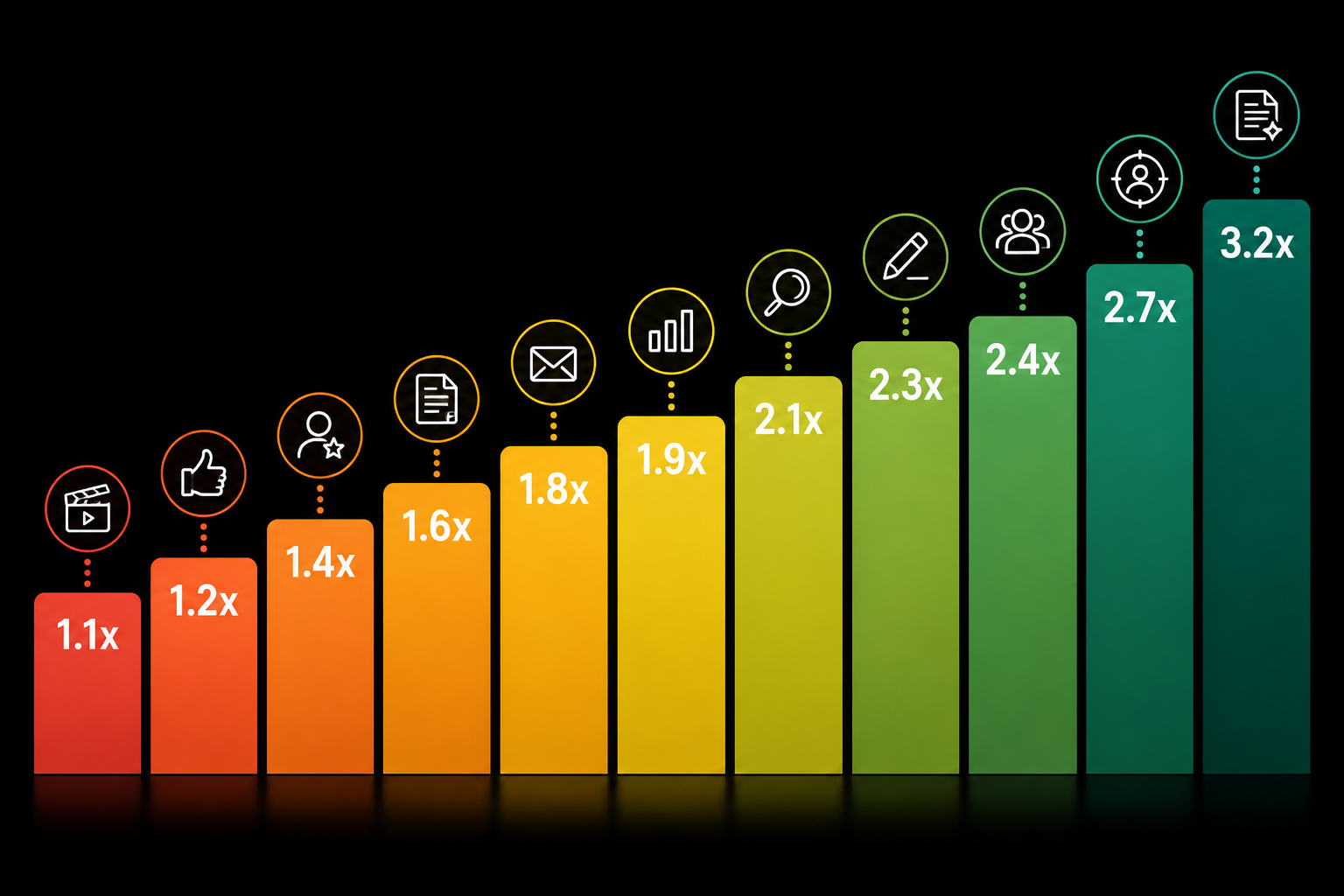
That question gets much easier when AI marketing is treated as a portfolio of use cases instead of one software category. In the available ROI data, the spread is wide enough to matter: content drafting is reported at 3.2x ROI, while AI video creation sits at 1.1x. That is not a rounding error. It is nearly a 3x difference between two applications that may both appear under the same “AI marketing” budget line.[1]
The ROI Spread by Use Case
| Rank | AI marketing use case | Reported ROI multiplier | Practical read |
|---|---|---|---|
| 1 | Content drafting | 3.2x | Strongest fit when it reduces blank-page work and speeds production inside an existing editorial process |
| 2 | Personalization engines | 2.7x | High upside when customer data, segmentation, and decision rules are already usable |
| 3 | Audience research | 2.4x | Useful when it shortens research synthesis and improves campaign inputs |
| 4 | Ad copy | 2.3x | Pays when teams can test more variants without losing message discipline |
| 5 | SEO content briefs | 2.1x | Works best as planning support, not as a substitute for editorial judgment |
| 6 | Campaign analytics | 1.9x | Valuable when it reduces analysis lag and improves budget decisions |
| 7 | 1.8x | Moderate return where lifecycle volume and testing discipline exist | |
| 8 | Video scripts | 1.6x | Helpful for early ideation, less powerful once production and approvals begin |
| 9 | Lead scoring | 1.4x | Depends heavily on data quality and sales follow-through |
| 10 | Paid social creative | 1.2x | Often cheap to generate, but exposed to creative fatigue, weak performance, and possible platform penalties |
| 11 | AI video creation | 1.1x | Low reported return because generation does not remove the most expensive review and production steps |
The figures should not be read as guaranteed returns. They come from survey and benchmark-style reporting, which means they reflect averages across uneven implementations and, in some cases, self-reported performance. Still, the pattern is operationally coherent: the best-performing use cases tend to improve work the team already knows how to do, while the weakest ones create output that still has to survive brand review, platform distribution, and buyer judgment.
That distinction is the budget lesson. AI does not become profitable because it produces something quickly. It becomes profitable when the speed turns into more shipped campaigns, better targeting, faster analysis, lower external spend, or higher conversion. If the saved hour simply moves from drafting to cleanup, approval, or explanation, the ROI case is thinner than the demo suggests.
Why the Top Use Cases Pay Back Faster
The top tier is not glamorous. Content drafting, personalization, audience research, ad copy, SEO briefs, and campaign analytics are mostly knowledge-work accelerators. They do not ask the marketing organization to invent a new channel. They compress work that already exists: first drafts, message variations, segment summaries, query clustering, campaign readouts, competitive scans, and performance explanations.
Content drafting leads because the mechanism is easy to trace. A content lead still needs positioning, examples, review, and editing, but the tool can reduce the blank-page portion of the job. If that reduction lets the team publish more useful assets, refresh decaying pages faster, support more campaign launches, or reduce freelance overflow, the return has somewhere concrete to appear. If it only creates more mediocre drafts waiting for review, the reported 3.2x benchmark is not the relevant number.[1]
Personalization engines rank high for a different reason. Their value comes less from writing and more from matching. When a company has usable customer data, meaningful segments, and enough traffic or audience volume, AI can help decide which message, offer, product, or sequence should appear for whom. The return depends on an existing measurement system. Without that, personalization becomes a presentation layer over weak data, and the budget request starts leaning on aspiration instead of evidence.
Audience research, SEO briefs, and campaign analytics sit in a similar family. They improve the inputs and interpretation around campaigns. The team still has to choose a strategy, but it can spend less time sorting raw material and more time deciding what to do with it. That matters because delays in research and analysis often create real costs: campaigns launch with stale assumptions, paid spend keeps flowing while reports are being assembled, and content calendars fill with topics that nobody has pressure-tested.
Ad copy earns a high-middle position because volume has value only when the testing loop is healthy. AI can produce more headline, hook, and CTA variants than a human team would normally draft by hand. But the return shows up only if the team can route those variants into controlled tests, read the results, and fold the learning back into the next batch. More variants without a decision loop is just more inventory.
This is also where broader measurement maturity matters. If your organization is still wrestling with the adoption-versus-proof problem, the related analysis on AI marketing ROI measurement is the more basic dependency. Use-case selection helps, but it cannot compensate for a team that has no way to connect output to pipeline, revenue, conversion, or cost reduction.
Company Size Changes the Payback Math
The same use case does not carry the same economics in every company. Cross-referenced 2026 benchmark sources in the research set report enterprise AI marketing ROI at 3.4x, mid-market ROI at 2.8x, and SMB ROI at 2.3x, with a median payback period of 4.2 months, down from 7.8 months in 2024.[2][3][4]
| Company size | Reported AI marketing ROI | What usually explains the difference |
|---|---|---|
| Enterprise | 3.4x | More volume, more data, more repeatable workflows, and more opportunities to reduce agency or production spend |
| Mid-market | 2.8x | Enough campaign volume to benefit, but less implementation capacity than enterprise teams |
| SMB | 2.3x | Lower overhead and faster decisions, but smaller data sets and fewer repeatable high-volume workflows |
Enterprise teams often have the volume to make small workflow improvements meaningful. If an AI-assisted briefing process saves time across hundreds of assets, or a personalization engine improves performance across large audience pools, the return can compound. Enterprises also have more places where AI can replace outside spend, especially in research, production support, reporting, and variant generation.
Mid-market teams face a cleaner tradeoff. They usually have enough content, campaign, and lifecycle volume to benefit, but not enough slack to absorb a messy implementation. A tool that needs constant manual setup, data cleanup, or manual QA may quietly consume the same people it was supposed to free. For these teams, the best AI investments are usually close to existing workflows and owned by someone who can change the process, not just buy the software.
SMBs may see faster adoption but smaller total returns. A founder-led or lean marketing team can move quickly, and drafting support can be genuinely useful. But advanced personalization, predictive lead scoring, and complex analytics may not pay off if there is not enough data, traffic, or campaign repetition. The practical question is not whether the tool is sophisticated. It is whether the business has enough repeated work for sophistication to matter.
The Two Underperformers Need a Different Diagnosis
AI video creation and AI-generated paid social creative are easy to oversell because their demos are visual. A generated video or ad looks like a finished asset. In production, it is more often a starting point with a hidden tail of work attached.
AI video creation: the expensive work moves downstream
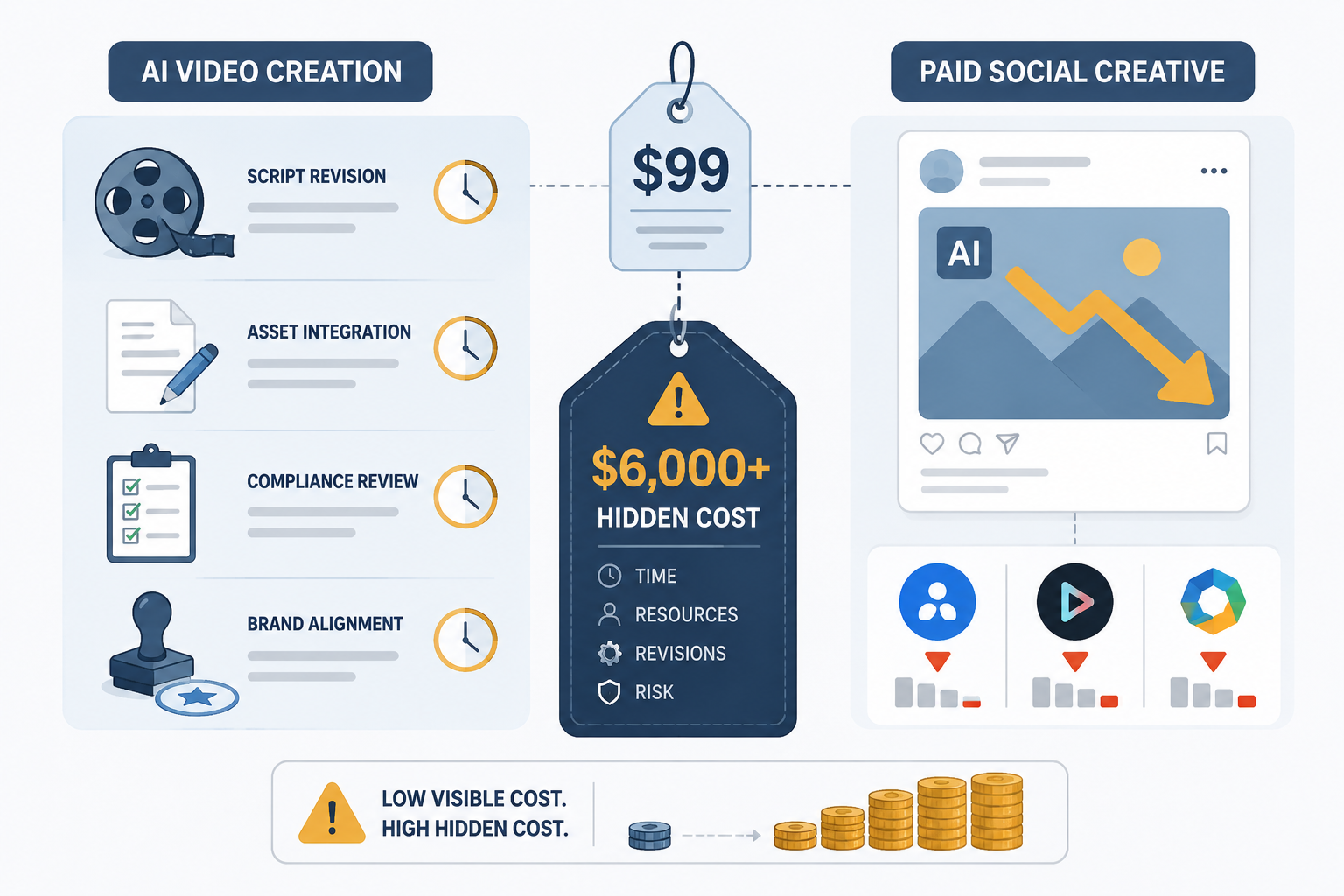
The 1.1x ROI figure for AI video creation should not be read as proof that AI video tools are useless. It says the average return is weak after the full production process is counted.[1] The reason is straightforward: generation may reduce the time needed to create a rough asset, but it does not remove script revision, asset integration, brand alignment, legal or compliance review, stakeholder feedback, or final QA.
Case-study and report material from Visme and Canva points to the same operational issue: AI can accelerate creative production, but brand teams still have to manage consistency, review standards, and the handoff between generated material and publishable assets.[7][8] That is not a small caveat. In many organizations, the bottleneck in video is not only making the first version. It is getting the approved version that product, legal, brand, demand generation, and sometimes regional teams can all live with.
This matters most when a budget request assumes that AI video will replace production spend one-for-one. It may reduce storyboarding or rough-cut labor. It may help a team test concepts before paying for full production. It may make short internal or social assets cheaper. But if the output still requires a senior marketer to rewrite the script, a designer to fix brand issues, a reviewer to check claims, and a manager to explain why the final asset does not look quite right, the savings are not where the spreadsheet placed them.
Paid social creative: cheap assets can become expensive distribution
Paid social creative reports only 1.2x ROI in the use-case ranking.[1] The weak return is not just a matter of taste. It sits at the intersection of creative quality, audience trust, and platform behavior.
The platform issue has to be handled carefully. The research set points to agency performance studies and industry reporting, not public platform documentation, suggesting that obvious AI-generated paid social creative has been down-ranked across Meta, TikTok, and Google environments in 2026 ranking updates.[5][6] That is a weaker evidence category than an official platform statement. It is still too important to ignore when teams are budgeting for creative volume.
A paid social manager does not buy impressions from a neutral file server. They buy distribution through systems that estimate user response, ad quality, relevance, and platform experience. If a synthetic-looking asset gets lower engagement, weaker watch time, more negative feedback, or a lower quality signal, the cost of distribution can rise even if the cost of production falls. The output was cheap; the reach was not.
That is the trap in AI-generated paid social creative. The asset can look efficient in a production dashboard and still perform poorly in an auction. A team may celebrate that it produced 50 variants instead of 5, while the media buyer sees higher costs, faster fatigue, and more time spent excluding losers. If the platform is also less willing to reward obvious synthetic creative, the budget case gets worse.
Consumer trust compounds the problem, but it is not the whole story. Buyers do not need a philosophical objection to AI content for performance to suffer. They only need to recognize that an ad feels generic, unedited, or disconnected from the brand. In that sense, the trust issue shows up as a practical media problem: weaker attention, weaker click quality, and more creative cleanup before the next test.
A Budget Framework That Survives Finance Review
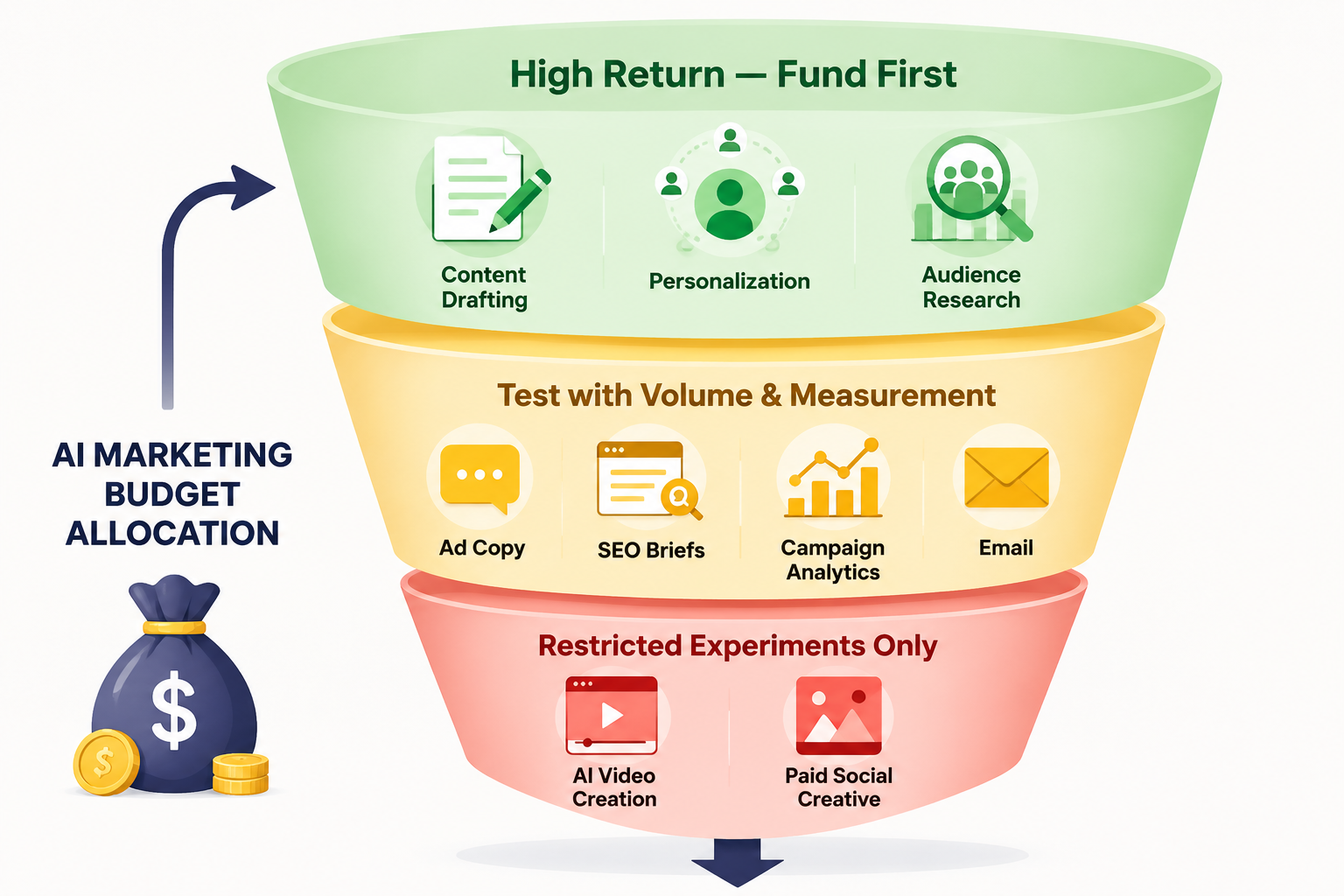
A workable AI marketing budget should separate use cases by return mechanism and implementation risk. The goal is not to ban low-return categories. It is to stop funding them as if all AI output has the same path to value.
| Budget tier | Use cases | Funding logic | What to measure |
|---|---|---|---|
| Fund first | Content drafting, personalization, audience research | Highest reported returns and clearest connection to existing workflows | Asset throughput, conversion lift, research cycle time, reduced external spend, campaign velocity |
| Test with volume and measurement | Ad copy, SEO briefs, campaign analytics, email, video scripts, lead scoring | Returns depend on campaign volume, data quality, and disciplined testing | Variant performance, reporting speed, organic traffic outcomes, email conversion, sales acceptance, pipeline quality |
| Restrict to controlled experiments | Paid social creative, AI video creation | Low reported ROI and higher risk of hidden labor or distribution penalties | Fully loaded production time, approval time, CPM/CPC/CPA movement, creative fatigue, rejection or revision rates |
The first tier deserves the least drama and the most operational discipline. Fund content drafting when there is a clear editorial process and enough publishing demand. Fund audience research when it changes campaign inputs, not when it merely produces attractive summaries. Fund personalization when the data is clean enough for decisions and the team can measure lift by segment or experience.
The middle tier should be tested where volume exists. Ad copy, SEO briefs, campaign analytics, email, video scripts, and lead scoring can all work, but they need enough repetition for learning to accumulate. A company running a few campaigns per quarter will not learn from AI-generated ad variants the same way a company running structured tests every week will. A team with messy CRM data should not expect lead scoring to rescue sales alignment.
The restricted tier needs stricter gates. AI video creation should have a defined review path before spend scales: who owns the script, who checks brand fit, who approves claims, who integrates assets, and how much human time is still required after generation. Paid social creative should be tested against human-made or human-directed controls, with media performance included in the ROI calculation. Production cost alone is the wrong denominator.
For teams that need a more detailed workflow audit before buying tools, the useful question is whether AI removes a bottleneck or just moves it. The related guide on digital marketing AI workflow audits is a better starting point than another tool comparison if the current process already has unclear ownership, slow reviews, or weak measurement.
How to Defend the Allocation
A defensible AI marketing plan should make four assumptions visible. First, which business outcome the use case is expected to affect. Second, which human work remains after AI is introduced. Third, how the team will measure the difference. Fourth, what level of risk the channel can tolerate if the output underperforms.
- For content drafting, do not report only hours saved; report whether publishing volume, update frequency, assisted conversions, or outside production spend changed.
- For personalization, do not report only the number of experiences launched; report lift by segment, offer, journey stage, or conversion event.
- For audience research and SEO briefs, do not report only documents created; report faster planning cycles, better topic selection, or improved campaign performance.
- For campaign analytics, do not report only dashboards or summaries; report whether budget decisions happened sooner or wasted spend decreased.
- For AI video and paid social creative, do not report only production cost; report review labor, approval time, platform performance, and creative replacement rate.
This is where the nearly 3x ROI spread becomes useful in planning. It gives managers permission to say yes to AI without saying yes to every AI request. A content workflow pilot with clear throughput and quality measures deserves a different budget conversation than an AI video subscription justified by cheaper first drafts. A personalization test with clean data deserves a different risk rating than a paid social program built on synthetic creative at scale.
The cleanest budget split is usually not tool-first. It is use-case-first: fund the work that improves existing production, targeting, and analysis; test the work that needs volume and measurement to prove itself; constrain the work where cheap generation can hide expensive review or weaker distribution. That is the version of digital marketing with AI that can survive the second meeting, after the demo is over and the payback period is on the screen.
References
- The Economic Potential of Generative AI, McKinsey
- AI Marketing Statistics 2026: Adoption Data Points, Digital Applied
- AI in Marketing Statistics & Use Cases, Technology Checker
- Top AI Marketing Statistics, Rank Masters
- AI Marketing Case Study: Successful Campaigns, Pragmatic Digital
- AI in Marketing Statistics, SQ Magazine
- AI Marketing Case Studies, Visme
- State of Marketing and AI Report 2026, Canva

Comments
Join the discussion with an anonymous comment.