

AI Marketing Workflow Audit: 7 Patterns That Turn Drafts into Reliable Production Systems
Most teams fail with AI marketing tools not because the tools are underpowered, but because their workflows around them are unstructured. This article presents a seven-pattern diagnostic framework—based on real brand case studies and composite industry data—that marketers can use to audit their own AI workflows and close the gap between output volume and output quality.
The first warning sign is not bad AI copy. It is a full draft queue and the same tired editor rebuilding everything anyway.
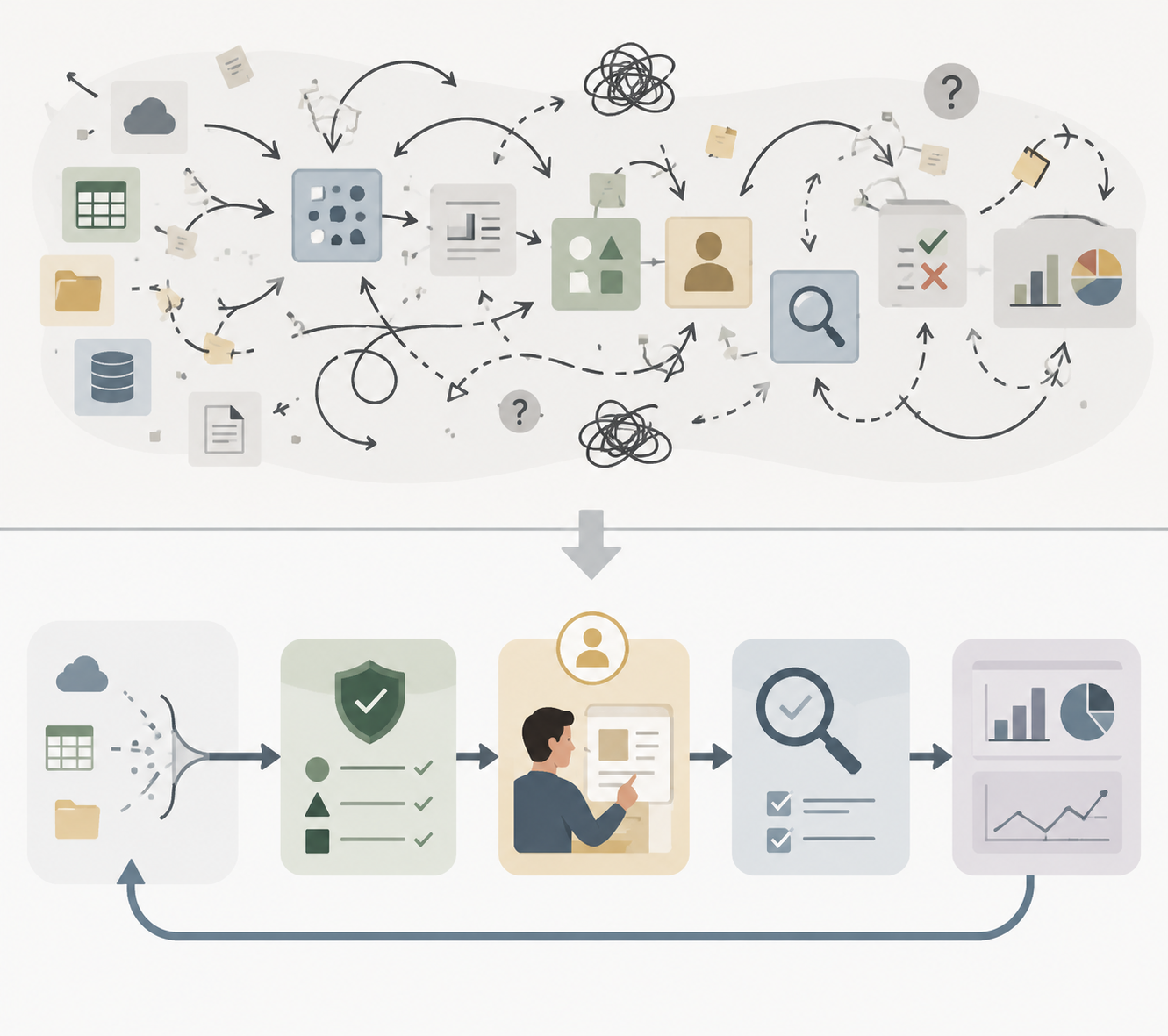
That is where many teams are with AI for digital marketing in 2026. They have campaign outlines, landing page variants, product descriptions, paid social hooks, email drafts, and SEO briefs appearing faster than before. What they do not have is a reliable production system. Someone still has to check whether the source material was current, whether the claim is safe to publish, whether the tone sounds like the brand, whether the asset fits the channel, and whether the result performs after it goes live.
The tool gets blamed because it is visible. The workflow usually deserves more attention.
Adore Me is the cleanest example in the available case material because the operational mechanism is visible. The company reduced product description generation from 20 hours to 20 minutes per batch and reported a 40% increase in non-branded SEO traffic. The important detail is not that it used an AI writing tool. It trained AI agents on structured product data and brand rules, so the system had better inputs and clearer constraints before words were generated.[1]
That distinction matters. A better prompt can improve a draft. A better workflow can reduce the number of judgment calls that land on an editor after the draft exists.
The audit question: where does the work actually land?
A production-ready AI workflow should be able to answer four plain questions before a team scales it: what inputs does the system need, what quality threshold must the output meet, where do humans intervene, and which business outcome justifies the work?
If those answers are vague, the workflow is not automated. It is deferred manual work.
The performance data points in the same direction. A composite of 2026 HubSpot, Semrush, and Ahrefs studies found that teams publishing AI-assisted content with human editing equal to at least 20% of word count reported 2.7x better organic traffic outcomes than teams with less than 5% editing. The source studies define “editing” differently, so the benchmark should be treated as directional rather than a universal rule. Still, it gives teams a useful mirror: if editing is almost absent, the workflow is probably relying on the model to do work the process never designed.[2]
Another composite ranking study found that purely AI-generated pages without human editing won top-3 rankings 3.1x less often than mixed or human-led content. After Google’s March 2026 core update, 18% of sites publishing unedited AI at scale lost more than 40% of organic traffic, according to the same Digital Applied analysis.[2]
The practical conclusion is not “never use AI.” It is that unreviewed scale has started to carry measurable downside.
The seven-pattern workflow audit
Use these patterns as an audit, not a maturity badge. A small team may not be able to install all seven at once. That is fine. The goal is to find the weakest handoff first: source control, brand control, review, measurement, learning, or scale.

| Pattern | What a working system can answer | Common failure sign |
|---|---|---|
| Structured source material | Which approved data, facts, offers, product attributes, and audience inputs feed the AI? | The prompt depends on whoever happens to write it that day. |
| Encoded brand guidance | Which voice rules, banned claims, proof points, and examples shape the output? | Editors keep saying the copy is “off” but cannot point to a shared standard. |
| Measurable review standards | What must be true before the asset can move forward? | Review is a preference debate instead of a pass-fail decision. |
| Human oversight gates | Where does a person check facts, risk, strategy, and final suitability? | Humans touch everything late, under deadline pressure. |
| Outcome linkage | Which metric makes this output type worth producing? | The team celebrates volume because nothing else is tied to the workflow. |
| Performance feedback loop | How do results change prompts, templates, source data, or rules? | Every new asset starts from scratch. |
| QA before scale | What test must a workflow pass before production volume increases? | A workflow goes from experiment to bulk publishing without inspection. |
1. Structured source material replaces prompt improvisation
The most expensive AI content problem often happens before the model writes a sentence. The input is too loose.
For product descriptions, that might mean the system receives only a product name and a few adjectives. For SEO content, it might mean a target keyword and a competitor URL. For paid media, it might mean a campaign goal but no audience segment, offer hierarchy, compliance constraints, or landing page promise. The model fills the gaps because that is what it is built to do. Then the editor spends the afternoon discovering which gaps mattered.
Adore Me’s case is useful because the workflow did not treat a prompt as the source of truth. Structured product data and brand rules became the operating material. That is why the 20-hour-to-20-minute reduction is worth studying as a workflow pattern, not simply as a tool result.[1]
Audit your own process by choosing one recurring output type and listing the inputs it needs before generation. For an SEO article, that list might include the approved claim set, internal subject-matter notes, search intent, target reader, product positioning, prohibited claims, internal links, and required examples. For a paid social test, it might include offer, audience stage, emotional angle, channel limits, proof point, CTA, and landing page match.
If the source packet is not repeatable, the output will not be repeatable either.
2. Brand voice becomes a system rule, not an editor’s rescue job
Brand voice guidance cannot stop at “confident, helpful, and concise.” Almost every team can write that sentence. It does not tell an AI system what to avoid, when to be direct, how much explanation is enough, which phrases sound like the company, or which claims require proof.
The stronger pattern is encoded guidance: approved examples, rejected examples, vocabulary rules, tone boundaries, required disclaimers, prohibited exaggerations, and channel-specific adjustments. This is where brand work becomes operational rather than decorative.
The case-study compilation includes brands such as Virgin Holidays, Cadbury, Farfetch, Unilever, BILL, and Cushman & Wakefield using AI in marketing or business content workflows. Those examples are vendor- or brand-published and should not be read as typical outcomes. Their value is pattern evidence: the successful examples described in the source material rely on constraints, data, workflow integration, or review structures rather than unrestricted copy generation.[1]
A useful brand rule is something a reviewer can apply consistently. “Avoid hype” is weak. “Do not describe a feature as industry-leading unless the approved proof library contains a current third-party ranking” is much stronger. “Sound premium” is weak. “Use sensory product details from the approved attribute fields; do not invent occasions, body types, or customer reactions” is stronger.
The audit question is simple: could a new editor, using the same rules, make roughly the same accept-reject decision as the current content lead? If not, the AI system is probably receiving taste preferences instead of brand guidance.
3. Review standards need thresholds, not vibes
Most teams say AI content needs review. Fewer define what review is allowed to approve.
That missing threshold is where cleanup grows. A draft is “pretty good,” so it moves forward. Then the SEO specialist spots unsupported claims. The editor rewrites the intro. The product marketer changes the positioning. Legal asks where a comparison came from. Paid media trims the message until the ad no longer matches the landing page. Nobody failed individually; the workflow failed to define done.
The 20% editing benchmark is useful here because it punctures the fantasy that review can be ceremonial. The composite studies connect heavier human editing with better organic outcomes, while very light editing is associated with weaker results.[2]
That does not mean every small team can afford a full editorial rebuild on every asset. It does mean teams should stop pretending that a quick skim is the same as review. If capacity is limited, narrow the workflow before lowering the standard: run AI on one template, one content type, one product line, or one channel until the review criteria are stable.
- Minimum factual threshold: every non-obvious claim maps to an approved source, product field, or subject-matter note.
- Minimum brand threshold: the asset follows named voice rules and avoids prohibited phrases, claims, and unsupported superlatives.
- Minimum channel threshold: the asset fits the placement, character limits, search intent, funnel stage, or campaign promise.
- Minimum usefulness threshold: the reader receives specific information, not a generic restatement of the topic.
- Minimum performance threshold: the asset type has a metric attached before publication volume increases.
Review standards should remove decisions from the final hour. They will not remove judgment, but they make judgment easier to apply.
4. Human oversight belongs at defined gates
Human-in-the-loop is too often used as a comforting phrase. In practice, it can mean anything from a strategic review before generation to a frantic proofread after 200 assets have been produced.
A better workflow names the gates. A human approves the source packet before generation. A human reviews risky claims before layout or upload. A human checks brand and usefulness before publication. A human reviews performance after enough data exists to change the template. Not every person needs to touch every step, but the workflow should make clear which decisions cannot be delegated to the model.
This is not only an SEO concern. Composite B2B buyer surveys cited in the analysis found that 67% of B2B buyers said they could identify unedited AI content, and 58% said that identification reduced trust in the publishing brand. At the same time, 81% said they did not mind AI-assisted content if it was accurate and specific.[2]
That split is the whole argument for oversight gates. Buyers are not necessarily rejecting AI assistance. They are rejecting content that feels ungrounded, generic, or careless.
Consumer survey data from 2023 and 2024 points in the same direction, though it is older and should be treated directionally. Across Qualtrics, Attest, and YouGov research summarized in the same source material, comfort with AI dropped from 57% to 46% in one year, and 59% of consumers cited “loss of human touch” as the top disadvantage.[3]
For marketing teams, the immediate takeaway is not to make content sound artificially human. It is to decide where human responsibility belongs. Hallucinated claims, outdated product details, mismatched offers, and invented proof points are workflow risks before they are writing problems. If that is a current pain point, the internal guide to AI content hallucination risks in marketing is a useful companion to this gate.
5. Each output type needs a business outcome
Volume is a tempting metric because AI makes it easy to improve. It is also a dangerous one because it can hide whether the work is useful.
A blog workflow should not be judged by drafts created. It should be judged by indexed pages, rankings, qualified organic sessions, assisted pipeline, internal link coverage, or another metric the team actually uses. Product descriptions might be tied to publish cycle time, non-branded search traffic, conversion rate, merchandising coverage, or localization throughput. Paid ad variants might be tied to test velocity, CPA, CTR, creative fatigue, or landing page message match.
This is where some AI agent deployments break down. The Pragmatic Digital compilation reports successful AI agent deployments with 4.1x to 5.3x ROI, but also notes that 29% were abandoned within 90 days. The cited causes were unclear success criteria at 41%, poor tool access at 33%, and brand-voice drift at 19%.[1]
Those failure causes are not model capability complaints. They are operating-design complaints. The agent did not know what success meant, could not reach the systems it needed, or produced work that drifted away from the brand.
Before scaling an AI workflow, write the outcome next to the asset type. If the outcome is not worth measuring, the asset may not be worth generating at scale.
6. Performance feedback has to change the system
A feedback loop is not a dashboard. A dashboard shows what happened. A loop changes what happens next.
For an SEO team, that might mean losing templates are retired, winning structures are added to the brief, thin sections are removed from future prompts, internal link instructions are updated, and source requirements are tightened when unsupported claims keep appearing. For paid media, it might mean high-performing angles are preserved, rejected hooks are tagged, audience-message mismatches are documented, and landing page learnings feed back into the next creative batch.
The operational test is whether the next batch becomes easier to approve. If the team catches the same issue every week, the workflow is collecting feedback but not using it.
This is one reason the Adore Me example is more persuasive than a generic productivity claim. The workflow had structured inputs and brand rules, so there was something to improve besides the wording of a prompt. Source fields, rules, templates, and review notes are all adjustable parts of a system.[1]
Teams that want more case-level detail can also compare this audit against AI content marketing workflow patterns from brands that actually get results. The useful question is not which brand used which tool. It is which part of the workflow made the result repeatable.
7. QA comes before scale, not after traffic drops
The riskiest moment in an AI marketing workflow is the moment a pilot becomes a production habit. A few drafts look acceptable. The team is under pressure. Someone asks why the workflow is not being used across every product, market, or keyword cluster.
That is exactly when QA should slow the team down.
A QA gate before scale should inspect a sample of outputs against the standards that matter for that channel: factual accuracy, claim support, brand fit, duplication, search intent, internal linking, accessibility, legal sensitivity, formatting, metadata, and performance fit. The sample does not need to be enormous to be useful, but it does need to be reviewed before the workflow becomes bulk production.
The March 2026 Google update data makes this more than housekeeping. In the cited Digital Applied analysis, 18% of sites publishing unedited AI at scale lost more than 40% of organic traffic after the update.[2]
A team does not need to wait for a traffic loss to discover that a template creates thin intros, repeats unsupported claims, misses internal links, or produces pages too similar to one another. Those are QA findings, and they belong before scale.
For a more granular inspection list, use the pre-publish audit for AI content quality after this workflow audit identifies where the process is weakest.
How to run the audit without overbuilding it
The fastest version of this audit is not a transformation program. Pick one recurring AI-assisted output and trace it from request to performance review. Do not start with the tool. Start with the work.
- Name the output type: product description, SEO article, ad variant, email sequence, sales enablement page, or another repeatable asset.
- Write down the required source inputs before generation.
- Add the brand, claim, channel, and usefulness rules that define an acceptable draft.
- Mark the human gates: source approval, risk review, editorial approval, and performance review.
- Attach one business outcome to the output type.
- Decide what performance data will change in the next batch.
- Run QA on a sample before increasing volume.
A very small team may only be able to fix two patterns at first. Start with structured source material and a QA gate. Those two changes prevent the most damaging failure mode: confident, fast production built on unclear inputs and no inspection.
A larger team should be less forgiving. If multiple people touch a workflow, undocumented standards become rework. The editor becomes the brand guide. The SEO specialist becomes the fact checker. The paid media manager becomes the message-match safety net. The content lead becomes the person explaining why “more drafts” did not become more publishable work.
The practical threshold
A production-ready AI marketing workflow does not have to be elaborate. It does have to keep drafts from bypassing the controls that make marketing assets safe and useful: source control, brand control, human review, outcome measurement, performance learning, and QA before scale.
When those controls are missing, AI does not remove work. It moves the work downstream, usually to the people already responsible for quality.
References
- Pragmatic Digital / Writer AI Studio case study compilation
- Digital Applied composite ranking study and 2026 AI content performance benchmarks
- Qualtrics, Attest, and YouGov consumer trust surveys, 2023-2024

Comments
Join the discussion with an anonymous comment.