
Agentic AI Is Capturing Intent Before Your Bid Runs
Agentic AI's biggest impact on paid ads in 2026 is happening before the auction: Google AI Mode, Amazon Alexa for Shopping, and AI Overviews capture commercial intent first, and platforms are moving ads into those agent surfaces. The dated, sourced evidence shows what a bid now buys, what converts, and why ROAS needs re-reading when agent traffic isn't segmented.
- Platform
- Google Ads
- Bid strategy
- AI Max
- Last reviewed
- 0-08-27
Grounded in benchmark case file: AI Max cost and auction-participation benchmark
As of August 27, 2026, the agentic AI infrastructure transformation’s impact on paid ads is visible along the path from commercial query to reported conversion. Google can place eligible ads in AI Overviews without a separate opt-out, then report them as Top Ads without an AI Overview segment. Amazon can turn advertiser-supplied product information into Sponsored Prompts that the advertiser may disable but cannot directly write. The immediate problem is therefore less abstract than whether agents will replace search: after an agent has interpreted and narrowed intent, what is the subsequent bid actually purchasing?
| Surface, as of Aug. 27, 2026 | Ad or commercial placement | How participation occurs | Advertiser control | Separate performance reporting |
|---|---|---|---|---|
| Google AI Overviews | Ads can appear above, below or within the overview; availability covers English on mobile and desktop in 11 countries. | Eligibility depends on existing Search, Shopping or Performance Max campaigns using supported AI-powered targeting. | No surface-specific opt-out. | No. Ads are included in Top Ads reporting.[1] |
| Google AI Mode | Direct Offers is a pilot placing sponsored, exclusive deals in the AI experience. | The pilot initially uses discounts, with bundles and free shipping identified as planned offer types. | Control centers on campaign, feed and offer inputs rather than authoring the agent response. | No distinct campaign benchmark is established by the material used here.[2] |
| Amazon Alexa for Shopping | AI-generated Sponsored Prompts can appear in the shopping assistant formerly called Rufus in the US. | Amazon generates prompts from product and advertising materials supplied by sellers and advertisers. | Prompts can be disabled but not directly authored. Rufus was renamed Alexa for Shopping in the US on May 13, 2026.[3][4] | The cited material does not establish a standalone performance segment comparable across accounts. |
| External LLM referrals | This article does not make a verified claim about an ad unit on ChatGPT or Perplexity. | A merchant may receive visits after a shopping conversation or recommendation. | There is no paid-platform placement control assumed here. | Referral distinctions depend on the analytics available to the merchant; they are not a substitute for Google’s missing AI-surface ad segment. |
These surfaces should not be treated as interchangeable traffic simply because each involves generative AI. An AI Overview ad remains part of Google Ads delivery. A Direct Offer is an early-stage Google pilot. A Sponsored Prompt is generated inside Amazon’s shopping assistant from seller or advertiser inputs. An LLM referral recorded by a retailer is an external visit, not evidence that the retailer bought an ad on that assistant.
The distinction matters when an account-level ROAS moves. The interface can combine delivery from conventional search results and an agent surface even though the user’s route to the ad, the information already supplied and the degree of intent refinement were different.
The query now reaches an interpretive layer before the ad
In familiar paid search, the working model begins with a query, proceeds through matching and auction eligibility, and ends with an ad click and attributed action. Agent surfaces insert another active system near the beginning. That system can summarize, compare, ask follow-up questions or reformulate the request before deciding where a commercial result belongs.
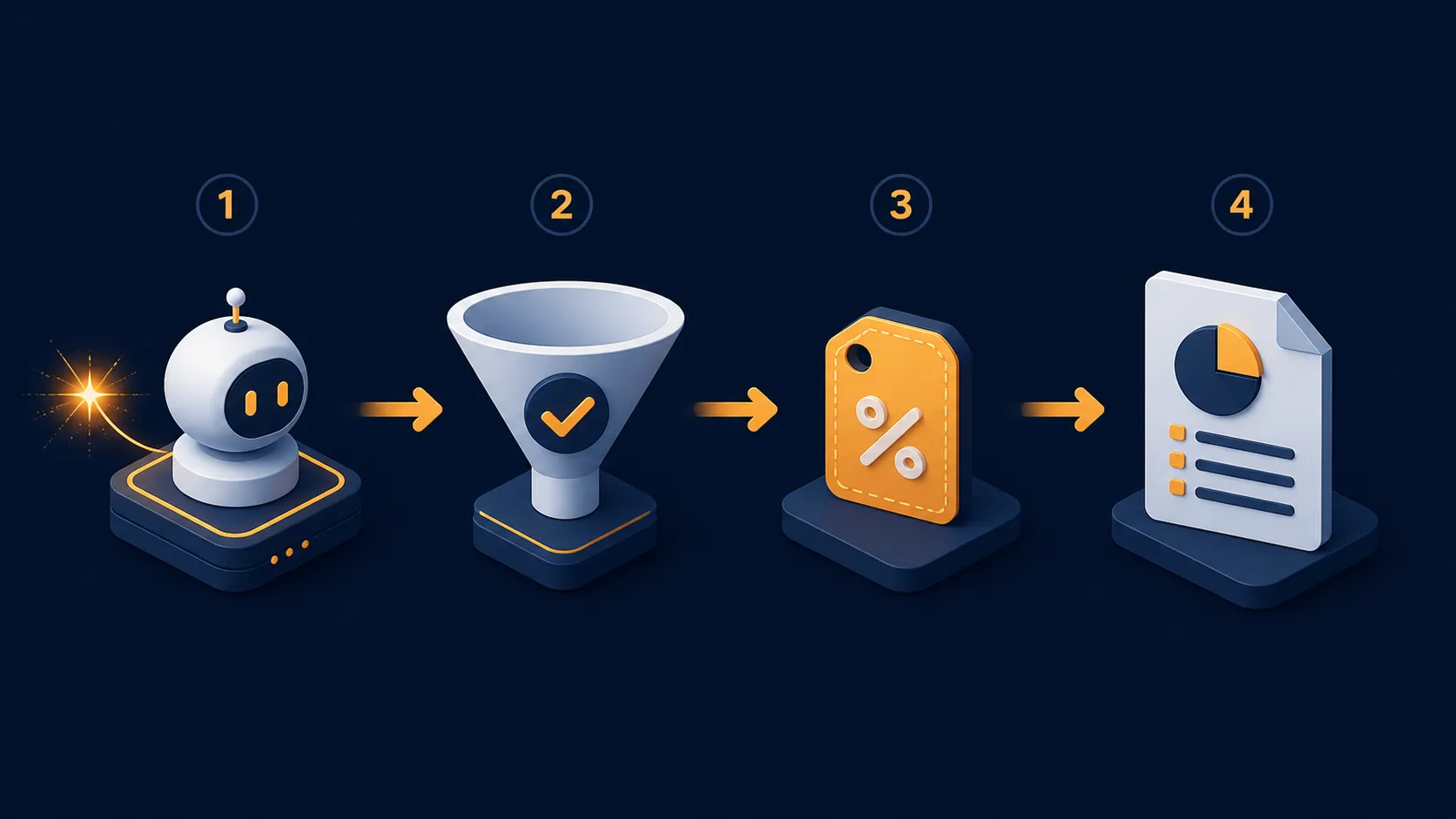
For Google AI Overviews, the operational chain currently looks like this: the AI surface interprets the search; the advertiser must have an eligible campaign and targeting setup; an auction determines whether an ad appears; the result is served in or around the overview; and its performance is folded into existing Top Ads reporting. Google identifies broad match, keywordless AI Max targeting, Performance Max and Dynamic Search Ads among the AI-powered targeting routes that can make ads eligible for AI Overviews.[1]
The bid has not disappeared. It is competing for access after more of the user’s intent has been processed by Google’s system. That can change the commercial context of an impression: a user may arrive at the ad after reading a synthesized answer, after the system has inferred a category or after a multi-part request has been decomposed. The advertiser does not receive a report showing which of those paths preceded each AI Overview ad.
The chronology is worth keeping beside the performance chart. The AI-search-summary timeline records Google’s dated changes since May 2024, while the August 2026 agent-surface map distinguishes live AI Overview ads, AI Mode testing and the ad-free status of the Gemini app at that point. A product announcement, a pilot and generally available delivery should not be entered into the account change log as though they took effect on the same date.
AI Max expands eligibility; it is not a campaign type
AI Max is an optimization layer for Search campaigns, not a separate campaign type. Its matching can use broad match and keywordless technology to reach searches beyond the account’s explicit keyword list. Google also warns that AI Max will not work effectively when campaigns are constrained by budget caps.[5]
That combination creates a practical dependency. Wider matching can make the advertiser eligible for intent that the system has inferred, including delivery on AI surfaces, but a capped campaign may not have enough budget to participate consistently. A buyer reviewing an AI Max account therefore needs to separate at least three questions: whether matching expanded, whether the account entered more auctions and whether budget limits prevented the system from acting on that eligibility.
Cost evidence belongs in the same review. The AI Max cost and auction-participation benchmark records named buyers reporting roughly 10%–15% CPC increases, with some accounts reaching 25%, alongside Adthena’s reported 35% year-over-year growth in auction participants. Those observations provide cost-of-entry context, not a universal AI Max lift and not a first-party campaign benchmark for this article.
The tracked September 1, 2026 AI Max auto-upgrade window is still upcoming as of this article’s August 27 cutoff. It is planning context, not an effective account change that can explain August performance.
Offers are entering the selection process
Google’s Direct Offers pilot moves the agent layer closer to the transaction. In AI Mode, a result can carry a “Sponsored deal” with an exclusive discount. Google says the initial format focuses on discounts and identifies bundles and free shipping as planned additions.[2]
This is more than another place to render conventional ad text. Price, discount depth, shipping treatment and bundle structure become inputs that can affect which commercial option the system presents. The media buyer’s controllable object is no longer confined to a keyword, bid and creative combination; it also includes the accuracy and competitiveness of the offer supplied to the platform.
Because Direct Offers remains a pilot, it establishes product direction rather than settled auction economics. It does not yet justify assuming that discounts will systematically lower acquisition cost, improve incrementality or receive a consistent reporting treatment across advertisers.
A better conversion rate can still make ROAS harder to explain
The strongest indication that agent-referred shopping traffic may behave differently comes from an externally reported Prime Day comparison. Rithum’s August 20 account of Adobe’s 2026 findings says traffic from LLMs including ChatGPT and Perplexity grew 89% year over year and converted 40% better than paid search and email. One year earlier, the same traffic category had converted worse than every traditional channel in the comparison.[6]
That swing is commercially interesting because it suggests agent-referred visitors can move from exploratory behavior toward stronger purchase intent quickly. It is not a universal conversion benchmark. The figures are presented through Rithum’s secondary account of Adobe data, and they do not prove that using an LLM caused the higher conversion rate. Changes in referral volume, shopper mix, merchant coverage and the Prime Day environment may also matter.
The reporting problem appears when similarly prequalified behavior occurs inside a paid platform but the surface is hidden. Suppose total conversion value rises while spend is stable. The account-level ROAS improves, but the buyer cannot tell whether the movement came from ordinary search-result ads, ads shown to users after an AI Overview refined the request, a different query mix, stronger offers or conversion changes elsewhere in the account. A decline is equally ambiguous: agent-surface expansion, broader matching, higher auction costs and a budget cap can all coexist in the same reporting period.

Google’s classification makes this especially difficult. AI Overview ads are reported with Top Ads, and advertisers receive neither a surface-specific opt-out nor segmented reporting.[1] Search Console does not close the gap: its Generative AI reporting record exposes no clicks or paid data that would let a buyer reconcile AI-surface ad delivery against Google Ads.
Query and auction records remain useful, but they answer adjacent questions. Search-term movement can show that matching broadened. CPC and impression-share changes can indicate more expensive or more competitive entry. Budget status can show constrained participation. None of those records identifies the missing AI Overview segment after the platform has combined it with other Top Ads.
Amazon shifts ad-copy influence into the product record
Amazon offers a narrower but useful comparison. Rufus was renamed Alexa for Shopping in the US on May 13, 2026.[3] Within the assistant, Amazon can generate Sponsored Prompts using product information and advertising materials the seller or advertiser supplied. The advertiser may disable those prompts but cannot directly author their wording.[4]
Listing content consequently becomes an indirect creative input. Titles, attributes, descriptions and other supplied materials are not merely inputs to organic discovery or a product detail page; they can shape an AI-generated sponsored message. The control asymmetry differs from Google’s—Amazon provides a disable option for Sponsored Prompts—but both systems put generated presentation between the advertiser’s source material and the shopper.
That calls for a different review process than proofreading a fixed ad. A team should compare generated prompts with current price, availability, eligibility, product claims and brand restrictions, then correct the underlying listing or supplied asset when the output is wrong. Directly rewriting the prompt is not available under the mechanics described by the cited source.[4]
How to defend a changed ROAS number
A defensible account review starts with the user’s route to the reported conversion rather than with a tour of campaign settings. The evidence should be aligned by effective date so that a pilot announcement, an eligibility change and an observed performance shift do not collapse into one explanation.
| Record to inspect | What it can establish | What it cannot establish |
|---|---|---|
| Dated surface and product log | Whether an ad surface, pilot, rename or upgrade was active during the reporting period. | How much account spend or revenue came from that surface. |
| Search terms and matching changes | Whether query coverage expanded or moved beyond explicit keywords. | Whether a particular impression appeared in an AI Overview when the platform withholds that segment. |
| CPC, impression share and auction participation | Whether entry became more expensive or competition changed. | Whether agent interpretation caused the cost movement. |
| Budget status | Whether capped campaigns could participate consistently in expanded matching. | The performance those campaigns would have produced without the cap. |
| Offer and feed change log | Whether discounts, shipping, bundles or listing inputs changed near the ROAS movement. | The incremental effect of an agent-selected offer without an appropriate experiment or segment. |
| External LLM referral reporting | How separately identifiable referral traffic behaved in the merchant’s analytics. | The behavior of unsegmented ads served inside Google’s AI surfaces. |
The resulting explanation may be less tidy than a dashboard annotation, but it is more accurate. For example: matching expanded during the period; CPC increased; the campaign spent against its cap; an offer changed; and Google does not provide the AI Overview split needed to quantify that surface’s contribution. That account does not support the stronger claim that AI traffic improved or damaged ROAS by a particular amount.
Scale forecasts do not resolve the measurement issue. PHD and WARC forecast that agents will facilitate $944 billion in global consumer spending during 2026, equal to 1.3% of private consumption, rising to $3.35 trillion by 2030. They identify telecommunications and utilities, financial services, and travel and transport among the first sectors expected to move toward agent-to-agent transactions.[7][8] Those figures describe a forecast, not observed advertising spend or proven campaign effectiveness.
Auctions are not disappearing from the evidence available through August 27, 2026. Bids still determine participation, but intent formation, eligibility and offer selection increasingly occur before or around the auction. Reporting has not kept pace. Until it does, ROAS should be read beside dated surface changes, query and auction-cost evidence, budget constraints, offer history and whatever agent-referral distinctions are genuinely available—without claiming that those adjacent records can reconstruct a segment the platform does not expose.
References
- About ads in AI Overviews, Google Ads Help.
- Agentic commerce: AI tools and protocols for retailers and platforms, Think with Google.
- Amazon’s Souped-Up AI Rebrand With Alexa Reveals Its Advertising Growth Plans, Adweek, May 13, 2026.
- Amazon Rufus Guide 2026, AMALYZE.
- About AI Max for Search campaigns, Google Ads Help.
- AI Shopping Assistants: Holiday Prep 2026, Rithum, August 20, 2026.
- From abundance to agents: How the delegation of choice is transforming marketing, WARC.
- How marketers can more effectively use agentic AI, PHD Media.