
Can Search Console's Generative AI Report Show Paid Impact?
Search Console's Generative AI report measures impressions, pages, countries, and devices — no clicks, queries, position, or paid data. Understand why that makes it a triage signal for paid teams rather than a paid-impact report, and what to pair it with before concluding that AI search is hurting your campaigns.
- Platform
- Change category
- measurement
- Effective date
- 0-06-03
- Change type
- default-on change
- Impact level
- low
The short answer for paid teams
No: the Google Search Console Generative AI report cannot show paid-search impact by itself. Google launched the Search Generative AI performance reports on June 3, 2026 for Search and Discover, and the report exposes impressions, pages, countries, devices, and dates for generative AI visibility. It does not expose clicks, CTR, queries, position, campaign data, ad placement, CPC, conversion data, or a split between AI Overviews and AI Mode. A Google spokesperson said only that “additional metrics” may come over time. [1][2]
That makes it useful, just not in the way a nervous paid-search thread usually wants it to be useful. It can tell a team where the site is appearing in Google’s generative AI surfaces. It cannot tell them whether AI Overviews are killing ads, protecting ads, moving budget into broad match, suppressing paid CTR, or improving conversion mix.
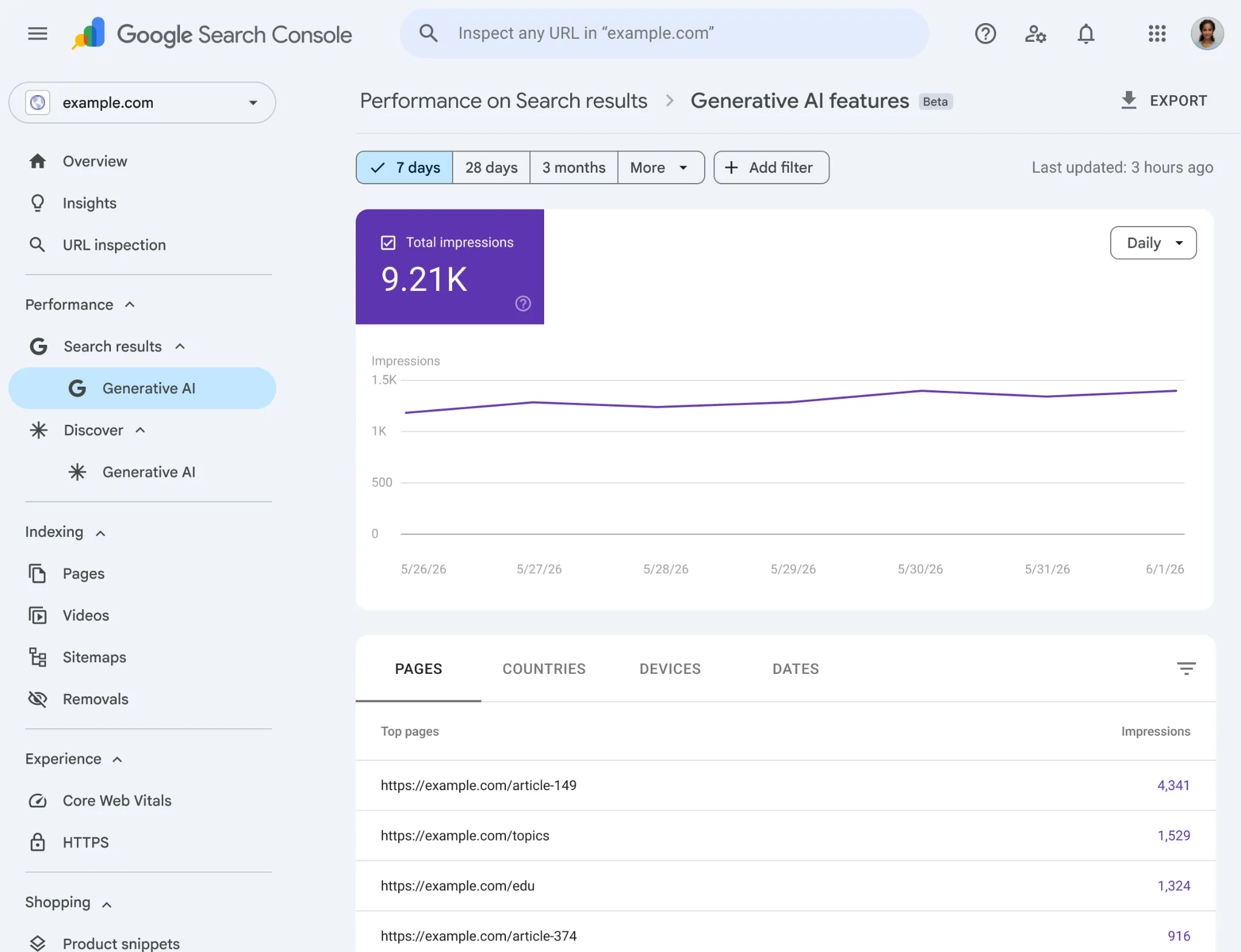
What the report actually exposes
The rollout also matters before anyone treats absence of the tab as evidence. The report first appeared for a subset of UK properties in the UK CMA context, then expanded more broadly by August 11, 2026. John Mueller later confirmed it was not live on every domain and appears only where there are sufficient impressions. [3][4]
| Area | What Search Console provides | What that means for paid analysis |
|---|---|---|
| Launch and surface | Search Generative AI performance reports for Search and Discover, launched June 3, 2026. [1] | The report is dated and real, but it is not a Google Ads report. |
| Primary metric | Impressions for generative AI features. [1] | It measures visibility, not visits, ad clicks, revenue, or conversions. |
| Breakdowns | Pages, countries, devices, and dates. [1] | Useful for narrowing where to investigate in paid accounts. |
| Missing metrics | No clicks, CTR, query data, or position data. [2] | No direct way to connect an AI impression to a paid query, paid click, or lost click. |
| AI surface split | No AI Overviews versus AI Mode split. [2] | You cannot assume the same behavior across both surfaces. |
| Counting rule | An impression is counted only when a link is scrolled or expanded into view. [5] | The report is not counting every generated answer where the page could have been present but unseen. |
| Aggregation | Chart data is aggregated by property; table data is by page. [5] | A page-level table is not the same as query-level demand. |
| Attribution and limits | Canonical URL attribution, Pacific Time, and a 1,000-row limit apply. [5][6] | Exports can miss long-tail pages, and date matching to ad platforms needs care. |
| Relationship to existing Search data | AI impressions are already a subset of Web search-type Performance data, not new incremental volume. [5] | Do not add AI impressions on top of Web impressions as if they are separate reach. |
The most dangerous dashboard mistake is treating that last row casually. If AI impressions are already inside the Web search-type Performance report, the Generative AI tab is a slice of existing organic visibility, not an extra pool of impressions that suddenly appeared above the search market. It helps identify the generative-AI portion of visibility Google is willing to expose. It does not create a new denominator for paid impact.
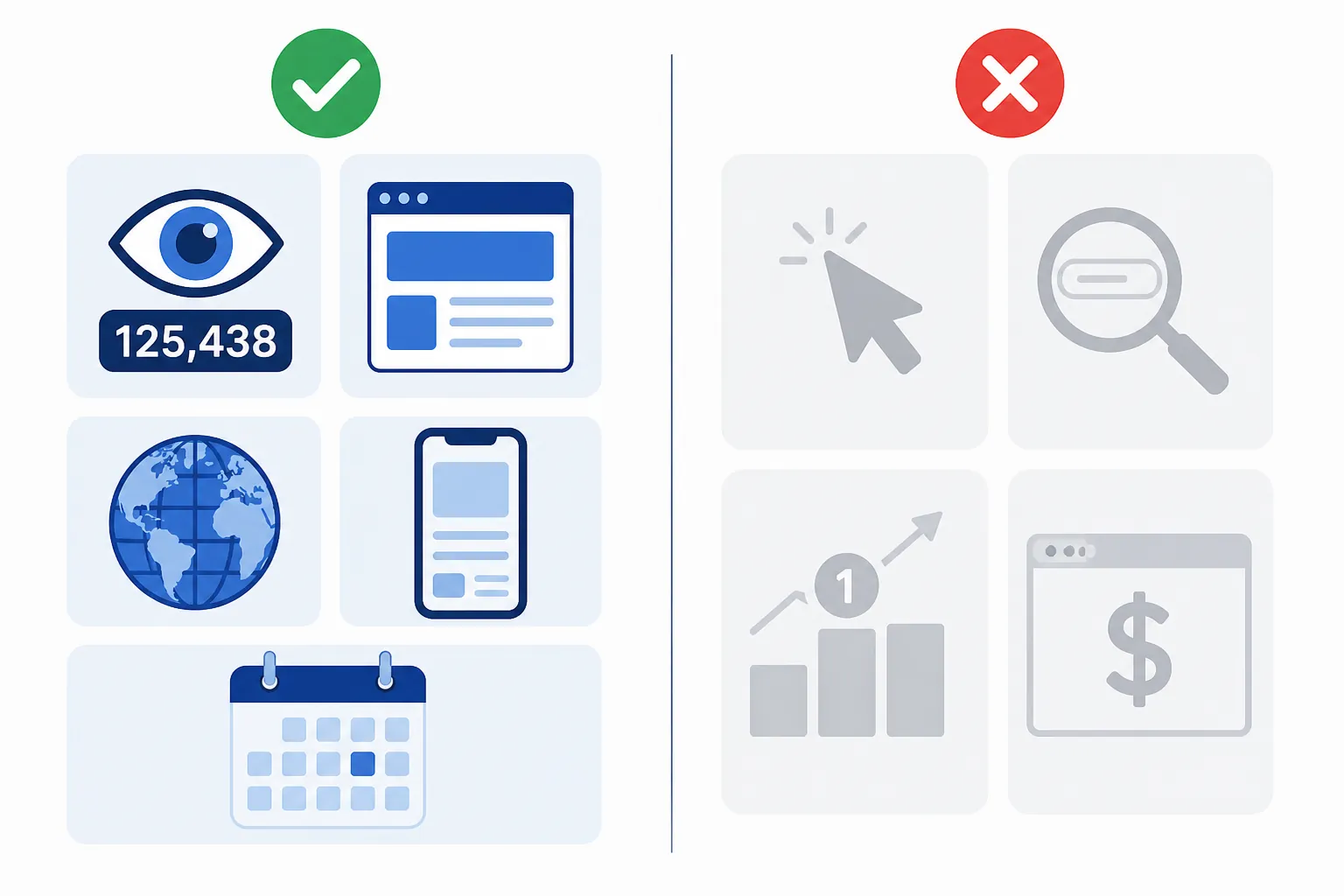
Why it cannot diagnose paid impact
Paid impact needs a connection to at least one paid-search object: query, campaign, ad group, keyword or keywordless target, placement, click, cost, conversion, or revenue. The Search Console Generative AI report has none of those. It also lacks the organic query that triggered the visibility event, which means even an organic-to-paid comparison starts with a missing join key.
A paid team therefore cannot look at a page with rising AI impressions and conclude that branded search is safe, nonbrand CTR is down, Performance Max is over-crediting itself, or broad match is capturing replacement demand. Those may be worth testing. They are not outputs of this report.
- Do not compare Generative AI impressions directly with Google Ads clicks and call the gap lost paid traffic.
- Do not infer paid CTR movement from an impressions-only organic report.
- Do not use page-level AI visibility to change keyword match types without checking search-term and campaign data.
- Do not treat the absence of the tab as proof that AI search is irrelevant for the account; availability depends on rollout and sufficient impressions. [3][4]
This is also where the missing AI Overviews versus AI Mode split matters. If a paid team is trying to understand whether an ad appeared above an AI Overview, below it, inside a supported AI Overview ad format, or around a different generative surface, Search Console does not separate those cases. For the SEO-side measurement problem, the companion piece on why Google Search Console is not enough for AI Overviews covers citation and segmentation gaps in more detail; the same missing split is also the core reason paid teams should be careful with AI Mode comparisons in AI Mode vs. AI Overviews SEO benchmarks.
What paid teams can defensibly do with it
The report is still useful as a triage layer. It can narrow the paid-search investigation from “AI search is changing everything” to a page, country, device, and date range where the site actually has generative-AI visibility. That is already better than arguing from screenshots.
| Search Console signal | Paid-side check | Defensible statement |
|---|---|---|
| A high-value landing page begins receiving AI impressions | Review Google Ads search terms, query themes, campaign CTR, CPC, conversion rate, and impression share for the same page’s paid traffic where available. | “This page has AI visibility; paid performance around related demand needs review.” |
| AI impressions concentrate in one country | Segment Google Ads performance by the same country and compare against nearby markets without the same visible signal. | “The country split gives us a place to look; it does not prove causation.” |
| AI impressions skew mobile or desktop | Check device-level paid CTR, CPC, conversion rate, and landing-page behavior over the same window. | “Device behavior may be worth isolating before making bid or budget changes.” |
| AI impressions rise during a specific date range | Align dates carefully, remembering Search Console’s Pacific Time reporting, then compare against Google Ads day-level metrics. | “The timing is a hypothesis window, not an attribution window.” |
| A page has AI visibility but no obvious paid decline | Check whether paid query mix, brand/nonbrand split, or conversion quality changed before declaring no impact. | “No visible paid damage in the first pass is not the same as no change.” |
The clean workflow starts with Search Console and leaves Search Console quickly. Pull the pages, countries, devices, and date ranges with AI impressions. Map those to the closest paid campaigns, landing pages, search-term themes, and business outcomes. Then decide whether the paid account shows an actual movement in CTR, CPC, conversion rate, conversion volume, revenue, or query mix.
For some accounts, the first follow-up is not a bid change. It is a naming and mapping exercise: which paid campaigns actually send traffic to the pages that now show AI impressions, which campaigns cover adjacent queries, and which reports can separate brand from informational nonbrand demand. If that mapping does not exist, the Generative AI report will expose a measurement gap faster than it exposes a media problem.
If the concern is broader AI traffic measurement beyond Google’s report, use a separate analytics stack rather than asking this tab to do everything. The GA4-side setup belongs in an AI search traffic measurement workflow, while citation and brand-presence work sits closer to answer engine optimization tactics. Search Console’s Generative AI tab is one input, not the full verification loop.
The opt-out and ad-placement facts do not turn it into a paid report
Google’s controls add another boundary. Sites can opt out of generative AI features, and doing so forfeits AI impressions and traffic, but the control is not a ranking signal for classic search. That is a visibility and inclusion decision, not a paid-performance measurement feature. [2][5]
The ads environment is separate again. Google says ads can show above or below AI Overviews in more than 200 markets. Ads inside AI Overviews are English-only in 12 countries, require broad match or keywordless AI targeting, cannot be opted out of, and are reported as Top Ads. [7]
Those facts matter for campaign interpretation, especially when a team is checking whether a paid click came from an AI-adjacent SERP. They still do not make the Search Console Generative AI report a paid report. The ad-serving and reporting details live in Google Ads; the generative organic visibility slice lives in Search Console.
What the paid-impact research says, separately
Third-party research is useful here, but it should be labeled as context, not smuggled into Search Console as if Google reported it. Seer Interactive reported that paid CTR on AIO queries fell from 19.70% in June 2024 to 6.34% in September 2025, a 68% decline, compared with a 32% decline without AIOs. Seer also reported that cited brands showed a 91% higher paid CTR. The caveats are material: the finding is correlational, the paid sample was 1.1 million impressions, and the analysis was limited to informational queries. [8]
That Seer result is the kind of benchmark a paid team can use to justify looking harder at informational nonbrand campaigns and cited-versus-uncited brand presence. It is not enough to cut budget from a specific account unless the account’s own query, click, and conversion data show the same pattern.
Agarwal and Sen’s randomized field experiment points in a different direction for ads. As reported by Search Engine Journal, the study found that AI Overviews reduced organic outbound clicks by 38% on triggered queries while sponsored clicks stayed steady. That is a stronger design than a simple before-and-after correlation, but it was reported as a non-peer-reviewed SSRN draft, so it should not be treated as a settled platform law. [9]
Other paid-search benchmarks are broader directional context. Adthena projected 8- to 12-point paid-CTR declines from a 21 million-SERP analysis and argued that AI Overviews are moving onto commercial queries. [10] Digiday reported agency observations of 15% to 20% CTR decreases and broad-match spend rising after a year of AI Overviews. [11] Search Engine Land covered a 16,446-campaign benchmark where click volume fell but conversions rose in 65% of industries. [12]
Those studies do not form one clean verdict. One suggests paid CTR pressure on AIO queries, one randomized experiment suggests sponsored clicks were comparatively steadier than organic clicks, and broader agency or campaign benchmarks show mixed account outcomes. The practical use is to build a watchlist: informational nonbrand queries, commercial queries where AIOs appear, brand citation status, device splits, and campaigns leaning more heavily on broad match or keywordless AI targeting.
The workflow boundary
Use the Search Console Generative AI report to find where AI search visibility is appearing around the site. Use Google Ads to determine whether paid queries, clicks, costs, conversions, and revenue moved. Keep third-party paid-impact studies labeled as benchmarks or context. Do not let an impressions-only organic report become the proof behind a paid-budget decision.
References
- Search Generative AI performance reports in Search Console, Google Search Central Blog, June 3, 2026.
- Google Search Console AI performance reports and controls to block your content in AI responses, Search Engine Land.
- Google Search Console AI Report Live, Search Engine Roundtable.
- New AIO and AIMode info in GSC, Marie Haynes.
- Search Generative AI performance report, Google Search Console Help.
- Google Search Console Generative AI Report: How to Analyze It, AIOSEO.
- About ads in AI Overviews, Google Ads Help.
- AIO Impact on Google CTR: September 2025 Update, Seer Interactive.
- AI Overviews Cut Organic Clicks 38%, Field Study Finds, Search Engine Journal.
- How Google’s AI Overviews are Accelerating Change in Paid Search, Adthena.
- After a year of Google’s AI Overviews, marketers consider tweaking their paid search strategies, Digiday.
- Paid search pivots for Google AI Overviews, Search Engine Land.
Primary source: https://developers.google.com/search/blog/2026/06/search-generative-ai-performance-reports