
Satya Nadella's Open-Weight Push Slashes Ad Creative Spend
Satya Nadella's July 2026 open-weight advocacy translates into a concrete cost-saving strategy for ad creative production. This article breaks down when to switch from proprietary models to open-weight alternatives based on AOV, campaign objective, and trust sensitivity, with real pricing benchmarks.
- Platform
- Google Ads
- Campaign type
- Performance Max
- Spend range
- $0k - $100k per month
- Timeframe
- June-July 2026
- ROAS
- Parity under $0 AOV
- Verdict
- mixed
- Industry vertical
- ecommerce
- Last reviewed
- 0-07-27
The invoice is usually where the open-weight argument stops being abstract. A team starts with one premium AI subscription, then adds a second seat for the copywriter, then API access for bulk generation, then a creative tool that quietly calls the same expensive model underneath. By the time Advantage+ and Performance Max need fresh angles every week, “AI made us faster” can turn into a five-figure monthly line item that nobody in media, creative, or finance really wants to own.
That is the practical version of Satya Nadella’s open-weight AI support for ad creative: not a purity test about open models, and not a claim that cheap models are suddenly better at everything. It is a procurement question. If open-weight production models are 10x, 50x, or even 150x cheaper than proprietary flagships for some workloads, which creative jobs are safe to move, and which ones still deserve Claude or GPT at the expensive end of the stack?
The price spread is large enough that “we prefer the best model” is no longer a budget strategy. OpenRouter’s June–July 2026 pricing puts DeepSeek V4 Flash at $0.14 per million input tokens and $0.28 per million output tokens. GPT-5.6 Sol is listed at $5 and $30. Claude Fable 5 is listed at $10 and $50. Even allowing for routing, caching, discounts, and messier real usage, the production-cost gap is not cosmetic; it changes what belongs in the default creative factory. For a rough 1 million chat-turns-per-month ad creative workload, the open-weight route can sit around $1,000 per month while proprietary flagship production can land closer to $50,000–$100,000 per month.[1]
There are caveats before anyone starts bulk-moving every creative task. OpenRouter numbers are weighted and provider-based snapshots from June–July 2026, not guaranteed contract rates. DeepSeek’s first-party API routes through China and trains on user data; Western no-train hosts such as Fireworks, Together, and Groq cost roughly 2x more but do not train on customer data. Actual spend depends on input length, output length, caching, retries, discounts, and whether the team is generating usable ads or piles of variants nobody ships.[1]
The cost table that should change the routing conversation
| Model | Type | Input price per 1M tokens | Output price per 1M tokens | Where it starts to make sense |
|---|---|---|---|---|
| DeepSeek V4 Flash | Open-weight production model | $0.14 | $0.28 | High-volume variant generation, catalog copy, low-AOV direct response [1] |
| Llama 4 Maverick | Open-weight production model | $0.22 | $0.85 | Retargeting refreshes, product descriptions, testable ad angles [1] |
| Kimi K2.6 | Open-weight production model | $0.60 | $2.80 | Mid-cost production where quality lift is worth more than the cheapest route [1] |
| GPT-5.6 Sol | Proprietary frontier model | $5 | $30 | Brand concepting, higher-AOV offers, nuanced messaging [1] |
| Claude Opus 4.8 | Proprietary frontier model | $5 | $25 | Longer-form brand work, tone-sensitive creative, complex briefs [1] |
| Claude Fable 5 | Proprietary frontier model | $10 | $50 | Premium positioning, emotional storytelling, executive-level creative review [1] |
This is where API pricing becomes a media-ops issue rather than an engineering curiosity. If the job is to generate 300 near-identical retargeting hooks for a $39 skin-care bundle, paying flagship output-token prices is hard to defend. If the job is a new positioning platform for a $2,800 product with compliance language and a skeptical buyer, the cheaper model may save pennies while costing trust.
For teams still comparing subscriptions, tools, and API routes, the same cost logic applies beyond this model table. The deeper pricing mechanics are covered in Is the GPT API Cheaper for Ad Creative Than Dedicated Tools?. The short version for production teams: a dedicated creative tool can still be worth paying for if workflow, approvals, and asset management save labor. It is harder to justify if it is simply wrapping premium tokens around routine copy expansion.
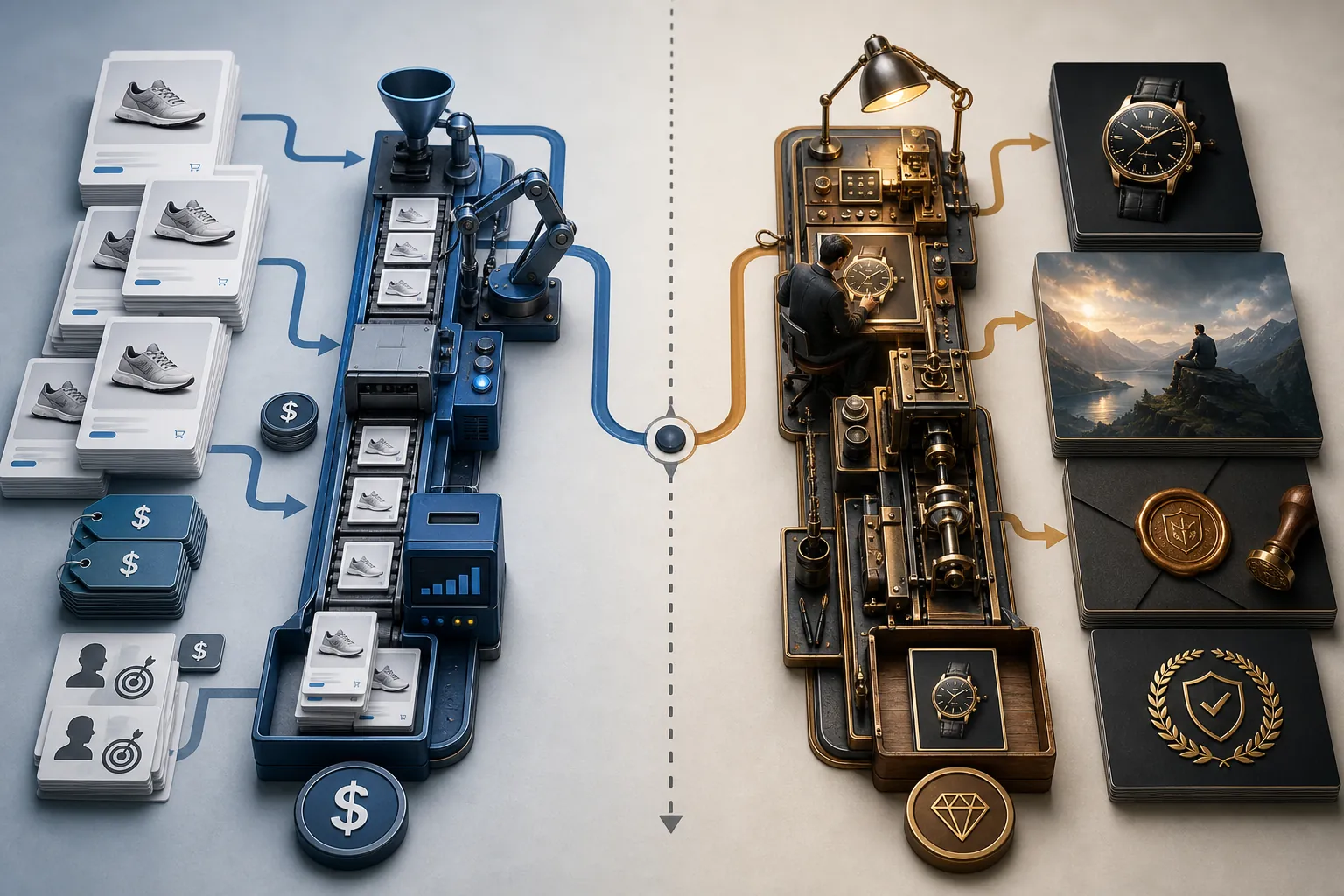
Nadella’s point is orchestration, not cheapness
Nadella matters here because he gives a business-friendly version of something media buyers already know from campaign structure: one machine should not do every job. In a June 27, 2026 Business Insider interview, he said that “every company should build its own AI model.”[2] On July 24, 2026, Microsoft published a joint letter co-signed by Nvidia, Meta, and more than 25 other companies supporting open-weight access as an economic competitiveness issue for startups, established businesses, universities, and public institutions.[3][4] His January 2026 Davos argument, reported by Digiday, was even closer to ad operations: the future is orchestration across multiple models, not dependence on a single model.[5]
That maps cleanly to creative production. A growth team does not need one “best” model. It needs routing rules. The model that writes a believable founder letter, checks a regulated claim, or catches a premium brand’s voice should not be forced to grind through thousands of feed-ad headlines. The model that cheaply rewrites product-benefit bullets should not be trusted by default with a high-consideration message where consumer confidence is part of the conversion path.
Growth Method’s July 2026 model-selection analysis points in the same direction: the marketing question is becoming less “which model wins?” and more “which model should handle this class of work?”[6] For small agencies and in-house buyers, that is a useful shift. It turns AI model choice into the same kind of routing problem as budget allocation, audience segmentation, or creative testing.
Performance evidence supports the switch, but only for the right jobs
The case for moving volume work to open-weight models does not rest on cost alone. Digital Applied’s 2026 benchmark of more than 50,000 creative variants found AI-generated ads delivering a 12% CTR lift on Meta and a 7% lift on Google, with ROAS parity reached for products under $100 average order value.[7] That is exactly the zone where most ecommerce variant generation lives: many ads, fast feedback, small creative deltas, and a buying decision driven more by offer clarity than by deep brand persuasion.
The Taboola and Columbia sibling-ads study, reported by PPC Land in January 2026, adds a useful check from native advertising. AI-written ads produced a 0.76% CTR versus 0.65% for human-written ads, a result the study treated as statistically equivalent rather than a clean AI win.[8] That distinction matters. For production routing, equivalence is often enough. If a cheaper model produces copy that tests roughly the same for a low-risk, low-AOV placement, the buyer does not need it to be magical. It just needs to be publishable, varied, and cheap enough to test.
The Digital Applied threshold also gives media buyers a hard line to start from: below $100 AOV, AI creative reached ROAS parity; above $100 AOV, the benchmark showed an 8% conversion decline.[7] That does not mean every $101 product needs a flagship model, or every $89 product can run untouched machine copy. It does mean AOV belongs in the routing rule. A $29 replenishable product can tolerate more raw variation. A $450 purchase asks more of confidence, context, and taste. The $100 break-even discussion is expanded in AI Creative Advertising: Where It Wins CTR, Loses Conversions, and Breaks Even on ROAS.
The routing framework: AOV, objective, trust sensitivity
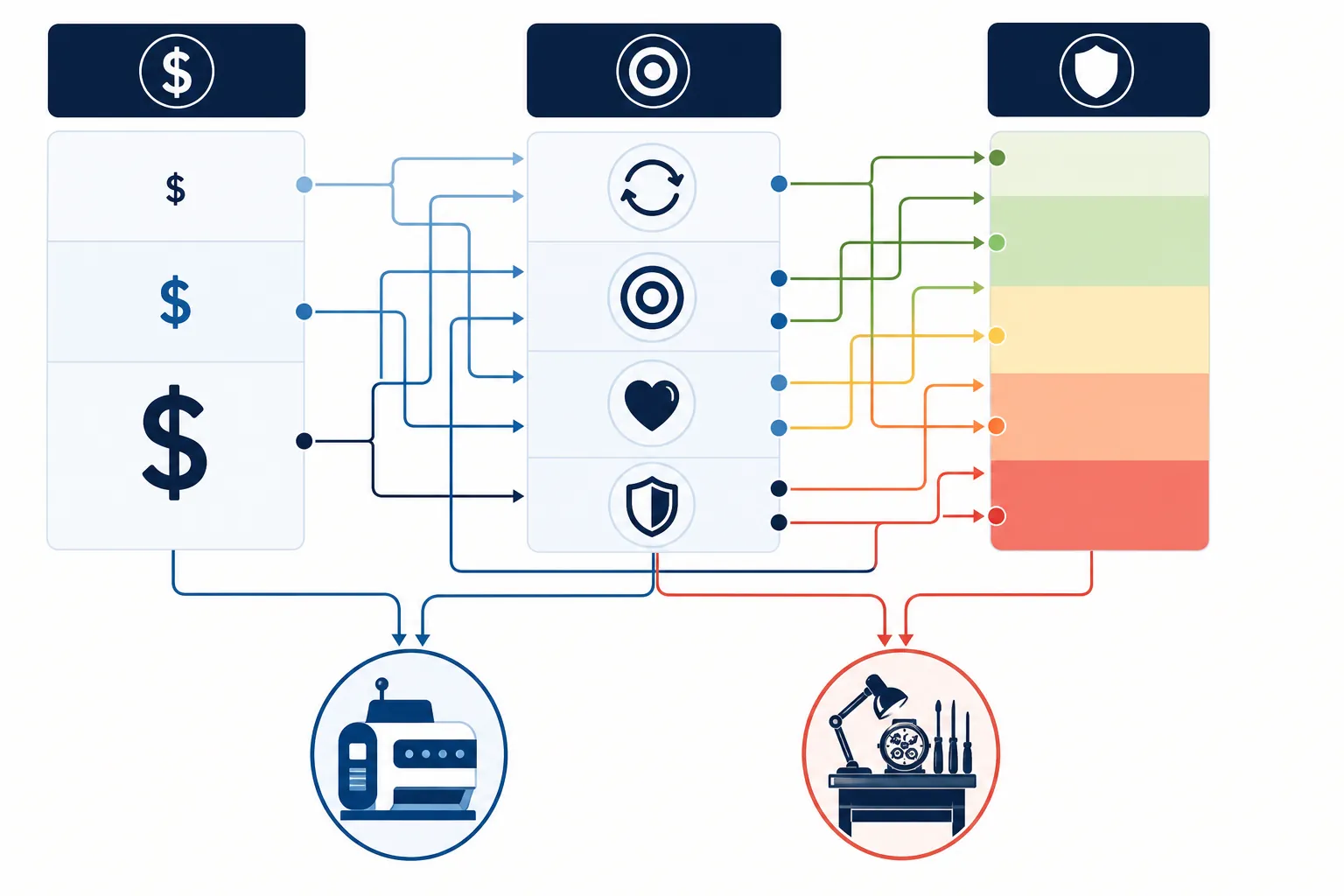
The cleanest way to apply Nadella’s multi-model argument is to stop assigning models by brand name and start assigning them by consequence. A creative request should carry three labels before anyone starts generating copy: average order value, campaign objective, and trust sensitivity.
| Creative job | Default model tier | Why | Human review requirement |
|---|---|---|---|
| Product catalog titles, descriptions, and bullet rewrites | Open-weight | Repetitive, structured, easy to compare against source product data | Light QA for factual accuracy and banned claims |
| Low-AOV direct-response hooks under roughly $100 AOV | Open-weight | Benchmarks show ROAS parity under $100 AOV; volume and test speed matter more than polish [7] | Review top variants before launch |
| Retargeting refreshes and abandoned-cart angles | Open-weight | Audience already has product context; the task is variation and offer clarity | Check discount terms, urgency claims, and fatigue |
| A/B test variants for headlines, CTAs, and benefit framing | Open-weight | The platform will judge performance; cost per variant matters | Review sampling set and reject repetitive outputs |
| Performance Max and Advantage+ volume creative | Open-weight first, frontier only for seed concepts | These systems reward diverse assets; production cost compounds quickly | QA before upload and after early delivery signals |
| High-AOV acquisition creative above roughly $100 AOV | Proprietary frontier or hybrid | Digital Applied found an 8% conversion signal above $100 AOV; message quality and confidence matter more [7] | Senior marketer or brand owner review |
| Premium brand positioning and emotional storytelling | Proprietary frontier | Tone, pacing, and implied status carry conversion weight | Brand, creative, and sometimes legal review |
| Trust-sensitive claims: health, finance, safety, sustainability, guarantees | Proprietary frontier plus human review | The cost of an inaccurate or overconfident claim exceeds token savings | Mandatory human and policy review |
This is not a permanent caste system for models. A good open-weight model can draft strong first passes for premium work. A frontier model can still be useful for generating seed angles that cheaper models expand. The point is to stop using the most expensive tier as the default production engine.
Low-AOV direct response: move the volume
For low-AOV ecommerce, the media buyer’s problem is rarely “we need one perfect line.” It is usually “we need enough distinct angles to keep delivery learning without paying a copywriter or a premium model to say the same thing 200 ways.” Product-benefit rewrites, urgency variations, social-proof hooks, bundle copy, price-framing, and carousel-card text are good candidates for open-weight production.
The operating pattern is simple: use a strong model or human strategist to define the offer, audience, prohibited claims, and winning angles; then use the open-weight model to produce controlled variants inside that box. Media buyers already do the second half with spreadsheets and naming conventions. The model is just cheaper labor for structured variation.
For Performance Max and Advantage+, the same logic applies. Variety matters because the systems need assets to match placements, audiences, and intent states. Paying flagship rates for every minor variant is an expensive way to learn that most variants will never become winners. The workflow case for high-volume asset production is covered in Performance Max Creative Strategy: Why Variety Matters More Than Polish.
Retargeting and refresh work: use open-weight unless the claim is sensitive
Retargeting copy has built-in context. The user saw the product, visited the site, abandoned the cart, watched the video, or engaged with the brand. That makes the copy task narrower. You are not explaining the whole brand from zero; you are reminding, reframing, reducing friction, or presenting an offer.
That narrowness is exactly why open-weight models belong here. Ask for five reminder angles, five objection-handling angles, five bundle angles, five urgency angles, and five proof angles. Reject anything repetitive, exaggerated, or off-policy. The review burden stays manageable because the source material is familiar and the claims are bounded.
The exception is sensitive persuasion. A retargeting ad for supplements, debt products, medical devices, insurance, or safety equipment is not just another abandoned-cart nudge. If the model invents a guarantee, implies a clinical result, or overstates eligibility, the cheap variant is not cheap anymore.
High-AOV acquisition: hybrid by default
Above the low-AOV zone, the creative job changes. Higher consideration products need more than benefit enumeration. They need sequencing, risk reduction, credibility, taste, and sometimes restraint. Digital Applied’s negative conversion signal above $100 AOV is useful here because it gives buyers permission to stop treating all AI-generated copy as one bucket.[7]
A practical hybrid workflow is to use a frontier model for the strategic layer: audience tension, value proposition, objection map, tone, and a small number of concept directions. Then move controlled expansion to an open-weight model only after the expensive model or a senior human has established the guardrails. If the open-weight variants start flattening the brand, inventing proof, or sounding like marketplace filler, route the job back up.
This is also where choosing between proprietary models still matters. Claude and GPT can be worth the spend when the work requires tone control, longer narrative continuity, or subtle brand positioning. A companion breakdown of that side of the stack is in When to Use Claude Opus 5 vs GPT-5.6 Sol for Ad Creative.
The trust penalty is where cheap creative can become expensive
The strongest argument against careless open-weight routing is not capability. It is perception. Digital Applied found a 17% premium perception penalty when consumers detected AI generation.[7] The IAB’s January 2026 “AI Ad Gap Widens” survey found that 82% of ad executives thought consumers felt positive about AI in advertising, while only 45% of consumers actually felt positive — a 37-point perception gap.[9]
That gap changes the math for premium products. A cheap model can produce a headline that lifts CTR and still damage the purchase environment if the creative feels synthetic, generic, or careless. The budget line sees lower token cost; the landing page sees colder buyers. For low-AOV replenishment goods, that may not matter much. For luxury, health, finance, B2B, family safety, or anything sold on expertise, it can matter a lot.
This is why human review is not ceremonial. Someone has to read for claims, tone, evidence, and the faint plastic sheen that gives AI copy away. The broader trust benchmark is in Does AI-Generated Ad Creative Hurt Trust and Sales?, and the advertiser-consumer mismatch is covered in The AI Ad Perception Gap: What Marketers Get Wrong About Consumer Trust. The operational takeaway is narrower: if a campaign depends on being believed, do not route it only by token price.
The open-closed capability gap is real, just not equally important everywhere
Stanford’s AI Index 2026 puts the capability gap between open and closed models at 3.3%, and Epoch AI’s work points to an open-model lag of roughly four months.[10][11] That gap is real. It is also easy to overpay against it.
For routine ad creative, a small capability gap is often irrelevant. Drafting 50 alternate benefit-led headlines, converting a product page into catalog descriptions, or making Meta primary text shorter does not usually require the best reasoning model in the market. The bottleneck is brief discipline, source material, review, and testing cadence.
For complex brand storytelling, legally sensitive language, premium positioning, or campaigns where the wrong implication can change consumer trust, that same gap can become meaningful. The frontier model is not being paid for because it is “smarter” in a general sense. It is being paid for because the creative consequence of nuance is higher.
Inference is becoming the control layer
The infrastructure market is moving in the same direction as the media-buying workflow. Forbes contributor Janakiram MSV argued in July 2026 that open-weight models are turning inference into a control point.[12] In the same period, Fireworks, Together AI, and Baseten represented a $3.8 billion inference-layer funding signal across four weeks, with reported rounds of $1.5 billion, $800 million, and roughly $1.5 billion respectively.[13]
For advertisers, the funding story is only useful if it produces better routing options: no-train hosting, lower latency, model choice, better caching, and enough provider competition to keep production costs from being held hostage by one flagship API. Nobody needs to become a venture analyst to use the signal. It simply means the layer between the creative request and the model is becoming a place to negotiate cost, privacy, and control.
A Monday-morning routing rule
A media buyer does not need a perfect AI governance program to stop overspending. Start with the next month of creative requests and label each one before model selection:
- AOV: under $100, around the threshold, or clearly high-consideration.
- Objective: catalog completion, retargeting refresh, direct response, acquisition concepting, brand storytelling, or trust-sensitive persuasion.
- Trust risk: low if the copy is factual and easily checked; medium if it shapes brand perception; high if it touches health, finance, safety, guarantees, eligibility, sustainability, or premium status.
- Model tier: open-weight for structured volume, frontier for strategy and high-consequence language, hybrid when a strong concept needs cheap expansion.
- Review level: light QA for routine product copy, marketer review for paid social variants, legal or senior review for trust-sensitive campaigns.
Most ecommerce creative volume can move to open-weight alternatives because the work is repetitive, test-driven, and cost-sensitive. The expensive frontier models should be reserved for the smaller share of work where judgment, trust, nuance, or regulatory sensitivity can change conversion quality. Nadella’s argument matters to ad buyers because it turns model choice into media operations, not ideology: sort the workload by AOV, objective, and trust risk, then assign model tiers accordingly instead of letting one premium subscription or API become the default factory.
References
- OpenRouter model pricing, OpenRouter, June–July 2026.
- Satya Nadella says every company should build its own AI model, Business Insider, June 27, 2026.
- Joint letter on open-weight AI access, Microsoft, July 24, 2026.
- Microsoft, Nvidia, Meta Back Open-Weight AI Access, PCMag, July 2026.
- Satya Nadella’s Davos thesis on multi-model orchestration, Digiday, January 2026.
- Best AI Models for Marketing, Growth Method, July 2026.
- 2026 AI Ad Creative Benchmarks, Digital Applied, 2026.
- Taboola and Columbia sibling-ads study, PPC Land, January 2026.
- AI Ad Gap Widens, IAB, January 2026.
- AI Index Report 2026, Stanford Institute for Human-Centered AI, 2026.
- Open models lag closed models by about four months, Epoch AI, 2026.
- Open-Weight Models Are Turning Inference Into a Control Point, Forbes, July 18, 2026.
- Fireworks, Together AI, and Baseten inference-layer funding reports, July 2026.
Built on this evidence
No Bidding tactic or Creative record currently cites this case file. Compare it against other results in Benchmarks.
Related benchmark reading
Report a corroborating or contradicting result
Seeing something different in your own account? Feed the data-integrity loop instead of leaving an open comment.