
Is the GPT API Cheaper for Ad Creative Than Dedicated Tools?
Media buyers weighing build vs buy for AI ad creative need a per-unit cost comparison. This analysis breaks down OpenAI GPT API token costs versus dedicated tool subscriptions, with a breakeven framework based on variant volume.
- Platform
- Meta
- Creative type
- AI image ads
- Last reviewed
- 2026-07-25
Last verified: July 2026 for OpenAI API pricing; dedicated AI ad creative tool prices reflect published Q2 2026 plan ranges.
If the spreadsheet only asks for copy, the GPT API looks absurdly cheap for ad creative. A typical Meta-style copy variant can land around $0.002–$0.005 on GPT-5.4 Mini, which is roughly 200–500 copy variants per dollar under the token assumptions used here.[1][2] Once images, prompt iteration, QA, naming, export formatting, and the person maintaining the workflow enter the sheet, the answer changes: below roughly 500 usable variants a month, a $29–$99 dedicated tool often wins on total operating cost and speed-to-account; above that, or inside a team that already has a maintained pipeline, the API can become the cheaper and more flexible route.
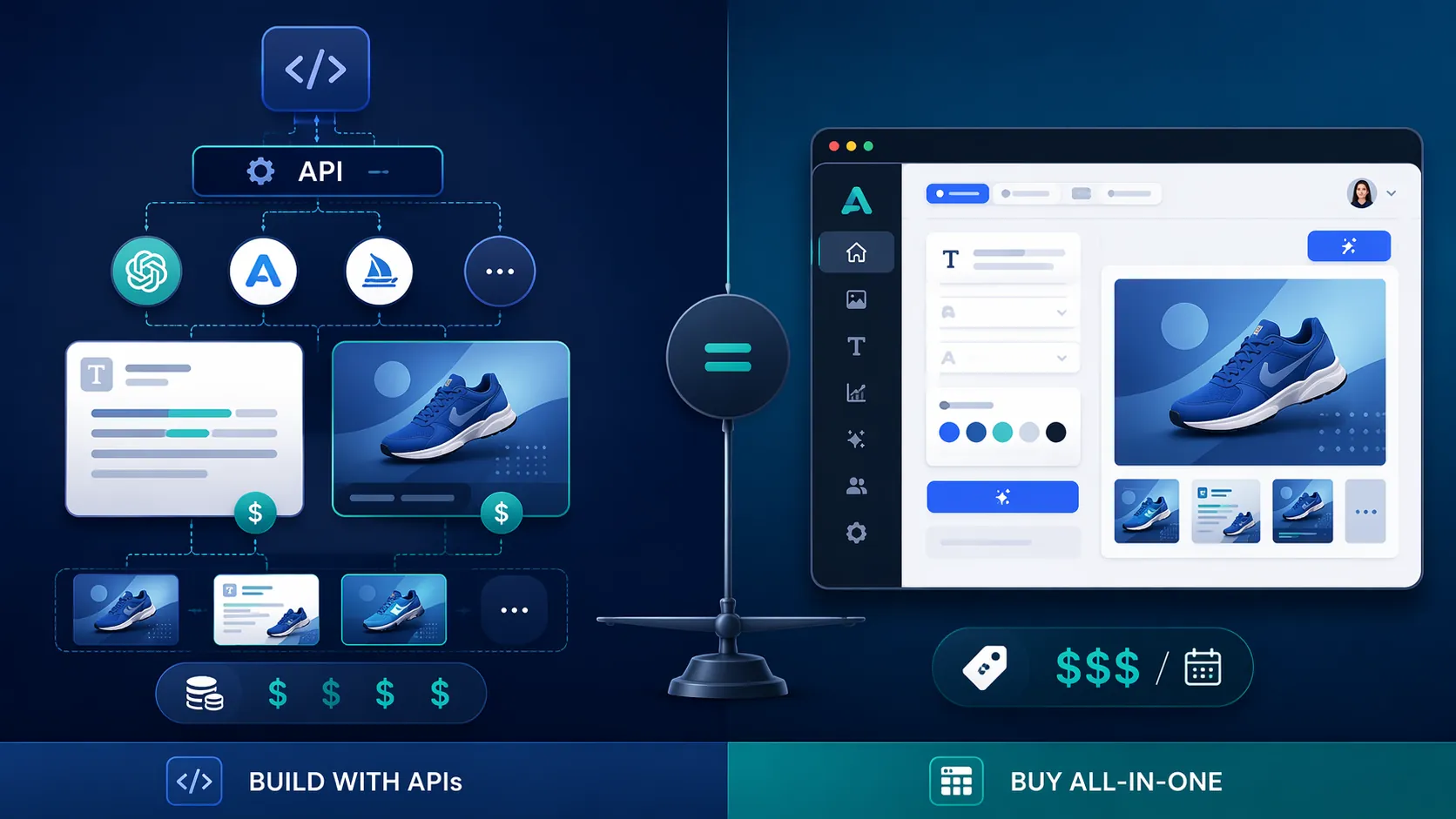
The API Cost Starts With Tokens, Not Ads
OpenAI prices the API by input and output tokens, so the useful unit for ad creative is not “one ad” until the ad format is translated into a prompt shape. As of the July 2026 pricing table, GPT-5.4 Mini is $0.75 per 1M input tokens and $4.50 per 1M output tokens; GPT-5.4 Nano is $0.20 and $1.25; GPT-4.1 Nano is $0.10 and $0.40; and gpt-image-2 is $8 and $30 per 1M input and output tokens.[1]
The current flagship family also matters for model-selection conversations, but usually not for cheap ad-variant production. GPT-5.6 Sol, Terra, and Luna are listed at $5/$30, $2.50/$15, and $1/$6 per 1M input/output tokens respectively.[1] Those models may be useful for strategy, brand-system interpretation, or more complex creative reasoning, but a paid-search or paid-social pipeline generating many routine copy variants will usually start its cost model with Mini or Nano. For a deeper model-choice discussion, see When to Use Claude Opus 5 vs GPT-5.6 Sol for Ad Creative.
| Model or endpoint | Input price | Output price | Where it fits in ad creative |
|---|---|---|---|
| GPT-5.6 Sol | $5 per 1M tokens | $30 per 1M tokens | Flagship reasoning or strategy work, not the cheapest variant factory |
| GPT-5.6 Terra | $2.50 per 1M tokens | $15 per 1M tokens | Higher-quality creative reasoning when cost is less sensitive |
| GPT-5.6 Luna | $1 per 1M tokens | $6 per 1M tokens | A closer flagship-family option for production workloads |
| GPT-5.4 Mini | $0.75 per 1M tokens | $4.50 per 1M tokens | Practical baseline for many copy-variant pipelines |
| GPT-5.4 Nano | $0.20 per 1M tokens | $1.25 per 1M tokens | Very low-cost drafting, expansion, or structured variant generation |
| GPT-4.1 Nano | $0.10 per 1M tokens | $0.40 per 1M tokens | Lowest-cost lightweight copy tasks where quality tolerance is higher |
| gpt-image-2 | $8 per 1M tokens | $30 per 1M tokens | Image generation, where the API cost gap narrows quickly |
A Worked Copy Variant Estimate
For a practical ad-copy variant, assume the request includes a compact system instruction, product context, and one structured output: primary text, headline, description, and CTA. A workable estimate is about 200 tokens for the system prompt, 150 tokens for product context, and 300 tokens for the generated ad fields, or roughly 650–700 total tokens per copy variant.[2]
| Cost component | Estimated tokens | GPT-5.4 Mini price basis | Approximate cost |
|---|---|---|---|
| System prompt | 200 input tokens | $0.75 per 1M input tokens | $0.00015 |
| Product or offer context | 150 input tokens | $0.75 per 1M input tokens | $0.00011 |
| Ad copy output | 300 output tokens | $4.50 per 1M output tokens | $0.00135 |
| One copy variant | About 650 tokens | Input plus output | About $0.0016 before buffer |
| Practical planning range | 650–700+ tokens | Includes prompt variance and retries | About $0.002–$0.005 |
That is the cleanest argument for the API. If a buyer needs 100 copy variants for a new angle test, the raw copy generation line can be measured in cents, not dollars. Batch API improves the scheduled-production version further: OpenAI lists a 50% discount for 24-hour turnaround processing, which can push GPT-5.4 Mini copy generation toward about $0.001 per variant when the work can wait overnight.[1]
But the spreadsheet should keep “generated” separate from “usable.” A generated variant still has to pass brand checks, avoid offer mistakes, fit platform limits, land in a naming convention, and sometimes be rewritten because the model found six ways to say the same discount. The API wins the raw copy-cost column. It does not automatically win the operating-cost column.
Images Are Where the Gap Narrows
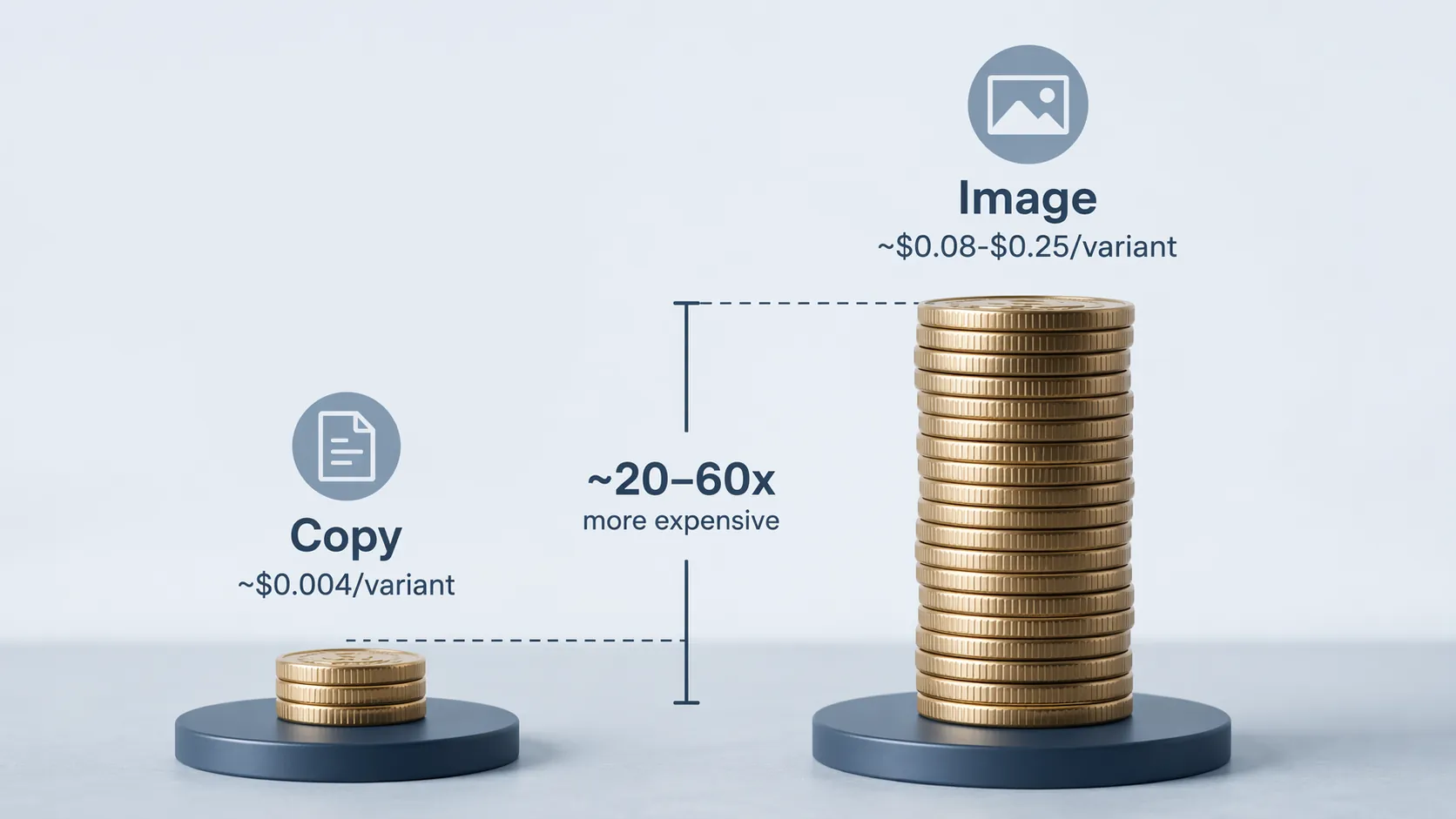
Copy makes the API look almost free. Image generation does not. At gpt-image-2 pricing, the planning range is about $0.08–$0.25 per image, depending on output resolution, detail level, and cache behavior.[1] That is still inexpensive, but it is no longer a rounding error.
It also puts the API in the same neighborhood as some credit-based ad creative tools. AdMake AI’s credit model is cited around $0.08–$0.16 per creative in Q2 2026 pricing comparisons, while broader dedicated-tool ranges include AdCreative.ai at $29–$249 per month, AdStellar at $49–$499 per month, WASK at $15–$165 per month, AdGPT at $29–$1,899 per month, and other AI ad generator plan structures that vary by credits, seats, exports, and brand features.[3][4][5][6][7]
| Monthly volume | API copy only at $0.002–$0.005 each | API image add-on at $0.08–$0.25 each | What the comparison really says |
|---|---|---|---|
| 50 variants | $0.10–$0.25 | $4–$12.50 | Token cost is tiny, but labor and workflow setup dominate |
| 300 variants | $0.60–$1.50 | $24–$75 | Images start to resemble a low-to-mid subscription plan before labor |
| 500 variants | $1–$2.50 | $40–$125 | The API can beat many tools if workflow maintenance is already handled |
| 1,000 variants | $2–$5 | $80–$250 | API economics become compelling, especially for scheduled bulk generation |
The copy-only API case is therefore strongest for teams that separate copy ideation from image production, use existing templates, or push generated copy into human-edited statics and video scripts. Once the pipeline is expected to generate complete image-led ad variants, the cost model becomes less magical and more like normal media-ops math.
The Subscription Equivalent at 50, 300, and 500 Variants
A flat-rate tool is not buying tokens at a better price. It is bundling interface, prompt scaffolding, brand inputs, image workflows, export steps, collaboration, and support into a predictable monthly line item. That bundle is annoying when the vendor hides usage behind credits. It is useful when the alternative is a half-maintained script that only one person knows how to fix.
| Monthly usable variants | API token bill, copy only | API token bill, copy plus one image | Dedicated tool comparison | Likely winner on total cost |
|---|---|---|---|---|
| 50 | About $0.10–$0.25 | About $4.10–$12.75 | $29–$99 plans can look expensive on unit cost but save setup time | Dedicated tool for most non-technical teams |
| 300 | About $0.60–$1.50 | About $24.60–$76.50 | Low and mid-tier plans are still competitive after labor | Usually dedicated tool unless API workflow already exists |
| 500 | About $1–$2.50 | About $41–$127.50 | Subscription cost depends heavily on credits and export limits | Breakeven zone |
| 1,000+ | About $2–$5 before Batch savings | About $82–$255 before Batch savings | Higher-tier plans or credit overages may rise quickly | API more likely to win with maintained infrastructure |
This is why “the API is cheaper” is true and still incomplete. At 50 variants a month, saving $20 in token cost does not matter if someone spends even one extra hour stitching together prompts, checking outputs, and resizing assets. At 300 variants, the raw API line may still look better, but the difference can disappear once the team adds QA and maintenance. Around 500 variants, the answer becomes more sensitive to the team’s actual workflow: whether outputs are generated in batches, whether naming and export are automated, and whether the team already has a reliable way to feed product, offer, and performance data into the prompts.
That last condition is not cosmetic. The API route depends on clean inputs and stable handoffs. If product feeds are messy, offer rules change weekly, or creative results are not joined back to spend and conversion data, the cheap generation layer can simply produce more things to clean up. The infrastructure burden is closer to the problem described in The Data Prerequisites That Make or Break AI-Driven Ad Performance than to a normal software subscription decision.
Labor Is the Line Item That Ruins Cute API Math
Prompt engineering and workflow upkeep have a cost even when nobody invoices them separately. The cost assumptions here use $60–$100 per hour for prompt engineering time and a minimum of 2–4 hours per week for technical setup and maintenance when a team builds its own API pipeline.[2] That does not mean every API project burns four hours forever. It means the breakeven model needs a labor row before anyone celebrates a $0.003 ad.
| Labor assumption | Monthly cost at $60/hr | Monthly cost at $100/hr | Impact on breakeven |
|---|---|---|---|
| 2 hours/week | About $480/month | About $800/month | Can overwhelm token savings at 50–300 variants |
| 4 hours/week | About $960/month | About $1,600/month | Only makes sense if the pipeline supports high volume or multiple accounts |
| Existing maintained pipeline | Incremental cost may be much lower | Incremental cost may be much lower | This is where API economics become much more attractive |
For a small agency, this is the uncomfortable part. The owner may be right that another subscription is bloated. The account manager may also be right that a custom workflow will become one more thing to debug before launch. If the same person is already fixing UTMs, catalog errors, offline conversion uploads, and creative naming, the “free” API workflow is not free. It is a transfer of cost from a vendor invoice to an operations queue.
For an in-house growth team with a developer already maintaining marketing automation, the same equation can flip. Adding GPT generation to an existing pipeline is different from inventing a pipeline from scratch. If product data, claims, exclusions, landing-page URLs, naming conventions, and review steps already exist in structured form, the API becomes an incremental generation layer rather than a second job.
Scheduled Bulk Generation Is Not the Same as Real-Time Iteration
Batch API pricing is a real advantage, but only for work that can wait. A 50% discount with a 24-hour turnaround is excellent for Monday variant production, seasonal refreshes, account-wide copy expansion, localization queues, and planned creative testing.[1] It is much less useful when a buyer needs to react to a rejected asset, a fast-moving promo, or a founder asking for three new angles before the afternoon budget shift.
- Use Batch API when the team can generate large copy or image queues overnight and review them the next day.
- Use real-time API calls when speed matters more than the discount and the workflow is already connected to review or export.
- Use a dedicated tool when the bottleneck is not generation cost but getting a usable asset into Meta, Google, TikTok, or a client review deck.
This distinction matters especially for Performance Max and other asset-hungry systems. High variety has strategic value when the account can actually test and learn from it; more variants are not useful if they sit in a folder waiting for someone to crop, label, and upload them. The practical creative-variety argument is broader than API pricing, and it is covered in Performance Max Creative Strategy: Why Variety Matters More Than Polish.
Why the Winner Rate Changes the Economics
The API’s strongest case is not just “we saved money on generation.” It is “we can afford to test enough variants to find the few that matter.” Benchmark sources cite a 6–7% winner rate for ad variants becoming scale performers, supported by 2026 AI creative benchmark data and case-study material.[8][9] That should not be read as a universal law for every account or vertical. It is a useful planning reminder: most variants do not become winners.
If 100 variants produce only 6 or 7 candidates worth scaling, then the cost of the 93 or 94 non-winners matters. With API copy, testing 100 variants may cost about $0.20–$0.50 in raw tokens. With a dedicated tool, the same test may be absorbed into a $49–$99 monthly subscription, assuming the plan allows the needed volume.[1][2][3][4] Neither comparison includes media spend, which is where the real test cost lives, but generation cost can still determine whether the team creates 20 angles or 200.
This is also where the broader AI creative question belongs. If the account economics make creative quality and testing velocity meaningful, cheap variant production can matter a lot. If the offer, AOV, funnel, or tracking setup cannot support the test, cheaper variants just make the failure cheaper to produce. For that wider breakeven discussion, see AI Creative Advertising: Where It Wins CTR, Loses Conversions, and Breaks Even on ROAS.
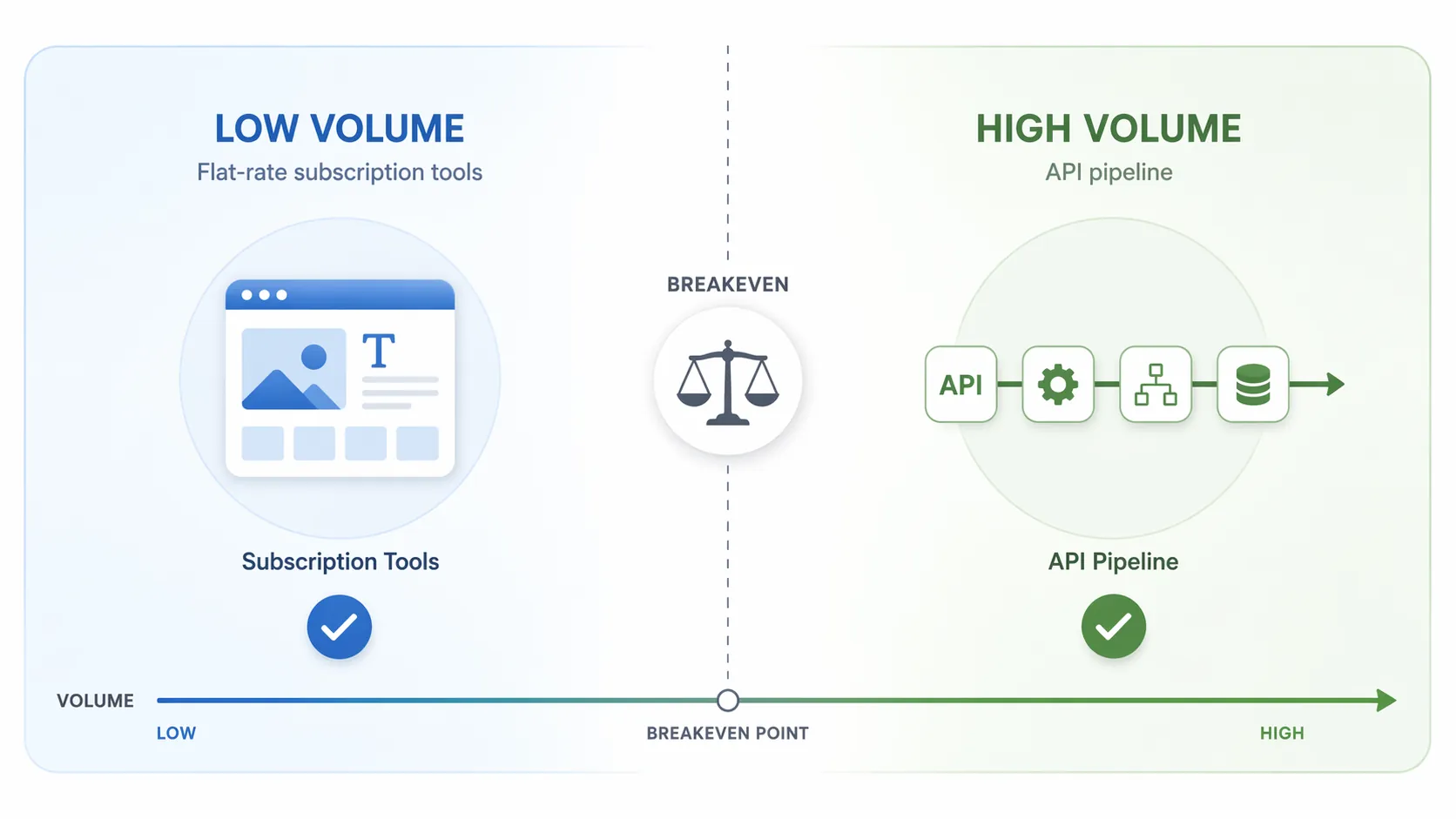
A Practical Breakeven Rule
The clean decision rule is to price the usable tested variant, not the generated output. A usable tested variant has passed review, fits the placement, carries the right offer and URL, is named correctly, and can be connected back to performance. That definition is less elegant than token math, but it is the number a media team can actually defend.
| Team situation | Better default | Reason |
|---|---|---|
| 50 variants/month, no developer support | Dedicated tool | Subscription cost is easier to justify than building and maintaining a fragile workflow |
| 300 variants/month, mixed copy and image needs | Usually dedicated tool | API token cost is low, but image cost and labor can erase the savings |
| 500 variants/month, structured inputs, repeatable reviews | Compare both carefully | This is the practical breakeven zone where workflow maturity decides the answer |
| 1,000+ variants/month or multiple accounts | API likely wins | Generation volume can absorb setup cost, especially with Batch API for planned production |
| Existing marketing automation pipeline | API likely wins sooner | The team is adding a model call, not inventing a production system |
For most teams producing 50–300 variants a month, dedicated tools often win because they collapse the distance between idea and usable account asset. For teams above roughly 500 variants a month, or teams with existing development infrastructure, the GPT API can become cheaper and more flexible. The best answer is not a universal build-or-buy rule; it is a breakeven sheet with four separate rows: copy tokens, image tokens, labor, and delay between generation and launch.
Re-check the OpenAI pricing table before committing the model, and re-check tool plans before comparing subscriptions, because both sides change. The useful comparison is not GPT API pricing versus a plan name. It is total operating cost per usable tested ad variant.
References
- OpenAI API Pricing, OpenAI.
- OpenAI Cost per API Call, CloudZero.
- AI Creative Tools Pricing, WASK.
- AI Creative Platform Pricing, AdStellar.
- 9 Tools + TCO, AdLibrary.
- AI Ad Generator Pricing, Shhots.ai.
- AdGPT Pricing, AdGPT.
- AI Ad Creative Benchmarks 2026, Digital Applied.
- AI-Generated Ad Creative Case Studies, Admiral Media.
This is a record of what happened and what was tested, not legal advice. Compliance determinations require qualified counsel.