
Does AI-Generated Ad Creative Hurt Trust and Sales?
When consumers detect AI-generated ads, brand trust drops 22 points and purchase intent falls 14%. Learn which verticals are most at risk and which mitigation strategies actually close the gap, based on the Edelman Trust Barometer, Kantar, and a 500M+ impression field study.
- Platform
- Meta Ads
- Campaign type
- Advantage+
- Spend range
- Varied
- Timeframe
- 0
- ROAS
- -14%
- Verdict
- mixed result
- Industry vertical
- Luxury
- Last reviewed
- 0-07-25
The uncomfortable part of the AI prompt breakthrough for ad creative is not that synthetic ads can get clicks. They can. The uncomfortable part is that the same campaign can look efficient in-platform while quietly making the brand feel less believable at the point where trust is supposed to convert.
The blunt numbers are hard to wave away. A 2026 Edelman Trust Barometer special report cited in AMRA & ELMA’s compilation found that 61% of consumers can identify AI-generated ad content, and among those who can detect it, brand trust drops by 22 points on a 100-point scale. The same compilation cites consumer perception findings showing that ads perceived as AI-generated see 17% lower premium perception, 19% lower inspiration, and 14% lower purchase intent.[1]
That is the part a CTR dashboard will not protect you from. A cheaper creative pipeline can produce more variants, faster tests, and attractive engagement metrics, but if the winning unit makes a premium product look generic, fake, or low-care, the campaign has only moved the problem downstream.

The penalty is about detection, not authorship
The useful distinction is simple: consumers are not necessarily punishing the fact that a model helped make the ad. They are punishing the moment the ad reads as artificial. That can mean plastic skin, uncanny hands, too-perfect lighting, generic facial expressions, dead-eyed lifestyle scenes, fake-looking product interaction, or a composition that feels like a stock-image cliché with a prompt pasted over it.
This distinction matters because it keeps the conclusion from becoming lazy. “AI creative hurts trust” is too broad. The stronger read is that perceived artificiality hurts trust, and AI-generated workflows raise the risk of shipping artificiality at scale because they make it easy to produce plausible-looking work without enough human judgment at the finish line.
Kantar’s AI in advertising research, as summarized by StackAdapt, adds the consumer-side anxiety underneath that reaction: 61% of consumers worry AI-generated ads could be fake or misleading, and more than 60% support mandatory AI disclosure labels.[2] Disclosure may become a compliance or platform requirement in some contexts, but it is not a creative fix. If the unit still looks fake, a label does not make the product feel more credible.
This is where many AI creative conversations get soft. The problem is not solved by saying “be transparent” and moving on. Transparency may answer one question: was AI involved? It does not answer the commercial question: does this execution make the buyer more or less willing to trust the brand with money, health, risk, status, or a long internal approval process?
Why platform wins can diverge from business wins
A strange-looking ad can still earn attention. Novelty, contrast, and pattern interruption are real forces in paid media. An image that looks slightly wrong may stop a thumb. It may even produce a cheap click. That does not mean it has improved the purchase path.
The survey data should not be treated as completed conversion proof. Edelman and Kantar are measuring recognition, trust, concern, and stated attitudes, not every downstream checkout, sales call, or renewal decision. But those measures explain a failure pattern media buyers recognize: the ad unit performs well enough to survive creative testing, then the lead quality, close rate, AOV, sales feedback, or brand lift looks worse than the engagement numbers promised.
The field-study evidence is the important counterweight. A Taboola field study with Columbia, Harvard, Technical University of Munich, and Carnegie Mellon, summarized by AdBeacon, analyzed more than 500 million impressions and found that AI-generated creative can achieve the highest engagement when it does not visually read as AI-made, especially in ads with large, clear human faces.[3] That is not a small nuance. It suggests the problem is not the production method; it is the visible quality signal.
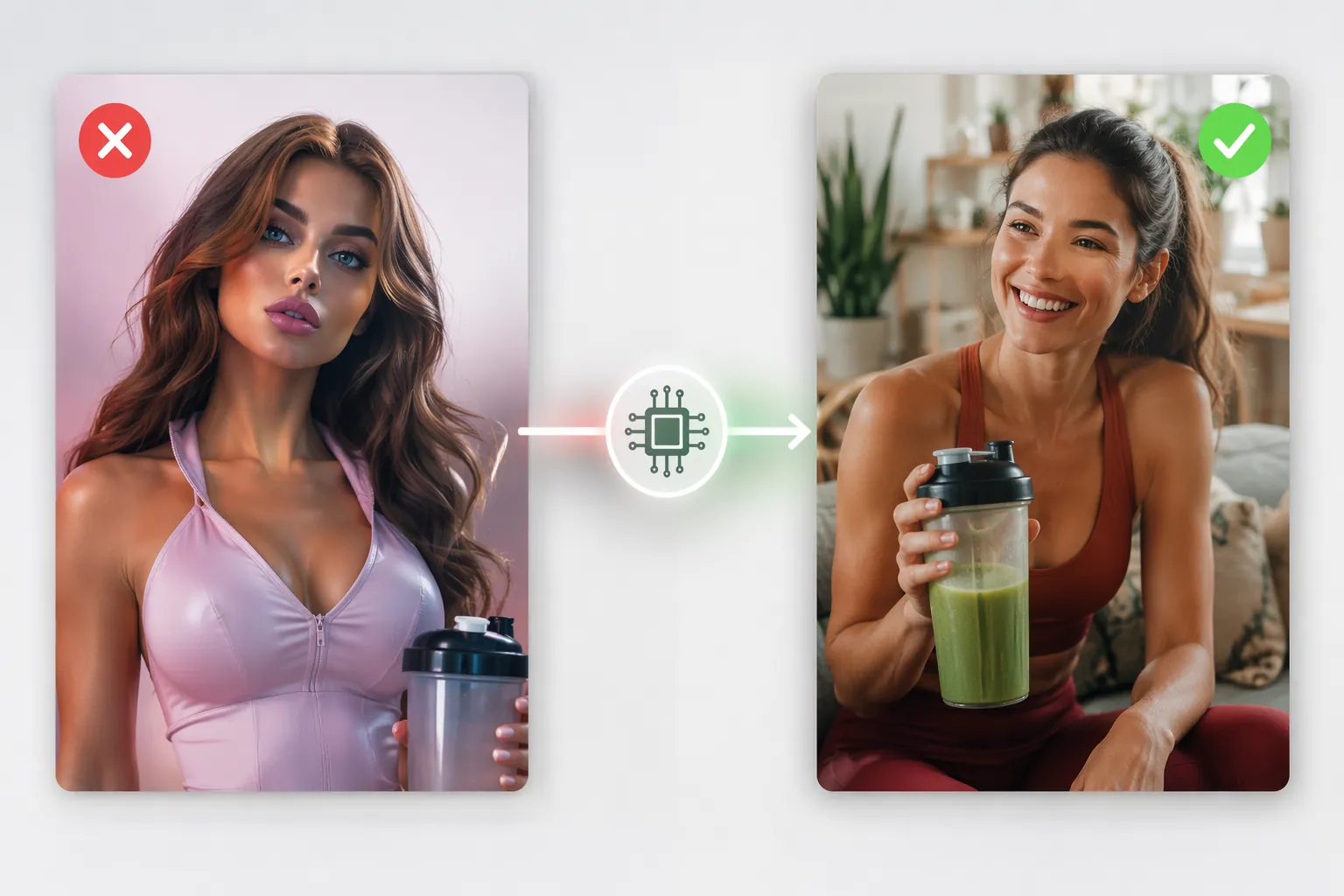
For a media buyer, that changes the operating question. The question is not whether AI belongs in the workflow. The question is whether the winning variant is winning because it communicates the offer more clearly, or because it creates a cheap attention spike while introducing doubt that the conversion environment then has to overcome.
The categories where “looks fake” costs more
Trust is not equally expensive in every category. If the offer is a low-risk impulse buy, a synthetic-looking image may be a creative quality issue, but it may not threaten the core transaction. In luxury, financial services, healthcare, and B2B, believability is part of the product. The ad is not only asking for a click; it is asking the buyer to believe the brand can handle status, money, risk, the body, or a professional reputation.
Digital Applied’s 2026 AI ad creative benchmarks report, summarized in AdBeacon’s synthesis, points in that direction with vertical-specific conversion gaps: luxury at -22%, B2B at -18%, and financial services at -12%.[4][3] The available evidence does not support treating those figures as universal law across every account, market, or creative format. It does support a practical warning: the categories most dependent on credibility appear more exposed when AI creative is perceived poorly.
| Category | Reported conversion gap | Why the penalty matters |
|---|---|---|
| Luxury | -22% | Premium perception is part of the offer, so artificiality can make the product feel cheaper. |
| B2B | -18% | The ad may be the first credibility filter before a buyer risks time, budget, or internal reputation. |
| Financial services | -12% | The buyer is evaluating competence and safety, not only message relevance. |
Luxury is the easiest place to see the damage. A premium campaign can survive abstraction, minimalism, even strangeness. It has a harder time surviving visual cheapness. When the model’s skin looks waxy, the bag floats a little too cleanly in the frame, or the environment feels assembled from generic prestige cues, the ad starts subtracting from the price story. That is not an aesthetic complaint; it is a margin problem.
B2B has a different version of the same issue. The buyer may not care whether an image was generated, but they do care whether the company looks rigorous. Synthetic office scenes, fake dashboards, vague futuristic diagrams, and over-polished “team collaboration” visuals often signal that no one close to the customer reviewed the work. In a long buying cycle, that weakens the ad before sales ever sees the account.
Financial services adds a further constraint: the creative has to feel controlled. An ad for a savings product, lender, insurer, or investment platform can lose ground when the image looks manipulated or too fantastical, because the category already asks the customer to hand over information, money, or long-term confidence. A small visual trust leak can become a larger conversion leak.

Audience assumptions are getting less safe
There is also an audience trap here. It is tempting to assume younger consumers will be more forgiving because they are more fluent in AI tools, synthetic media, and creator-style production. The cited Salesforce/Edelman data in AMRA & ELMA’s compilation cuts against that easy assumption: 39% of Gen Z dislike AI-generated ad creative, nearly double the Millennial figure cited in the same source.[1]
That does not mean every Gen Z-targeted campaign should avoid AI. It means fluency is not the same as tolerance. A younger buyer may be quicker to spot the tell. They may also be less impressed by novelty because they have seen too much of it already.
Country-level trust drops add another modifier. The Edelman figures cited by AMRA & ELMA report larger trust declines among consumers who detect AI-generated ad content in Japan at -29 points, France at -26 points, and Canada at -24 points.[1] Those are survey findings, not a substitute for market-level conversion testing, but they are enough to make global creative rollouts risky if the same synthetic look is being pushed across regions without local review.
What to change in creative testing
The mitigation is not to slow the whole AI workflow back down to pre-AI production speed. That throws away the useful part of the breakthrough. The better move is to separate generation volume from approval standards. Use AI to create more routes, angles, formats, crops, and localized variants. Then judge the finalists by the trust event they have to support, not only by the click they can attract.
- Add an artificiality review before launch: ask whether the image reads as synthetic, generic, distorted, over-polished, or disconnected from the actual product experience.
- Segment tests by business risk: low-risk prospecting units can tolerate more experimentation than retargeting, high-AOV landing-page traffic, lead-gen offers, or premium product launches.
- Watch post-click quality: compare AI-heavy variants on conversion rate, qualified lead rate, AOV, refund behavior, sales feedback, or brand-lift measures where available.
- Use disclosure as a compliance and expectation tool, not as a substitute for believable craft.
- Keep human faces under stricter review: the field-study upside is strongest when faces are large and clear, but face quality is also where detection cues can become obvious fastest.
The face point deserves extra care. The Taboola study’s finding that AI creative performs well when it does not visually read as AI-made, particularly with large, clear human faces, should not be interpreted as “put synthetic people everywhere.”[3] It means human presence can work when the execution carries warmth, clarity, and plausibility. If the face is almost right but emotionally empty, the ad may become more memorable for the wrong reason.
A useful pre-launch review can be very plain. Show the finalist creative without context to a few people who match the target customer closely enough to be useful. Ask what feels off. Ask what kind of company they think made it. Ask whether the product feels premium, credible, safe, or worth contacting. Do not lead with “does this look AI-generated?” unless detection itself is the variable being tested; otherwise, you risk training the reviewer to look for artifacts instead of reporting the actual brand impression.
For paid testing, the cleanest setup is not AI versus human creative as a philosophical duel. It is perceived-natural versus perceived-artificial execution, with production method tracked in the background. A human-made ad can look fake. An AI-assisted ad can look credible. The buyer only sees the unit.
Where the evidence stops
The evidence used here is external research. Signal & Convert has not independently reproduced the 500 million-impression field study, the Edelman trust figures, the Kantar disclosure sentiment, or the vertical-specific conversion gaps. That matters because paid media effects are sensitive to offer strength, placement, audience intent, category norms, landing-page quality, and measurement windows.
The right conclusion is narrower and more useful than a blanket warning. The available evidence supports treating detectable artificiality as a real campaign risk, especially in high-trust and high-consideration categories. It does not support treating all AI-generated creative as commercially harmful.
That is the operating rule: use AI creative aggressively where it expands testing capacity, but do not let prompt volume outrun believability. The variant that wins the click still has to survive the moment when the customer decides whether the brand feels premium enough, competent enough, and real enough to trust.
References
- AI Generated Ad Creative Performance Statistics — AMRA & ELMA
- AI Advertising — StackAdapt
- AI Creative Wins Clicks, Loses Conversions — AdBeacon
- AI Ad Creative Benchmark 2026: CTR & ROAS Data — Digital Applied
Built on this evidence
No Bidding tactic or Creative record currently cites this case file. Compare it against other results in Benchmarks.
Related benchmark reading
Report a corroborating or contradicting result
Seeing something different in your own account? Feed the data-integrity loop instead of leaving an open comment.