
What Qualcomm's Q3 Earnings Tell Advertisers About AI Chips
Qualcomm's July 2026 Q3 earnings reveal two structural shifts—on-device NPU and data-center Dragonfly chips—that will reshape ad targeting costs and creative evaluation over the next 2-3 years. This analysis extracts the concrete signals media buyers need for Q4 planning, including inference cost implications and a new privacy-safe targeting surface.
- Platform
- Google Ads
- Campaign type
- Performance Max
- Spend range
- General
- Timeframe
- Q0 2026
- CPA
- General
- Verdict
- mixed
- Last reviewed
- 0-07-30
For a media buyer setting Q4 budgets, Qualcomm’s Q3 FY2026 earnings do not justify changing bids tomorrow. They do, however, add two dated items to the planning tracker: premium Android inventory that may become a better test bed for on-device AI targeting, and data-center inference costs that could eventually change how often ad platforms can afford to score creative, audiences, and bids.
The timing matters. Qualcomm reported fiscal Q3 results on July 29, 2026; this is not calendar Q3 performance. The numbers belong to the quarter ended in June, while the practical advertising questions point forward into September pricing, holiday inventory mix, and 2027 platform testing assumptions.
| Signal from Qualcomm Q3 FY2026 | Why advertisers should care | Planning status |
|---|---|---|
| $9.9B revenue and $2.21 EPS | The AI-chip story is coming from a large supplier, not a lab demo. | Context, not a bidding input |
| Handset revenue down about 20% year over year | Qualcomm has a real incentive to push AI beyond a mature phone cycle. | Watch inventory mix |
| Auto up 61% year over year; non-handset areas up 28% | The center of gravity is moving toward compute surfaces beyond phones. | Longer-range infrastructure signal |
| Double-digit price increases starting September 1, 2026 | Higher device costs can affect which phones drive impression growth. | Q4 device-tier watchlist |
| Apple modem revenue expected to fall about 50% from September to December 2026 | Qualcomm-enabled AI capability is becoming less relevant to newer iOS hardware assumptions. | Separate Android and iOS assumptions |
| Dragonfly revenue from two hyperscaler wins starts December 2026 | Inference-cost claims move from slideware toward revenue recognition. | 2027 validation watchlist |
The earnings snapshot is strong enough to make the infrastructure signal worth watching: Qualcomm reported $9.9 billion in revenue and $2.21 in EPS, while handset revenue fell about 20% year over year, automotive revenue rose 61%, and non-handset businesses including auto, IoT, and data center grew 28%.[1] The stock still slid after the report, which is the market’s reminder that a revenue beat and a credible AI roadmap are not the same thing as a proven timeline.[2]
For advertisers, the cleanest split is immediate versus conditional. The immediate part is device mix: Qualcomm said double-digit price increases begin September 1, 2026, and it expects Apple modem revenue to fall about 50% from September to December as Apple shifts toward in-house modems.[3] The conditional part is adtech behavior: no earnings material names Google, Meta, TikTok, Amazon, or another ad platform as a Qualcomm AI-chip customer. Any claim about lower CPAs from this report alone would be ahead of the evidence.

The Two Tracks That Matter for Ad Economics
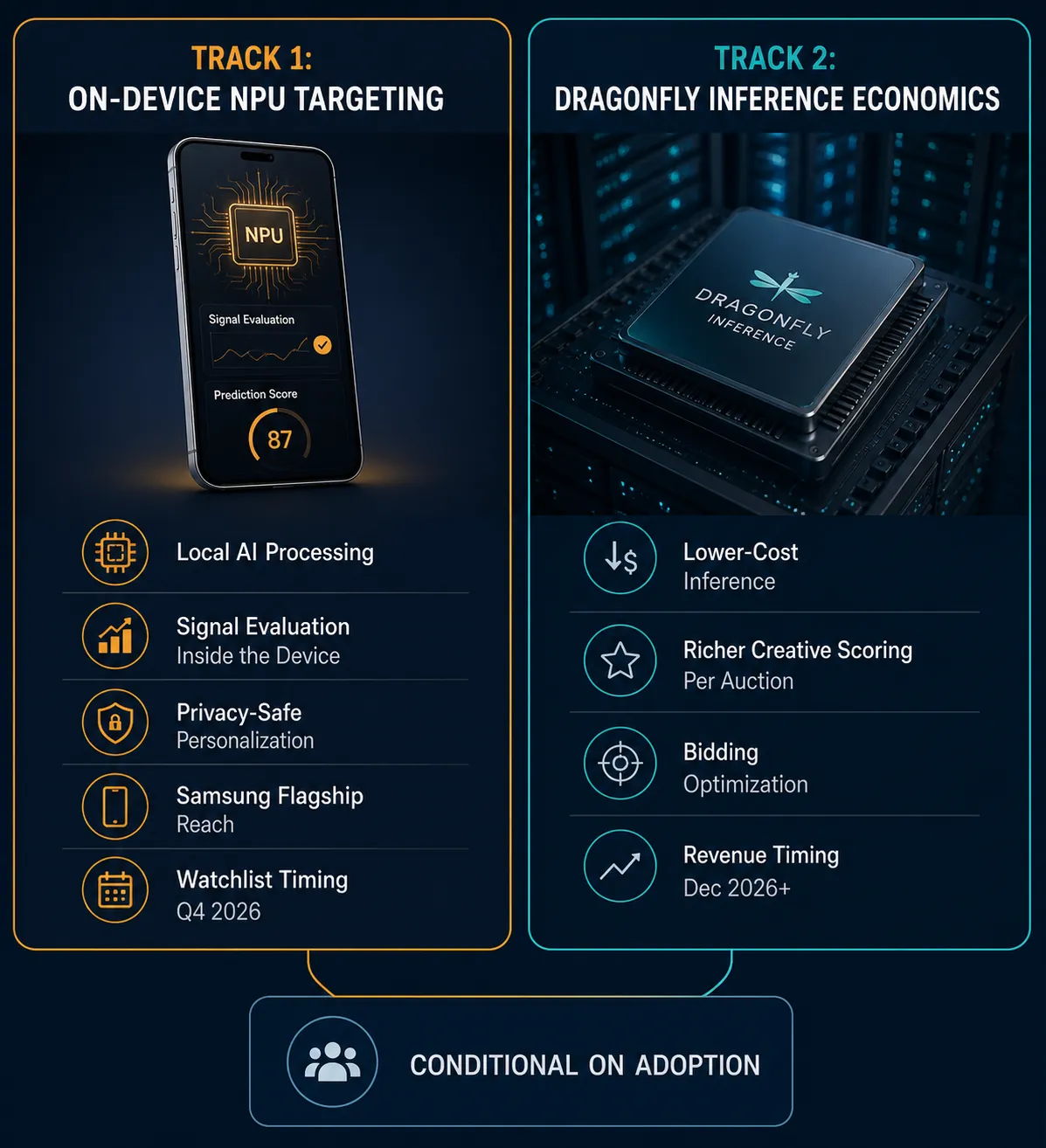
Qualcomm’s AI-chip update matters to advertisers only if it enters the auction chain. There are two plausible routes. One starts on the phone, where a Snapdragon NPU evaluates signals locally before an ad request is shaped. The other starts in the data center, where cheaper inference lets a platform run more model calls before deciding what to show, what to bid, or which creative to assemble.
- On-device NPU targeting: closer to mobile media buying because it touches user signals, privacy constraints, and premium Android inventory.
- Dragonfly inference economics: farther from the buyer’s console today, but potentially important if lower-cost model calls let platforms score more auction variables.
- Both tracks are conditional: Qualcomm has capability claims, not direct ad-platform proof.
Track One: Premium Android Becomes the First Real Surface to Watch
The on-device track is the more practical one for Q4 planning because it sits closer to inventory. Qualcomm’s Snapdragon 8 Elite Gen 5 Hexagon NPU is positioned to run generative AI models, including LLM and image-generation workloads, locally without cloud connectivity.[4] At CES 2026, demos showed on-device agents, and Qualcomm’s CEO said Chinese OEMs are preparing on-device agentic experiences.[5]
That does not mean a media buyer can select “Snapdragon NPU audience” in a platform UI. It means the technical surface exists for a platform, operating system partner, or OEM layer to evaluate some user context locally. A phone could classify intent, app behavior, creative affinity, or task context without sending the raw underlying data to the cloud. If that local judgment is exposed to an ad platform as a privacy-preserving signal, the platform gets something useful without recreating the older third-party-cookie bargain.
The Samsung exposure is why this is not just a developer demo. Qualcomm says Snapdragon powers about 70% of Samsung flagship devices.[5] Premium Android is exactly where a new targeting or personalization surface would likely appear first: higher device capability, heavier app usage, higher advertiser value, and enough scale for platforms to test without waiting for the whole market to refresh.
The privacy appeal is straightforward. After ATT and cookie deprecation pressure, platforms want signals that do not require the same level of cross-site or cross-app data movement. Local models can inspect local context, produce a category or score, and keep the raw material on the device. That is not magic; it is a different boundary for signal processing.
The trade-off is fidelity. Smaller local models, isolated device-level signals, and crowd-anonymity thresholds can make on-device targeting less precise than a cloud system that sees broader behavior across properties. That ceiling is the reason an on-device targeting test should be judged by incrementality and stability, not by the elegance of the privacy architecture. The site’s earlier analysis of on-device AI’s structural ceiling in mobile ad targeting is the skeptical companion to this part of the Qualcomm story.
The September 1 price increase gives this track a near-term planning hook. Double-digit component price increases can show up indirectly through handset pricing, device replacement cycles, and the mix of premium versus mid-range Android impressions. The research does not prove that mid-range shipments will fall, or that CPMs will move because of Qualcomm pricing. It does make device-tier mix worth checking more carefully in Q4, especially for advertisers whose results already vary sharply between flagship and budget Android inventory.
What an On-Device Ad Test Would Need to Prove
The first useful test will probably not arrive as a semiconductor announcement. It will arrive as a platform feature with soft language: better personalization, privacy-preserving optimization, AI-powered mobile context, or improved creative matching on eligible devices. The buyer’s job is to ask what is being processed locally, what signal leaves the phone, and whether the control group isolates device capability from audience quality.
- Does performance lift concentrate on premium Android devices, or is it platform-wide?
- Does the feature change targeting, creative selection, bidding, measurement, or all four at once?
- Does the platform disclose whether raw user data stays on-device?
- Does the test hold budget, creative, conversion window, and placement mix steady enough to read?
- Does the gain persist after the first learning period, or does it disappear once the model exhausts easy signal?
That is the level at which Qualcomm’s earnings become actionable. Not “AI phones are here,” but “a named platform is using local inference on eligible premium Android devices, and the test design shows whether it improves auction outcomes.” Until then, the media-buyer action is to tag the surface, not reprice the whole plan.
Track Two: Dragonfly Is an Inference-Cost Story
The Dragonfly track is more remote from the campaign dashboard, but it speaks to a real bottleneck. Modern AI ad platforms cannot run every expensive model evaluation on every bid request forever. They ration inference: which creatives get scored, how often audiences are refreshed, how much context is considered before a bid, and how deeply a campaign agent can reason before the auction clock runs out.
Qualcomm’s HBC architecture claim is aimed directly at that constraint. The company says Dragonfly can deliver 8 times the tokens per watt and 6 times the memory bandwidth per watt versus GPUs.[6] Those are Qualcomm claims, reported from its investor materials; the chips have not yet produced independent third-party validation in production ad workloads. Still, if that direction proves even partially true, it changes the cost envelope for platforms that currently have to choose which model calls are worth paying for.
Qualcomm has attached a business timeline to the architecture. It is targeting $15 billion in data-center revenue by FY2029, has two hyperscaler custom-silicon wins exceeding $1 billion each, and expects revenue from those wins to begin in December 2026.[6][7] Its roadmap includes the AI250 accelerator in mid-2027, a CPU in mid-2028, and a C1000 CPU described as running above 5 GHz with configurations above 250 cores for hyperscaler use.[6][7]
The Modular acquisition matters here because heterogeneous AI infrastructure is a software problem as much as a chip problem. Qualcomm is not only saying it can build more efficient inference hardware; it is trying to make workloads portable across different compute pieces. For an ad platform, that portability would matter if it wanted to route some inference away from scarce or expensive accelerators without rewriting the whole stack.[6]
The advertising implication is not that Qualcomm will power tomorrow’s auctions. It is that lower inference cost could let platforms spend more model calls per auction. That could mean deeper creative scoring before impression selection, more frequent audience-model refreshes, stronger landing-page or product-feed interpretation, and more granular bid shading. These are all conditional uses; none is confirmed by Qualcomm’s Q3 materials.
Agentic campaign systems make the cost pressure sharper. Agentic AI queries can generate 50 to 100 times more inference requests than conventional prompts, according to the Forbes/NAND Research coverage of Qualcomm’s data-center positioning.[6] If ad platforms keep moving from static automation toward agents that diagnose, simulate, rewrite, and rebid, the number of model calls behind a single visible recommendation can rise quickly.
This is where the earnings update intersects with products buyers already use: Performance Max, Advantage+, AI Max, Symphony, and similar systems. The buyer sees one toggle, one recommendation, or one automated campaign type. Underneath it, the platform is deciding how much compute to spend on prediction, creative evaluation, audience inference, and optimization. If inference becomes cheaper, platforms can either improve the product, widen usage, protect margin, or some mix of the three.
The Restraints Are Not Footnotes
There is no direct Qualcomm-to-advertising proof in the earnings materials. No named ad platform customer appears. No auction-level test is disclosed. No platform says it is using Dragonfly to lower inference costs, and no OEM says it is shipping an advertising-specific Snapdragon feature. The adtech argument is an infrastructure read, not a customer announcement.
The competitive context also keeps the Dragonfly case from becoming a simple cost-down story. NVIDIA’s data-center moat remains substantial, and Broadcom reported $10.8 billion in AI revenue, up 143% year over year.[8] Qualcomm may add pressure to the inference market, but pressure is not the same as platform migration, and migration is not the same as lower advertiser prices.
Even if silicon costs fall, ad prices do not automatically fall with them. Auction prices reflect advertiser demand, conversion value, platform take rates, measurement quality, and competitive density. Lower compute cost can give a platform more room to optimize; it does not require the platform to pass savings through as cheaper clicks. That distinction is the same one behind the broader chip-to-ad-cost framework in AI inference chip demand and ad costs.
What Changes for Q4 Planning
Q4 plans should not reforecast CPA because Qualcomm beat revenue expectations or described efficient AI silicon. The earnings are useful because they tell buyers where to watch before the platforms package the same infrastructure shift as an “AI performance” feature.
- Add a premium Android line to Q4 reporting: separate flagship Android performance where platform reporting allows it, especially after the September 1 Qualcomm price increases.
- Track platform tests that mention on-device processing, privacy-preserving personalization, mobile agents, or local AI eligibility.
- Do not blend Android and iOS assumptions when evaluating Qualcomm-linked AI capability, given the expected Apple modem revenue decline from September to December.
- For 2027 planning, watch whether Dragonfly revenue beginning in December 2026 is followed by independent silicon validation and named hyperscaler deployment detail.
- Treat any platform claim of cheaper or better AI optimization as incomplete until it shows auction-level performance, not just model capability.
The Qualcomm Q3 earnings update gives advertisers two legitimate infrastructure signals: a nearer-term premium Android surface for on-device targeting experiments, and a longer-term inference-cost path that could let ad platforms run richer models per auction. Neither signal is ready to price into next quarter’s CPA. Both are specific enough to put on the tracker now, before they arrive in a platform release note with cleaner marketing language than the evidence deserves.
References
- Qualcomm Reports Third Quarter Fiscal 2026 Results, Qualcomm, July 29, 2026.
- Qualcomm shares slide despite revenue beat, CNBC, July 2026.
- QUALCOMM Incorporated Q3 2026 Earnings Call Transcript, Investing.com, July 2026.
- Mobile AI, Qualcomm.
- Qualcomm at CES 2026: On-device AI and agentic experiences, Futurum Group, January 2026.
- Qualcomm’s Dragonfly data center AI portfolio targets inference efficiency, Forbes / NAND Research, 2026.
- Qualcomm data center roadmap and hyperscaler custom silicon wins, Reuters, 2026.
- Broadcom Reports AI Revenue Growth, Broadcom, 2026.
Built on this evidence
No Bidding tactic or Creative record currently cites this case file. Compare it against other results in Benchmarks.
Related benchmark reading
Report a corroborating or contradicting result
Seeing something different in your own account? Feed the data-integrity loop instead of leaving an open comment.