
Palantir's Earnings Beat Signals a Shift in AI Advertising
Palantir's Q1 2026 earnings beat validates enterprise demand for governed, auditable AI in advertising. This article explains what that means for performance marketers running black-box platforms like Performance Max and Advantage+, and what to watch for in the Q2 earnings report on Aug 3.
- Platform
- Palantir AIP
- Campaign type
- Enterprise AI Campaign Optimization
- Spend range
- Enterprise-level
- Timeframe
- Q0 2026
- Revenue
- $0B
- Verdict
- win
- Industry vertical
- Enterprise Software
- Last reviewed
- 0-07-29
Palantir’s Q1 2026 earnings beat matters to advertising less because it says anything new about media buying, and more because it puts a hard number behind a different AI budget line. The company reported $1.63 billion in revenue, up 85% year over year, with U.S. commercial revenue reaching $595 million, up 133%. It also reported $1.2 billion in U.S. commercial total contract value bookings in the quarter and 206 deals worth at least $1 million.[1][2]
That is not an ad-platform story in the usual sense. Palantir is not selling impressions against search queries, social feeds, retail listings, or short-form video. The more useful question for advertising is narrower: are large enterprises funding a governed AI layer that can sit around campaign data, approvals, forecasting, optimization, and measurement, while Google, Meta, TikTok, Amazon, and others continue to own the actual delivery surfaces?
Q2, scheduled for Aug. 3, is the next checkpoint. Consensus previews cited revenue around $1.8 billion, up 80% year over year, and EPS of $0.35, up 169%. For marketers, the cleaner signal is not the EPS print; it is whether U.S. commercial revenue keeps compounding after Q1’s $595 million and whether management’s guidance and commentary point to durable enterprise delivery rather than one exceptional quarter.[11][12]

The advertising read is infrastructure, not inventory
A media buyer does not need another dashboard promising that AI will find the right audience. That promise is already embedded in Performance Max, Advantage+, AI Max, Symphony, retail media automation, and almost every campaign product released over the past few years. The frustration is not that the machines do nothing. The frustration is that the machine often does something consequential without giving the buyer enough visibility into why it did it, who approved it, which data it used, what it cost, or how to correct it without bluntly resetting the campaign.
Palantir’s AIP and Foundry pitch sits in a different layer. Its own explanation of AIP emphasizes ontology-based controls, permissioning, provenance, transparent tool handoffs, approval gates, an LLM Debugger for inspecting agent behavior, per-agent cost attribution, and chargeback mechanisms.[3] Those are not media efficiency metrics. They are operating controls. In a marketing organization, operating controls decide whether an AI workflow can survive legal review, finance scrutiny, agency-client accountability, and the uncomfortable postmortem after a campaign produces the wrong outcome.
That distinction matters because the dominant ad platforms have moved in the opposite direction: more automation, less line-item explainability. AdExchanger described Performance Max as “the blackest black box of all Google ad products,” a phrase that has stuck because it matches the daily experience of buyers trying to understand budget movement across channels, audiences, and creative combinations.[4] The issue is not only philosophical transparency. It changes how fast a team can diagnose waste, prove compliance, separate platform behavior from buyer error, and tell a client what actually happened.
| Layer | What it optimizes | What the buyer usually gets | Where Palantir is relevant |
|---|---|---|---|
| Platform-owned ad optimizer | Delivery, bidding, audience expansion, creative matching | Performance outputs with limited internal explanation | Not a replacement for the media surface |
| Governed enterprise AI layer | Data access, workflow rules, approvals, provenance, agent actions, cost attribution | Inspectable process around decisions and handoffs | Potential control layer around planning, optimization, and measurement |
What governed AI would actually change in a campaign workflow
Ontology is the part that sounds abstract until a campaign breaks. In Palantir’s model, the ontology maps business objects and relationships: customers, products, regions, budgets, creative assets, sales teams, margin rules, inventory constraints, permissions, and operational events. The point is not to make the AI sound smarter. The point is to keep the AI from treating every available signal as equally usable.
For a performance team, that could mean an agent can forecast demand using approved first-party segments, but cannot expose restricted customer attributes to a media activation workflow. It could recommend shifting spend toward a product line with available inventory, but trigger an approval gate before changing a client-facing budget. It could generate campaign recommendations for an account team while preserving provenance: which data sources informed the recommendation, which model or tool acted, which human approved the step, and where the cost should be charged.
This is where Palantir’s architecture is most relevant to advertising. The buyer running automated campaigns is already surrounded by optimization. What is scarce is inspection. A governed layer does not make Google’s or Meta’s delivery algorithm transparent from the inside. It can, however, make the enterprise-side inputs, decisions, permissions, and agent handoffs more reviewable before those instructions reach the platform and after results come back.
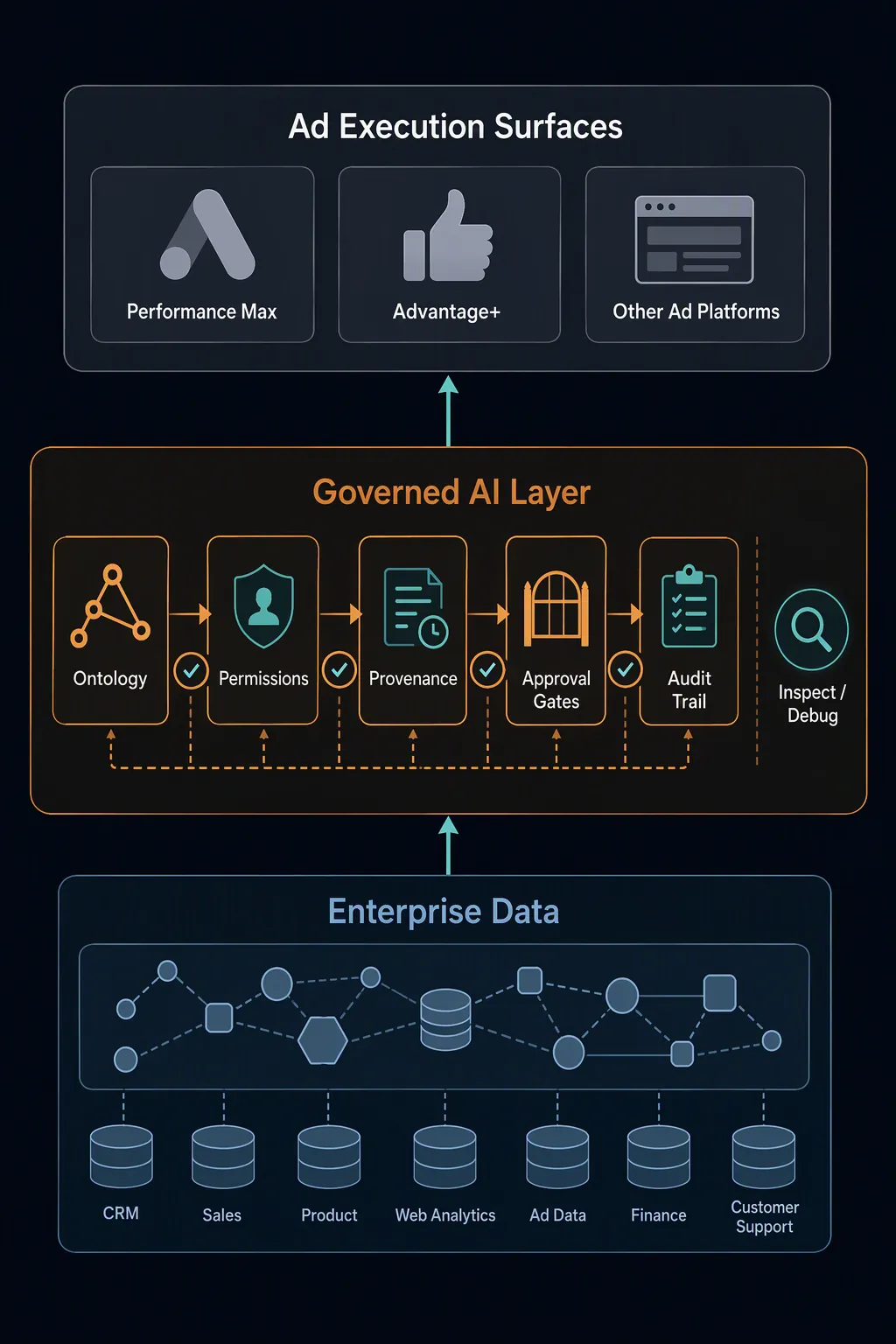
The practical value shows up in dull but important places: who can use which audience data, whether a recommendation used current margin assumptions, whether an agent skipped a required approval, whether media spend can be attributed to a specific automated workflow, and whether finance can see the cost of using different agents or models. Those are the questions that usually appear after the campaign has already spent money.
The Stagwell and Zeta signals are real, but they are not the same kind of evidence
Stagwell is the stronger operating signal today. In November 2025, Palantir and Stagwell announced work on AI-powered marketing products, with Stagwell agency Assembly already using the platform and a broader rollout planned. Stagwell CEO Mark Penn called the work “the holy grail of marketing brought to life.”[5][6] The quote is expansive, but the more important detail is that this was described as past the MVP stage, not merely a press-release concept.
For agencies, that kind of system is less about replacing the planner or trader and more about compressing the messy middle of marketing operations: pulling together client data, market context, audience definitions, budget constraints, creative status, approval rules, and performance feedback. If the system makes those steps inspectable, it addresses a workflow complaint that buyers have had for years: the work is increasingly automated, but accountability still lands on the human team.
Zeta Global is strategically important but more forward-looking. On June 23, 2026, Zeta and Palantir announced a seven-year partnership to rearchitect Zeta Data Cloud on Palantir Foundry, with a target of more than $100 million in annual revenue and Palantir supporting Zeta’s go-to-market to eligible Foundry customers.[7][8] Because the deal was announced so late in Q2, it should not be treated as a material explanation for the Aug. 3 report. It is better read as a marker of where customer-data, identity, activation, and governed AI infrastructure may be moving.
That caveat matters. A partnership target is not revenue already earned, and a data-cloud rearchitecture is not the same thing as proof that a brand’s ROAS improves next quarter. The Zeta announcement makes the advertising thesis more plausible because it connects Palantir to a marketing-data company with activation relevance. It does not prove performance outcomes.
There is already campaign-optimization proof of work
The cleanest concrete example is not a self-serve media platform. It is a Palantir campaign optimization case involving a Latin American broadcast company. Palantir says the company used Foundry to integrate more than 10 data sources, build audience forecasts and dynamic pricing models, and power an AI optimization engine that generated campaign recommendations for account executives.[9]
That case should be read carefully. It is useful because it shows the governed-data model being applied to advertising-adjacent commercial decisions: audience forecasting, pricing, recommendation generation, and account-executive workflow. It should not be stretched into a universal benchmark for digital performance media. A broadcast sales environment and a large-scale automated auction environment are different operating systems.
Still, it gives the earnings story a practical anchor. The implication is not that Palantir has invented a better bid strategy than Performance Max. The implication is that campaign optimization work can be organized around governed enterprise data and auditable recommendations before the final activation step happens elsewhere.
Why the earnings beat matters to media buyers
Media buyers should care about Palantir’s Q1 numbers only to the extent that they show enterprise demand for this kind of architecture. The Q1 beat says large commercial customers are writing checks for governed AI at scale. It does not say Palantir has an advertising segment. It does not say marketers can log into a Palantir ad-buying console. It does not say black-box ad delivery is going away.
The broader market context makes that boundary obvious. In Q1 2026, Big Tech ad revenue topped $150 billion across Google, Meta, Amazon, and Reddit, including $77 billion for Google, $55 billion for Meta, and $17 billion for Amazon.[10] Palantir is not competing for that inventory dollar in the way those companies are. Its opportunity, if the advertising thesis continues to develop, is in the governance and orchestration layer around enterprise marketing operations.
That may sound less exciting than “AI ad platform,” but it is closer to the actual pain inside large organizations. A brand can already buy automated reach. What it often cannot do well is explain how first-party data, business rules, creative approvals, model-generated recommendations, and platform outputs moved through one accountable workflow.
What to watch on Aug. 3
The Q2 report does not need to mention advertising explicitly to matter for this read. The more useful checks are commercial and operational.
- U.S. commercial revenue trajectory: Q1’s $595 million was the key demand signal, and acceleration or deceleration will shape how much weight to put on the governed-AI adoption story.[1][2]
- Bookings and large-deal momentum: the Q1 base of $1.2 billion in U.S. commercial TCV bookings and 206 deals of at least $1 million gives Q2 a high comparison point.[1][2]
- Guidance: previews point to expectations for a comfortable beat and a possible full-year guidance raise above 75%, so the tone of forward guidance may matter as much as the reported quarter.[11][12]
- Delivery capacity: rapid enterprise growth raises the practical question of whether Palantir can support deployments at the pace implied by deals with agencies, data-cloud partners, and large commercial customers.[2]
- Marketing-specific commentary: any update on Stagwell, Zeta, campaign optimization, or commercial use cases would strengthen the advertising-infrastructure read, while silence would keep the thesis inferential.
There is also a reputational filter. Agency coverage and analyst discussion have noted concerns some agencies may have about working with Palantir.[2][6] For brand-side marketers, that does not erase the operational value of governed AI, but it does affect procurement, communications, client approvals, and partner selection. Infrastructure choices are never only technical once they touch customer data and public-facing marketing.
The narrower conclusion
Palantir’s earnings beat does not mean performance marketers are about to trade Performance Max or Advantage+ for a Palantir media console. That is the wrong comparison. Google, Meta, Amazon, TikTok, and other platforms still control the inventory, auctions, signals, and delivery mechanics that buyers work with every day.
The more credible implication is that enterprise AI advertising is splitting into two layers. One layer is platform-owned optimization, where the buyer receives automated performance but limited internal visibility. The other is governed enterprise infrastructure, where brands and agencies try to make the data, rules, approvals, agent actions, costs, and recommendations around campaign execution more auditable.
Q1 validated that enterprises are funding Palantir’s governed-AI model at a meaningful scale. Stagwell shows the marketing application is already operationally relevant. Zeta shows a larger marketing-data partnership taking shape, though too recently to prove anything in Q2. The Aug. 3 report is the next dated check on whether the commercial demand behind that infrastructure read is still accelerating.
References
- Palantir (PLTR) Q1 earnings report 2026, CNBC, May 4, 2026.
- Palantir Q1 FY 2026 Revenue Beats Estimates, U.S. Demand Drives Outlook Raise, Futurum Group.
- Thinking Outside the (Black) Box, Palantir.
- Meet Performance Max, The Blackest Black Box Of All Google Ad Products, AdExchanger.
- Palantir Technologies Inc. (PLTR) and Stagwell (STGW) Join Forces to Design Product for the Future of Marketing, Stagwell, November 2025.
- A Peek Inside Stagwell’s Early AI Trials With Palantir, Adweek.
- Palantir and Zeta Global Announce Strategic Partnership, Zeta Global, June 23, 2026.
- Palantir and Zeta Global Ink 7-Year Deal Targeting $100M in Annual Revenue, Adweek.
- Campaign Optimization, Palantir.
- Big Tech Q1 2026 ad revenue AI, The Keyword.
- Palantir Earnings Set For Major Beat, Yahoo Finance.
- What To Expect From Palantir Q2 2026 Earnings, Yahoo Finance.
Built on this evidence
No Bidding tactic or Creative record currently cites this case file. Compare it against other results in Benchmarks.
Related benchmark reading
Report a corroborating or contradicting result
Seeing something different in your own account? Feed the data-integrity loop instead of leaving an open comment.