
How ARM's AI Chip Stock Surge Inflates Advertiser Costs
ARM's stock surged 270% in 2026 behind its AGI CPU launch, but the same hyperscaler build driving that growth is also pushing Meta CPMs up 20% YoY. This article traces the direct link from chip-level economics to ad platform cost inflation.
- Platform
- Meta Ads
- Campaign type
- Advantage+
- Spend range
- General
- Timeframe
- 0
- CPM
- $0
- Verdict
- loss
- Last reviewed
- 0-07-30
The uncomfortable part of ARM’s 2026 AI chip story is not that investors are excited. It is that the same infrastructure cycle behind the excitement is showing up inside media plans before it shows up as cheaper compute. ARM is up roughly 270% year to date, helped by a reported $15 billion AGI CPU revenue target, while Meta advertisers are looking at third-party benchmarks showing CPM up around 20% year over year, CPA up 38%, and CPC up 11%.[1][2]
That does not prove ARM caused anyone’s CPM increase. It would be too neat, and the ad auction is never that clean. The better read is that ARM’s stock surge and Meta’s ad inflation are both symptoms of the same buildout: hyperscalers are spending heavily on AI infrastructure, platforms are carrying higher compute and data center costs, and auction-based ad systems are one of the easiest places for those costs to be recovered.
For the broader pass-through pipeline, the useful starting point is Your Ad Costs Are Rising Because of AI Infrastructure Spending. This ARM piece narrows that argument to one semiconductor signal: if the market is rewarding CPU vendors because AI infrastructure demand is structural, advertisers should be careful about assuming that chip-level efficiency will quickly flow back into cheaper impressions.

Infrastructure Sprint As The Shared Driver
The load-bearing number is not ARM’s core count. It is the size of the AI infrastructure race. Futurum Group’s 2026 analysis puts the hyperscaler infrastructure sprint at $660 billion to $690 billion.[3] Meta alone has guided 2026 capital expenditures in the $115 billion to $145 billion range.[4]
Those numbers matter to advertisers because Meta is not funding that buildout in a vacuum. The company sells attention through an auction. When its infrastructure base gets more expensive, the pricing system already has the opacity and elasticity needed to recover costs without adding a separate “AI infrastructure fee” line item to Ads Manager.
This is why a chip stock chart can be relevant to a media buyer without turning the media buyer into a semiconductor analyst. ARM’s reported $15 billion AGI CPU target is a signal about where infrastructure buyers may spend next.[1] Meta’s capex guidance is a signal about how much cash one of the largest ad platforms expects to put into compute, data centers, and supporting infrastructure.[4] The CPM line in an ad account is where that macro story gets painfully boring.
| Signal | What It Measures | Why Advertisers Should Care |
|---|---|---|
| ARM stock up roughly 270% YTD | Investor expectations for AI infrastructure demand | Suggests the market sees compute demand as persistent, not temporary |
| $660B-$690B hyperscaler infrastructure sprint | Scale of AI infrastructure spending in 2026 | Creates the cost base that cloud and platform businesses need to fund |
| Meta 2026 capex guidance of $115B-$145B | Platform-level infrastructure commitment | Raises the probability that ad monetization remains under margin pressure |
| Meta CPM up around 20% YoY in third-party benchmarks | Advertiser-facing auction cost movement | Shows the account-level effect buyers actually have to explain |
Visible Pass-Through Pressure
The cleanest evidence for cost pressure is not a platform executive saying, “We raised CPMs because GPUs, CPUs, memory, and power got expensive.” Platforms rarely hand buyers that sentence. The evidence comes from adjacent cost layers.
Forbes, citing Raymond James data, reported memory component prices rising more than 90% per quarter in the AI infrastructure affordability squeeze.[5] Memory is not the whole ad auction, but it is part of the inference and training stack that makes AI-driven ad delivery more expensive to operate. If the input costs for serving, ranking, generating, and measuring ads keep rising, the platform has to decide whether to absorb the hit or recover it.
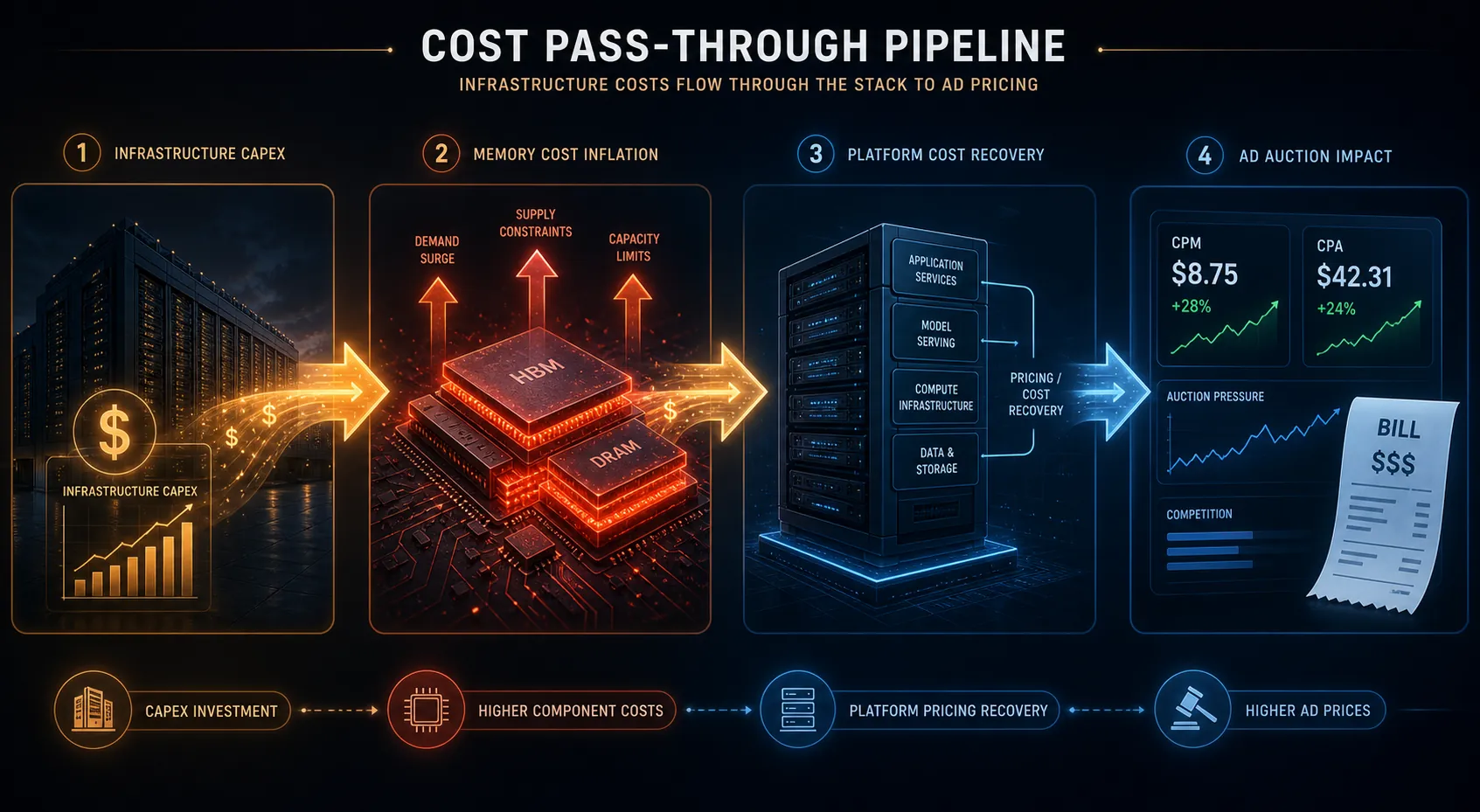
The Akamai and Fastly contrast is useful because it strips away the romance. When Akamai passed higher costs through to customers, its stock rose; when Fastly absorbed costs, its stock fell 30%.[5] That is not a Meta case study, and it should not be treated as one. It does show the operating choice infrastructure-heavy platforms face when input costs rise: protect margins by pushing costs downstream, or absorb them and take the punishment somewhere else.
Ad platforms have an even cleaner route than most infrastructure companies because pricing is already dynamic. A CDN customer may see a contract change. A Meta advertiser sees the auction clear at a higher CPM, a higher CPC, or a higher CPA, then has to decide whether the creative, audience, landing page, or budget is to blame.
Third-Party Benchmarks And Planning Reality
Ryze AI’s 2026 Meta Ads benchmark puts CPM at $14.19, up 20% year over year, with CPA up 38%.[2] Coinis data points in the same general direction, with CPC up 11%.[6] These are third-party benchmarks, not Meta’s internal global average, and no buyer should pretend they explain every account, vertical, geography, or optimization event.
Still, the direction is consistent enough to matter for budget planning. A founder does not care whether the exact platform-wide CPM is 15%, 18%, or 20% higher when the account’s blended acquisition cost has moved outside the model. The operating question is whether higher auction costs look temporary or structural.
This is where ARM becomes more than a ticker. If CPU vendors are being rewarded because agentic AI and inference workloads need more specialized infrastructure, and if Meta is guiding toward enormous capex while third-party ad costs rise, the safer budget assumption is that AI infrastructure is still a cost pressure, not yet a relief valve.
Why Investors Care About ARM
The investment case is not hard to understand at a high level. The I/O Fund’s ARM analysis frames agentic AI as a CPU bottleneck story: as AI systems move beyond isolated model calls into workflows that coordinate tools, memory, retrieval, and actions, the CPU becomes more important in the infrastructure stack.[7]
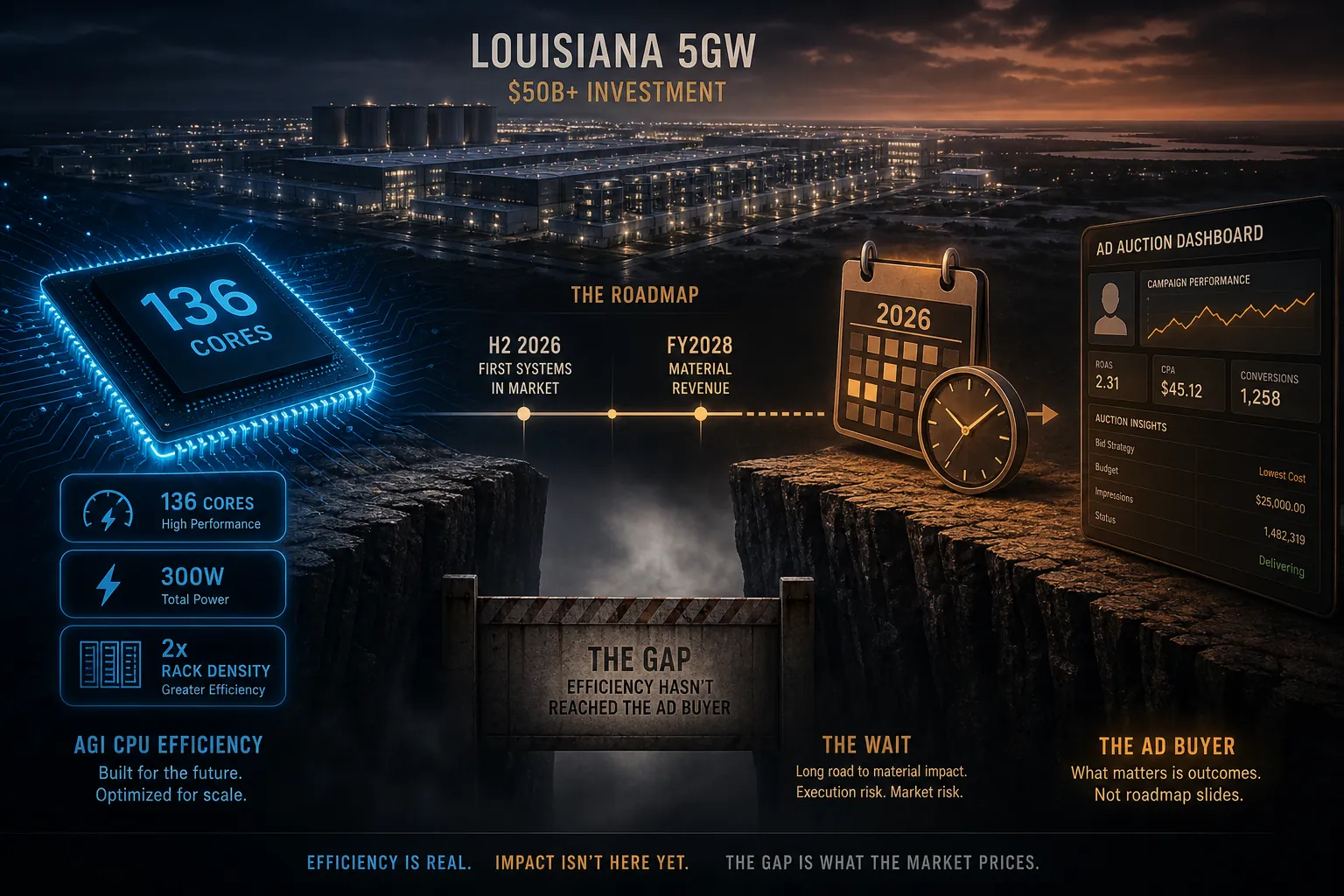
That framing makes ARM’s AGI CPU story directionally important. Tech Insider reported ARM claims around a 136-core CPU at 300 watts compared with a 500-watt x86 alternative, 2x rack density, and potential savings of $10 billion per gigawatt.[8] Those are exactly the kinds of numbers infrastructure buyers want to hear when power, space, and component costs are constraining AI expansion.
But those claims are still vendor-side performance and economics claims, not independently verified operating results across the ad platforms buyers use every day. First commercial systems are expected in the second half of 2026, and material AGI CPU revenue is not expected until FY2028.[1][8]
Launch Specs Do Not Lower Auctions Immediately
Even if ARM’s technical claims prove directionally right, the advertiser does not get the benefit when the press release lands. The sequence is longer: systems ship, hyperscalers qualify them, workloads migrate, utilization ramps, depreciation schedules keep running, and platforms decide how much of any savings they keep versus pass through.
Meta’s infrastructure scale makes the timing problem obvious. Meta’s planned Louisiana data center is described as a 5-gigawatt facility representing more than $50 billion of investment.[9] A chip-level efficiency gain can improve the economics of future capacity, but it does not erase the near-term funding requirement for facilities, power, networking, memory, and already-committed buildout.
This is the gap advertisers need to price into 2026 and 2027. ARM may lower the cost curve later. That does not mean Meta CPMs fall while the platform is still scaling AI infrastructure, buying expensive components, and defending margins in an auction where advertisers bid against each other for constrained attention.
Meta's ARM Shift: Signal, Not Guarantee
Maginative has reported on Meta’s ARM infrastructure shift, which matters because it connects the semiconductor story directly to one of the largest ad platforms.[10] The point is not that Meta adopting ARM-based infrastructure mechanically raises or lowers CPM. The point is that Meta is actively reworking its compute base for AI, and that rework sits inside the same capex envelope advertisers are indirectly exposed to.
A buyer does not need to predict which CPU architecture wins to make a budget call. The practical read is simpler: Meta is spending at infrastructure scale, chip vendors are being valued for that demand, and any efficiency dividend has to travel through platform finance before it reaches the ad auction.
Automation Complicates The Read
There is another reason not to overstate the ARM-to-CPM chain: auction behavior changed at the same time. Ryze AI reports that 78% of Meta advertisers now use Advantage+.[2] That kind of adoption means more buyers are letting Meta’s automation layer make more bidding, placement, and creative-delivery decisions.
That matters because AI automation can intensify competition for the same pockets of converting users. If many advertisers hand similar objectives to the same optimization system, the platform may become better at finding likely buyers while also making the auction more crowded around those users. Infrastructure cost pressure and automation-driven bidding pressure can arrive together, which makes pure attribution messy.
So the correct claim is narrow: ARM’s surge does not explain Meta CPM inflation by itself. It is one signal within a larger AI infrastructure cycle that also includes hyperscaler capex, memory inflation, data center power needs, platform automation, and advertiser adoption patterns.
Advertising Incentives Keep Strengthening
Axios has reported that AI companies are leaning into advertising as infrastructure costs rise.[11] That is not surprising. When the cost to train, serve, and scale AI products climbs, ad monetization becomes attractive because it converts usage into revenue without requiring every user to pay directly.
For existing ad platforms, the incentive is even clearer. Meta already has the demand side, the auction, the measurement layer, and the automation tools. If AI infrastructure spending raises the cost of running the platform, there is no obvious reason to expect Meta to pass future efficiency gains to advertisers before recovering the buildout that made those gains necessary.
That is also why Why the AI chip selloff won't lower your ad costs is the companion argument to this one. Chip stocks can fall without lowering advertiser costs, and chip stocks can surge without proving a direct CPM increase. The advertiser-facing issue is the infrastructure cost base, not the daily move in a semiconductor ticker.
How To Read ARM In A Media Plan
ARM’s 2026 surge is useful for media planning only if it is treated as a structural cost signal, not as a forecast that cheaper AI compute is around the corner. The AGI CPU specs may matter. The rack density claim may matter. The power savings may matter. The problem is timing.
- For 2026 planning, assume AI infrastructure remains a CPM headwind rather than a source of auction relief.
- For 2027 forecasts, separate platform efficiency claims from advertiser price outcomes; the platform can keep savings.
- For FY2028 and later, watch whether ARM-based systems move from announced performance claims to material deployed capacity.
- For account reviews, explain CPM inflation as a mix of infrastructure cost pressure, auction competition, and automation adoption, not a single-cause chip story.
The useful question is not whether ARM wins the AI CPU cycle. The useful question is whether the platforms funding that cycle have any reason to let the savings reach advertisers before they have recovered the buildout. Through at least FY2028, the evidence points to planning for persistence, not relief.
References
- Reuters on ARM's stock surge and $15B AGI CPU revenue target, Reuters.
- Meta Ads Benchmarks 2026, Ryze AI.
- AI Capex 2026 analysis, Futurum Group.
- Meta investor relations capital expenditure guidance, Meta Investor Relations.
- AI infrastructure affordability crisis and memory inflation, Forbes.
- Coinis Meta advertising benchmark data, Coinis.
- ARM analysis on agentic AI CPU bottlenecks, I/O Fund.
- ARM AGI CPU specifications, Tech Insider.
- Meta Louisiana data center investment, Maginative.
- Meta's ARM infrastructure shift, Maginative.
- AI companies lean into advertising as infrastructure costs rise, Axios.
Built on this evidence
No Bidding tactic or Creative record currently cites this case file. Compare it against other results in Benchmarks.
Related benchmark reading
Report a corroborating or contradicting result
Seeing something different in your own account? Feed the data-integrity loop instead of leaving an open comment.