
On-device AI's structural ceiling in mobile ad targeting
On-device AI processing imposes architectural constraints—smaller models, signal isolation, and crowd anonymity thresholds—that create a structural accuracy ceiling on mobile ad targeting. This article explains why cloud-based ML cannot be replaced and what media buyers can do about it.
- Platform
- Meta Ads
- Campaign type
- Advantage+
- Spend range
- Variable
- Timeframe
- 0-2026
- ROAS
- 0-40% lower incremental vs reported
- Verdict
- mixed result
- Industry vertical
- ecommerce
- Last reviewed
- 0-07-25
The practical question for mobile buyers in 2026 is not whether on-device AI will get better. It will. The question is whether it can see enough to replace the cloud-side pattern recognition that performance campaigns used to lean on. For targeting, the hard part is not only the model. It is the missing signal graph around the model: fewer cross-app paths, fewer user-level links, delayed feedback, and attribution thresholds that quietly reward accounts with enough volume to clear them.
That is where on-device AI's limitations in mobile advertising targeting become less like an abstract privacy debate and more like a budget allocation problem. A platform can still model, rank, and optimize. But if the system cannot connect enough behavior across apps, users, campaigns, and conversion windows, its reported efficiency can look cleaner than the real business result.

The Ceiling Is Architectural
On-device AI trades reach and compute for privacy, latency, and offline operation. That trade can be worth making for many product experiences. In ad targeting, though, it puts a ceiling on what the system can infer before the auction, and on how quickly it can learn after the conversion.
| Constraint | What changes for a buyer |
|---|---|
| Smaller models | The local model has less capacity than the cloud systems that historically absorbed broad behavioral and conversion data. |
| App-level signal isolation | Each app sees its own limited context instead of a richer cross-app behavioral trail. |
| Crowd anonymity thresholds | Granular campaign combinations may not receive fine conversion values until enough installs accumulate. |
| Delayed postbacks | Optimization waits for attribution feedback that arrives hours, days, or weeks after the user acted. |
| Cross-app blindness | The model cannot fully recover population-level patterns that depended on identifiers and shared cloud-side histories. |
The model-size gap is the easiest constraint to understand and the easiest to overstate. On-device models are commonly described as roughly 100-1000x smaller than cloud equivalents, a dimensional difference that reflects limits in memory, battery, latency, and local compute rather than a single universal benchmark.[1][2] Smaller does not mean useless. It means the local model is optimized for a narrower job under tighter constraints.
For a media buyer, the consequence is simple: do not confuse a more efficient local model with a full replacement for the cloud learner that used to connect far more events. A compact model may classify local context well. It may decide when to surface a message, summarize an interaction, or make an app experience feel faster. But targeting has historically depended on the ability to compare many users, many apps, many conversion paths, and many negative signals. That comparison layer is where privacy-preserving architecture removes surface area.
The Missing Graph Matters More Than the Local Prediction
The more important limitation is signal isolation. A phone can process information locally, but each app still operates inside a thinner permission environment than the old IDFA-driven ecosystem. Without cross-app identifiers, the ad system loses behavioral sequences that used to help it separate a likely buyer from a merely curious user.
IAB Tech Lab has described the publisher-side version of this problem as publishers “flying blind” without cross-app signals.[3] That phrase is useful because it keeps the issue grounded. The blindness is not that every individual impression becomes random. It is that the system loses a shared field of view. A shopping app, a news app, and a game may each hold fragments of intent, but those fragments no longer combine as freely into the same cloud-side pattern.
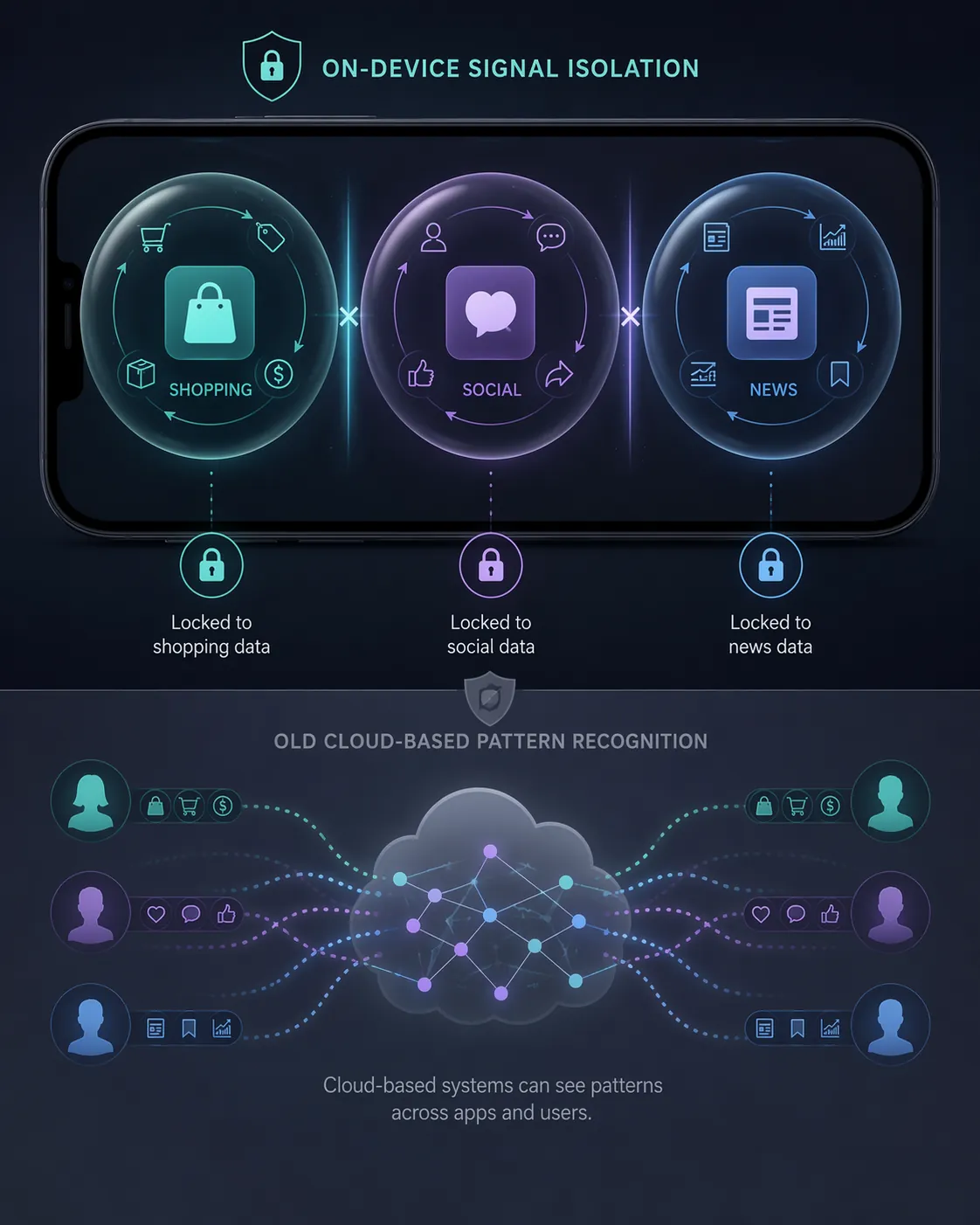
This is why better on-device inference does not automatically restore targeting accuracy. If one app knows that a user browsed a product category, the local model can use that fact inside that app. It cannot necessarily join that behavior with what the same user did elsewhere, or with cloud-scale lookalike patterns built from many users’ paths. The loss is not just a targeting input. It is a loss of relationships among inputs.
That distinction matters in account reviews. Platform language often compresses targeting, optimization, and attribution into the same promise of smarter automation. They are not the same system. Targeting decides who enters the auction or how an impression is valued. Optimization learns from conversion feedback. Attribution decides which touchpoint receives credit. On-device AI can contribute to all three, but the constraints around each one are different. A clean local prediction cannot fix a weak conversion feed, and a stronger conversion feed cannot fully recreate cross-app behavioral history.
SKAN Turns Privacy Thresholds Into Buying Pressure
SKAdNetwork makes the ceiling visible in a place buyers can feel: campaign structure. Fine conversion values are not simply available because a campaign exists. Industry research citing Singular’s work estimates that SKAN crowd anonymity commonly requires roughly 25-50 installs per campaign combination before fine conversion values return.[4] Apple does not disclose that threshold as a fixed public number, so it should be treated as an industry estimate, not a platform guarantee.
The operational effect is still real. A high-volume campaign can reach usable feedback faster. A smaller advertiser, or a larger advertiser that splits budget across too many countries, creatives, audiences, ad sets, and conversion mappings, may sit below the threshold long enough to lose fine-grained learning. The system then optimizes on coarser signals, delayed signals, or modeled signals that finance may not recognize when the month closes.
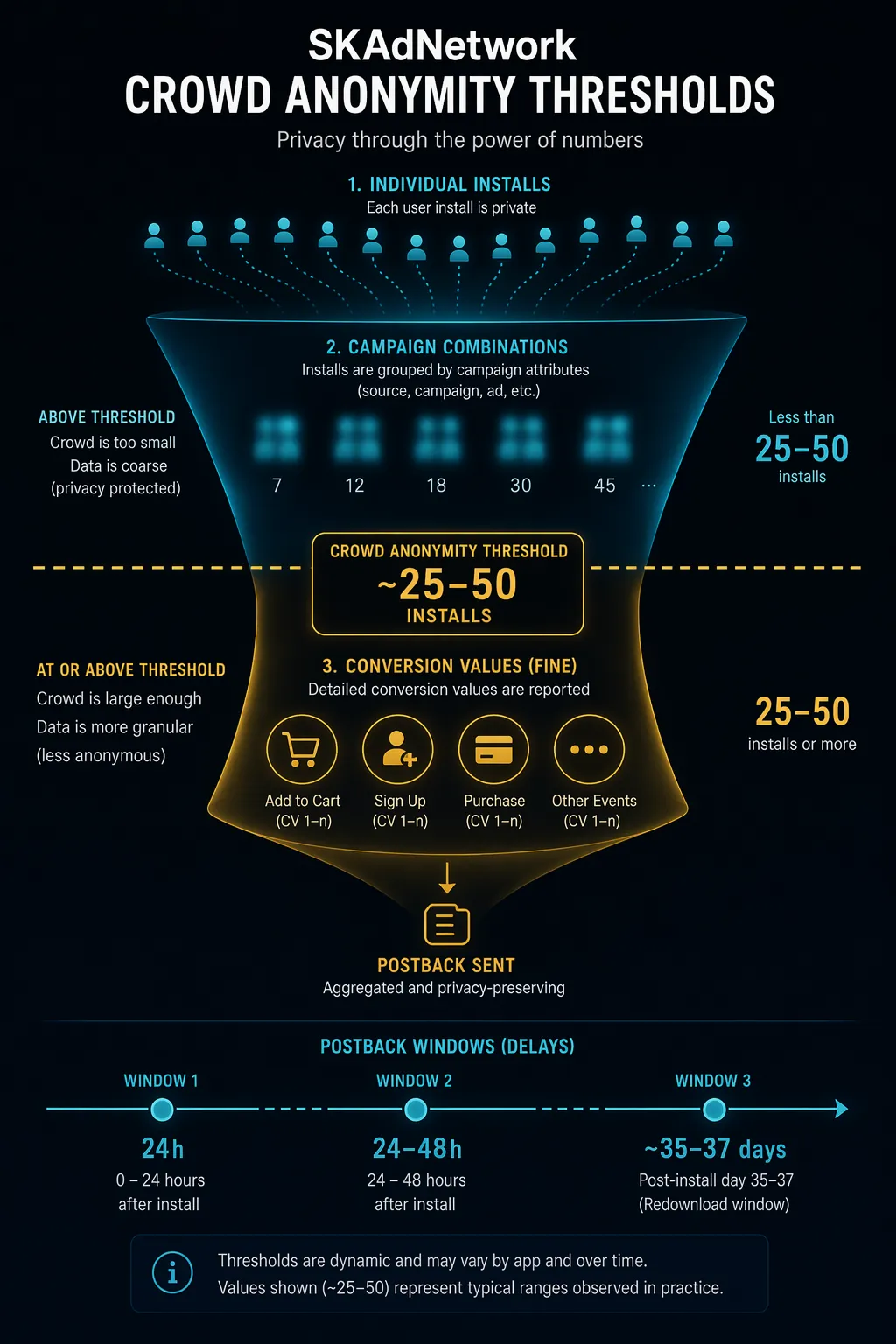
This is where privacy architecture creates a bias toward scale. The account with enough spend can consolidate, clear thresholds, and feed the model. The account trying to learn five markets, three creative angles, two optimization events, and several campaign objectives on a modest budget may never give the system a stable read. The buyer may think she is testing rigorously. The attribution layer sees sparse cells.
Postback delay extends the same problem into time. SKAN postbacks arrive with a 24-48 hour delay per window, and window 3 postbacks can arrive roughly 35-37 days after install.[4] That is not just inconvenient reporting latency. It slows the learning loop. Creative fatigue, bid changes, seasonality, and promo timing can all move before the cleanest signal arrives.
A buyer can still operate inside that system, but the account has to respect its physics. If the conversion signal arrives late and only clears detail at sufficient volume, then over-segmentation is not sophistication. It is a way to starve the learner and then blame the model for failing.
Market Evidence Has Caught Up With the Dashboard Problem
The commercial record after ATT is messy because platforms adapted. Meta said Apple’s iOS privacy changes would cost it about $10 billion in 2022 revenue, but that figure should not be read as a permanent loss curve; Meta later invested heavily in AI-driven optimization and server-side signal recovery.[5] The lesson is not that advertising stopped working. It is that the old signal architecture was valuable enough that losing it forced one of the largest ad platforms in the world into a multi-year repair job.
ATT opt-in rates also argue against any easy return to the pre-ATT graph. A five-year retrospective from AdLibrary reports that ATT opt-in rates stabilized around 25% globally, with major vertical differences: gaming around 15% and finance around 38%.[6] Those are attitude-and-permission outcomes, not direct performance outcomes. Still, they define the signal pool that ad systems can lawfully and technically use.
Google’s Privacy Sandbox reversal adds another caution. Google ended its Privacy Sandbox initiative in October 2025 after low adoption and regulatory pressure, while Criteo had estimated that publishers could face substantial revenue declines under the proposals.[7] That does not mean privacy-preserving advertising will disappear. Apple’s SKAN successor path and regulatory pressure in major markets keep the same constraint direction alive. It does mean the industry has struggled to turn privacy-preserving replacements into systems that all sides trust commercially.
Vendor-side material points in the same direction, although it needs to be read carefully. Verve argues that on-device cohorts need “data enrichment beyond basic demographics, device characteristics, and behavioral data” to be effective.[8] That is partly a product argument, but it also admits the core issue: basic local or cohort-level signals do not automatically carry enough commercial meaning for high-confidence targeting.
Reported ROAS Can Survive Signal Loss Better Than Incrementality
The most dangerous version of this problem is not a campaign that obviously fails. It is a campaign whose platform-reported ROAS looks acceptable while blended revenue, holdout results, or incrementality tell a weaker story. Wevion reports that incremental ROAS is often 20-40% lower than reported ROAS because machine-learning systems may claim credit for conversions that would have happened organically.[9]
That claim should not be treated as a universal law for every account. It is a warning about measurement incentives. A platform model can be excellent at finding users who are likely to convert and still overstate the lift created by the ad. When cross-app signals disappear and attribution windows become delayed or aggregated, the gap between “the platform found a converter” and “the spend caused incremental revenue” deserves more scrutiny, not less.
This is also why server-side measurement quality has become a performance input, not a back-office hygiene task. AdLibrary’s 2026 ATT retrospective describes a CAPI match rate below 60% as a “measurement emergency” and a match rate above 80% as table stakes.[6] Those thresholds do not make attribution perfect. They decide whether the platform is learning from a tolerable representation of conversions or from a badly distorted feed.
There is a practical difference between imperfect and broken. Imperfect means the buyer uses modeled reporting, delayed postbacks, and incrementality checks with the right skepticism. Broken means purchase events are missing, deduplication is unreliable, value mapping is inconsistent, and the algorithm is being asked to optimize toward a business outcome it cannot see. On-device AI does not rescue the second condition.
What Buyers Can Actually Change
The operating response is not to reject automation. It is to stop asking automation to compensate for structural blindness. Campaign architecture, measurement plumbing, and finance-side validation have to do more work than they did when user-level identifiers and faster feedback were easier to access.
- Consolidate where volume is too thin: if campaign combinations cannot clear anonymity thresholds, fewer cells may produce more usable learning than a more granular test plan.
- Protect conversion feed quality: prioritize server-side events, deduplication, value mapping, and match-rate monitoring before making creative or bid changes the default explanation.
- Separate targeting from attribution: a model may find likely buyers while the reporting layer still overcredits the media that reached them.
- Compare platform ROAS with incrementality and blended revenue: use platform reporting as an optimization interface, not as the final financial truth.
- Treat on-device signals as constrained inputs: use their privacy, latency, and offline advantages where they help, but do not assume they recreate cloud-scale cross-user learning.
The accounts most exposed to this ceiling are usually not the ones with the most sophisticated slides. They are the ones with just enough budget to fragment, not enough volume to recover, and enough reported ROAS to postpone the uncomfortable reconciliation. In Q3 2026, the cleaner answer is to build around the constraint: fewer underpowered splits, stronger first-party and server-side signals, slower interpretation of delayed feedback, and more skepticism when platform efficiency does not show up in incremental revenue.
References
- On-Device AI vs Cloud AI Economics, MindStudio, https://www.mindstudio.ai/blog/on-device-ai-vs-cloud-ai-economics
- On-Device AI: Building Smarter, Faster, More Private Applications, Smashing Magazine, 2025, https://www.smashingmagazine.com/2025/01/on-device-ai-building-smarter-faster-private-applications/
- Beyond the Hype: Why On-Device AI Is Ad Tech’s Untapped Frontier for Publishers, IAB Tech Lab, https://iabtechlab.com/beyond-the-hype-why-on-device-ai-is-ad-techs-untapped-frontier-for-publishers/
- SKAdNetwork Explained, AdLibrary, https://adlibrary.com/posts/skadnetwork
- Facebook says Apple iOS privacy change will cost $10 billion this year, CNBC, 2022, https://www.cnbc.com/2022/02/02/facebook-says-apple-ios-privacy-change-will-cost-10-billion-this-year.html
- iOS 14 ATT Five-Year Retrospective, AdLibrary, 2026, https://adlibrary.com/posts/ios-14-att
- Google Privacy Sandbox Is Dead, Usercentrics, https://usercentrics.com/knowledge-hub/what-is-google-privacy-sandbox/
- 5 Ways Advertisers Can Target Mobile Audiences Without Cookies, Verve, https://verve.com/blog/mobile-targeting-without-cookies/
- Machine Learning Ad Targeting Explained, Wevion, 2026, https://wevion.ai/en/blog/machine-learning-ad-targeting-explained/
Built on this evidence
No Bidding tactic or Creative record currently cites this case file. Compare it against other results in Benchmarks.
Related benchmark reading
Report a corroborating or contradicting result
Seeing something different in your own account? Feed the data-integrity loop instead of leaving an open comment.