
Samsung Fold 8 Amazon Trade-In Ads Drove 187% Sales Lift
Samsung's Amazon Ads case study shows how Sponsored Brands Reserve SOV and a $350 gift card converted shoppers on a $1,899+ device, achieving 187% sales lift in a low-CVR category.
- Platform
- Amazon Ads
- Campaign type
- Sponsored Brands Reserve SOV
- Spend range
- High
- Timeframe
- 0 launch campaign
- Sales lift
- 0%
- Verdict
- win
- Industry vertical
- Electronics
- Last reviewed
- 0-07-30
The useful number in Samsung’s Amazon Ads case study is not the headline sales lift by itself. It is the move from 44.9% to 99.8% top-of-search impression share on brand search terms after using Sponsored Brands Reserve SOV. In the same Samsung US case study, Amazon reported a 187% increase in sales from clicks and a conversion-rate move from 13.2% to 14.3%.[1] That is a launch-window media result worth filing, with one important boundary: the case study was published in 2025 and should be treated as a Samsung/Amazon launch benchmark, not as proof that the current Galaxy Z Fold 8 Amazon pre-order offer stack will reproduce the same lift.
The result is still directly relevant to a Fold 8-style launch because the paid-media problem is the same: a premium Samsung device, short pre-order demand, expensive attention, and a shopper who may already know the brand but has not yet accepted the checkout math. For a $1,899+ foldable, the ad does not need to introduce Samsung. It needs to keep Samsung’s own listing in the first commercial position while the buyer is deciding whether Amazon, Samsung direct, a carrier, or no purchase at all gets the order.
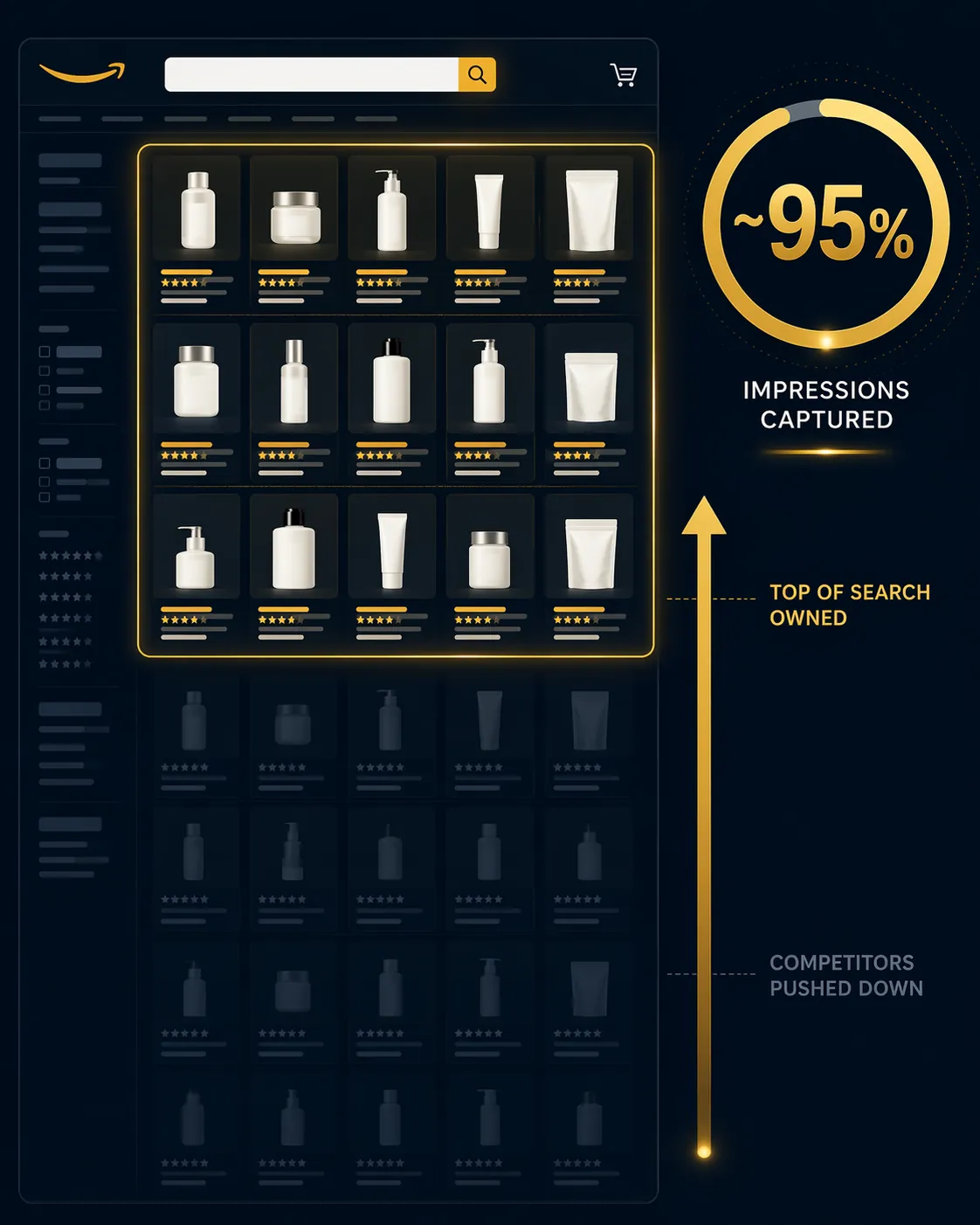
What Reserve SOV Actually Bought
Sponsored Brands Reserve SOV is most interesting when brand demand is already forming. In that environment, the question is not whether shoppers will search. They will. The question is how much of the first screen the brand can reserve before competitors, marketplaces, and alternative offers turn that demand into comparison shopping.
Samsung’s reported 99.8% top-of-search impression share matters because top-of-search is where pre-order intent can still be steered. A shopper searching a Samsung launch term is not equivalent to a cold prospect scrolling a feed. They have already supplied intent. Reserve SOV turns that intent into a cleaner auction environment: fewer visible exits, less competitor oxygen, and a shorter path from query to product detail page.
| Metric | Before Reserve SOV | After Reserve SOV | Why it matters |
|---|---|---|---|
| Top-of-search impression share | 44.9% | 99.8% | The brand nearly eliminated top-of-search leakage on brand terms. |
| Sales from clicks | Baseline | +187% | Amazon attributed materially higher sales to the click path. |
| Conversion rate | 13.2% | 14.3% | The lift was modest in percentage points but meaningful against a high-ASP purchase. |
The conversion-rate movement is easy to underrate. A move from 13.2% to 14.3% is only 1.1 percentage points, but on an ultra-high-ASP product it can carry more revenue weight than a much larger relative CVR move on a low-ticket accessory. The sales lift came from the full system: impression capture, click volume, offer framing, and the fact that the shopper had a reason to complete the purchase inside Amazon instead of moving elsewhere.
The Category Benchmark Is Useful, Then Immediately Too Blunt
Triple Whale’s 2025 full-year Amazon benchmarks put Electronics at a 4.60% median conversion rate, a $25.08 CPA, 3.98 ROAS, $104.48 AOV, 0.62% CTR, and $8.34 CPM. The same benchmark set reported Amazon platform CPM rising 47.46% year over year, from $5.30 to $7.82, with Electronics sitting above that platform average.[2]
Those figures set the headwind, not the forecast. A $104.48 Electronics AOV does not describe a $1,899+ Fold buyer. It mixes very different products into the same category bucket: cables, accessories, small devices, midrange electronics, and premium hardware. If anything, the median makes the Fold 8 job look cleaner than it is. The real purchase has a larger cash commitment, more financing friction, more retailer comparison, and more temptation to wait for carrier or trade-in math to improve.
That is why the Amazon case is valuable without being portable. It gives buyers a hard campaign result in a category where public benchmarks are too broad for launch planning. It does not say that any electronics SKU can buy 99.8% top-of-search coverage and expect a 187% sales lift. It says Samsung, in a US Amazon launch context, turned reserved search real estate into a measurable click-to-sales gain.[1]
The $350 Gift Card Is an Offer Mechanic, Not a Price Cut
The live July 2026 Fold 8 offer stack explains why Amazon is a credible place for this kind of ad pressure. Amazon’s pre-order offer was reported as a $350 unrestricted gift card plus up to $600 in trade-in value.[3] TechTimes framed the same no-trade-in comparison as Amazon’s $350 value against roughly $330 in combined Samsung-direct value for buyers without a device to trade.[4]
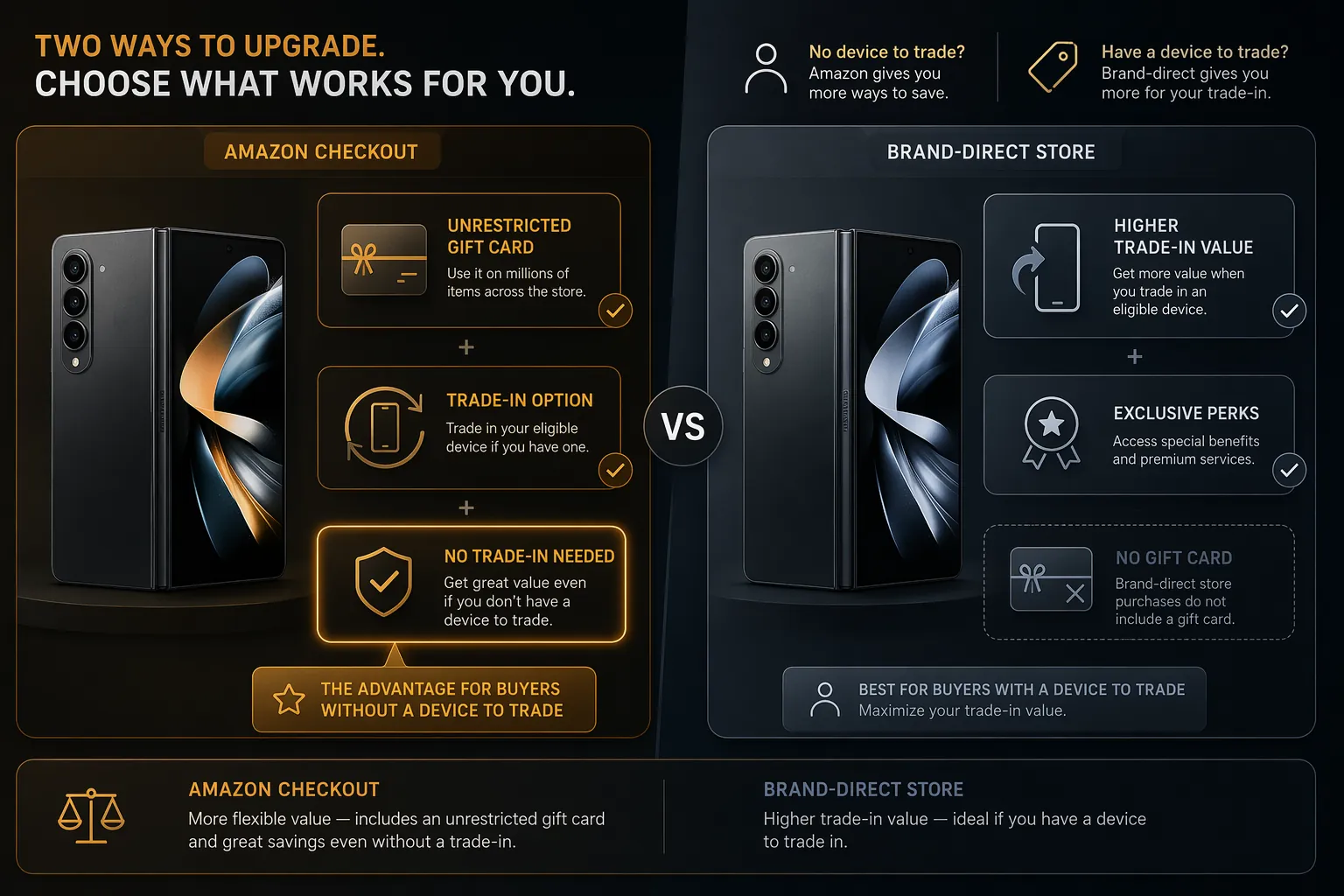
That difference matters because the gift card does not require Samsung to visibly cut MSRP. The product can still sit at premium launch pricing while Amazon gives the shopper a separate, spendable asset. For the buyer, the perceived risk changes: the phone is still expensive, but part of the commitment comes back as flexible Amazon value rather than a narrower ecosystem credit.
Samsung direct still had the stronger trade-in ceiling in the July 2026 stack: reports cited up to $1,200 trade-in value, $200 Samsung credit, PAYPAL100, and a $30 reservation credit.[3][4] That is the better headline for a buyer holding an eligible high-value device. It is less clean for the no-trade-in buyer, which is exactly where Amazon’s unrestricted $350 card becomes operationally useful.
In media terms, the gift card gives the reserved search placement something concrete to close with. The ad does not have to argue that the Fold 8 is cheap. It has to make Amazon the easiest acceptable place to buy during the pre-order window. For shoppers who cannot or will not trade in a qualifying device, an unrestricted gift card is a cleaner nudge than a higher theoretical trade-in number they cannot use.
Why the Pre-Order Window Changes the Math
Reserve SOV is easier to defend when the buying window is short. In always-on campaigns, missed impressions can sometimes be recovered later. In a pre-order week, demand is compressed. A buyer who leaves Amazon to compare Samsung direct, a carrier, or a tech publisher’s deal post may not return through the same paid path.
That compression also changes how CPM inflation should be read. Triple Whale’s reported platform CPM increase and Electronics’ above-average $8.34 CPM make cheap reach unlikely.[2] But a launch buyer is not buying generic reach. They are buying protection around a known demand spike. The relevant waste question is not simply whether CPM is high; it is whether the brand can afford to let high-intent branded searches fragment across competing offers.
This is where Samsung’s 44.9% baseline impression share is revealing. The brand already had meaningful presence before Reserve SOV. The campaign did not rescue an invisible launch. It closed a gap. Moving from roughly half of top-of-search impressions to nearly all of them is a different media decision from trying to manufacture demand from zero.
Do Not Average the Benchmarks Into a Fake Planning Number
The public benchmark sets do not agree tightly enough to support a single clean Electronics planning model. Ad Badger’s 2026 Amazon advertising benchmarks report Electronics CPC at $1.45, CVR at 9.5%, and ACOS at 29%.[5] Skale Strategy’s 2026 benchmark article reports Electronics CPC in a $0.75 to $1.20 range and ACOS from 12% to 20%.[6]
Those differences are not a rounding problem. They likely reflect different account mixes, samples, management styles, and category definitions. Blending them into an average would create a number that looks more precise while becoming less useful. For a Fold 8-tier launch, the planner should use those benchmarks as guardrails around auction pressure and category volatility, then anchor the actual launch argument on more specific evidence: Samsung’s own Reserve SOV result and the current offer structure.
There is also an attribution boundary. Amazon-reported conversion rate and sales from clicks are platform campaign metrics. They are the right metrics for judging the Amazon Ads case, but they do not automatically settle full unit economics once gift card cost, trade-in exposure, inventory, margin, and cross-retailer cannibalization are included. That distinction matters most when ROAS looks stable while the true economics of an incentive-heavy launch move underneath it, a problem that shows up in broader discussions of ad attribution inflation.
What a Media Buyer Can Actually Take From the Case
The defensible lesson is narrower than the headline. Samsung’s case supports Reserve SOV as a launch-window tactic when three conditions line up: branded search demand is already forming, the product has enough ASP to make incremental conversion valuable, and the retailer offer gives shoppers a reason to finish the purchase on that surface.
- Use Reserve SOV to protect high-intent launch queries, not to pretend every generic category query is equally close to purchase.
- Separate trade-in buyers from no-trade-in buyers when evaluating offer strength; the best headline discount may not be the best conversion lever for every shopper.
- Treat category CVR and CPA medians as context, not as a forecast for a $1,899+ handset.
- Read Amazon-reported sales lift alongside incentive cost and channel cannibalization, especially when a gift card is part of the close.
The Fold 8 promotional stack gives the Samsung/Amazon mechanism a current reason to matter. Samsung direct can win the trade-in-maximizer. Amazon can win the buyer who values an unrestricted $350 card and a familiar checkout more than a larger conditional trade-in ceiling. Reserve SOV makes that Amazon option harder to miss at the moment the shopper is already searching.

For ultra-high-ASP electronics launches, Reserve SOV can be worth defending when brand-search demand is time-constrained and the offer gives shoppers a non-MSRP reason to act. Samsung’s 187% lift is a strong benchmark for that setup. It should stay in the benchmark file as a Samsung/Amazon launch-window result, not be promoted into a portable forecast for every premium electronics launch.
References
- Samsung achieves 99.8% top-of-search impression share with Sponsored Brands reserve share of voice, Amazon Ads
- Amazon Ads Benchmarks by Industry (Updated Data), Triple Whale, updated March 2026
- This is the best Galaxy Z Fold 8 deal, 9to5Google, July 29, 2026
- Amazon Outbids Samsung on Galaxy Z Fold 8 for No-Trade-In Buyers: $350 vs $330, TechTimes, July 28, 2026
- Amazon Advertising Benchmarks 2026: Stats Every Seller Needs, Ad Badger, 2026
- Amazon Advertising Benchmarks 2026: ACOS, CPC, and ROAS by Category, Skale Strategy, 2026
Built on this evidence
No Bidding tactic or Creative record currently cites this case file. Compare it against other results in Benchmarks.
Related benchmark reading
Report a corroborating or contradicting result
Seeing something different in your own account? Feed the data-integrity loop instead of leaving an open comment.