
Advantest Stock Surge Signals Trouble for AI Ad Attribution
When ad platforms report stable ROAS but your new-customer CAC is climbing, attribution inflation may be the cause. Advantest's record earnings signal that the AI compute ramp powering this inflation is accelerating, not peaking — here's why the gap will widen and how to measure around it.
- Platform
- Meta Ads
- Bid strategy
- Advantage+
- Last reviewed
- 0-07-29
No specific Benchmarks record is cited for this tactic yet — treat it as directional, not evidence-backed.
The uncomfortable meeting does not start with Advantest's stock chart. It starts with a familiar dashboard split: Meta says ROAS is holding, the campaign team says Advantage+ is doing its job, and finance is looking at new-customer CAC that no longer behaves like a healthy channel.
That contradiction is the useful entry point for the ad-tech implication of Advantest's AI-demand surge. The semiconductor signal matters because ad platforms are not just media marketplaces anymore. They are compute-heavy prediction systems that decide who gets shown an ad, which conversion paths count, how much modeled lift appears in the interface, and how confidently the platform credits itself after the fact.

The danger is not that AI bidding is fake. Plenty of automated campaigns clear real business metrics. The danger is that the same systems that improve prediction can also make attribution more elastic. With more compute, a platform can evaluate more paths, model more missing events, identify more assisted conversions, and extend credit across fuzzier journeys. That may improve optimization. It may also make reported ROAS look calmer than the cash economics underneath it.
The ROAS-CAC Gap Is Already Showing Up
The strongest marketing evidence here is not a theory about chip testers. It is the mismatch between platform reporting and independent performance reads.
Pixis cites an analysis of 55,000 Meta campaigns in which new-customer CAC on Advantage+ more than doubled from $257 in May 2024 to $528 in May 2025, while Meta's reported ROAS stayed at $4.52. The same Pixis article cites Haus results from 640 incrementality tests indicating that Advantage+ campaigns underperformed manual campaigns over time despite strong platform-reported ROAS.[1]
Source attribution matters here. These are Pixis-cited findings, not a directly reviewed original dataset inside this article. They should not be treated as a universal law of Meta buying. But they describe the exact failure mode many senior buyers recognize: the platform interface remains defensible while the business ledger gets worse.
| Signal | What the platform view can say | What the business view may show |
|---|---|---|
| Reported ROAS | Stable or strong | May not reflect marginal new demand |
| New-customer CAC | Often secondary inside the buying UI | Can rise even when platform ROAS is flat |
| Incrementality | Modeled or inferred by the platform | Needs holdouts or non-platform testing |
| Campaign automation | Optimizing toward available signals | Can scale credit faster than profit |
This is why a platform-side ROAS explanation is not enough. If Advantage+ reports a stable return while new-customer CAC doubles, the buyer does not need a philosophical debate about whether AI is good. They need to know whether the campaign is finding incremental customers or getting better at attaching itself to customers who would have arrived anyway.
Why Advantest Belongs in a Media-Buying Conversation
Advantest does not sell ad attribution software. It sells semiconductor test equipment. The connection to ad tech is therefore not a measured one-step pipeline from tester orders to inflated ROAS. It is a synthesis across infrastructure signals: AI chip demand, hyperscaler spending, platform model capacity, and the incentives of self-attributing ad systems.
Still, the Advantest numbers are hard to ignore because they sit upstream of the compute layer. Advantest reported FY25 revenue of ¥1.13 trillion, up 44.7% year over year, with operating margin expanding to 44.2%. Its SoC tester sales rose 74.3% to ¥767 billion, and the company was described as holding roughly 65% share in SoC testers.[2][3]
Capacity is the more operational signal. The company has been scaling from 3,000 test units toward 5,000, with a path toward 10,000 units, while projecting the SoC tester market to grow from $6.9 billion in CY2025 to $8.7 billion–$9.5 billion in CY2026.[2][3]
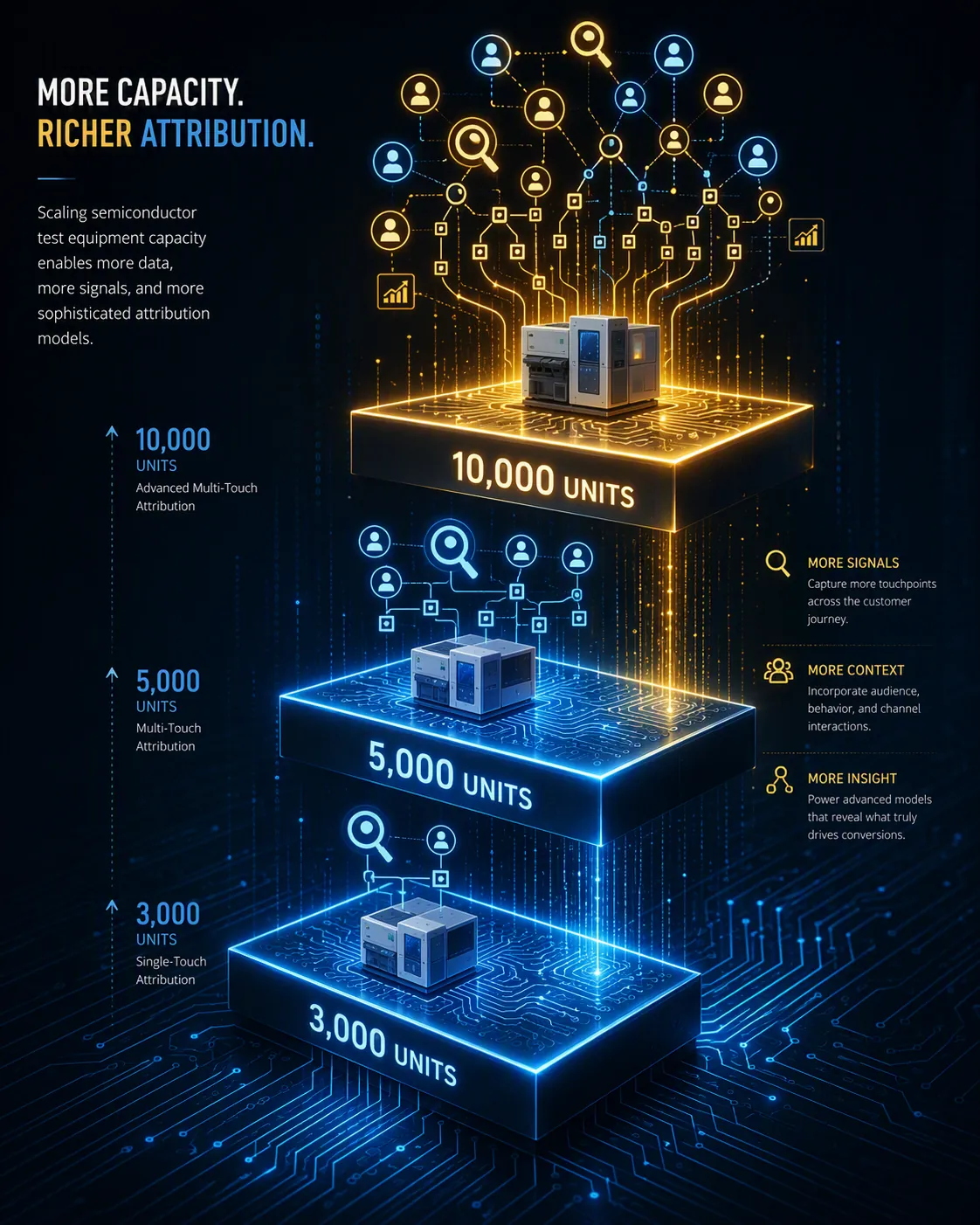
The market reaction was loud, but it is not the main evidence. CNBC reported that Advantest had reached about $52 billion in market value, with the stock up roughly 450% year over year and a 300% gain in FY25 alone.[4] For a media operator, the practical read is simpler: the supply chain that tests advanced AI chips is not behaving like a cycle that has already exhausted itself.
That matters because ad platforms consume the same broad AI infrastructure wave. Hyperscaler spending estimates point in the same direction: ValueAddVC described a $725 billion Big Tech AI capex race for 2026, including Meta at $115 billion–$145 billion and Amazon at about $200 billion, while Yahoo Finance reported that Big Tech was set to spend $650 billion in 2026 as AI investments continued to rise.[5][6]
Those capex figures do not prove that a specific Meta attribution model changed on a specific date. Data center buildouts, chip availability, internal allocation, and model deployment all sit between the spending announcement and the ad account. But they do show that the environment around automated bidding and measurement is becoming more compute-abundant, not more constrained.
That is the same infrastructure layer discussed in How Hochul's Data Center Moratorium Impacts AI Ad Performance: when compute is scarce, platforms must ration scoring and modeling; when compute becomes abundant, they can evaluate more auctions, more creative variants, more user paths, and more modeled outcomes.
More Compute Makes Attribution More Flexible
The old version of attribution was easier to argue with because it was visibly crude. A click happened, a cookie existed, a purchase appeared inside a window, and the platform took credit. It was incomplete, but the mechanism was legible.
The newer version is harder to audit. Platforms can combine observed events, modeled conversions, probabilistic identity, creative engagement, audience similarity, conversion API data, and path-level prediction. More compute gives those systems more room to search for weak signals and attach value to interactions that were previously ignored or too expensive to score.
In practice, that can change several things a buyer sees:
- More assisted conversions can be identified after the fact, especially when a user has multiple platform touches.
- Longer or less direct paths can receive more modeled credit, even when the purchase intent formed elsewhere.
- Campaigns can optimize toward signals that correlate with conversion without proving the campaign caused the conversion.
- Reported ROAS can remain stable while marginal new-customer economics deteriorate.
None of this requires a platform to falsify data. Attribution inflation can emerge from generous rules, incomplete counterfactuals, and models trained to value signals inside the platform's own observable universe. The more paths a system can evaluate, the more chances it has to find a defensible reason to claim influence.
There are other explanations for rising CAC, and they should stay on the table. Auction pressure can increase. Inventory mix can shift. Platform pricing can change. Demand quality can deteriorate. Creative fatigue can hide inside an automated structure. The attribution warning does not erase those explanations; it explains why the platform's reported ROAS may fail to expose them quickly enough.
The Search Versus PMax Clue
The Pixis-cited comparison between B2B Search and Performance Max is useful because it strips the argument down to attribution complexity. In that article, B2B Search campaigns are described as outperforming PMax on ROAS, 553% versus 436%.[1]
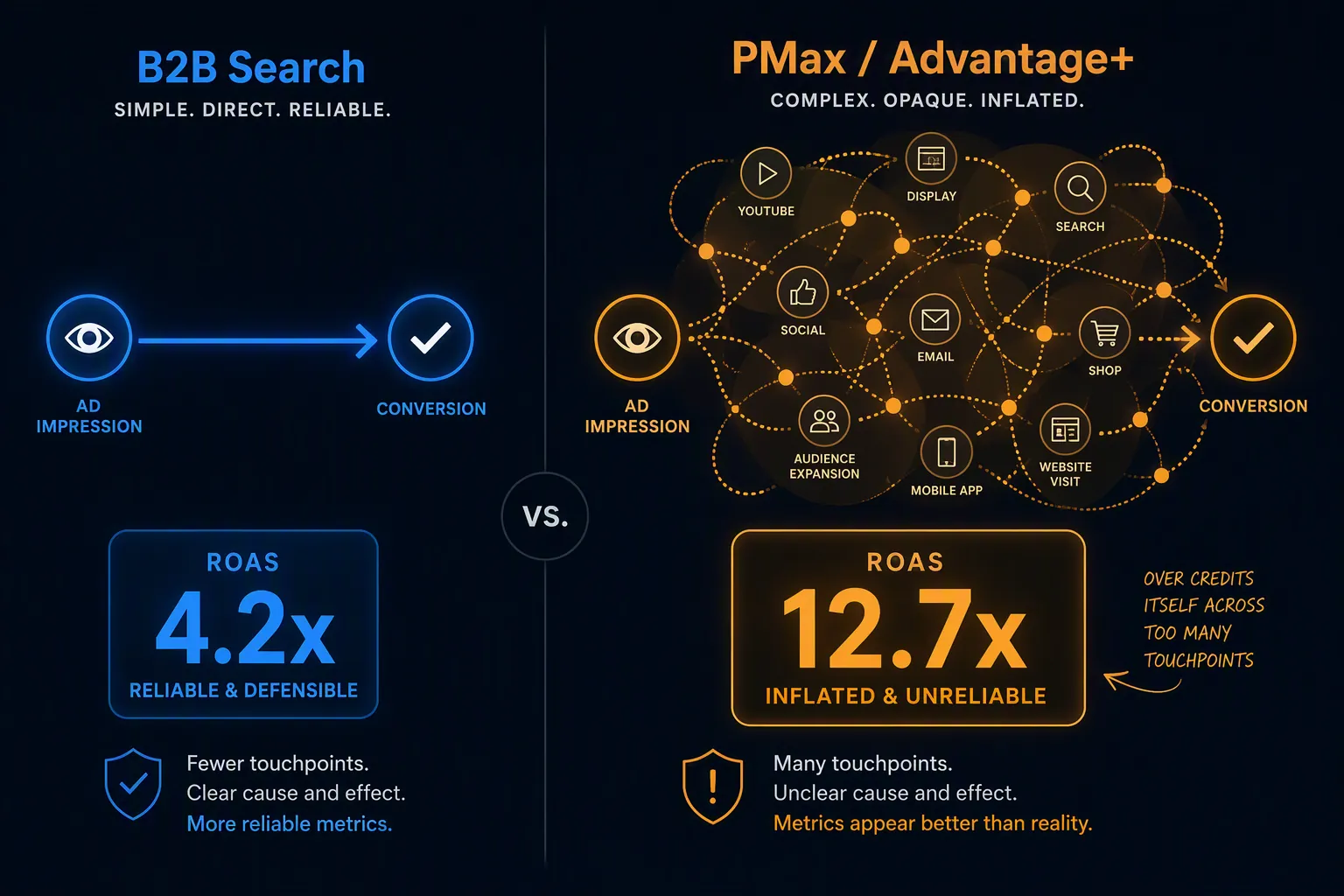
That does not mean Search is always better than PMax. It means the measurement surface is cleaner. A high-intent query creates a shorter line between user intent, ad exposure, and conversion. PMax and Advantage+ operate across more placements, more inferred audiences, and more modeled touchpoints. The broader the system, the more opportunities it has to optimize well — and the more opportunities it has to overcredit itself.
For a B2B buyer, that distinction matters. If branded or high-intent Search is carrying demand that already exists, PMax may still report attractive returns by surrounding the same users. If Advantage+ finds users who were already warmed by email, organic search, affiliates, or offline sales, the campaign can look efficient inside Meta while adding less incremental revenue than the dashboard implies.
How to Measure Around the Inflation Risk
The operating response is not to turn off AI campaigns because Advantest is selling more testers. That would confuse an infrastructure signal with a campaign diagnosis. The response is to stop letting platform ROAS be the final judge of automated media.
The first control is new-customer CAC outside the platform UI. Define the customer cohort before the campaign starts, keep the definition stable, and reconcile spend against customers the business can identify as new. If the platform reports steady ROAS while new-customer CAC rises, the campaign has to earn its budget through another metric, not through the interface's blended return.
The second control is incrementality. Holdout tests, geo tests, conversion lift studies, and matched-market designs all have tradeoffs, but they answer the question the platform interface usually avoids: what would have happened without the spend? A perfect test is rare. A recurring imperfect test is still better than treating self-attribution as neutral.
The third control is channel contrast. Keep a clean read on simpler intent channels, especially Search segments where query intent and conversion path are easier to inspect. If PMax or Advantage+ improves reported efficiency while Search, direct, and total new customers do not move in the same direction, the automation may be redistributing credit rather than creating demand.
- Track platform ROAS and blended MER, but do not let either replace cohort-level CAC.
- Separate new customers from returning customers before evaluating automated campaign scale.
- Run incrementality tests on a cadence, not only after performance becomes suspicious.
- Compare automated campaign gains against Search, direct, CRM, and total revenue movement.
- Treat platform lift claims as inputs for investigation, not as closing evidence.
This is also where finance and media teams need the same vocabulary. A buyer may be right that Advantage+ is finding cheaper attributed conversions. Finance may be right that the company is paying more for each real new customer. Both statements can be true when attribution expands faster than incrementality.
The Practical Read on Advantest
Advantest's surge does not predict tomorrow's Meta ROAS. It does not prove that every automated campaign is overcredited. It does not isolate attribution from auction pressure, pricing, creative quality, or inventory changes.
It does show that the AI hardware cycle underneath platform automation is still expanding. Record FY25 revenue, wider margins, fast-growing SoC tester sales, rising tester capacity, and a larger CY2026 SoC tester market projection all point to more AI infrastructure moving through the system.[2][3] The hyperscaler capex cycle points in the same broad direction.[5][6]
For media buyers, the conclusion is operational: keep using AI campaigns when they clear business metrics outside the ad account, but stop treating platform ROAS as sufficient evidence. As compute capacity expands, independent incrementality testing, new-customer CAC tracking, and non-platform measurement become the baseline cost of running automated campaigns.
References
- Advantage+ vs. Performance Max Head-to-Head (2026), Pixis
- Advantest FY25 slides: record margins as AI testing demand surges, Investing.com
- Advantest rises with the AI tide, RCR Wireless, 2026-01-30
- Advantest shares jump as much as 14% as AI chip boom drives record sales, CNBC, 2026-01-29
- Big Tech's $725B AI Capex in 2026, ValueAddVC
- Big Tech set to spend $650 billion in 2026, Yahoo Finance