
Testing Google's Rambler Dictation for Ad Creative
Google's Gboard Rambler cleans filler words from casual speech, but ad copy media buyers face character limits, brand-name accuracy issues, and a restrictive hardware gate that make it more suitable for brainstorming than production copy. We break down what Rambler actually does, where it falls short, and what alternatives already work.
- Platform
- Google Ads
- Campaign type
- Search
- Spend range
- No spend
- Timeframe
- 0-05 to 2026-07
- CTR
- 0
- Verdict
- mixed
- Last reviewed
- 0-07-30
Google’s Rambler dictation sounds close to perfect for a media buyer’s actual day: say the messy version into your phone, let Gemini clean out the filler, then move the better version into an ad doc. That is useful. It is also not the same as producing ad creative.
The practical test for Gemini voice dictation in ad creative is not whether Rambler can turn a rambling sentence into a polished paragraph. It is whether the output survives the next handoff: Google Ads, Meta, a shared creative sheet, a client approval thread, or a performance marketer trying to build headline variants without rewriting every line by hand.
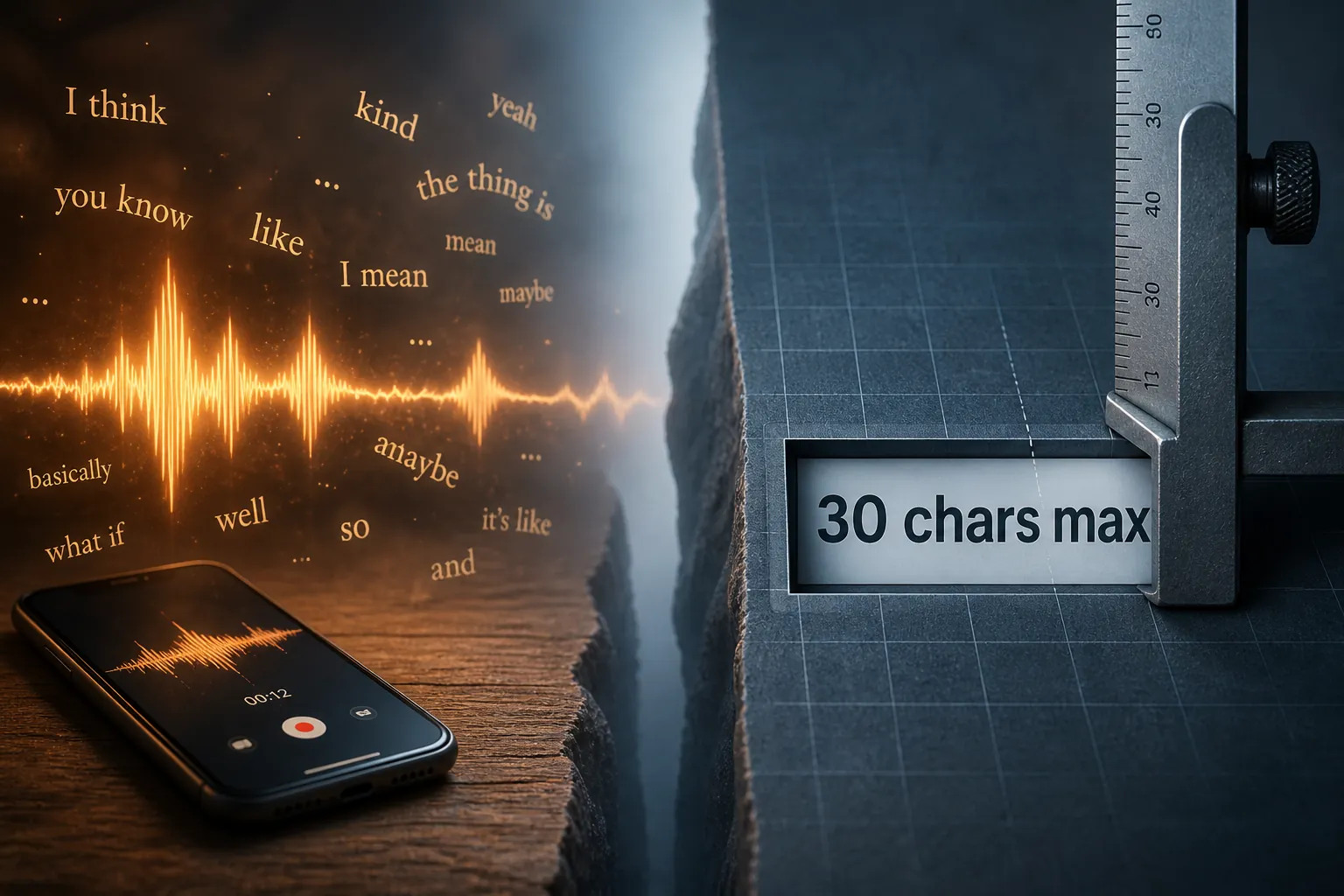
Rambler Cleans Speech, But Ads Are Not Cleaned-Up Speech
Rambler’s advertised value is straightforward: Gboard listens to loose speech and uses Gemini to remove filler, handle self-corrections, and produce smoother text. TechCrunch’s launch coverage described it as Gemini-powered dictation inside Gboard, aimed at turning spoken thoughts into cleaner written output.[1] Android Authority also emphasized the stream-of-consciousness angle, including filler removal and code-switching support.[2]
That is a real convenience layer. If someone says, “Okay, maybe lead with the spring sale, no, actually make it about free setup for new customers,” Rambler is the kind of feature that can probably turn that into a usable note faster than thumb-typing it.
But ad copy is not judged by whether it reads smoothly in a notes app. A responsive search ad headline in Google Ads can be up to 30 characters, and each description can be up to 90 characters.[3] That single constraint changes the job. The useful output is not a clean paragraph; it is a set of short, distinct, policy-safe, brand-correct assets that fit platform limits.
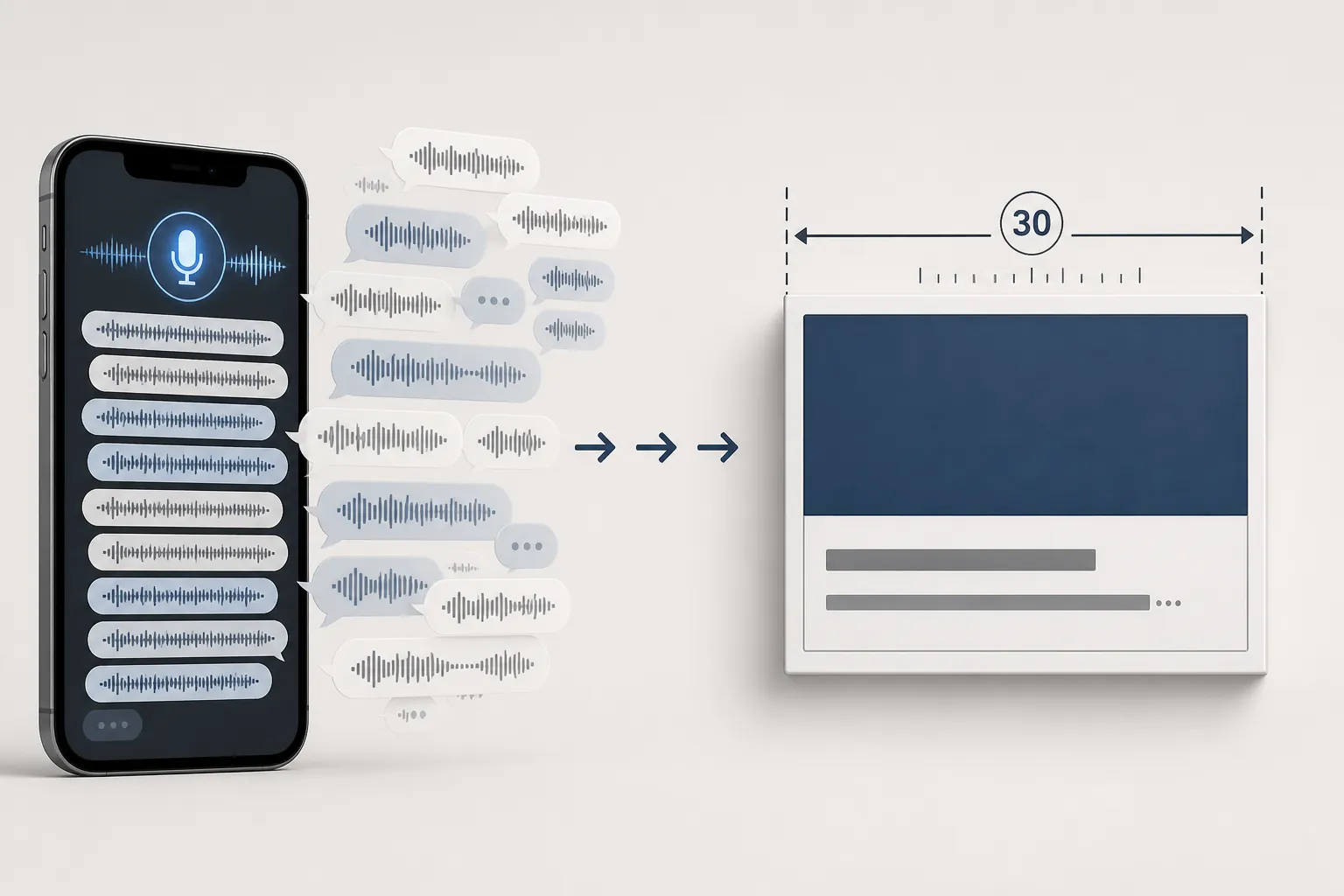
A polished line like “Get faster onboarding for your team with guided setup included” may be fine as a concept. It is not a Google Ads headline. It has to be split, shortened, checked against the account’s naming conventions, and compared against other variants. That is where the work usually starts.
The Bottleneck Is The Ad Box, Not The Microphone
Voice dictation helps at the idea-capture stage. It does not automatically solve the format stage. For paid search, the format stage is brutal because small changes carry real consequences: a headline gets rejected by length, a brand term is spelled wrong, a differentiator becomes too generic, or two variants collapse into the same claim.
| Workflow Moment | What Rambler Helps With | What Still Needs Manual Or Platform-Aware Work |
|---|---|---|
| Capturing a rough offer idea | Turning rambling speech into readable text | Choosing the offer angle and deciding whether it belongs in search, social, or a landing page |
| Drafting RSA assets | Generating longer phrasing that can be mined for ideas | Fitting 30-character headlines and 90-character descriptions |
| Using brand and product terms | Transcribing ordinary language | Protecting proper nouns, trademark styling, abbreviations, and industry jargon |
| Moving into production | Reducing blank-page friction | Building variant sets, checking duplication, reviewing policy risk, and routing for approval |
This is why the speed argument needs a ceiling. ClickUp’s 2026 guide cites a broad voice-to-text comparison of about 150 words per minute for voice versus about 40 words per minute for typing.[4] That kind of benchmark explains why dictation feels attractive on mobile. It does not measure the slower part of ad copywriting: compressing, labeling, checking, and placing assets.
If the spoken draft produces one long, elegant line, someone still has to turn it into platform-ready options. For RSA work, a more useful workflow is often a structured variant generator: define the offer, audience, proof point, and constraint, then ask for headline candidates that already respect the character limit. That is the job covered more directly in this AI headline variant playbook.
Brand Terms Are The Wrong Place To Be “Mostly Right”
The other fragile point is terminology. Advertisers do not treat every word equally. The highest-value words are often the easiest for dictation to damage: product names, branded feature names, acronyms, competitor names, regulated terms, category jargon, and internal campaign labels.
User reports on Reddit have described Gemini dictation mangling proper nouns and industry-specific language. Those reports are useful warning signals, not proof of a measured failure rate. There is no systematic, cited brand-name accuracy test for Gemini dictation across advertiser vocabulary in the available material.
That distinction matters. The evidence does not support saying Rambler generally fails brand terminology. It does support a narrower, more operational conclusion: if the output is going into paid media, the proper nouns and jargon need review before they become assets.
A notes app can tolerate a funny transcription error. An ad account cannot always tolerate one in a brand headline. A single wrong product name can slow approval, annoy a client, or make a variant unusable even if the rest of the sentence reads well.
The Hardware Gate Makes Rambler Hard To Standardize
The most concrete limitation is not copy quality. It is access. As of the available Q3 2026 reporting, Gemini Intelligence features tied to Rambler require 12GB or more RAM, a flagship chip, and Gemini Nano v3. TechRadar reported those requirements alongside a supported-device list that centered on newer high-end Android phones.[5] 9to5Google also reported the high spec requirements and noted uncertainty around whether the Pixel 9 Pro would qualify despite its 16GB RAM, because it shipped with Gemini Nano v2 and had no confirmed upgrade path in that coverage.[6]
This is a live eligibility situation, so the device list may expand. But the workflow problem is already clear: a feature cannot become a dependable team process if only some people on the team can use it, and if even a recent premium Pixel sits in an uncertain bucket.
That matters more for paid search teams than consumer coverage usually implies. A media buyer may draft on a personal Android phone, paste into a desktop browser, send copy to a client from a laptop, and hand edits to a teammate on iOS. If Rambler only exists on a narrow slice of Android hardware, it is a personal capture tool, not shared creative infrastructure.
Android Police’s July 2026 hands-on coverage also complicates the pitch: the author found that Gboard’s existing Detailed edits and Fix it features already covered much of the cleanup value people were waiting for from Rambler, without the same hardware gate.[7] For ad copy, that is a meaningful comparison. If the main benefit is cleaning up rough text, a lighter editing feature may be enough for the note-taking part of the workflow.
Where Rambler Actually Fits
Rambler makes sense when the goal is to capture a thought before it disappears. That could be a positioning angle after a campaign check, a client’s phrasing from a call, a quick list of objections from sales notes, or a rough hook for a new offer. In those moments, the value is speed plus cleanup.
The safe workflow is to treat Rambler output as raw creative material, not ad inventory. A spoken draft can become a brief. It can become a seed prompt. It can become a line in a scratch document. It should not move straight from voice dictation into Google Ads without character checks, brand review, and variant shaping.
- Good use: dictating messy campaign angles while away from a desk.
- Good use: turning a voice note into a cleaner creative brief.
- Risky use: producing final RSA headlines directly from speech.
- Risky use: trusting dictated brand terms, product names, or jargon without review.
- Poor team use: building a workflow that depends on everyone having the newest supported Android hardware.
Cross-platform dictation tools such as Wispr Flow and DictaFlow may be worth evaluating if the main need is voice capture across devices. They still do not remove the ad-format problem. They just reduce the dependency on a specific Android hardware path.
The Better Production Tool Is Closer To The Ad Platform
For final ad asset production, Google’s more practical AI direction is not Gboard dictation. It is Gemini-backed asset generation inside Performance Max. Google announced in February 2024 that Gemini models were coming to Performance Max to help generate text assets, with the feature living closer to campaign context and output formats.[8]
That does not mean PMax asset generation should be trusted blindly. It means it starts nearer to the real constraint. The system is already oriented around ad assets, campaign structure, and Google’s delivery environment. Rambler starts with a cleaned-up sentence and leaves the production structure to someone else.
The same logic applies outside PMax. Structured prompting beats freeform dictation when the desired output is a set of constrained variants. A custom Gemini setup can hold brand rules, offer language, exclusions, and format requirements; Gemini Gems for ad creative workflows is a better model for that kind of repeatable drafting than asking a keyboard to clean up a thought.
For teams already comparing AI copy systems, the useful split is simple: use voice when the bottleneck is getting the idea out of your head; use structured AI when the bottleneck is producing assets that fit a channel. That is also where ChatGPT ad copy prompt templates can be more directly useful than dictation, because the prompt can demand headline counts, character limits, tone rules, and exclusions before generation starts.
PMax and AI Max also deserve to be evaluated in their campaign context, not as generic writing assistants. If the question is where Google’s AI fits inside paid search production, this PMax and AI Max breakdown is the more relevant next stop than another consumer dictation demo.
So the verdict is not to ignore Rambler. If it is available on your device, it is worth using for mobile brainstorming and rough concept capture. Just do not mistake cleaned-up speech for production ad copy infrastructure. The current production path still runs through character limits, brand review, asset variation, and platform context.
References
- Google adds Gemini-powered dictation to Gboard, which could be bad news for dictation startups — TechCrunch, May 12, 2026
- Gboard is learning to turn your stream-of-consciousness rambling into polished text — Android Authority, May 2026
- About responsive search ads — Google Ads Help
- How to Use Gemini Voice to Text in 2026 — ClickUp, 2026
- Gemini Intelligence hardware requirements revealed — TechRadar
- Gemini Intelligence has high spec requirements on Android — 9to5Google, May 15, 2026
- Why I stopped waiting for Rambler after testing Gboard's hidden voice tools — Android Police, July 2026
- Gemini models are coming to Performance Max — Google Blog, February 2024
Built on this evidence
No Bidding tactic or Creative record currently cites this case file. Compare it against other results in Benchmarks.
Related benchmark reading
Report a corroborating or contradicting result
Seeing something different in your own account? Feed the data-integrity loop instead of leaving an open comment.