
The real difference between Claude and ChatGPT for ad creative
This comparison sorts the available evidence by trustworthiness—vendor tests, independent field tests, and practitioner consensus—then gives media buyers a task-by-task rule for allocating ad creative work between Claude and ChatGPT without relying on vendor spin.
- Platform
- Meta Ads, Google Ads
- Creative type
- AI image ads, AI video ads
- Last reviewed
- 2026-07-31
For a media buyer deciding where to send ad-creative work this week, the cleanest Q3 2026 rule is simple: use ChatGPT for fast angle volume, image generation, visual variations, and campaign-data work where Code Interpreter matters; use Claude for on-brief copy, brand voice, constraint-heavy UGC scripts, and first drafts that should come back needing fewer edits.
That rule is useful, but it is not a universal benchmark. Most of the hard comparison numbers attached to “Claude vs ChatGPT for ad creative” come from companies selling AI marketing tools. Some of those numbers are still worth reading. They just belong in the right drawer: vendor-claimed context, independent field signal, or practitioner consensus. They do not get to sit above your own CTR, CPA, ROAS, approval rate, edit time, or creative-fatigue data.
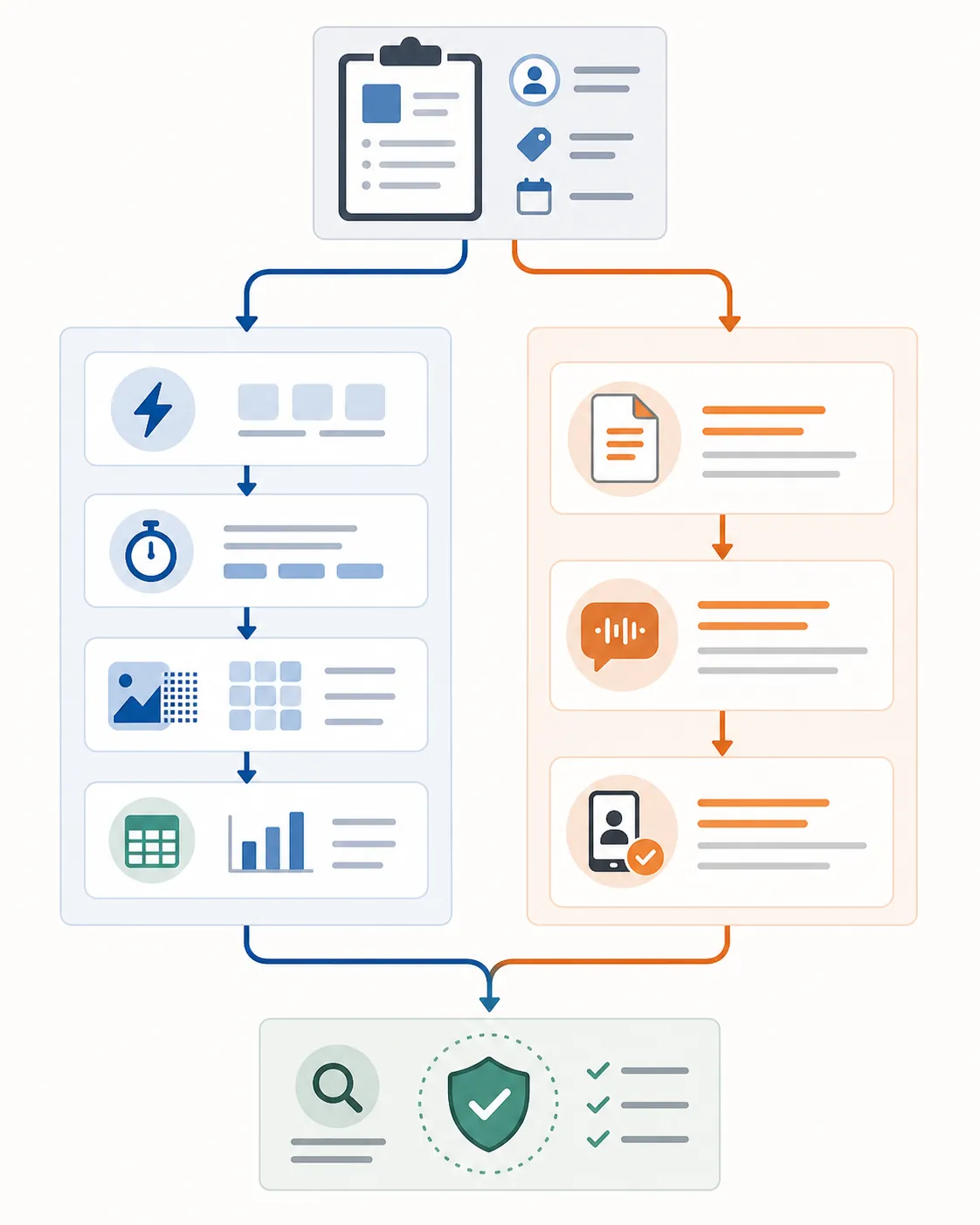
Start by sorting the evidence, not picking a mascot
The search results around Claude and ChatGPT are full of confident claims because “better model” is easier to sell than “better for this one task, under this brief, after this much editing.” For ad creative, the evidence stack is uneven. Vendor tests give the most specific numbers. The independent field test is more trustworthy but older. Practitioner consensus is useful for workflow intuition, not for proving lift.
| Evidence tier | What it can tell you | How to use it |
|---|---|---|
| Vendor-published tests | Specific edit-rate, brand-voice, headline, and constraint-following numbers from companies selling AI ad or UGC tooling | Treat as useful test design and directional context, not portable proof that one model will improve your account |
| Independent field test | Real Meta-ad workflow observations on older models, including image generation, recognizable model voice, verbosity, and the last human polish step | Use as the best outside reality check, while remembering it tested Claude 3.7 and GPT-4o in May 2025 |
| Practitioner consensus | What operators say they reach for: Claude for customer-facing copy, ChatGPT for speed, images, and analysis | Use as routing intuition only; do not quote informal preference claims as conversion evidence |
Vendor numbers are useful when the label stays attached
Ryze AI’s Meta-ad comparison is one of the most cited number sets because it gives operators the kind of measurements they actually care about. Ryze says it evaluated more than 500 Meta ad variations over six months, with ChatGPT producing 23 high-performing variations per 100 versus Claude’s 18, ChatGPT posting a 2.84% CTR versus Claude’s 2.61%, Claude showing an 11% conversion advantage, Claude requiring 31% fewer edits, and Claude scoring 89% on brand voice versus ChatGPT’s 71%.[1]
That is a good operator checklist: volume, CTR, conversion, edit burden, and brand voice. It is not a platform-level law. Ryze sells AI ad automation, the tested accounts and review process are not a neutral academic benchmark, and the model versions age quickly. The edit-rate and brand-voice numbers are the most operationally interesting because they describe last-mile labor. The conversion number is the easiest one to overuse because it depends on offer, account history, audience, landing page, tracking, and creative mix.
Ryze’s Google Ads RSA example points in the same direction. In that scenario, eight of 15 ChatGPT headlines needed edits, compared with three of 15 Claude headlines, while ChatGPT was described as two to three times faster.[2] For a buyer building a test queue before a launch window closes, that split is believable enough to change routing: ask ChatGPT for volume, then expect a human or Claude pass before the copy hits the account. But the number still remains vendor-claimed context, not a guarantee that Claude will always write better RSAs.
UGC Copilot’s script comparison is also worth reading with the vendor label left on. Its test found Claude following roughly 14 of 15 brief constraints, while ChatGPT followed about 11 to 12 of 15; it also described Claude’s hooks and CTAs as more conversational, while ChatGPT was faster and punchier.[3] That maps cleanly to a real UGC workflow. If the script has mandatory claims language, creator tone, objections to cover, a product-use sequence, and a platform-safe CTA, Claude is the safer first-draft station. If the brief is thin and the team needs 40 hook shapes, ChatGPT can still fill the queue faster.
The July 2026 update in UGC Copilot’s comparison notes that Anthropic shipped Fable 5 and Sonnet 5 and OpenAI shipped the GPT-5.6 family, with prior patterns described as having “carried over,” but that is not the same as re-proving the test on the new lineup.[3] This matters. A model comparison that was reasonable in May can become stale by August. The version-pinned snapshot for the newest Claude/OpenAI pair belongs in a separate benchmark record, and the site’s Claude Opus 5 vs GPT-5.6 SOL ad-creative benchmark is the better place to check the current model lineup before treating any routing rule as fresh.
The independent field test is more credible, but older
Shared Physics is the strongest outside signal in the current comparison set because it tested LLMs against real Meta ad workflow rather than publishing a product-marketing benchmark. The caveat is just as important: the test used Claude 3.7 and GPT-4o in May 2025, not the Q3 2026 flagship models.[4]
The findings still sound familiar to anyone who has cleaned up generated ads. ChatGPT’s image generation outperformed Claude’s visual output; ChatGPT copy carried a recognizable “ChatGPT voice” that needed heavier editing; Claude sometimes drifted into verbose artifacts and ran into length-limit problems; and LLMs got roughly 80% of the way to a production-ready ad, leaving the last 20% to human polish and platform-measured performance.[4]
That 80% rule is more useful than a model leaderboard. It says the buyer still owns the expensive part: trimming, claim-checking, adapting to the account’s winners and losers, reviewing policy risk, and deciding what actually earns spend. Shared Physics also found that experts benefited while novices could be misled, which is exactly why model choice should sit inside a disciplined creative test loop rather than replace one.[4] The site’s creative-fatigue benchmark is the better frame for deciding how often to refresh angles, rotate proofs, and stop a tired winner from biasing the next AI prompt.
Practitioner consensus is not evidence of lift
The floating claim that “80% of marketers prefer Claude for customer-facing copy” should not be treated like a published study. Stormy AI traced that idea to informal practitioner polling, not to a controlled research paper or platform benchmark.[5] It is still directionally useful because it matches the workflow split seen elsewhere: Claude often feels more natural and brief-aware in copy; ChatGPT often feels faster and broader in idea generation.
Orr Consulting describes a similar split from practice: Claude for marketing writing and ChatGPT where Code Interpreter can run Python on uploaded CSV campaign data, which Claude does not do natively.[6] That is not a conversion claim. It is a work-allocation claim, and those are much easier to use responsibly.
How to route actual ad-creative work
The practical question is not whether Claude or ChatGPT is smarter. It is where each one reduces rework before the asset reaches Ads Manager, Google Ads, a client approval thread, or a compliance review.
| Task | Default first stop | Why |
|---|---|---|
| Angle brainstorming | ChatGPT | More useful for fast volume, divergent hooks, and rough concept spread |
| Meta primary-text drafts | Claude | Better fit when the brief, tone, claim boundaries, and brand voice matter more than raw count |
| Google RSA headline variants | ChatGPT first, Claude or human editor second | ChatGPT is fast for volume; vendor examples show more edit burden than Claude |
| UGC scripts | Claude | Best supported by the available constraint-following evidence |
| Image assets and product-style visuals | ChatGPT | Native raster image generation is the decisive practical difference |
| Landing-page or ad-account CSV analysis | ChatGPT | Code Interpreter can run Python on uploaded campaign data |
| Brand-voice polishing | Claude | The strongest recurring signal is fewer edits and better tone adherence |
| Final QA before launch | Human owner | Claims, provenance, policy, disclosure, and account-level performance judgment cannot be delegated |
Brainstorming and hooks: let ChatGPT make the mess
For early ideation, mess is not a flaw. It is the point. ChatGPT is the better first stop when the team needs a large spread of angles: objection-led hooks, founder-story hooks, price-friction hooks, “why now” hooks, before/after structures, competitor-switching angles, seasonal tie-ins, and short-form UGC openings. The first pass does not need to sound launch-ready. It needs to expose enough directions that the buyer can see what is worth briefing into real variants.
The edit queue should be expected. Shared Physics’ note about recognizable ChatGPT voice is the warning label: if the copy sounds like a polished generic LinkedIn paragraph or a familiar AI ad cadence, it goes through another pass before launch.[4] This is where Claude can be useful as a second station. Feed it the surviving angles, the product notes, rejected phrases, compliance boundaries, and examples of past winners, then ask for fewer, tighter drafts rather than another flood.
RSAs and short ad copy: separate volume from finish
Google RSA production is one of the easiest places to confuse output count with usable output. ChatGPT can quickly produce headline and description pools, which helps when the account needs a fresh variant set. But the Ryze RSA example, again vendor-published, found eight of 15 ChatGPT headlines needed edits versus three of 15 from Claude.[2] The right lesson is not “never use ChatGPT for RSAs.” It is “do not let fast variants skip the edit column.”
For RSAs, route the work in two passes: first, generate a wide set of distinct benefits, objections, use cases, and proof points; second, remove duplicate meanings, unsupported claims, awkward truncations, and headlines that only look different because the adjectives changed. Claude is usually the better model for the second pass when the brief is strict and the brand has phrases it will not approve.
UGC scripts: Claude gets the brief-heavy work first
UGC scripts fail quietly. A hook can be lively and still miss the required product-use moment. A creator line can sound casual and still introduce a claim legal will reject. A CTA can be punchy and still ignore the landing-page promise. That is why UGC Copilot’s constraint-following result matters more than its tone adjectives: Claude followed roughly 14 of 15 brief constraints, compared with about 11 to 12 for ChatGPT, in a vendor-published test.[3]
Use Claude when the script has to carry a precise sequence: opening problem, lived-use moment, product mechanism, objection handling, proof point, offer, CTA, and forbidden-claims list. Use ChatGPT around it for alternate hooks, faster cutdowns, or punchier creator-style openers. The script that goes to the creator should still be read by someone who knows the brand and the platform policy, because a model can follow the format and still create a launch problem.
Images: the code-vs-pixels distinction is not academic
For ad images, ChatGPT has the decisive practical edge because it has native raster image generation through OpenAI’s image tooling, while Claude’s visual work is code-based through HTML, CSS, and JavaScript-style artifact creation rather than native product photography or pixel-level ad-image generation.[7] Claude can help structure a layout concept, write a shot list, generate a landing-page mockup, or describe a visual system. It is not the station that produces the actual image asset.
This is also where the launch gate gets stricter. Generated visuals can create provenance, labeling, and factual-representation problems that ordinary copy review will not catch. If an AI-generated image, synthetic person, product scene, or materially altered visual is going into an ad, check the site’s EU AI Act Article 50 labeling tracker before launch, especially with enforcement timing effective August 2, 2026.
Campaign data: send the CSV work to ChatGPT
When the job is analyzing exported performance data, ChatGPT’s Code Interpreter changes the workflow. It can run Python on uploaded CSV campaign data, which lets a buyer inspect spend distribution, variant fatigue, simple performance groupings, outliers, and messy naming conventions without leaving the chat environment.[6] Claude can reason through a table and help interpret findings, but it does not natively replace that same Python-on-uploaded-CSV workflow.
The model should not decide what “won” without the account owner. It can surface candidates: hooks that carried spend, variants that had early CTR but weak CPA, audience pockets where thumb-stop did not translate into purchase, or ads that look fatigued. The buyer still decides whether the next test should refresh the angle, the offer, the proof mechanism, the visual pattern, or the audience setup.
Pricing, model names, and context windows: keep this part dated
As of Q3 2026, any plan-by-plan comparison is perishable. The sources in circulation compare different model generations, from Claude 3.7 and GPT-4o in May 2025 to newer Claude Sonnet, Opus, Fable, and GPT-5.x families referenced in 2026 updates.[3][4] Some summaries also describe Claude as having a larger context window than ChatGPT, commonly around 200K versus about 128K, while consumer and API pricing summaries conflict across sources. That is not worth turning an ad-creative routing article into a subscription roundup.
For teams buying tokens rather than using consumer seats, use the dedicated GPT API ad-creative pricing comparison and calculate cost per workflow: 100 hooks, 20 UGC scripts, 15 RSA headlines, one image set, one CSV analysis pass. A cheaper model that creates more cleanup can cost more in account-lead time. A more expensive model that produces copy closer to approval can be cheaper for a small team with no spare editor.
The account-level testing rule
Use outside numbers to design the test, not to declare the winner. A clean account-level test should track model source alongside the normal paid-media metrics and the hidden production metrics. The hidden ones are where the model difference often shows up first: how many drafts were rejected, how many needed claim edits, how many sounded off-brand, how many required a second prompt, how many passed client review, and how long the editor spent before upload.
- Tag each asset by model, model version, prompt template, editor, and task type.
- Separate production metrics from media metrics: edit time, approval rate, policy rejections, CTR, CPA, ROAS, and spend to decision.
- Do not compare a Claude polished draft against a raw ChatGPT draft. Compare equivalent workflow stages.
- Keep vendor-claimed benchmarks in the notes column, not in the decision column.
- Retest when the model version changes or when the account’s winning angle starts to fatigue.
A practical test might route first-pass hooks through ChatGPT, brief-heavy scripts through Claude, visual assets through ChatGPT, and final brand polish through Claude, then compare the combined workflow against the team’s current human-only or single-model process. The result worth keeping is not “Claude beat ChatGPT” or “ChatGPT beat Claude.” It is “this route reduced editing by a measurable amount without hurting CPA or approval quality.”
Final QA is a separate job, not a better prompt
Neither model gets to own factual review. Alpha Level’s copywriting comparison describes a familiar asymmetry: Claude tends to hedge or flag uncertainty more often, while ChatGPT can produce confident-sounding invented claims.[8] That is useful to know, but it does not make Claude a compliance system. Product claims, competitor claims, awards, percentages, customer quotes, medical or financial implications, and implied guarantees still need a source check before spend goes live.
Provenance review is a different gate from factual review. A generated image can be properly labeled and still contain a factual error. A factual claim can be accurate and still be paired with a misleading synthetic visual. The AI map-blunder provenance example is the right reminder: checking where an asset came from and checking whether it is true are not the same task.
That is where the comparison lands in an actual ad account. ChatGPT and Claude are not rivals in the abstract. They are different stations in the production line: one better at volume, pixels, and data work; the other better at brief adherence, tone, and constrained copy. The responsible buyer routes the work by task, labels the evidence by trust tier, and keeps the last human 20% in place before the budget starts moving.
References
- ChatGPT vs Claude Meta Ads Creative, Ryze AI
- Claude vs ChatGPT Google Ads Comparison, Ryze AI
- Claude vs ChatGPT UGC Scripts, UGC Copilot
- Field Testing LLMs for Marketing and Advertising, Shared Physics, May 2025
- Claude vs ChatGPT Meta Ad Copy 2026, Stormy AI
- Claude vs ChatGPT for Marketing: What I Actually Use and Why, Orr Consulting
- Claude Design vs GPT Images 2, MindStudio
- Claude vs ChatGPT Copywriting 2026, Alpha Level
This is a record of what happened and what was tested, not legal advice. Compliance determinations require qualified counsel.