

Why Consumer Skepticism About Generative AI Ads Is Growing and How to Respond
Advertiser enthusiasm for generative AI ads is surging, but consumer skepticism—especially among Gen Z—is growing. This article examines the widening perception gap and provides three concrete actions marketing leaders can take to rebuild trust without abandoning AI creative.
Generative AI advertising has reached the point where the internal numbers and the audience numbers can both be true and still tell a worrying story. In January 2026, IAB and Sonata Insights reported that 83% of ad executives had deployed AI in the creative process, up from 60% in 2024. The same report found that 82% of ad executives believed consumers felt positive about AI-generated ads, while only 45% of Gen Z and Millennial consumers actually did. That is a 37-point perception gap, wider than the 32-point gap measured in 2024. [1]
That gap matters because it is not only a disagreement about taste. It changes who carries the risk after a campaign ships. The media team may see faster versioning, cheaper asset production, and a broader testing matrix. The brand lead hears from customers who think the work feels synthetic. The agency strategist has to explain why an execution that looked efficient in the workflow now looks careless in-market. A dashboard can show a lower production cost before it can show a slow decline in trust.
The sharper reaction is concentrated among younger consumers, but even there the story is not as simple as “young audiences hate AI ads.” Gen Z consumers in the IAB/Sonata Insights data were nearly twice as likely to feel negative about AI ads as Millennials, at 39% versus 20%. Gen Z respondents also described brands using AI as “inauthentic” at 30%, “disconnected” at 26%, and “unethical” at 24%. At the same time, clear disclosure increased or did not change purchase likelihood for 73% of younger consumers. [1]
The Efficiency Win Can Become the Creative Trap
The most revealing shift in the data is not simply that adoption rose. It is what marketers now say they value most. Cost efficiency became the top cited benefit of AI in advertising at 64%, rising from fifth place in 2024, while consumer association of AI ads with being “innovative” fell from 30% to 23% year over year. [1] That does not make cost efficiency a bad goal. Every paid media team knows the pressure of more channels, more formats, more tests, and fewer hours than the plan pretends to allow.
The problem begins when efficiency becomes the review standard rather than the production advantage. AI-assisted versioning can help a team explore more angles before launch. It can also let a team approve work because it is fast, plausible, on-brand enough, and cheap enough. Those are not the same thing. One expands creative judgment; the other quietly replaces it with throughput.
Governance data makes that distinction harder to ignore. IAB and Aymara reported in August 2025 that more than 70% of marketers had encountered an AI-related incident, including hallucinations, bias, and off-brand content, while fewer than 35% planned to increase AI governance investment. [2] In other words, the industry is learning where the failure modes are, but many organizations are not yet funding the controls that would keep those failures from reaching the audience.
Start With Disclosure, Because the Data Gives Permission
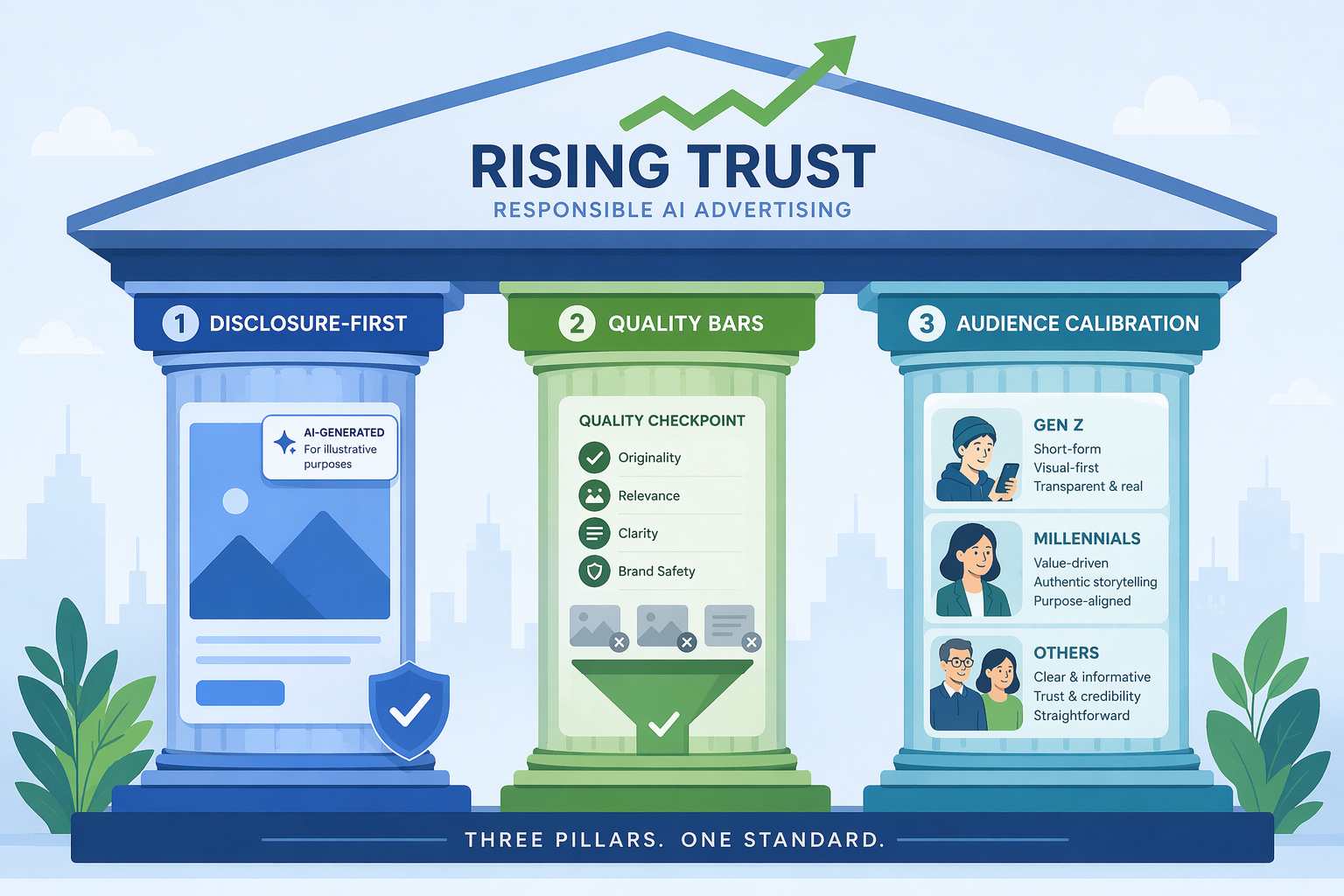
The clearest operational response is also the least theatrical: label AI-generated or AI-assisted creative plainly when the use is material to the ad. The disclosure finding is useful because it cuts through the stale choice between hiding AI use and turning every campaign into a manifesto about technology. Among younger consumers in the IAB/Sonata Insights data, clear disclosure increased or did not change purchase likelihood for 73% of respondents. [1]
That does not prove disclosure will lift every campaign. It does say the downside is often overstated, at least for the Gen Z and Millennial consumers measured. A practical disclosure standard should answer three questions before launch: whether the audience would reasonably expect to know AI was used, whether the ad depicts people, claims, or scenarios where synthetic generation could mislead, and whether the label is visible enough to be understood without interrupting the creative experience.
| Standard | What Changes In Practice | What It Protects |
|---|---|---|
| Disclosure-first creative | Material AI use is labeled clearly, especially when synthetic people, scenes, or claims could affect interpretation. | Audience trust and post-launch defensibility |
| Quality bar before scale | AI-assisted assets pass the same brand, taste, claims, and channel-fit review as traditionally produced creative. | Creative standards from being diluted by cost pressure |
| Audience-specific calibration | AI use, disclosure language, and testing plans vary by segment and placement instead of following one universal rule. | Overreaction to one data slice or underreaction to segment-specific skepticism |
Disclosure also gives the person defending the campaign a cleaner position. If consumers object to the creative, the team can evaluate taste, relevance, and execution. If consumers object because they feel misled, the team is now dealing with a preventable trust problem. Those are different meetings.
Keep the Quality Bar Separate From the Cost Case
A serious generative AI advertising program needs two ledgers. One tracks the operational case: production time, asset volume, testing capacity, localization speed, and media learning. The other tracks the creative standard: whether the work still feels specific, persuasive, legally supportable, and appropriate to the placement. If the first ledger is allowed to absorb the second, the organization will eventually call a lower-quality workflow a productivity gain.
This is where governed workflows matter more than tool enthusiasm. A team using AI to generate twenty headline variants still needs a decision system for which claims are allowed, which visual conventions are tired, which prompts create off-brand tone, which assets need legal review, and which channels deserve human craft rather than automated adaptation. For teams building that operating layer, a governed AI creative workflow is more useful than another disconnected image or copy tool.
The same logic applies at the campaign level. If AI-generated assets move through the same loose review queue as everything else, the team will not notice when volume starts to crowd out judgment. A better AI campaign operating system makes ownership explicit: who approves claims, who checks brand fit, who reviews synthetic imagery, who monitors comments after launch, and who has authority to pause an execution that is technically performing but reputationally wrong.
Real workflow examples are useful here because the quality bar is not an abstract virtue. It shows up in mundane decisions: whether a product image can be synthetically extended, whether a creator-style ad should disclose AI assistance, whether localization changes the meaning of a claim, and whether a cheaper variant still carries the same brand idea. Teams that want to compare how others structure those decisions can study AI advertising workflow examples rather than treating governance as a policy document that no one opens during production.
Calibrate by Audience Instead of Writing One AI Rule
The IAB/Sonata Insights consumer data covers Gen Z and Millennials, not the full adult population. The advertiser-side sample is also 104 ad executives, which is a relatively small B2B sample even if it is appropriate for surveying senior decision-makers. [1] Those caveats do not erase the warning. They do mean leaders should resist turning the data into a universal consumer law.
Gen Z and Millennials are not reacting identically, so a blanket policy will be too blunt in at least one direction. For a Gen Z-heavy campaign, the plan may need more visible disclosure, more human-led creative review, and tighter monitoring of comments and sentiment after launch. For a Millennial-heavy campaign, the same AI use may be less likely to trigger negative reaction, though the work still has to earn attention and trust. For older audiences, this specific data does not tell us enough to assume either comfort or hostility.
Placement also changes the standard. An AI-assisted product retargeting unit, a synthetic creator-style video, a personalized offer, and a brand anthem do not ask the same thing of the audience. They appear in different contexts, make different implied promises, and create different levels of scrutiny. Teams mapping where AI shows up across the media environment should treat consumer perception as part of the AI attention stack in advertising, not as a single yes-or-no setting.
The Standard Is Readiness, Not Deployment
The uncomfortable part of the 37-point gap is that it exposes a management problem. Advertisers are not wrong to use generative AI. The technology can reduce production strain, expand testing, and give under-resourced creative teams more room to explore. But deployment is not proof that the organization is ready for the consumer reaction, the brand review burden, or the governance failures that come with scale.
A responsible leader does not need to retreat from generative AI advertising. They do need to stop treating internal adoption as the main success signal. The better test is whether the team can explain when AI is used, preserve creative standards when cost pressure rises, and adapt the approach to the audience actually receiving the ad.
References
- The AI Gap Widens, IAB, January 2026.
- AI Adoption Is Surging in Advertising, But Is the Industry Prepared for Responsible AI?, IAB, August 2025.
Comments
Join the discussion with an anonymous comment.