
Dalio warns of an AI bubble but Bridgewater owns AI stocks
The 'Dalio warns on AI but owns AI stocks' headline looks like hypocrisy until you check the 13F: the positions are Bridgewater's, the filings are backward-looking, and Dalio's framework separates the technology from expensive stocks. For media buyers, the same split applies to AI ad automation — running Advantage+ or Performance Max is not the same as believing platform-reported ROAS, so treat every lift number as a claim to verify against your own account.
- Platform
- Meta
- Change category
- bidding
- Change type
- opt-in feature
The feed version is easy to dunk on: Ray Dalio warns about an AI bubble while Bridgewater owns AI stocks. The cleaner version is less satisfying and more useful. The AI positions are Bridgewater Associates’ 13F positions, not a live readout of Dalio’s personal portfolio. The filings are backward-looking quarter-end snapshots. And Dalio’s own framework separates belief in a technology from willingness to buy every stock attached to it at any valuation.
That distinction matters beyond the finance headline. It is the same distinction a media buyer has to make when Meta, Google, or a vendor says an AI campaign product is producing lift. Using the automation is one decision. Accepting the platform’s reported ROAS as incremental business impact is another.

What the 13F actually says
Bridgewater’s Q4 2025 13F is the source of the cleanest version of the “owns AI stocks” claim. In that filing, Nvidia was reported as Bridgewater’s largest single-stock holding, worth about $721 million, or roughly 2.63% of a $27.4 billion U.S. stock portfolio. The same report said Bridgewater added about 1.35 million Nvidia shares worth roughly $253 million during the quarter.[1]
The Q1 2026 picture also supports the narrower claim that Bridgewater had meaningful AI-related exposure. Public 13F trackers show the firm holding large positions in names tied to AI infrastructure and large-cap technology.[2] Secondary coverage of the Q1 filing reported increases in Nvidia, Broadcom, and Micron, a new Taiwan Semiconductor Manufacturing position of about 1.077 million shares, and exits from Salesforce and ServiceNow.[3] Motley Fool’s June 2026 read of the filing described Bridgewater’s top six holdings as AI-related names and said Amazon was the largest at 4.1% of the portfolio.[4]
That is enough to say Bridgewater owned AI-linked stocks. It is not enough to say Dalio personally bought those stocks while making a contradictory market call. The same Q4 coverage noted that Dalio had sold his remaining personal stake in Bridgewater in 2025 and handed leadership to CEO Nir Bar Dea.[1] He is also no longer the firm’s CIO. A 13F filing says what an institutional investment manager reported holding at the end of a quarter; it does not show intraday positioning, current conviction, or a founder’s personal brokerage account.
This is where the headline compression does the most damage. “Dalio warns but owns” turns three separate claims into one: Dalio’s public macro warning, Bridgewater’s reported holdings, and the assumption that holding AI exposure contradicts concern about an AI bubble. Each piece needs its own provenance.
Dalio’s warning is about price, not whether AI is real
Dalio has not been arguing that AI is fake. His public framing is closer to the familiar bubble pattern: a real technology can attract too much capital at the wrong price. In June 2026, Bloomberg reported him saying that “all great technology changes produce bubbles,” and that buying stocks is a bet on technologies “which is a different thing — because the stocks can be expensive.”[5]
That is not a subtle point, but it is often the part removed from the viral version. Railroads were real. The internet was real. AI can be real and still have securities, infrastructure plans, and revenue multiples that overshoot. A portfolio can also carry exposure to a theme while the person associated with the firm thinks parts of that theme are priced dangerously. That is not automatically hypocrisy; it may be sizing, hedging, indexing, factor exposure, a quarter-end snapshot, or simply a different decision-maker.
For an operator, the useful move is not to decide whether Dalio is “right” about 1929 or 2000. It is to keep the claim separated. Who made it? What instrument does it refer to? What date was it measured? What would falsify it?
The paid-media version: running Advantage+ is not believing Advantage+
The same mistake shows up in marketing decks, only with different nouns. A brand uses Advantage+ Shopping Campaigns, Performance Max, automated bidding, generative creative, or AI audience expansion. Then a platform report shows strong ROAS or lift. Somewhere between the dashboard export and the budget meeting, “we used the automation” becomes “the automation created incremental profit.”
Those are different claims. The first is adoption. The second is effectiveness. The third, if someone starts defending next quarter’s spend with it, is usually incrementality. A platform-reported ROAS number can be directionally useful inside the account, but it is still a platform-attributed number. It is not automatically a cash-flow result, a holdout result, or proof that the same customers would not have converted through another path.
This does not require being anti-automation. Automated buying can be the right operating choice when signal density, creative volume, product feed quality, and conversion lag make manual control clumsy. The verification habit is narrower: do not let the tool grade its own incremental contribution without a second measurement layer.
The Haus tests are the part worth sitting with
Haus’s Meta incrementality report is useful because it measures the exact gap that gets blurred in platform narratives. Across 640 incrementality experiments, Haus found that Advantage+ Shopping Campaigns looked strong by reported ROAS, but the experimental comparison moved differently over time. At the midpoint, Advantage+ was up 9% versus manual campaigns. By the end of the experiments, it was about 12% worse than manual campaigns. Advantage+ outperformed manual in only 42% of the tests.[6]
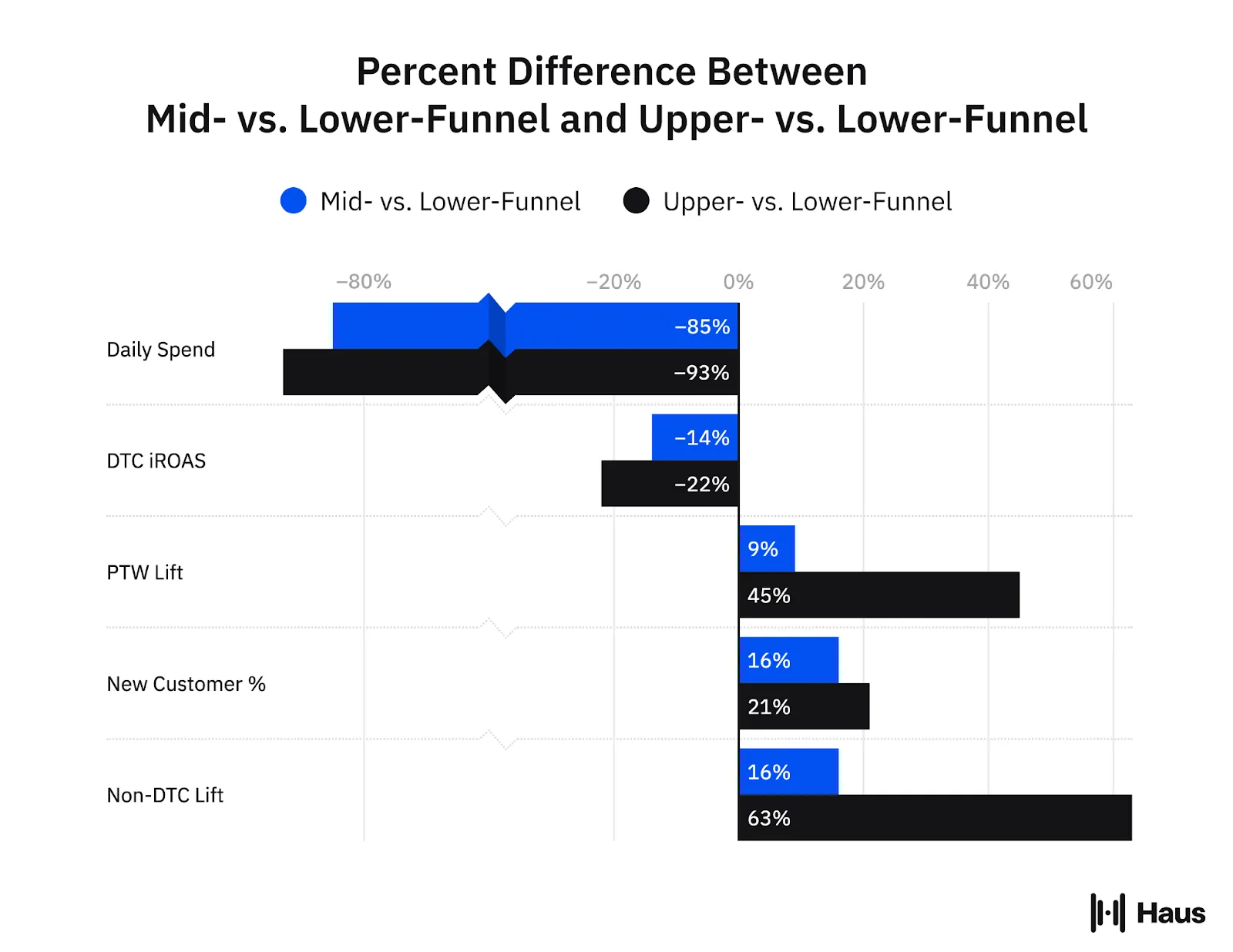
The key detail is not that Advantage+ “failed.” That would be the same kind of sloppy compression as the Dalio headline. The useful detail is that the platform-facing performance story and the incrementality story diverged. A buyer looking only at reported ROAS would have seen one answer. A buyer looking at experiment results would have seen a different one.
That divergence has budget consequences. If the dashboard says the AI campaign is efficient, finance may ask why spend is not being scaled faster. If a holdout or geo test says the campaign is harvesting conversions that would have happened anyway, the same spend may need to be capped, restructured, or judged against a different KPI. The person in the account is left reconciling two systems of truth: attributed performance and incremental performance.
Haus’s result also makes the “AI vs. manual” framing less useful than most decks make it sound. A manual campaign is not inherently better because it is manual. Advantage+ is not inherently better because it is automated. The account question is whether a given buying system, under a given budget, product mix, creative set, and customer base, produces more incremental value than the alternative. That has to be tested close to the account where the money is actually spent.
What to check before treating AI campaign ROAS as incremental
- Whether the number is platform-attributed ROAS, modeled lift, experiment-based incrementality, or blended business performance.
- Whether the comparison is against manual campaigns, business-as-usual spend, a holdout, a geo split, or a pre/post period.
- Whether the campaign is finding new demand or reallocating credit for demand already present in branded search, email, affiliates, organic, or returning-customer pools.
- Whether the measured window matches the buying cycle, return window, and cash collection reality of the business.
- Whether the result survives when judged against contribution margin, new-customer CAC, or payback period rather than account-level ROAS alone.
Pixis reported a related warning sign from its own analysis of 55,000 Meta campaigns: new-customer CAC on Advantage+ rose from $257 to $528 between May 2024 and May 2025 while reported ROAS held near $4.52.[7] That is not the Haus study, and it should not be treated as independent proof of the same effect. It is a secondary, vendor-published datapoint. Still, it points to the same verification problem: a ROAS metric can look stable while the economics a business actually cares about deteriorate.
Definition drift is already showing up in AI ad-spend numbers
The same provenance problem appears in market-size claims about AI advertising. eMarketer projected AI-powered ad spend would hit $57 billion in 2026, while a Forbes piece put AI ad spending at $32.03 billion for 2026.[8][9] Those figures are not automatically in conflict; they can be using different definitions, vintages, and inclusion rules. The practical issue is that “AI ad spend” may mean spend on AI-powered placements, spend influenced by AI tools, spend inside AI-mediated platforms, or spend newly relabeled because AI is now part of the buying workflow.
That definitional slippage is why the site’s earlier breakdowns of AI bubble impact on ad budgets and AI ad-spend relabeling are more useful than treating any single top-line number as the market. Madison & Wall’s modeling, for example, estimated AI-powered advertising at $35 billion rising to $142 billion by 2030, with an approximately 29% CAGR, and argued that “AI isn’t creating growth, it’s capturing it.” But those estimates were the firm’s own modeling from platform disclosures, and the report was commissioned by Adobe, so they belong in the vendor-adjacent bucket rather than the neutral benchmark bucket.[10]
For media buyers, the action is not to reject every AI spend number. It is to ask what got counted. The same label can cover very different economic realities: net-new ad dollars, existing search and social spend routed through more automated products, creative-production software budgets, or platform revenue that now carries an AI wrapper.
A cleaner way to read the next AI-market headline
The Dalio headline is useful because it is a compact example of claim inflation. A person’s macro warning becomes a firm’s holdings. A firm’s quarter-end holdings become a personal conviction. Exposure to AI-linked stocks becomes proof that the bubble warning is fake. The same inflation happens when platform adoption becomes platform effectiveness, and platform effectiveness becomes incremental profit.
A better read starts with source type:
| Claim | What it can support | What it cannot support by itself |
|---|---|---|
| Bridgewater 13F shows Nvidia or other AI-linked holdings | Bridgewater reported those positions at quarter end | Dalio personally bought the stocks or currently holds the same exposure |
| Dalio warns about an AI bubble | He sees bubble-like conditions in parts of the AI trade | He believes AI is not useful or that every AI-linked stock must be avoided |
| Platform dashboard shows strong ROAS | The platform attributed revenue to the campaign under its rules | The campaign created that revenue incrementally |
| Incrementality test favors or penalizes automation | The tested setup outperformed or underperformed under measured conditions | All Advantage+, Performance Max, or AI automation will behave the same in every account |
| AI ad-spend forecast rises | A defined category is expected to grow under that source’s methodology | All growth is net-new advertising demand |
This is also the useful bridge to broader macro-warning coverage, whether the warning is about data centers, chips, or AI infrastructure financing. A billionaire’s warning can be relevant to ad budgets without becoming a trading signal or a campaign-management rule. The better question is how that warning changes verification standards. The site’s earlier notes on Mark Cuban’s AI data-center warning, AI ad-bubble signals, and AI stock-crash ad-budget checks sit in that same lane: do not translate market anxiety directly into panic cuts, but do tighten the proof required for spend that depends on the AI narrative.
The most practical version of the Dalio lesson is boring in the right way. Keep using automated bidding, Advantage+, Performance Max, and AI creative systems where they earn their place. But when the platform reports lift or ROAS, treat it as a claim about attributed performance until your own account-level measurement says more. A 13F is not a live personal conviction statement. Platform ROAS is not incrementality. Both can be useful; neither should be promoted beyond what it actually measures.
References
- Ray Dalio Bridgewater invests $253 million in Nvidia — TheStreet via Yahoo Finance, Feb. 17, 2026, https://finance.yahoo.com/news/ray-dalio-bridgewater-invests-253-190300758.html
- Bridgewater Associates Inc — WhaleWisdom, https://whalewisdom.com/filer/bridgewater-associates-inc
- Bridgewater 13F Q1 2026: Ray Dalio’s Firm Boosts Chip Stocks Nvidia, Broadcom, Micron, TSMC and Exits Software Names Like Salesforce — KuCoin Blog, May 20, 2026, https://www.kucoin.com/blog/bridgewater-13f-q1-2026-ray-dalio-s-firm-boosts-chip-stocks-nvidia-broadcom-micron-tsmc-and-exits-software-names-like-salesforce
- Billionaire Ray Dalio Warns of AI Bubble. Here Are the AI Stocks His Hedge Fund Is Buying. — The Motley Fool, Jun. 9, 2026, https://www.fool.com/investing/2026/06/09/billionaire-ray-dalio-warn-ai-bubble-ai-stock/
- Dalio Sees AI Bubble Bursting as Wealth Is Converted Into Money — Bloomberg Tax, Jun. 3, 2026, https://news.bloombergtax.com/financial-accounting/dalio-sees-ai-bubble-bursting-as-wealth-is-converted-into-money
- The Meta Report: Lessons from 640 Haus Incrementality Experiments — Haus, https://haus.io/blog/the-meta-report-lessons-from-640-haus-incrementality-experiments
- Advantage+ vs Performance Max: Head-to-Head 2026 — Pixis, Jun. 12, 2026, https://pixis.ai/blog/advantage-vs-performance-max-head-to-head-2026/
- AI-powered ad spend will hit $57 billion in 2026 as brands go all-in — eMarketer, Apr. 2, 2026, https://www.emarketer.com/content/ai-powered-ad-spend-will-hit--57-billion-2026-brands-go-all-in
- AI Ad Spending Will Reach $32 Billion In 2026—And Paid Search Teams Are Already Running It — Forbes, Jul. 14, 2026, https://www.forbes.com/sites/gabrielalinzainescu/2026/07/14/ai-ad-spending-will-reach-32-billion-in-2026-and-paid-search-teams-are-already-running-it/
- How AI-Powered Advertising Totals — Madison & Wall, https://madisonandwall.substack.com/p/how-ai-powered-advertising-totals
Primary source: https://haus.io/blog/the-meta-report-lessons-from-640-haus-incrementality-experiments