
IBM Watson Advertising Accelerator
A practical review of IBM Watson Advertising Accelerator for paid media managers evaluating AI creative optimization platforms. Covers how the AI works, documented performance data from brand case studies, where it fits under watsonx in 2026, and how it compares to Google AI Max, Meta Advantage+, Madgicx, and Albert — including honest limitations around pricing opacity and platform dependency.
Key Integrations
Marketing Categories
⚠ Notable Limitations
Opaque pricing, platform dependency on IBM ecosystem, only 1 Capterra review, no free tier, limited creative format support
What Is IBM Watson Advertising Accelerator?
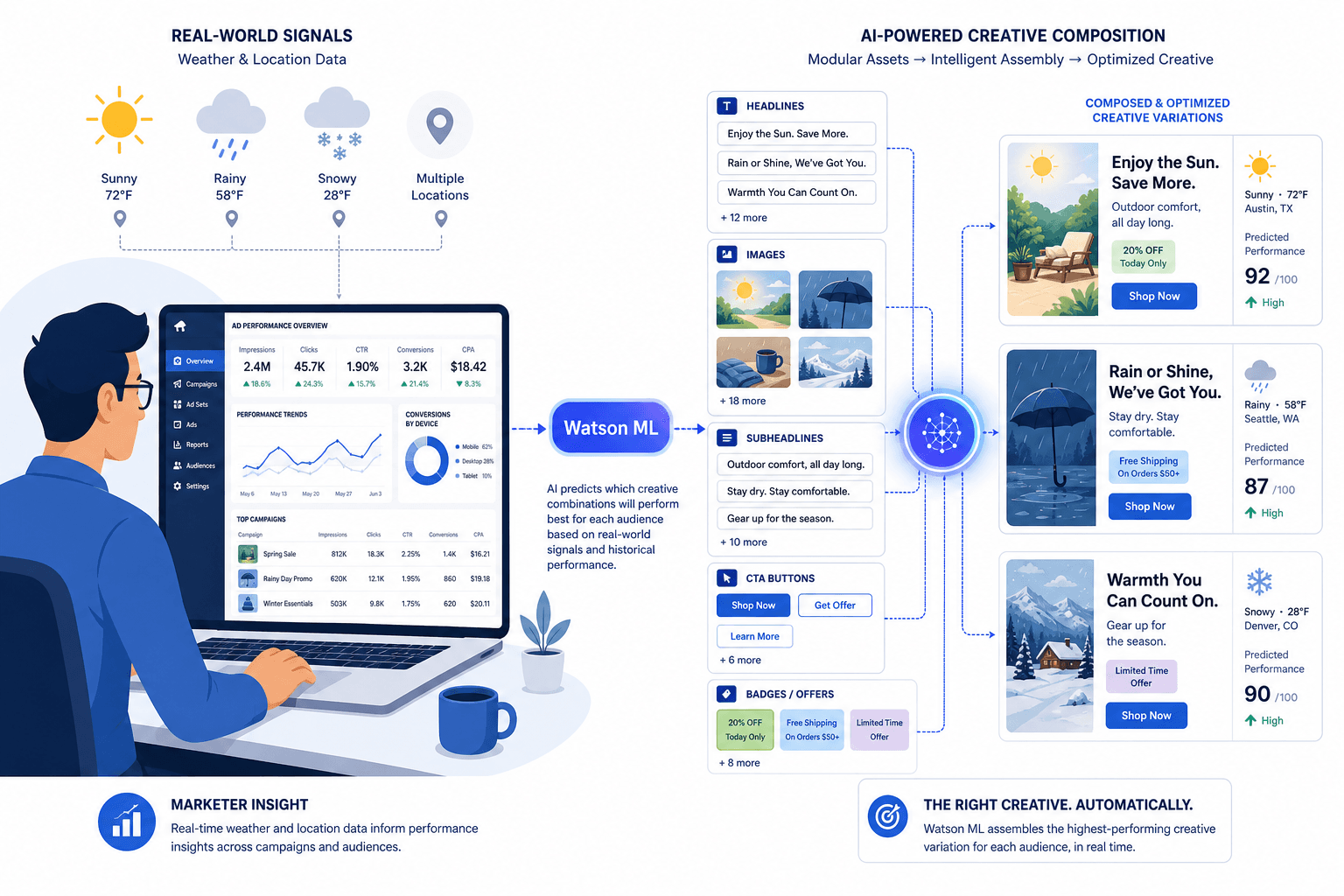
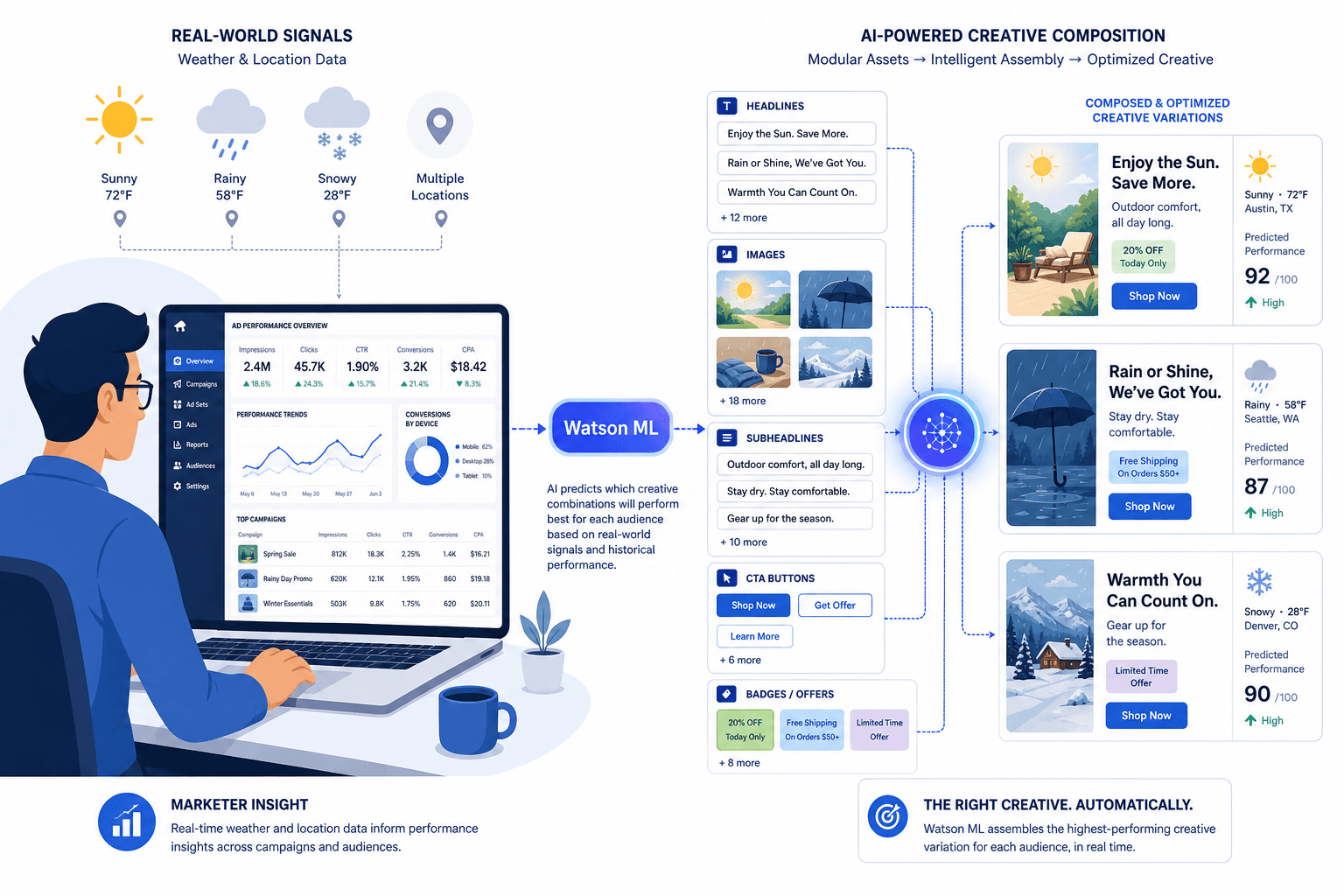
IBM Watson Advertising Accelerator is an AI-driven creative optimization platform that uses Watson machine learning to predict and dynamically assemble ad creative variations at the individual impression level. Rather than relying on a human marketer to manually test a handful of ad variants, the system processes a range of contextual signals — including weather, location, device type, and time of day — to determine which combination of headlines, images, calls-to-action, and other creative elements is most likely to drive engagement or conversions for each unique viewer.
First announced at CES 2020, the product was initially positioned as a display advertising solution. In April 2021, IBM expanded Accelerator to cover OTT and connected TV (CTV) inventory, using the same Watson ML engine to analyze cookieless data signals and assemble video ad variations. Key performance indicators for video campaigns include video completion rate (VCR), brand site actions, and app installs.
As of 2026, the product sits within IBM's broader watsonx AI portfolio, though its go-to-market branding has shifted. IBM now emphasizes Weather Powered Advertising Solutions under The Weather Company, an IBM business. The Advertising Accelerator with Watson remains the underlying AI engine, but it is no longer the front-facing product name in most marketing materials. This repositioning matters for advertisers evaluating long-term platform commitment — the tool's unique value proposition is increasingly tied to weather and location signals rather than a standalone AI platform play.
How the AI Works: Creative Element Prediction and Signal Processing
Accelerator's core technology is built around three capabilities that IBM calls Anticipation, Segmentation, and Revelation.
- Anticipation: The system uses Watson ML, trained on consumer engagement and user data, to predict which creative elements are most likely to drive conversions before a campaign launches. It analyzes historical performance patterns to recommend initial creative combinations.
- Segmentation: As the campaign runs, Accelerator discovers new audience segments based on which creative variations resonate with specific viewer profiles. This goes beyond basic demographic targeting — the AI identifies patterns in message resonance that a human planner might miss.
- Revelation: Post-campaign, the system provides analysis of which creative elements and audience combinations drove performance, giving advertisers actionable insights for future campaigns.
The signal processing layer is what differentiates Accelerator from most ad platform-native AI tools. The system ingests real-time data points including:
- Weather conditions (temperature, precipitation, humidity) at the user's location
- Geographic location (DMA, city, neighborhood-level)
- Device type and operating system
- Time of day and day of week
- Consumer reaction signals (engagement patterns with previous ad exposures)
These signals feed into the ML model, which dynamically assembles ad creative at the impression level. A viewer seeing an ad on a rainy Tuesday morning in Chicago might receive a different headline and image than someone viewing the same campaign on a sunny Saturday afternoon in Miami — without a human creative team needing to manually produce dozens of variants.
For paid media managers evaluating this approach, the key question is whether weather and location signals meaningfully improve performance over the behavioral and contextual signals already used by platforms like Google AI Max or Meta Advantage+. The published case study data provides some evidence, but the sample size is limited to a handful of brand campaigns.
Documented Performance Data: What the Case Studies Show
IBM has published several case studies documenting Accelerator's performance. These represent the primary source of performance data available to practitioners, as independent third-party benchmarks are scarce. The table below summarizes the key published results.
| Brand / Campaign | Key Metric | Result | Creative Variations Tested | Source |
|---|---|---|---|---|
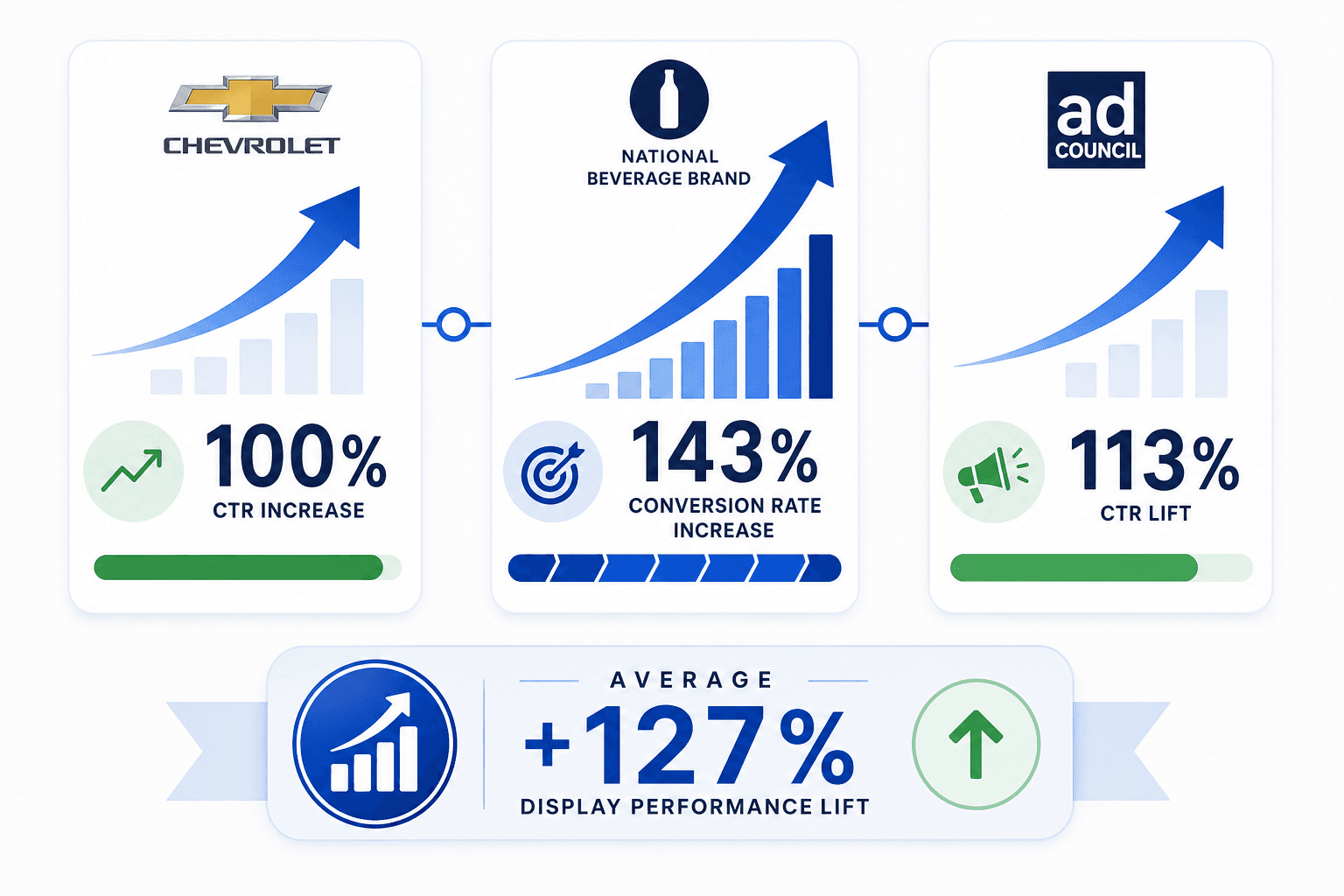
| Chevrolet Trailblazer (2021) | CTR increase | +100% from start to end of campaign | Not specified | IBM case study |
| National beverage brand (holiday) | Conversion rate increase | +143% | 108 | IBM case study |
| Ad Council 'Love Has No Labels' | CTR lift | +113% from start to end | 81 | IBM case study |
| Ad Council 'Love Has No Labels' | Conversion increase (site actions) | +69% | 81 | IBM case study |
| Ad Council 'Love Has No Labels' | Average CTR vs. brand benchmarks | 93% beat benchmarks by platform | 81 | IBM case study |
| Average across display campaigns | Display performance lift | +127% over campaign length | — | IBM newsroom (2021) |
The Chevrolet campaign is particularly instructive. Accelerator used Watson ML trained on consumer engagement and user data to predict creative variations most likely to drive conversions. The system processed signals including consumer reaction, weather, and time of day. Over the campaign's duration, CTR doubled from the initial baseline to the final performance.
The national beverage brand case study offers the most granular data. During a holiday campaign, Accelerator tested 108 creative variations and drove 990 total clicks to cart. The brand learned that seasonally relevant creative combined with 'click to cart' messaging significantly outperformed generic headlines — a finding that, while intuitive, was validated at scale by the AI's testing capacity.
The Ad Council campaign for 'Love Has No Labels' tested 81 creative variations and processed signals including DMA, device type, and time of day. Notably, 93% of the AI-generated creative variations beat the brand's existing CTR benchmarks by platform. The campaign also drove a 69% increase in on-site actions. The Ad Council was sufficiently impressed to plan a second campaign for its Vaccine Confidence Initiative.
Where Watson Advertising Accelerator Sits Under watsonx in 2026
IBM's advertising technology portfolio has undergone significant repositioning since Accelerator's 2020 launch. The product now exists within IBM's watsonx AI platform, IBM's enterprise AI and data platform announced in 2023. However, the most visible go-to-market branding has shifted toward Weather Powered Advertising Solutions under The Weather Company, which IBM acquired in 2015.
IBM's current advertising website emphasizes that 330+ million people per month use The Weather Channel's digital properties. Weather is positioned as a privacy-forward, contextual signal — it doesn't require personal data or cookies, making it attractive in a post-cookie advertising landscape. The solutions now offered include Weather Targeting, Audience Targeting, Premium Experiences, and Sponsorships, with Accelerator functioning as the AI engine that powers creative optimization within these offerings.
For paid media managers evaluating the platform in 2026, this repositioning has practical implications. The product is no longer marketed as a standalone AI creative tool that can be plugged into any ad server. Instead, it is increasingly tied to IBM's owned-and-operated inventory (The Weather Channel properties) and partner DSPs like Xandr. Advertisers who want to use Accelerator's AI capabilities outside of IBM's ecosystem may face integration challenges.
Competitive Comparison: Accelerator vs. Google AI Max, Meta Advantage+, Madgicx, and Albert
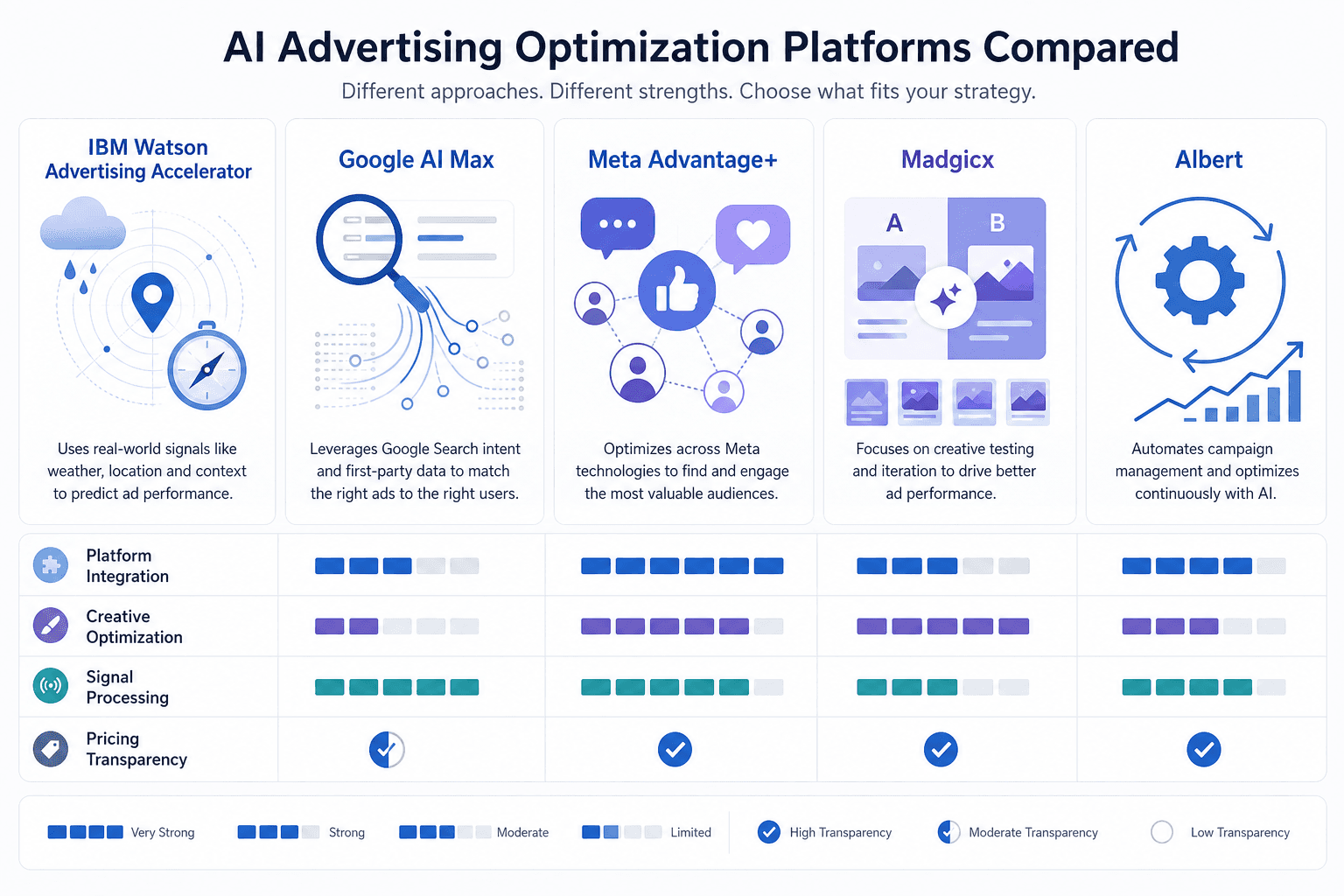
To understand where Accelerator fits in the 2026 AI creative optimization landscape, it helps to compare it directly with the alternatives that paid media managers are most likely evaluating. The table below provides a side-by-side comparison across key decision dimensions.
| Dimension | IBM Watson Advertising Accelerator | Google AI Max (PMax) | Meta Advantage+ | Madgicx | Albert |
|---|---|---|---|---|---|
| Primary signal types | Weather, location, device, time of day, consumer reaction | Search intent, browsing behavior, conversion data | Social engagement, user interests, platform behavior | Meta ad performance data, creative testing | Cross-channel performance data, attribution |
| Platform integration | IBM ad platform + partner DSPs (Xandr) | Native to Google Ads | Native to Meta Ads Manager | Deep Meta integration; limited Google/other | Multi-channel (Google, Meta, Amazon, etc.) |
| Pricing transparency | Contact vendor only | Pay-per-click/platform fees | Pay-per-click/platform fees | Subscription tiers ($199–$999+/mo) | Subscription tiers (custom pricing) |
| Free tier / trial | None | None (platform fees apply) | None (platform fees apply) | 7-day trial available | Demo available |
| Creative format support | Display, OTT/CTV | Search, Display, Shopping, Video, Discovery | Feed, Image, Video, Stories | Image, Video (Meta-native) | Cross-channel (varies by platform) |
| Best-fit advertiser | Enterprise brands in IBM/Weather ecosystem | Any Google Ads advertiser | Any Meta advertiser | Meta-focused ecommerce brands | Multi-channel DTC and B2C brands |
| Third-party reviews (Capterra) | 1 review | Hundreds (Google Ads overall) | Hundreds (Meta Business Suite) | 100+ reviews | 50+ reviews |
The most significant differentiator for Accelerator is its use of weather and location signals. No other major platform processes real-time weather data as a creative optimization input. For brands with weather-sensitive products — beverages, apparel, travel, automotive, CPG — this can be a genuine advantage. The national beverage brand case study, where seasonally relevant creative drove a 143% conversion rate increase, illustrates this potential.
However, Accelerator's platform dependency is its biggest competitive disadvantage. Google AI Max and Meta Advantage+ are built directly into their respective ad platforms — any advertiser already running campaigns on those platforms can enable AI creative optimization with a few clicks. Accelerator requires working through IBM's ad platform or a partner DSP like Xandr, adding friction for teams already embedded in walled-garden ecosystems.
For a detailed comparison of programmatic platforms, see our AI-powered programmatic platform comparison for 2026. For a deep dive on Meta's native AI creative tools, our Meta Advantage+ Creative Enhancement decision matrix covers which toggles to enable for different campaign objectives.
Key Limitations: Pricing Opacity, Platform Dependency, and Sparse Third-Party Reviews
For a tool that requires an enterprise sales conversation to even get a price quote, the lack of independent validation is a significant barrier to adoption. As of March 2026, IBM Watson Advertising Accelerator has exactly one user review on Capterra (overall rating 5.0, from an accountant in the business supplies industry). That single review praises the tool's machine learning features and AI capabilities, but it provides almost no useful signal for a paid media manager evaluating the platform for a real campaign.
Beyond pricing, the platform dependency issue is critical. Accelerator does not integrate natively with Google Ads or Meta Ads Manager. Advertisers must work through IBM's ad platform or partner DSPs like Xandr. For teams that have standardized on Google and Meta as their primary ad channels, adding a separate platform layer for creative optimization creates workflow complexity and potential data fragmentation.
Additional limitations to consider:
- Limited creative format support: While Accelerator expanded to OTT/CTV in 2021, its core strength remains display advertising. It does not natively support search ads, shopping feeds, or the full range of social ad formats that platforms like Meta Advantage+ handle.
- Small published case study set: The available performance data comes from a handful of IBM-published case studies, most from 2020-2021. There is no large-scale, independently audited benchmark data available.
- Brand safety and bias considerations: IBM announced a bias research initiative in 2021 to explore AI's role in detecting and mitigating bias in advertising. It is unclear whether subsequent findings were published, and advertisers should inquire about current bias mitigation practices during the sales process.
- No self-service onboarding: Training options include live online sessions, and support is available via email, help desk, and FAQs. There is no documented self-service setup process, which contrasts with the plug-and-play nature of platform-native AI tools.
Verdict: Who Should Consider It and Who Should Skip It
IBM Watson Advertising Accelerator occupies a narrow but defensible niche in the 2026 AI creative optimization landscape. Its unique value proposition — using weather and location signals to predict optimal creative combinations — is genuinely differentiated from the behavioral and intent-based signals used by Google AI Max, Meta Advantage+, and other competitors.
Consider Accelerator if:
- Your brand sells weather-sensitive products or services (beverages, apparel, travel, automotive, CPG, outdoor recreation)
- You are already working with IBM or The Weather Company for advertising inventory
- You have the enterprise budget and procurement process to engage in a custom-pricing sales conversation
- You value privacy-forward, contextual targeting signals as a differentiator in a post-cookie advertising environment
- Your primary ad format is display or OTT/CTV, and you can work through partner DSPs like Xandr
Skip Accelerator if:
- You are an SMB or mid-market advertiser without the resources for an enterprise sales process
- Your ad strategy is built primarily around Google Ads or Meta Ads Manager, and you want native AI integration
- You need transparent, published pricing to evaluate ROI before committing
- You rely on third-party reviews and community validation to inform tool selection
- Your campaigns span search, social, and programmatic channels, and you need a unified AI optimization layer
For most paid media managers, the practical answer will be to start with the AI creative optimization tools already built into their primary ad platforms — Google AI Max for search and display campaigns, Meta Advantage+ for social — and only evaluate Accelerator if weather/location signals represent a clear competitive advantage for their specific product category.
For a broader discussion on maintaining brand distinctiveness when using AI for ad creative, see our article on the sameness trap in AI-generated ads. And for a general workflow on AI-powered ad copy testing, our AI ad copy A/B testing guide provides a step-by-step approach that works across platforms.

Comments
Join the discussion with an anonymous comment.