
AI Agency Quadrant Framework
The AI agency landscape is fragmented and confusing. This article introduces a 4-quadrant framework to help marketing managers and agency principals understand the distinct types — AI Creative, AI-First Service, AI-Powered Service, and AI Automation — and choose the right model for their needs.
Key Integrations
Marketing Categories
⚠ Notable Limitations
Framework is a snapshot of a rapidly evolving landscape; quadrant boundaries may blur as AI capabilities advance
Why the "AI Agency" Label Has Become Meaningless
Walk into any marketing conference in 2026, and you will find dozens of agencies calling themselves "AI agencies." The term has become a catch-all. A solo freelancer who uses ChatGPT to draft blog posts claims the same label as a full-stack automation firm running autonomous campaign optimization across multiple platforms. For marketing managers and agency principals trying to make sense of the landscape, this lack of differentiation is a real problem.
The confusion starts at the definitional level. There is no universally accepted definition of what qualifies as artificial intelligence. The OECD has noted that AI means different things to different people, and NASA has acknowledged there is no single, simple definition of AI. When the foundational term is this ambiguous, it is no surprise that the agencies built on top of it resist clear categorization. Every firm has an incentive to position itself as broadly as possible to capture more business.
This ambiguity creates two distinct problems. For buyers, it makes comparison shopping nearly impossible. An "AI agency" could mean a creative studio that uses generative tools to produce ad variants faster, or it could mean a technical firm that builds custom machine learning models for predictive lead scoring. The budget, timeline, and outcome expectations for these two scenarios are completely different. For agency principals, the lack of a shared taxonomy makes it difficult to differentiate in a crowded market. If everyone is an AI agency, no one is.
The market has responded to this confusion with a proliferation of sub-labels — AI creative agency, AI-first agency, AI-powered agency, AI automation agency — but without a consistent framework to organize them, these labels add noise rather than clarity. What is needed is a systematic way to map the landscape that accounts for both the depth of AI integration and the type of value the agency prioritizes.
The 4 Quadrant Framework: Mapping AI Agency Types
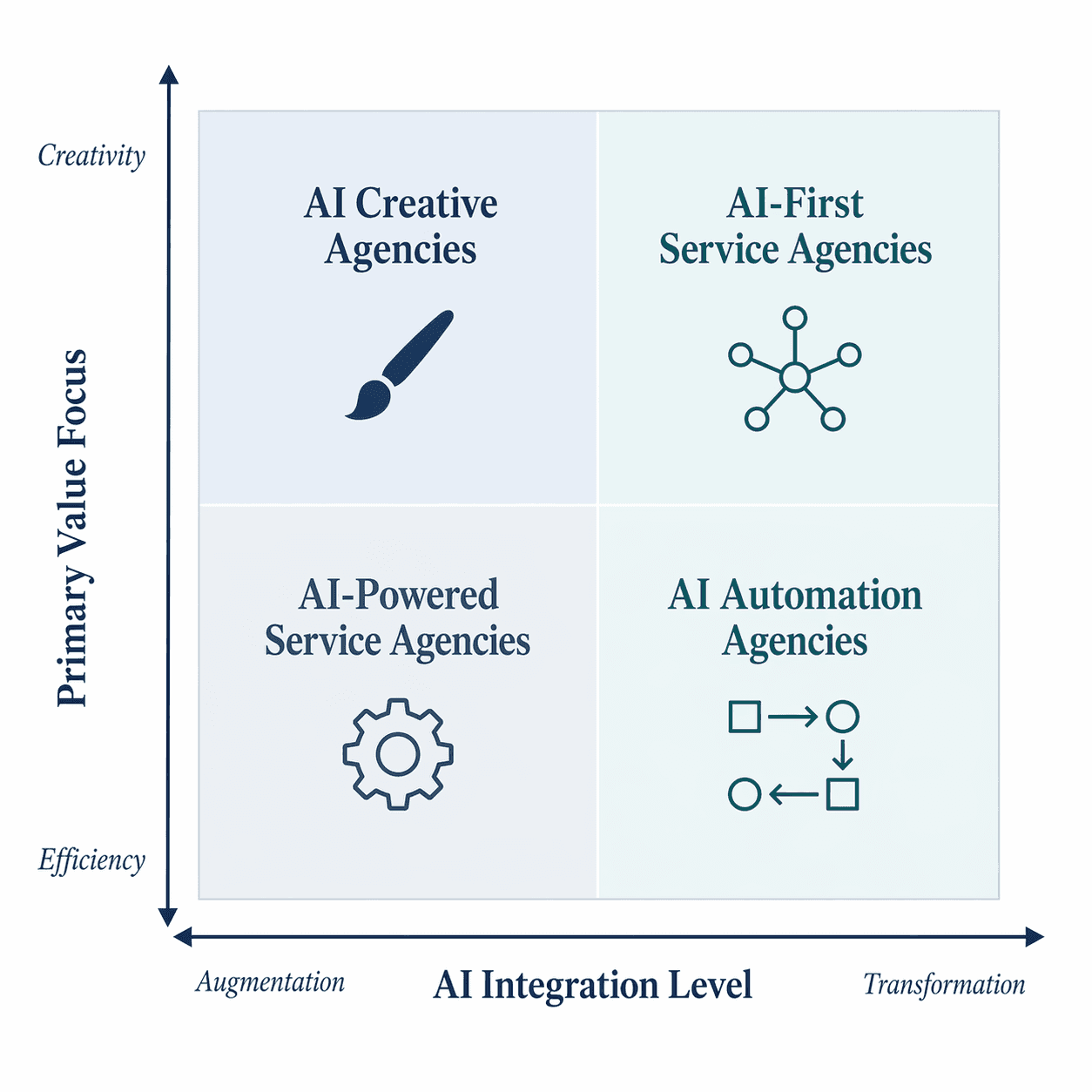
The AI Agency Quadrant, developed by Digital Agency Network, provides exactly this structure. The framework maps agencies along two independent axes, producing four distinct types. Understanding these axes is the first step to using the framework effectively.
The horizontal axis measures AI Integration Level, ranging from Augmentation on the left to Transformation on the right. Augmentation means AI is used as a tool to enhance existing human workflows — the agency still operates largely the same way, but faster and with better data. Transformation means AI fundamentally changes how the agency operates, replacing traditional workflows with AI-driven processes. As the Digital Agency Network framework explains, "AI-first replaces traditional workflows; AI-powered augments them." This is the critical distinction.
The vertical axis measures Primary Value Focus, ranging from Creativity at the top to Efficiency at the bottom. Creativity-focused agencies prioritize output quality, brand voice, strategic messaging, and design. Efficiency-focused agencies prioritize speed, cost reduction, automation, and scale. This is not a judgment of value — both are legitimate — but it determines what kind of client the agency serves best.
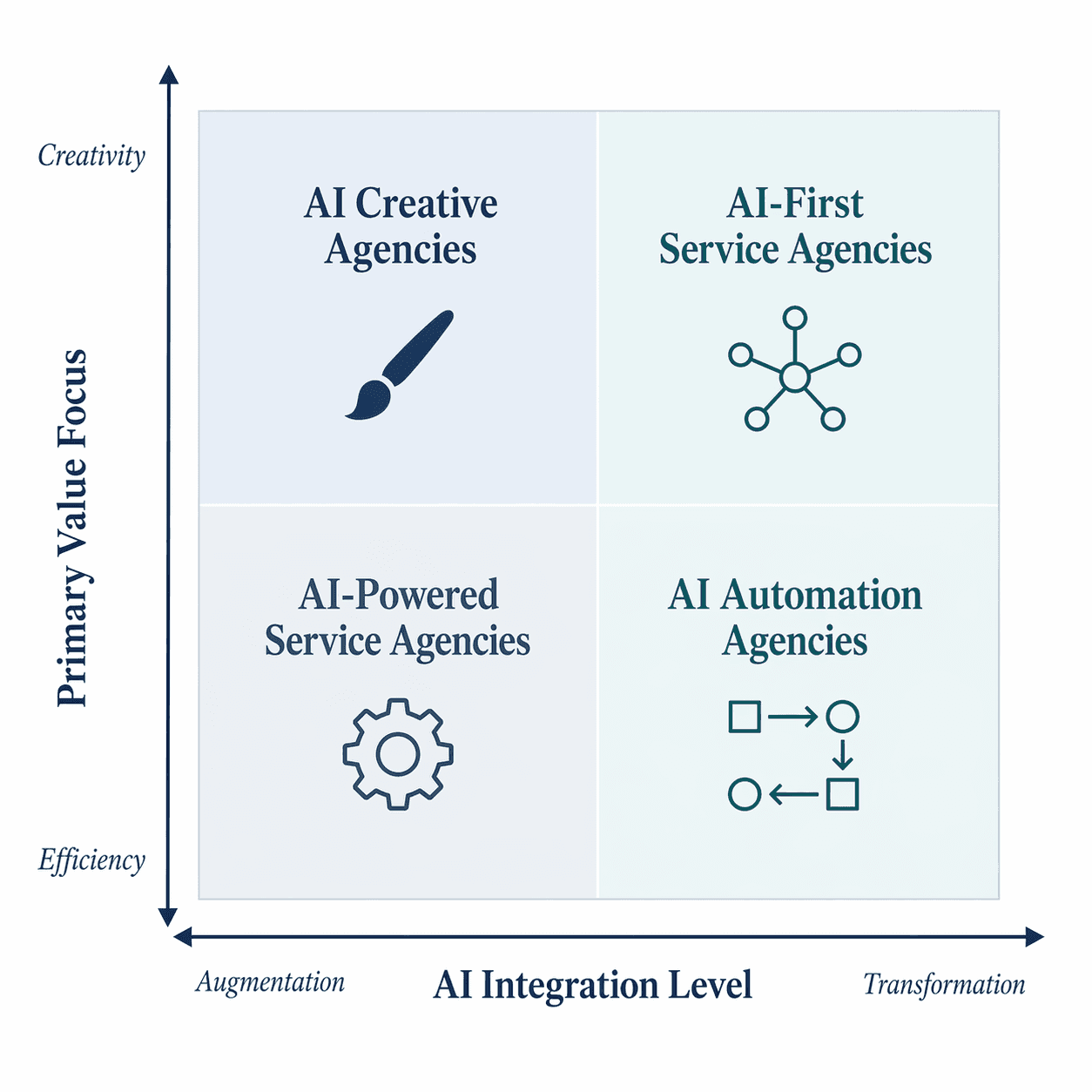
The four resulting quadrants are:
- Top-Left: AI Creative Agencies (Augmentation + Creativity)
- Top-Right: AI-First Service Agencies (Transformation + Creativity)
- Bottom-Left: AI-Powered Service Agencies (Augmentation + Efficiency)
- Bottom-Right: AI Automation Agencies (Transformation + Efficiency)
Each quadrant represents a fundamentally different business model, client profile, and value proposition. The following sections unpack each one with concrete examples and data.
Quadrant 1: AI Creative Agencies (Augmentation + Creativity)
AI Creative Agencies use generative AI tools to augment human creative work. Their value proposition is straightforward: produce more content, faster, with more iterations, while keeping a human creative director in the loop for brand voice, strategy, and quality control. The AI handles the heavy lifting of drafting, variant generation, and formatting; the human handles the judgment calls.
These agencies typically serve clients who need high-volume content production — ad creative at scale, social media content calendars, email sequences, blog posts, and video scripts. The core promise is speed and volume without sacrificing quality, but the human oversight layer means costs are not dramatically lower than traditional agencies. The savings come from reduced time per deliverable, not from eliminating roles.
A strong example is Superside, which operates as a creative technology agency combining AI tools with human designers and copywriters. A commissioned Forrester Consulting study reported that Superside delivered a 94% ROI within 6 months, with $4.16 million in total business value over three years, including $1.9 million in agency cost savings and $1.2 million in internal labor savings. Another example is Jellyfish, which used AI agents to reduce campaign launch time by 65%. For client Marks & Spencer, Jellyfish delivered 80% faster content delivery, a 30% reduction in unit costs, and a 25% boost in production capacity.
The key limitation of this quadrant is that the human-in-the-loop model creates a ceiling on scalability. Every piece of output still requires human review, which means the agency cannot fully pass automation savings to the client. For buyers, this model works best when brand voice and creative quality are non-negotiable, and the goal is to increase output volume without expanding the internal team. For a deeper look at the tools these agencies use, see our comparison of HubSpot AI Content Assistant vs. Jasper for mid-market marketing teams.
Quadrant 2: AI-First Service Agencies (Transformation + Creativity)
AI-First Service Agencies represent a more radical departure from the traditional agency model. These firms were built on AI from day one, or they have restructured their entire operation around AI-driven workflows. Unlike the augmentation model, where AI assists human workers, the transformation model means AI replaces or fundamentally redefines traditional roles.
The primary value these agencies deliver is personalization at scale combined with data-informed creative strategy. They use AI not just to produce content faster, but to analyze customer data, segment audiences, and generate personalized creative assets for each segment automatically. The human role shifts from production to strategy, data architecture, and creative direction.
A concrete example is Omneky, an AI-first creative agency that uses machine learning to generate and optimize ad creative across platforms. For client Omiana, Omneky reported a 3.5X ROI and 200% year-over-year sales increase. Another example is NoGood, which for ByteDance's Lark product achieved a 69% increase in sign-up rate and an 879% increase in organic traffic through AI-driven content and growth strategies.
The risk profile for this quadrant is higher. Because the agency's entire operation depends on AI systems, any failure in those systems — model drift, data quality issues, platform API changes — can cascade into client deliverables. The data infrastructure requirements are also significant. Clients need to provide clean, structured data for personalization to work, and many organizations are not set up for that. For a detailed look at how AI-first personalization works in practice, see our case study on B2C AI Email Personalization from ecommerce and DTC brands.
Quadrant 3: AI-Powered Service Agencies (Augmentation + Efficiency)
AI-Powered Service Agencies are traditional agencies that have integrated AI tools to improve operational efficiency. They did not start as AI companies, and they have not transformed their core workflows. Instead, they have adopted AI selectively — using smart bidding for ad campaigns, automated reporting dashboards, AI-assisted keyword research, and predictive analytics for budget allocation.
This is the most common type of AI agency in 2026, and it is also the hardest to identify from the outside. These agencies may use the same tools as AI-First agencies, but the integration is shallower. The AI is a productivity layer on top of traditional processes, not a replacement for them. The value proposition is reliability and incremental improvement rather than transformation.
The data supports the efficiency gains available to this quadrant. The McKinsey Global Institute has found that 60% of occupations have at least 30% of their activities that could be automated. For marketing specifically, agencies in this quadrant typically report 15–30% cost reductions compared to fully manual operations, according to industry analysis from Volado Labs. Campaign deployment speeds can be up to 75% faster for certain tasks.
However, the shallow integration model carries its own risks. Because AI is layered on top of existing workflows rather than embedded in them, these agencies can struggle with data silos, inconsistent tool adoption, and the overhead of managing both traditional and AI-driven processes. More critically, the human oversight that makes this model safe also limits its efficiency ceiling. The agency cannot pass on the full cost savings of automation because it still maintains a traditional staffing structure.
For buyers, this quadrant is the safest choice when the priority is reliability and proven process. The agency has a track record, established client relationships, and a conservative approach to AI adoption. But the trade-off is that the efficiency gains are modest compared to what a fully transformed agency can deliver. The need for human oversight in this model is also a trust signal — as our analysis of the AI Marketing Trust Gap shows, consumer skepticism about AI-generated content remains high, and agencies that can credibly claim human review processes have a competitive advantage.
Quadrant 4: AI Automation Agencies (Transformation + Efficiency)
AI Automation Agencies represent the most ambitious and controversial quadrant. These firms build and operate fully autonomous AI systems — marketing agents that manage campaigns, optimize bids, segment audiences, generate creative, and even handle CRM workflows without human intervention. The goal is not to augment human workers but to replace them entirely for defined tasks.
The capabilities of these systems are advancing rapidly. A BCG report cited by Digital Agency Network found that AI models now operate autonomously for up to one hour per task, with capabilities doubling every seven months. At this rate of improvement, the window of tasks that can be fully automated is expanding rapidly. McKinsey estimates that AI could generate $4.4 trillion annually in productivity gains, with marketing and sales applications contributing a significant share.
A vivid example comes from BattleBridge, which describes its own AI agency model as operating 10 AI agents across 3 servers with 46 registered skills, managing 8,442 CRM contacts, and maintaining 4,757 community listings. The firm reports that its agents executed a conversion optimization process — analyzing data, generating 23 page variants, deploying A/B tests, and collecting performance data — in 6 hours, a process they estimate would take a traditional agency 2–3 months and cost over $15,000. They claim their AI agents handle work equivalent to 40+ humans.
The risks in this quadrant are substantial. McKinsey's 2026 research found that roughly 77% of AI pilots fail to reach production or show measurable return. The gap between what autonomous systems can do in controlled demonstrations and what they deliver in messy, real-world marketing environments is still wide. Data quality issues, platform changes, and the inherent unpredictability of consumer behavior all create failure modes that fully automated systems struggle to handle.
For buyers, this quadrant is the highest risk and highest potential reward. It is best suited for organizations with strong technical capabilities that can manage the integration and monitoring overhead. It is a poor fit for brands that require tight creative control or have complex compliance requirements. For a deeper look at why many AI initiatives fail to deliver, see our analysis of Why Most Companies Using AI for Marketing Don't See Real ROI — and what the minority of successful firms do differently.
How to Choose the Right AI Agency Quadrant for Your Business
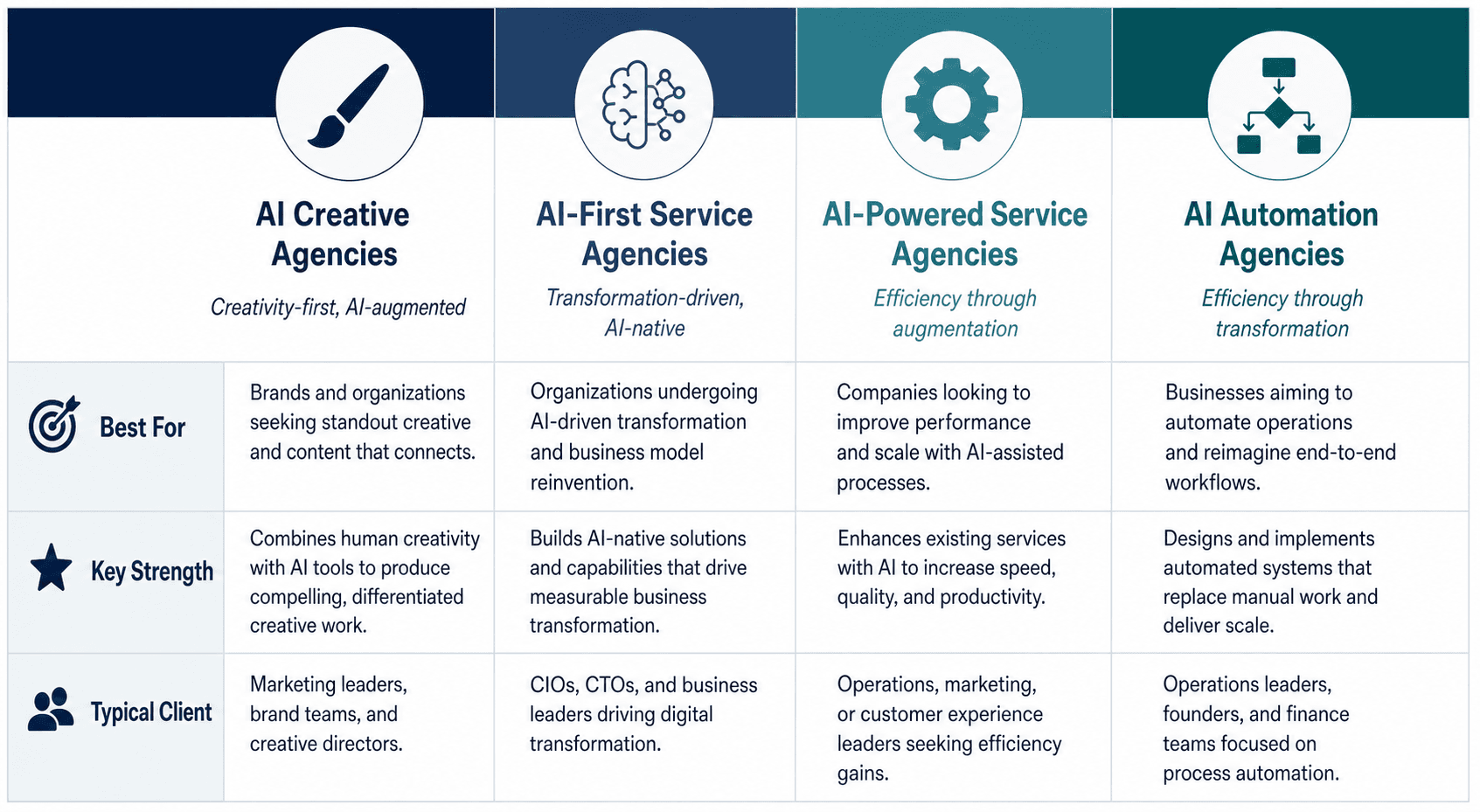
Selecting the right quadrant depends on your organization's priorities, technical maturity, and risk tolerance. The following table summarizes the key characteristics of each quadrant to help you map your needs to the right model.
| Factor | AI Creative | AI-First Service | AI-Powered Service | AI Automation |
|---|---|---|---|---|
| Best for | High-volume creative production | Personalization at scale | Reliable process improvement | Fully autonomous operations |
| Key strength | Speed + human quality control | Data-driven creative strategy | Proven workflows + incremental AI | Maximum efficiency at scale |
| Typical client | Brands needing more content without growing teams | Data-mature orgs willing to restructure | Risk-averse orgs wanting safe AI adoption | Tech-forward orgs with strong engineering |
| Monthly budget range | $5K–$25K | $10K–$50K+ | $3K–$15K | $15K–$100K+ |
| Primary risk | Scalability ceiling from human review | Data infrastructure dependency | Limited efficiency gains | High failure rate (77% of pilots) |
| Human oversight | Essential — every output reviewed | Strategic direction only | Moderate — process-level review | Minimal — exception handling only |
When evaluating agencies, ask these questions to determine which quadrant they actually operate in:
- How is AI integrated into your core workflow? Is it a tool your team uses, or does it drive the process itself? This distinguishes augmentation from transformation.
- What percentage of your deliverables involve direct human creation vs. AI generation with human review? A creative agency might be 80% human, 20% AI; an automation agency might be the inverse.
- What data do you need from me to start? AI-First and Automation agencies typically require structured data pipelines. If they do not ask for data, they are likely in the augmentation quadrant.
- How do you handle quality control and brand safety? The answer reveals how much human oversight is built into the process.
- Can you show me a case study where the AI system failed and how you handled it? Agencies that can answer this honestly are more likely to have mature risk management practices.
A practical starting point is to map your own needs on the same two axes. If your primary goal is creative quality and you want to keep your existing team structure, look at AI Creative agencies. If you need to scale personalization across millions of customer touchpoints and have the data to support it, AI-First Service agencies are a better fit. If you want reliable process improvements without disrupting your operations, AI-Powered Service agencies offer the safest path. And if you are willing to accept higher risk for the potential of dramatic cost reduction, AI Automation agencies represent the frontier.
The Future of AI Agency Models
The quadrant framework is a snapshot of a rapidly evolving landscape. Several trends suggest the boundaries between quadrants will blur over the next 12–24 months.
First, consolidation is accelerating. The PwC Middle East CEO Survey found that 73% of CEOs believe generative AI will significantly reshape how their companies create, deliver, and capture value in the next 3 years. As the market matures, we can expect AI-First and AI Automation agencies to acquire AI Creative and AI-Powered agencies to build full-stack capabilities. The standalone creative agency that uses AI as a tool may find itself squeezed between low-cost automation providers and high-value strategic firms.
Second, specialization will increase. The Grand View Research projects the AI marketing solutions market will reach $107.5 billion by 2028. As the market grows, agencies will differentiate by vertical expertise — healthcare AI agencies, ecommerce AI agencies, B2B SaaS AI agencies — rather than by generic AI labels. The quadrant framework will still apply, but the vertical specialization will become the primary filter for buyers.
Third, the augmentation vs. transformation axis may become less meaningful as AI capabilities continue to advance. The BCG finding that AI capabilities are doubling every seven months suggests that what counts as "transformation" today may be standard practice within two years. Agencies that currently operate in the augmentation quadrant may find themselves pushed toward transformation as the tools become more capable and clients expect deeper integration.
The 4-quadrant framework is not a permanent classification system. It is a tool for making sense of a confusing market at a specific moment in time. But for marketing managers and agency principals navigating the 2026 landscape, it provides something that has been missing: a shared language for discussing what an AI agency actually is, what it does, and whether it is the right fit for the work that needs to be done.

Comments
Join the discussion with an anonymous comment.