

AI chatbot for lead qualification
For marketing managers building a business case, this article compiles published ROI case studies and aggregate benchmarks from AI lead qualification chatbots, with sourcing quality flags so you know which numbers to trust and which to treat as directional.
Marketing Categories
⚠ Notable Limitations
Vendor-biased ROI claims; qualification definitions vary; implementation friction
The ROI case for an AI chatbot for lead qualification is credible enough to investigate, but not clean enough to paste into a forecast without caveats. The strongest argument is not that chatbots are fashionable or always-on. It is that lead response time matters, and the old handoff model leaves too many interested visitors waiting while forms, inboxes, SDR queues, and CRM rules decide what happens next. A widely cited Harvard Business Review speed-to-lead finding reported that contacting a lead within 5 minutes produced a 21x higher conversion rate than contacting the same lead after 30 minutes.[1]
That mechanism makes the published case studies worth reading. It also makes them easy to overread. Most of the best numbers come from vendor-published or company-published materials, and the aggregate benchmarks often arrive without enough source tracing to support a hard forecast. For a budget deck, that distinction matters.
| Evidence | Published outcome | Source quality flag | Safe way to use it |
|---|---|---|---|
| Speed-to-lead rationale | 5-minute contact associated with 21x higher conversion than 30-minute contact.[1] | Foundational behavioral rationale; older, widely cited study. | Use to explain why instant qualification and booking can plausibly affect ROI. |
| Wrike | 496% contributed pipeline increase YoY and 15x+ ROI after deploying Drift AI chat.[2] | Vendor-originated case study, cited by Warmly. | Use as a high-end named deployment, not as an expected average. |
| Kandji | 2 qualified meetings booked within 8 minutes of launching an AI sales chatbot.[2] | Single deployment moment, vendor-published. | Use as an example of speed and workflow immediacy, not typical performance. |
| Pipedrive | 1,000+ qualified leads via chatbot and 30% of trialists converting to customers.[2] | Published in a vendor case-study context; company is also a CRM vendor. | Use because it connects chatbot activity to downstream conversion, with self-reporting noted. |
| Lead Laundry | 35% conversion uplift and 50% higher lead quality using web chatbots.[3] | Vendor case-study source from Landbot. | Use as a mid-range conversion and lead-quality example. |
| Conversational Design | 40% increase in lead conversion rate and 200% reduction in cost per lead.[3] | Vendor case-study source from Landbot. | Use to show CPL impact, while checking baseline and attribution before modeling. |
| Silver Touch aggregate figures | 67% increase in qualified leads and 30% conversion lift within 6 months.[4] | Aggregator article without specific original-study citations. | Use as directional color only, not as a board-ready benchmark. |
| ChatSpark workflow figures | Button-based responses cited as lifting completion by 25-35%; hot leads booking inside chat show up at 70-80% versus 25-40% from email follow-up.[5] | Secondary figures needing source tracing. | Use to guide design hypotheses, not to promise performance. |
Why the ROI mechanism is believable
Lead qualification chatbots create ROI only when they remove a real bottleneck. The most common one is response latency: paid search, organic traffic, partner campaigns, webinars, and comparison pages create intent, but the next step still depends on a visitor filling out a form, waiting for an email, choosing a calendar link, or being manually routed. Every pause gives the buyer time to leave, compare, forget, or talk to a competitor.
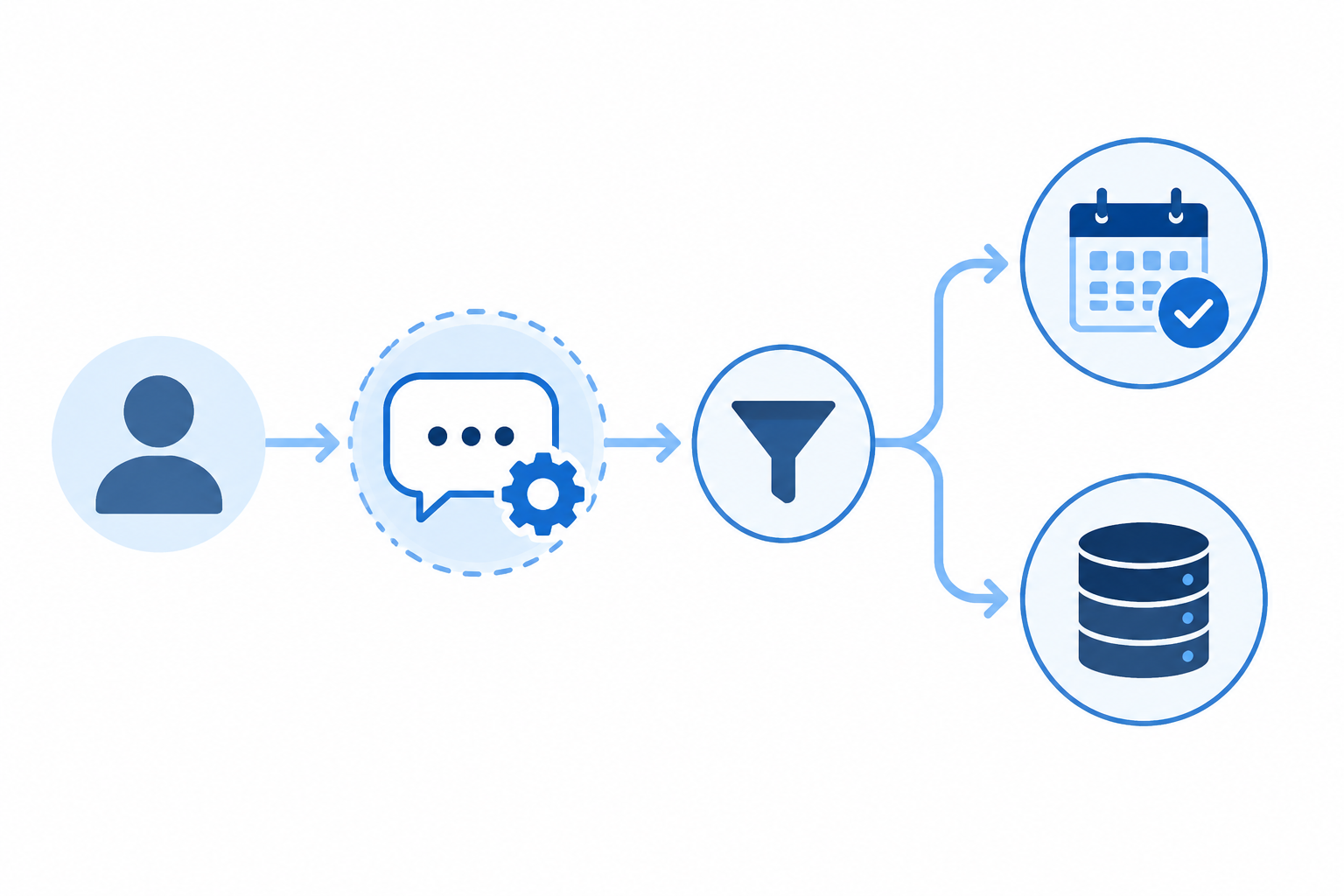
An AI chatbot can change that sequence. It can ask qualifying questions while the visitor is still on the page, identify basic fit, route the record, and offer a meeting slot before the lead cools. That does not prove pipeline will rise. It explains why pipeline can rise when the previous process was slow, leaky, or dependent on manual triage.
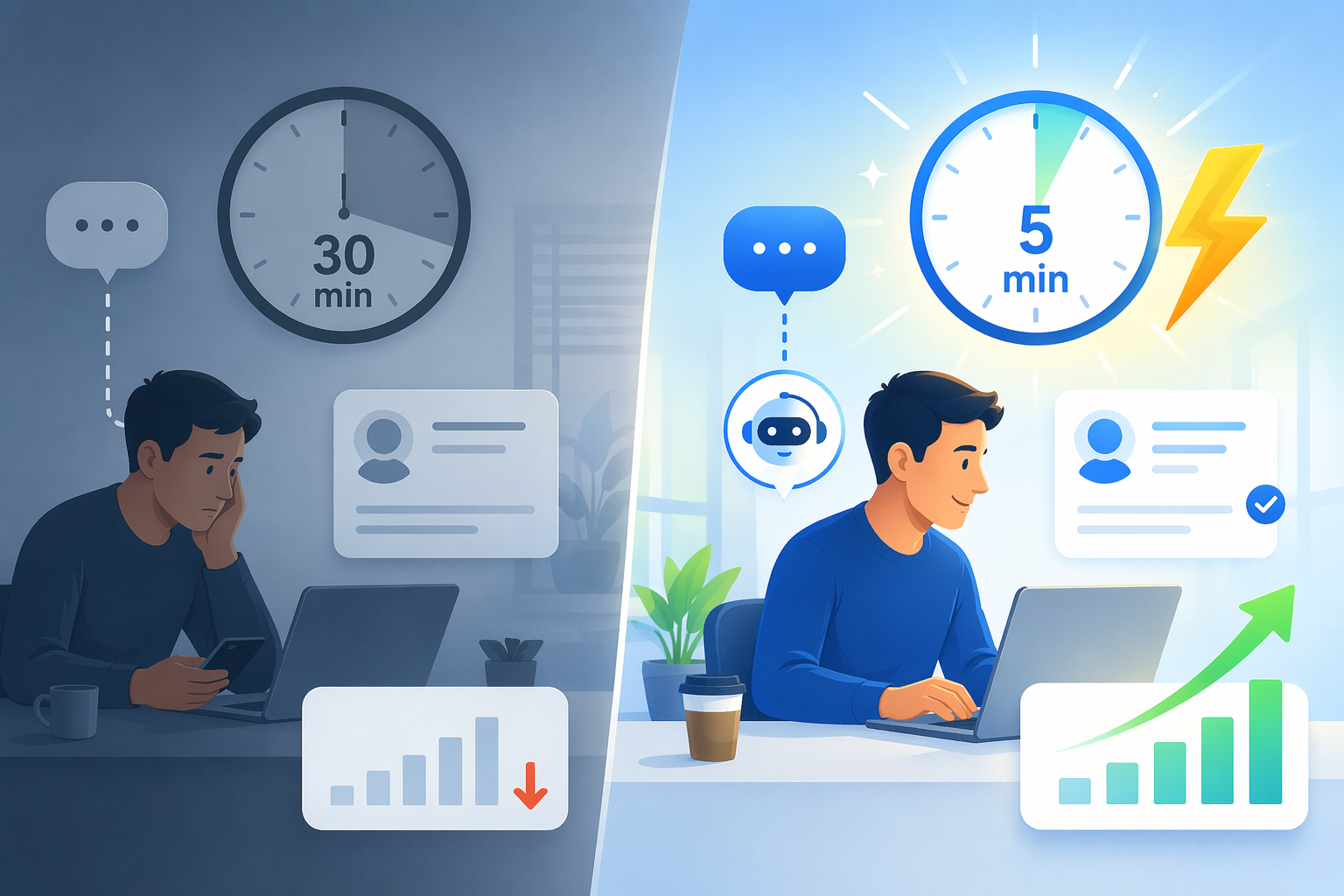
The HBR response-time finding is useful here because it gives the chatbot category a business mechanism rather than a feature list.[1] A bot that only greets visitors is not the same as a bot that qualifies, scores, routes, and books. The ROI lives in the operational handoff.
What the named deployments actually claim
Wrike is the headline number. Warmly’s roundup cites a Drift case study in which Wrike saw a 496% year-over-year increase in contributed pipeline and 15x+ ROI after using Drift’s AI chat.[2] That is a useful number for an internal discussion because it ties the chatbot to pipeline, not just engagement. It is also the exact kind of number that needs a source label on the slide. It comes through vendor-originated case-study material, not an independently audited ROI study.
Kandji’s case is smaller but more concrete: Warmly reports that Kandji booked 2 qualified meetings within 8 minutes of deploying an AI sales chatbot.[2] That does not establish average performance over a quarter. It does show what a well-placed chatbot can do when traffic, visitor intent, qualification logic, and calendar booking line up at the same time.
Pipedrive’s published example adds a different kind of evidence. The case reports 1,000+ qualified leads via chatbot and says 30% of trialists converted to customers.[2] For a marketing manager, this is more useful than a vanity engagement metric because it connects chatbot qualification to a later commercial action. The caveat is just as important: Pipedrive is a CRM company, and the result appears in a vendor case-study context.
Landbot’s case-study library gives two more outcome shapes. Lead Laundry reported a 35% conversion uplift and 50% higher lead quality using web chatbots, while Conversational Design reported a 40% increase in lead conversion rate and a 200% reduction in cost per lead.[3] These are the numbers a demand gen lead can use to discuss conversion-rate lift, lead-quality improvement, and CPL efficiency, provided the baseline and attribution assumptions are not hidden.
Taken together, the named deployments support a narrow but useful conclusion: published chatbot implementations have produced measurable improvements in pipeline, meetings, qualified lead volume, lead quality, conversion, and cost per lead. They do not prove that any AI chatbot installed on any site will produce those outcomes.
The aggregate benchmarks are useful, but softer
Silver Touch reports that businesses using AI chatbots see a 67% increase in qualified leads and a 30% conversion lift within 6 months.[4] Those are attractive planning numbers, and they are consistent with the direction of the named cases. The problem is sourcing depth: the article aggregates industry research but does not provide enough original-study detail to treat those figures as independently verified benchmarks.
That does not make the figures useless. It changes how they should be used. They belong in the “market context” section of a deck, not in the revenue model. If a forecast assumes a 30% conversion lift, the model should make clear whether that number comes from current site analytics, a pilot, a vendor case, or an aggregate article.
ChatSpark’s figures belong in the same careful category. The article says button-based responses can lift completion rates by 25-35%, citing Conferbot data, and states that hot leads who book inside the chat show up at 70-80% rates versus 25-40% from email follow-up.[5] Those figures are operationally interesting because they point to design choices that affect completion and attendance. They still need source tracing before they become finance-approved assumptions.
What “qualified” has to mean before the numbers matter
A chatbot can increase qualified leads by relaxing the definition of qualified. That is not ROI; that is a routing problem with better packaging. Before comparing vendor claims, the team needs to decide what qualification means in the business: sales-accepted lead, meeting booked, product trial started, target-account match, minimum company size, technical fit, buying timeframe, or some combination.
BANT still has a place in some B2B sales motions. ChatBot’s lead qualification guidance presents budget, authority, need, and timeline as a framework for chatbot-driven qualification.[6] That can work for higher-consideration sales where visitors are willing to answer buying-process questions. It is not universal. PLG, transactional ecommerce, and high-volume SMB funnels often need lighter scoring: use case, role, company size, urgency, product interest, plan fit, or readiness to start.
This is where many ROI claims become fragile. If the chatbot books more meetings but SDRs reject them, the dashboard may still look good while sales loses trust. If the chatbot captures more leads but required fields do not map cleanly into the CRM, RevOps inherits manual cleanup. If the bot scores a visitor as high intent but the calendar route sends them to the wrong territory, the conversion gain can disappear after the chat ends.
Implementation quality explains the gap between case study and reality
The same AI chatbot category can produce a pipeline case study in one company and noise in another because the chatbot is only one piece of the lead-management system. The important work sits in question design, branching logic, enrichment, scoring, routing, calendar rules, handoff messaging, and reporting definitions.
Question design affects completion. ChatSpark’s cited completion-rate discussion points toward a simple lesson: structured choices are often easier to finish than open-ended prompts.[5] That does not mean every chatbot should become a button maze. It means the bot should not ask a visitor to write an essay when the team only needs to know role, use case, company size, and urgency.
Routing determines whether a qualified lead becomes a sales opportunity or a support ticket in disguise. A serious lead qualification bot needs to know where to send enterprise accounts, existing customers, students, job seekers, low-fit regions, partners, and current opportunities. The qualification score is not enough if the next owner is wrong.
Meeting booking is usually where the ROI argument becomes concrete. ChatSpark’s meeting-booking comparison suggests that in-chat booking can outperform email follow-up for hot leads.[5] The practical reason is obvious enough: the visitor is already engaged, the calendar is present, and the next action is small. But the bot has to protect sales capacity. If every curious visitor can book an AE meeting, the cost shifts from missed demand to wasted selling time.
- Ask only for fields that change routing, scoring, personalization, or compliance.
- Separate sales-ready leads from nurture-ready leads instead of labeling both as qualified.
- Map chatbot fields to CRM fields before launch, not after the first export breaks.
- Test calendar rules by segment, territory, account ownership, and availability.
- Report meetings held, sales acceptance, opportunity creation, conversion, CPL, and pipeline contribution alongside raw lead count.
How to turn the evidence into a defensible business case
A useful business case should not lead with the largest published number. Lead with the bottleneck in the current funnel. If the company already has meaningful inbound traffic, slow follow-up, high form abandonment, uneven SDR routing, or poor meeting capture from high-intent pages, a chatbot has a plausible path to ROI. If the site has little qualified traffic, the bot may simply automate a shortage.
Use the case studies as ranges of possible outcome types, not as a blended average. Wrike supports a pipeline-lift narrative, Kandji supports a speed-to-meeting narrative, Pipedrive supports qualified-lead volume and trialist conversion, and the Landbot cases support conversion-rate, lead-quality, and CPL arguments.[2][3] Each belongs in a different model.
| If the current problem is... | Measure the chatbot against... | Do not rely on... |
|---|---|---|
| Slow follow-up from high-intent pages | Time to first response, meeting-booking rate, meetings held, opportunity creation | Raw chat starts |
| Too many unqualified form fills | Sales acceptance rate, disqualification reasons, SDR time saved | Total lead volume |
| Expensive paid traffic with weak conversion | Landing-page conversion rate, CPL, qualified CPL, pipeline per campaign | Generic engagement rate |
| PLG trial volume with weak handoff | Trialist-to-customer conversion, activation signals, sales-assist conversion | BANT completion |
| Messy CRM routing | Correct owner assignment, SLA compliance, duplicate rate, field completeness | Chatbot qualification score alone |
The chatbot-specific case also sits inside a broader AI ROI question. It should be weighed against AI sales ROI measurement challenges, the wider sales and marketing AI ROI landscape, and the lead-scoring tradeoffs in Salesforce Einstein vs. HubSpot predictive scoring. That keeps the chatbot investment from being treated as a standalone magic lever when it is really part of the revenue operating system.
The evidence hierarchy to use in the deck
For internal planning, the evidence should be layered. Start with the speed-to-lead rationale because it explains the mechanism.[1] Then use named deployments to show that companies have reported measurable results across pipeline, meetings, lead quality, conversion, and CPL.[2][3] After that, use aggregate figures such as Silver Touch’s 67% qualified-lead increase and 30% conversion lift as directional context, not as the center of the model.[4]
The model itself should be built from the company’s own baseline: current inbound sessions on high-intent pages, form conversion rate, meeting-booking rate, show rate, sales acceptance rate, opportunity creation rate, average deal size, paid media CPL, and SDR capacity. Then create conservative, moderate, and aggressive scenarios. The aggressive scenario can reference published case studies. The conservative scenario should assume implementation friction.
That friction is not theoretical. It includes visitors abandoning long question flows, sales rejecting weakly qualified meetings, duplicated CRM records, routing errors, calendar availability gaps, unclear ownership for existing accounts, and attribution debates when a visitor already had multiple campaign touches. Those are the places where a neat chatbot ROI story usually becomes a RevOps project.
When the investment is defensible
An AI chatbot for lead qualification is most defensible when the company already has meaningful inbound demand, a clear definition of qualified, sales capacity for good-fit meetings, fast routing rules, and reporting that follows the lead past the chat transcript. The stronger the existing traffic and the messier the current handoff, the more plausible the ROI case becomes.
The published evidence supports investment consideration, not blind adoption. Cite Wrike, Kandji, Pipedrive, Lead Laundry, and Conversational Design as named outcomes with vendor-source labels. Treat Silver Touch and ChatSpark figures as directional unless the original sources are validated. Build the forecast around meetings held, sales acceptance, conversion, CPL, lead quality, and pipeline contribution rather than the biggest qualified-lead increase on the page.
References
- The Short Life of Online Sales Leads — Harvard Business Review, March 2011.
- 10 Real-Life Examples of Sales Chatbots In Action [Case Studies] — Warmly.
- Landbot Case Studies & Success Stories — Landbot.
- How AI Chatbots Improve Lead Generation & Conversion Rates — Silver Touch.
- AI Chatbots for Lead Generation: How Businesses Capture and Qualify Leads Automatically — ChatSpark.
- Mastering Lead Qualification with Chatbots — ChatBot.

Comments
Join the discussion with an anonymous comment.