

The AI Sales ROI Paradox: What 93% of CMOs Believe vs. What 41% Can Prove
The widely cited 44% AI productivity gain in sales is not supported by the best available evidence — the actual figure from the Duke CMO Survey is 8.6%. This article examines why 93% of CMOs say generative AI delivers clear ROI while only 41% of marketers can prove it, and identifies the process differences that separate the minority reporting measurable returns.
The cleanest number I would put in a 2026 budget case for AI in marketing and sales is not 44%. It is 8.6%.
That 8.6% figure comes from the Duke CMO Survey’s Spring 2025 wave, where 281 marketing executives at VP level or higher reported the sales productivity improvement they attributed to AI.[1] It is still a meaningful gain. In a sales organization with expensive headcount, long ramp periods, and constant pressure to improve rep capacity, 8.6% is not trivial. But it is not the same kind of claim as a 44% productivity lift, and it should not be used as if the two numbers are interchangeable.
The 44% claim has appeared often enough in AI marketing content that it has started to function like a default assumption: AI goes in, productivity jumps by nearly half, and the business case writes itself. The problem is not that every large productivity claim is false. The problem is that a number without a source, date, sample, and definition is not a business case. It is decoration.
The paradox: ROI is widely believed and less often proven
The more useful tension is not whether AI is producing returns. It is why so many leaders believe it is, while far fewer teams can prove it in a way that survives finance review.
SAS’s 2025 CMO Survey found that 93% of CMOs said generative AI delivers clear ROI.[2] Jasper’s 2026 ROI Report, looking at marketers’ ability to demonstrate the return, found that only 41% could confidently prove ROI, down from about half the prior year.[3] Those two findings can both be true, but they are not measuring the same thing. One captures executive confidence that GenAI is paying off. The other asks whether marketing teams can substantiate that payoff.
| Claim | What it actually tells you | Why it matters |
|---|---|---|
| 8.6% sales productivity improvement from AI | Reported by VP-level-or-higher marketing executives in the Duke CMO Survey Spring 2025 wave | A defensible productivity benchmark, but scoped to reported sales productivity from a marketing-executive sample |
| 93% of CMOs say GenAI delivers clear ROI | A senior-leader attitude and assessment measure from SAS | Shows strong confidence, not necessarily audited financial proof |
| 41% of marketers can prove ROI | A practitioner proof measure from Jasper’s 2026 report | Shows the measurement gap behind the confidence |
This is where many AI in marketing and sales discussions get loose. Adoption, confidence, productivity, and ROI are treated as if they sit on the same line. They do not. A team can adopt a tool without changing a workflow. A leader can believe the tool is valuable without being able to isolate the return. A rep can save time without the organization seeing more qualified pipeline, faster deal movement, or better forecast accuracy.
Adoption is not the same as scaled return
The adoption numbers are high enough that they no longer settle much. McKinsey’s State of AI research reports that 88% of organizations use AI in at least one function, while only about one-third have genuinely scaled AI and more than 80% say GenAI has not yet produced a measurable enterprise-level profit impact.[4] Salesforce reported in 2025 that 87% of marketers run generative AI in workflows.[5]
Those figures explain why AI now shows up in almost every planning conversation. They do not explain whether the spend should expand. For that, the question has to move from “Are we using AI?” to “Which workflow changed, what baseline did we use, and which business metric moved?”
Supermetrics’ 2026 Marketing Data Report adds a useful caution: only 6% of marketers said AI was fully embedded into core workflows, based on its sample of 435 marketers.[6] That number should not be generalized too aggressively because “fully embedded” varies by survey definition. Still, it points at the practical issue. Many teams have AI access. Far fewer have redesigned the operating system around it.
How inflated productivity claims distort the business case
A productivity claim becomes dangerous when it migrates from a narrow test or survey context into a company-wide forecast. A 44% lift sounds like a staffing model. An 8.6% reported sales productivity improvement sounds like a benchmark that still needs translation.
That translation matters because saved time is not automatically captured value. If AI helps reps draft follow-up emails faster, the first-order result may be more emails. The finance-relevant result could be higher reply rates, more meetings from target accounts, shorter time between meeting and proposal, or lower cost per qualified opportunity. If no one defines which of those outcomes matters before rollout, the team ends up defending activity volume.
This is how a good tool creates a weak ROI story. Marketing operations sees more content variants. Sales sees more call summaries. Enablement sees more coaching clips. The CFO sees software spend, implementation time, data cleanup, and no agreed line between the new activity and revenue movement.
The correction is not to discount productivity. It is to stop treating productivity as the final metric. In revenue workflows, productivity is usually an input. The harder question is whether the saved time was redeployed into something that changes conversion, velocity, win rate, ramp time, retention, or forecast quality.
The measurable-return minority designs around a workflow
The stronger AI ROI cases tend to be narrower than the keynote version of the story. They do not start with “transform sales.” They start with a workflow where the before-and-after metric is close enough to revenue to measure.
Predictive lead scoring is one example. If the workflow begins with a known universe of inbound leads or target accounts, a historical conversion baseline, and a defined sales-accepted threshold, the team can test whether AI-assisted scoring changes conversion quality. Research summarized in the brief points to 20% to 30% conversion improvement in predictive lead scoring use cases, but that should be treated as a category-level indication, not a guaranteed benchmark for every company.
Conversation intelligence is another place where measurement can become concrete. If the business problem is rep ramp, the metric is not the number of calls recorded. It is time to productivity. Sales-specific research summarized for 2026 points to ramp compression from 6–9 months to 3–4 months in conversation-intelligence-enabled workflows.[7] That kind of claim still needs local validation, but at least the metric is tied to capacity and quota attainment rather than tool usage.
Personalization at scale has the same measurement split. AI-generated personalization can increase output cheaply, but the business case should not stop at the number of messages produced. The more useful test is whether reply rates, meeting conversion, or opportunity creation improve inside a defined segment. Sales and marketing statistics aggregated by Sopro point to 5–8x reply-rate improvement in personalization use cases, which is promising but should be read with the same caution as other aggregated figures: the underlying source and audience matter.[7]
Forecasting is often cleaner because the error is already painful. A traditional stage-based forecast can be compared with an AI-assisted forecast against actual closed revenue. One 2026 sales guide cites 79% forecasting accuracy for AI-supported approaches versus 51% for traditional stage-based forecasting.[8] That does not mean every forecast model will perform that way, but it shows why forecast accuracy belongs in the AI ROI conversation: it affects capacity planning, board reporting, discounting behavior, and risk management.
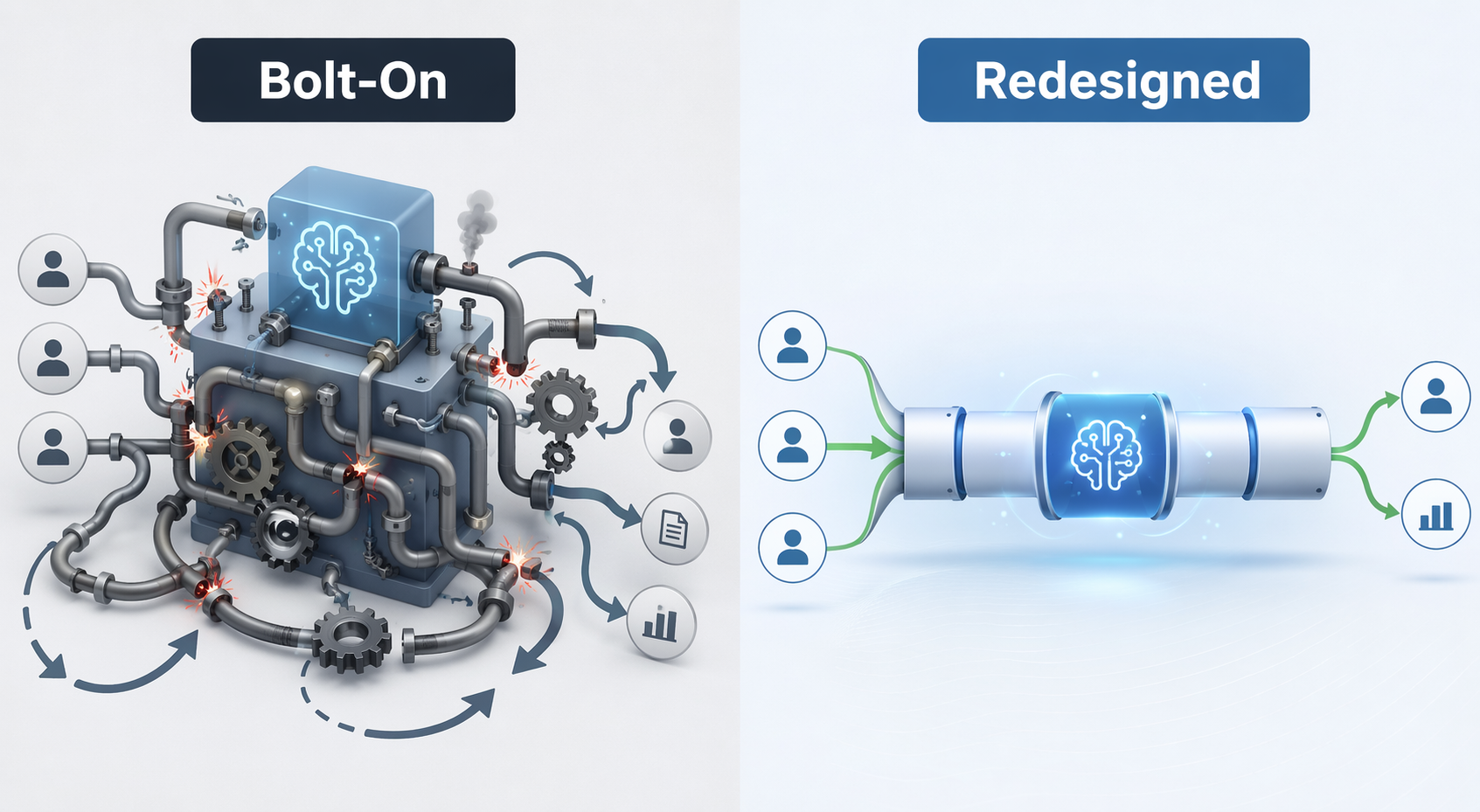
Bolt-on AI creates activity; redesigned AI changes handoffs
Most underwhelming AI deployments do not fail because the model cannot produce text, summarize a call, or rank records. They fail because the process around the model stays vague. Who reviews the score? Which lead threshold changes routing? What does the rep do differently after a call summary? When does the manager intervene? Which field in the CRM becomes more reliable because AI is involved?
Gartner has reported that 26% of sales transformations fail to meet expectations, with the top cause identified as buying tools before defining process problems.[9] That finding fits the AI pattern too well. A team buys a sales engagement assistant, gives everyone licenses, celebrates usage, and then discovers that no one changed territory prioritization, qualification rules, coaching cadence, or pipeline inspection.
The redesigned version is smaller and more operational. Pick a workflow where leakage is already visible. Define the current baseline. Decide which human decision AI is meant to improve or accelerate. Instrument the handoff. Then measure the business metric over a window long enough for the workflow to affect outcomes.
| Workflow | Weak measurement | Stronger measurement |
|---|---|---|
| Lead scoring | Number of leads scored | Conversion from scored lead to sales-accepted opportunity |
| Call intelligence | Number of calls summarized | Ramp time, coaching intervention rate, or stage progression after key calls |
| Personalized outreach | Number of emails generated | Reply rate, meeting conversion, or qualified opportunities from target accounts |
| Forecasting | Number of AI forecast reports created | Forecast accuracy against actual closed revenue |
This is also where softer gains can earn their place. Better manager coaching, higher rep confidence, and faster creative exploration are real operational benefits. They become easier to defend when they are connected to a workflow: reduced ramp time, fewer stalled opportunities, faster campaign testing, cleaner CRM records, or more consistent follow-up after discovery calls.
What a credible 2026 AI sales ROI case should contain
A credible AI case in 2026 does not need to promise transformation. It needs to show the receipt trail.
- A defined workflow: for example, lead scoring, outbound personalization, call review, CRM hygiene, forecasting, or rep coaching.
- A baseline: current conversion rate, reply rate, ramp period, forecast accuracy, cycle length, or manual hours spent.
- A business metric: revenue, qualified pipeline, deal velocity, win rate, forecast accuracy, sales-accepted conversion, or ramp time.
- A measurement window: long enough for the changed workflow to affect the chosen outcome, not just long enough for users to log in.
- A cost view: software, implementation, enablement, data cleanup, governance, and the time managers spend reviewing AI-assisted outputs.
The gap between 93% belief and 41% proof is not an argument against AI. It is an argument against sloppy measurement. AI in marketing and sales is producing returns, but the public numbers are messier than the pitch decks suggest. The teams with stronger ROI stories are not simply accelerating more activity. They are rebuilding one or two revenue workflows tightly enough that a before-and-after comparison means something.
That is the standard worth taking into a CFO conversation: not a vendor productivity statistic copied into a budget deck, but a workflow, a baseline, a business metric, and a measurement window.
References
- Duke CMO Survey Spring 2025 — Duke CMO Survey, Spring 2025.
- SAS 2025 CMO Survey — SAS, 2025.
- Jasper 2026 ROI Report — Jasper, 2026.
- The State of AI — McKinsey, 2025–2026.
- Salesforce 2025 — Salesforce, 2025.
- Marketing Data Report 2026 — Supermetrics, 2026.
- 75 Statistics About AI in Sales and Marketing for 2026 — Sopro, 2026.
- AI for Sales: The Complete 2026 Guide — Tommaso Maria Ricci, 2026.
- Gartner sales transformation research — Gartner.



Comments
Join the discussion with an anonymous comment.