

How to build an AI content stack that doesn't fail
Most marketers buy AI content tools in isolation and face high abandonment rates. This framework helps you select a coherent stack based on your team size, budget, and content goals, with clear guidance on where human editing fits to maximize ROI.
If you have read three or four lists of the “best AI content marketing tools” and still feel stuck, the problem probably is not your shortlist. It is the buying frame. Most lists ask you to compare tools one at a time. Many failed rollouts happen because nobody decided what part of the content system each tool was supposed to own.
That distinction matters because marketing teams are already carrying too much underused software. Gartner’s 2025-2026 martech survey, cited by Averi, put martech utilization at 33%, the lowest rate it had recorded; the same cited Gartner material found that 61% of marketers had buyer’s remorse on technology purchases in the prior 18 months.[1] Generative AI has its own version of the same waste pattern: Averi and theStacc report that 42% of generative AI initiatives are abandoned.[1] Those are broad martech and AI figures, not content-marketing-only failure rates, but they describe the buying environment content teams are working in.
Those figures are not a reason to avoid AI content marketing tools. They are a reason to stop buying them as isolated promises. A drafting tool, an SEO optimizer, a content intelligence platform, a workflow system, and a brand-governance tool can each be useful. Bought without a workflow, they become five places for editors to clean up the same mess.
Start with the layer, not the logo
A workable AI content stack usually has fewer tools than the shopping process suggests. The first question is not “Which platform has the most features?” It is “Which layer of the content workflow is currently breaking?”
| Workflow layer | What the tool should own | Where teams often overbuy |
|---|---|---|
| Research and planning | Audience questions, SERP patterns, topic gaps, brief inputs | Buying a large intelligence platform when the real need is a repeatable brief template |
| Drafting and repurposing | First drafts, outlines, variants, social cutdowns, email adaptations | Expecting draft volume to equal publishable output |
| Optimization | Search intent checks, content scoring, internal linking prompts, metadata support | Treating a score as editorial judgment |
| Governance and brand control | Voice rules, compliance language, approval paths, reusable prompts, knowledge bases | Paying for enterprise controls before the team has agreed on standards |
| Measurement | AI-specific KPIs, content performance, production cycle time, assisted conversions | Attributing every lift to AI because the tool is new |
A team that cannot produce clean briefs does not need a more theatrical drafting tool first. A team with strong briefs but slow production may need drafting and repurposing support. A team publishing across regulated markets may need governance before it needs more generation capacity. The right order depends on the bottleneck.
If you need individual tool comparisons by function, use a role-by-role guide for that narrower evaluation. The stack decision comes first: decide whether you are buying research capacity, draft capacity, optimization support, governance, or measurement. Then compare vendors inside that lane. Best AI for Marketing in 2026: A Role-by-Role Guide for Practitioners is the better place to go once the layer is clear.
The minimum coherent stack changes with team size
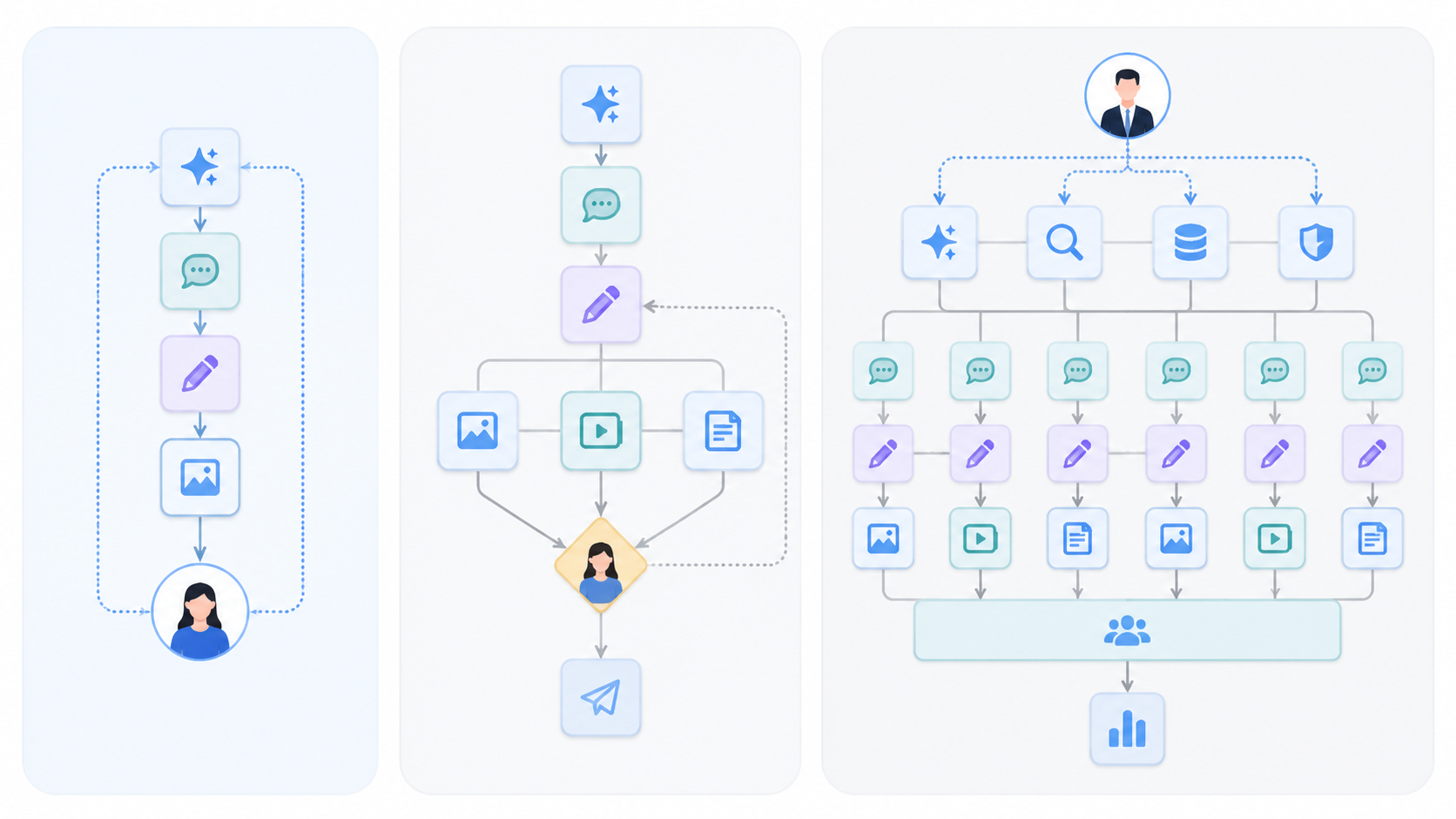
A solo marketer, a five-person content team, and an enterprise brand team should not be shopping from the same “top 10” list as if they have the same constraints. They have different editing capacity, different approval risk, and very different tolerance for pricing cliffs.
| Team context | Primary stack job | Minimum coherent stack | Human review position |
|---|---|---|---|
| Solo or very small team | Increase usable output without creating a review backlog | General AI assistant or writing tool, lightweight SEO support, simple project tracker | Before publishing and before any claim-heavy section is finalized |
| Growing content team | Standardize briefs, drafts, optimization, and approvals across multiple contributors | Briefing system, drafting or repurposing tool, optimization layer, workflow tracker | At the brief gate and again at the editorial approval gate |
| Larger organization | Control brand, compliance, permissions, and measurement across teams | Governed AI platform or knowledge layer, content operations workflow, optimization and analytics stack | At standards creation, exception review, and final accountability points |
Solo and very small teams: buy compression, not complexity
For a one-person or very small team, the stack should remove context switching. One drafting environment, one source of SEO guidance, and one place to track work is often enough. The trap is buying a platform that assumes someone else will configure workflows, maintain a knowledge base, audit outputs, and train contributors.
Pricing makes this practical fast. As a July 2026 planning input, eesel AI’s comparison table lists Jasper Pro at $69 per month for a single seat, with two seats requiring two subscriptions; Copy.ai with a jump from $24 per month to $1,000 per month; Koala with word-count double-counting on premium models; and Writer with unpublished five-to-six-figure enterprise annual contract values.[3] Pricing snapshots like these should not be treated as permanent vendor truth, but they are enough to show why “pick the best tool” is sloppy advice.
A small team does not fail because it lacks enterprise governance. It fails when the tool creates more review, setup, and vendor management than the person buying it can absorb.
Growing teams: make the brief the control point
Once more than one person is producing content, the brief becomes the cheapest place to prevent waste. If the brief is vague, the AI draft will be confidently vague. If the brief has a target reader, search intent, evidence requirements, internal links, claim boundaries, and a desired conversion action, the draft has a chance of being useful before an editor touches it.
This is where a growing team may need a stack rather than a favorite tool: a planning layer to shape the brief, a generation layer to create drafts or variants, an optimization layer to check the work against search intent, and a workflow layer to show who is waiting on whom. The stack can still be modest. The point is that each layer has a job and an owner.
If the team has not mapped where drafts stall, run the workflow audit before adding another subscription. The useful question is not whether AI can write faster. It is whether faster writing reduces the actual bottleneck. AI Marketing Workflow Audit: 7 Patterns That Turn Drafts into Reliable Production Systems is built for that diagnosis.
Larger organizations: governance is not optional polish
In a larger organization, the cost of a bad output is not limited to one weak blog post. The same error can move through regional teams, sales enablement, paid landing pages, partner materials, and executive decks. That does not automatically justify the most expensive platform, but it does change what the stack must protect.
A larger team usually needs shared knowledge, permission controls, brand rules, approved claims, workflow visibility, and measurement that survives beyond one enthusiastic pilot owner. If procurement buys a powerful system and content operations inherits a blank configuration screen, the rollout has already transferred cost from the invoice to the editors.
Match the stack to the content goal
Team size sets constraints. The primary content goal sets the shape of the stack. A company trying to refresh decaying SEO pages should not build the same system as a company trying to turn webinars into sales enablement assets.
| Primary goal | Stack emphasis | What to measure |
|---|---|---|
| Publish more SEO content | Briefing, drafting, optimization, internal linking | Publishable drafts per month, editor hours per article, rankings, assisted conversions |
| Refresh existing content | Content inventory, performance diagnostics, optimization, editorial QA | Traffic recovery, conversion lift, pages updated, decay reduced |
| Repurpose long-form assets | Transcription, summarization, channel adaptation, approval workflow | Derivative assets produced, usage by sales or social, time from source asset to distribution |
| Improve brand consistency | Governance, knowledge base, approved messaging, review workflow | Revision rate, compliance issues, approval cycle time, brand-rule exceptions |
| Support experimentation | Variant generation, campaign testing, analytics | Test velocity, winning variants, cost per learning, quality of insights |
This is also where AI-specific KPIs belong. Digital Applied reports that teams tracking AI-specific KPIs see 2.4x better content ROI.[2] Treat that as a directional benchmark, not a magic multiplier. The useful part is the discipline: define what the tool is supposed to improve before the contract is signed.
Content creation tools can show meaningful upside when the workflow is right. Quick SEO data cited by theStacc reports 420% ROI for content creation tools paired with the right workflow.[1] Vendor-aligned ROI benchmarks tend to be optimistic, so the number should not become a business case by itself. It should become a prompt to ask what “right workflow” would mean in your own team.
For leadership justification, separate three measures that often get blurred together: production efficiency, content quality, and business impact. If a tool reduces drafting time but increases editorial cleanup, that is not the same result as reducing cycle time for publishable assets. If a tool increases traffic to pages that do not convert, that is not the same as revenue impact. A more detailed measurement model belongs in an ROI framework, not in a vendor demo. Build a Marketing AI Tools ROI Framework That Works is the next step if budget defense is the hard part.
Put the editor where failure is most expensive
Human review is often discussed as if it is a moral preference: some people like human-written content, some people like AI-written content. That framing is too soft for operations. The real question is where a human editor prevents the most expensive failure.
Digital Applied reports that pure AI content underperforms by a -23% ranking change after 12 months, while human-edited AI content reduces bounce rates by 73%.[2] Those are broad reported findings, not a promise that every edited article will win. They do support a practical point: the editor is not decorative. The editor is the control point that decides whether AI speed becomes usable content or just faster cleanup.
| Editorial decision point | What the editor checks | Why it matters |
|---|---|---|
| Before generation | Audience, search intent, angle, claim boundaries, source requirements | Prevents the AI from producing a plausible draft for the wrong job |
| After outline | Structure, missing sections, duplicated ideas, unsupported promises | Catches strategic problems before full-draft cleanup begins |
| After draft | Accuracy, usefulness, brand fit, examples, internal links, conversion path | Turns generated text into publishable content |
| Before publication | Legal or compliance risk, final claims, formatting, metadata, ownership | Protects the business from visible mistakes |
| After performance data | What to update, retire, repurpose, or test | Keeps AI from becoming a one-way draft machine |
Small teams usually cannot afford all five review points on every asset. That is fine. Put review before generation for expensive pages, after draft for routine content, and before publication for anything with legal, financial, medical, technical, or reputational risk. The decision is not whether humans are involved. It is which failures deserve human attention before they spread.
The same logic applies to ChatGPT-style delegation. Tasks with clear inputs, reversible outputs, and low external risk are easier to delegate. Tasks involving positioning, original judgment, unsupported claims, or high-stakes accuracy need a tighter human gate. How to Decide Which Content Marketing Tasks to Delegate to ChatGPT gives that task-level sorting more room.
A buying sequence that avoids the usual waste
The sequence below is intentionally less exciting than a vendor comparison. It is also closer to how content teams avoid another half-used rollout.
- Name the content goal first: more SEO pages, better refreshes, faster repurposing, brand control, experimentation, or something else.
- Map the current bottleneck: brief quality, draft production, editor capacity, approvals, optimization, measurement, or governance.
- Choose the smallest stack that covers the bottleneck and connects to the surrounding workflow.
- Assign the human review point before buying, not after the first bad draft.
- Define AI-specific KPIs that separate speed, quality, and business impact.
- Pilot on one content motion before expanding the tool to every team and asset type.
A hypothetical example makes the tradeoff clearer. Suppose a four-person B2B content team wants to refresh old search pages. The tempting purchase is a drafting platform because “content” sounds like writing. The better stack may be a content inventory export, an SEO optimization tool, a repeatable refresh brief, and a general AI assistant used for rewrite options. The editor sits at the brief and final approval points, because the expensive mistake is not slow typing; it is refreshing the wrong page with the wrong search intent.
A different team may reach the opposite conclusion. A solo consultant with strong judgment and no junior writers may get more value from one flexible AI assistant and a simple checklist than from a multi-tool stack. A larger brand with many contributors may need governance before it needs another generation feature. The tool category is the same. The operating model is not.
The buying rule
Do not buy the “best” AI content marketing tool first. Define the content goal, choose the minimum coherent stack that supports it, assign human review where failure is most expensive, and measure the stack as a workflow.
That rule will sometimes lead to a premium platform. It will sometimes lead to one inexpensive tool and a better brief. Both can be correct. The stack is doing its job when editors spend less time repairing avoidable problems and more time improving the work that should have required human judgment in the first place.
References
- Averi guide citing Gartner’s 2025-2026 martech survey and theStacc / Quick SEO AI ROI benchmarks
- Digital Applied AI content ROI and human-edited AI performance findings
- eesel AI comparison table pricing data

Comments
Join the discussion with an anonymous comment.